

Make Clayton a Phone-Free School District
The Issue
May 16, 2024
Dear School District of Clayton Board of Education,
As Clayton citizens and Clayton School District parents, we care deeply about the education and well-being of all the District's students, as we know you do. So we want to first thank you for your service to our students and schools. The purpose of this letter is to request your action to make the School District of Clayton phone-free during school hours for the 2024-25 school year.
We request that you revisit the district policy on personal phone use in school and amend it to remove these “weapons of mass distraction” (smartphones) from academic time to improve student learning and mental health. This is a change that other local schools have already made.
We request a Clayton district-wide policy such as the following:
During school hours, students' personal cell phones and electronic devices must remain off and stowed away in a Yondr pouch. For smart watches, students can wear them, but they must remain in either school mode or airplane mode. If a message needs to be delivered to a student, please contact the school’s front office. If a student needs to contact a parent, they also can come to the office, and we can help facilitate that communication.
Since 2017, Congress has held at least 40 hearings on children and social media. Members from both parties have introduced legislation, including social media age limits, but nothing substantive has been passed. You have the power to do for the Clayton students what Congress is currently failing to do for the rest of America's youth. With this decision, you have the ability to substantively improve the lives of all Clayton students.
We have a collective action problem that requires all of us. A recent study from the University of Chicago found that 58% of the 1000 college students surveyed for the study said they would prefer to live in a world without Instagram or TikTok. However, individual students, parents, and teachers are at the mercy of these broader forces. It is a social dilemma because we are social animals. Not participating in this technological ecosystem feels like a kind of death, so much so that we are willing to pose the true risk of it to avoid that feeling.
As the School Board, you hold tremendous power to make eight hours a day a sanctuary from the deluge of content that frequently brings out the worst in people and is bad for focused thinking.
We therefore ask that you review the below attached data and scientific research which demonstrate that phones in schools are interfering with learning and students’ mental health and enforce a new district-wide policy for the 2024-2025 school year.
Respectfully, The undersigned concerned parents and community members of Clayton, Missouri
_______________________________________________________________
We know that some parents may be in favor of phones in schools due to safety concerns, however:
Having phones in a school environment when there is an emergency hinders following directions. The best protection against violence in schools is having a population of students who feel connected to one another and have strong, positive, meaningful relationships with one another.
There are ways to discontinue the use of phones in schools and still maintain the option for communication where necessary. Solutions — such as Yondr pouches and installing landlines for students who need to contact their parents- can be implemented successfully and have been implemented by hundreds of school districts.
The Data
- At the most fundamental level, an education is about teaching young people how to use their minds well—so that they are prepared for success in a complex economy and can live healthy, productive lives.
- Our children should be immersed in the school environment, fully focused on both the curriculum and civic-minded growth that school offers. A distracted mind cannot bring to bear the best thinking.
- The Clayton School District’s own mission statement is to “inspire each student to love learning and embrace challenges within a rich and rigorous academic culture.” Is the Clayton School District doing all that is in its power to promote a fully engaged student body to meet this mission?
- It has been recognized that we are witnessing the results of the largest unregulated experiment on the adolescent mind in human history. The results are not promising. In medicine, if the results of a study were so harmfully skewed, it would be unethical to continue it.
Phones and Mental Health:
Norway recently released the data from their cell phone ban in schools (from an analysis of 400 schools). The results were astounding:
-
- It significantly decreased doctor visits for psychological symptoms and diseases among girls (29% decrease)
- There was a 60% decline in visits to school psychologists
- It reduced bullying among both genders (a 43% decrease) (for comparison - US state laws meant to reduce bullying had an on average decrease of 8%)
- It improved girls’ GPA, standardize test scores, and attendance rates (we should note that in Norway boys spend about half as much time on their phones, when compared to their female counterparts)
- An average .08 increase in GPA
- The largest effect sizes were among the poorest kids
- Girls who attended schools with cell phone bans were more likely to be placed on tracks toward higher education. Essentially, their lifelong trajectory was impacted.
- The effects were most powerful in schools with the strictest regulations on phones and the longest durations of these bans.
- It significantly decreased doctor visits for psychological symptoms and diseases among girls (29% decrease)
- 30% of adolescent girls in the US have considered suicide in the last year.
- US Hospitalizations for International Self-Harm among Girls Ages 10-14 are up 518% since 2007-2008, and up 91% among Girls Ages 15-19, and 53.2% among Boys Ages 15-19. (This data trend is tracked with the widespread adoption of smartphones. Additionally, new data shows that increased social media use is not just correlative with poor mental health; it is causal)
- The CDC’s bi-annual Youth Risk Behavior Survey showed that most teen girls (57%) now say that they experience persistent sadness or hopelessness (up from 36% in 2011), and 30% of teen girls now say that they have seriously considered suicide (up from 19% in 2011). Boys are doing badly, too, but their rates of depression and anxiety are not as high, and their increases since 2011 are smaller.
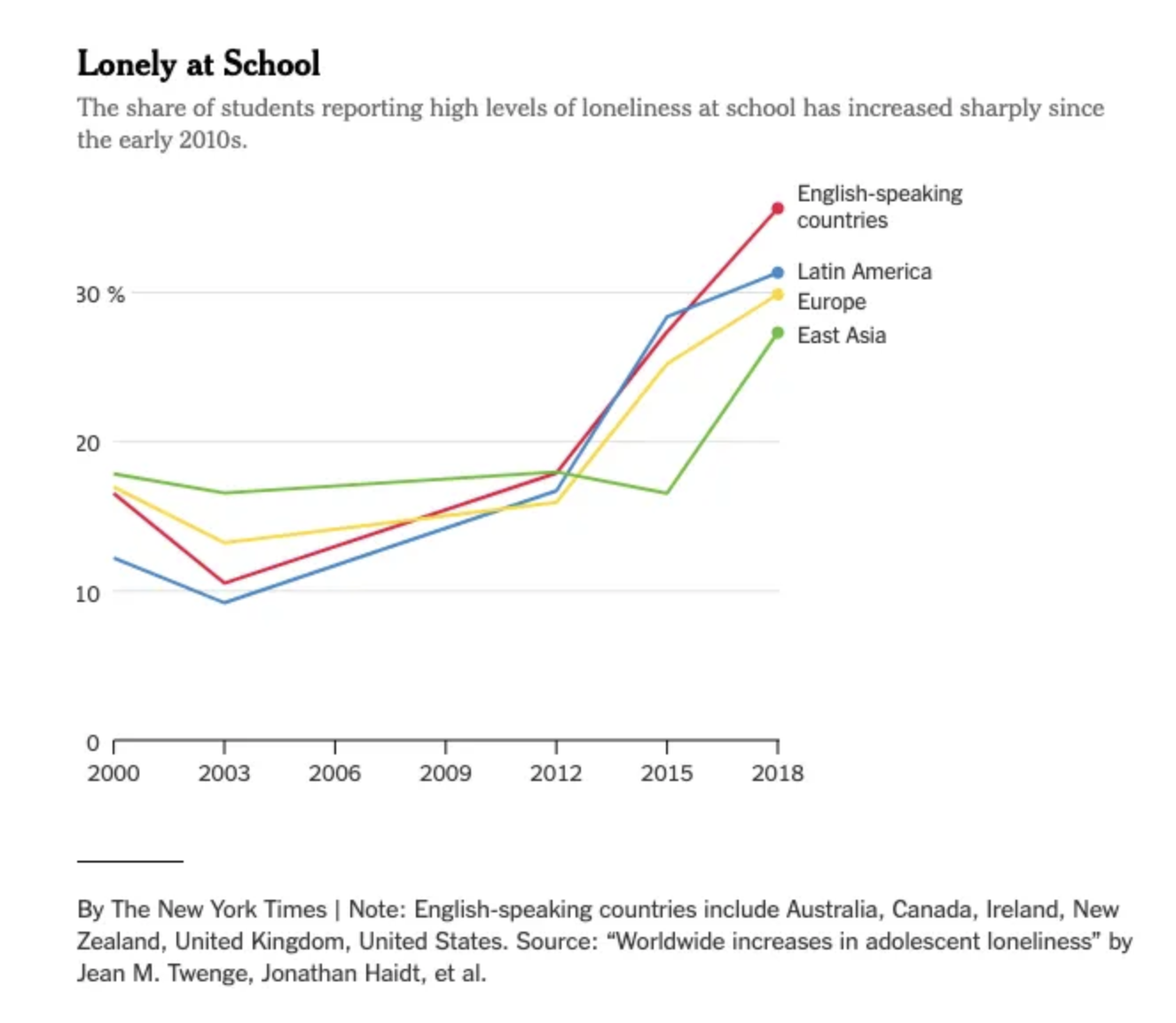
Phones and Academics:
- Many studies have established that students check their phones frequently during class and receive and send texts if they can. Their focus is often and easily derailed by interruptions from their devices.
- Nearly 60 percent of students said they spend more than 10 percent of class time on their phones, mostly texting.
- Many studies show that students who use their phones during class learn less and get lower grades.
- A survey of a school district in Virginia found that about a third of teachers were telling students to put away their cellphones five to 10 times a class, and 14.7% did so more than 20 times a class.
- When a middle school in Canada surveyed staff, 75% of respondents thought that cell phones were negatively affecting their students’ physical and mental health, and nearly two-thirds believed the devices were adversely affecting academic performances as well.
- This study, aptly titled “Brain Drain: The Mere Presence of One’s Own Smartphone Reduces Available Cognitive Capacity.” The students involved in the study came into a lab and took tests commonly used to measure memory capacity and intelligence.
- They were randomly assigned to one of three groups, given the following instructions: (1) Put your phone on your desk, (2) leave it in your pocket or bag, or (3) leave it out in another room. None of these conditions involve active phone use—just the potential distraction of knowing your phone is there, with texts and social media posts waiting.
- The results were clear: The closer the phone was to students’ awareness, the worse they performed on the tests. Even just having a phone in one’s pocket sapped students’ abilities.
- Nearly half of American teens say that they are online “almost constantly,” and such continuous administration of small pleasures can produce sustained changes in the brain’s reward system, including a reduction of dopamine receptors.
- This shifts users’ general mood toward irritability and anxiety when separated from their phones, and it reduces their ability to focus. That may be one reason why heavy phone users have lower GPAs.
- As the neuroscientists Jaan Aru and Dmitri Rozgonjuk put it in a recent review of the literature: “Smartphone use can be disruptively habitual, with the main detrimental consequence being an inability to exert prolonged mental effort.”
- Simply being in the presence of another person on a device distracts the other people in the room.
- The longest study of human flourishing, The Grant Study, conducted at Harvard, finds that the most important factor for overall life satisfaction is the quality of one's interpersonal relationships.
- Relationships are built from small interactions over time, interactions that students miss when they are more attentive to their phones than each other.
- For more information about this issue, visit The After Babel Substack, written and curated by NYU Moral Psychologist Jonathan Haidt, author of the new book The Anxious Generation.

921
The Issue
May 16, 2024
Dear School District of Clayton Board of Education,
As Clayton citizens and Clayton School District parents, we care deeply about the education and well-being of all the District's students, as we know you do. So we want to first thank you for your service to our students and schools. The purpose of this letter is to request your action to make the School District of Clayton phone-free during school hours for the 2024-25 school year.
We request that you revisit the district policy on personal phone use in school and amend it to remove these “weapons of mass distraction” (smartphones) from academic time to improve student learning and mental health. This is a change that other local schools have already made.
We request a Clayton district-wide policy such as the following:
During school hours, students' personal cell phones and electronic devices must remain off and stowed away in a Yondr pouch. For smart watches, students can wear them, but they must remain in either school mode or airplane mode. If a message needs to be delivered to a student, please contact the school’s front office. If a student needs to contact a parent, they also can come to the office, and we can help facilitate that communication.
Since 2017, Congress has held at least 40 hearings on children and social media. Members from both parties have introduced legislation, including social media age limits, but nothing substantive has been passed. You have the power to do for the Clayton students what Congress is currently failing to do for the rest of America's youth. With this decision, you have the ability to substantively improve the lives of all Clayton students.
We have a collective action problem that requires all of us. A recent study from the University of Chicago found that 58% of the 1000 college students surveyed for the study said they would prefer to live in a world without Instagram or TikTok. However, individual students, parents, and teachers are at the mercy of these broader forces. It is a social dilemma because we are social animals. Not participating in this technological ecosystem feels like a kind of death, so much so that we are willing to pose the true risk of it to avoid that feeling.
As the School Board, you hold tremendous power to make eight hours a day a sanctuary from the deluge of content that frequently brings out the worst in people and is bad for focused thinking.
We therefore ask that you review the below attached data and scientific research which demonstrate that phones in schools are interfering with learning and students’ mental health and enforce a new district-wide policy for the 2024-2025 school year.
Respectfully, The undersigned concerned parents and community members of Clayton, Missouri
_______________________________________________________________
We know that some parents may be in favor of phones in schools due to safety concerns, however:
Having phones in a school environment when there is an emergency hinders following directions. The best protection against violence in schools is having a population of students who feel connected to one another and have strong, positive, meaningful relationships with one another.
There are ways to discontinue the use of phones in schools and still maintain the option for communication where necessary. Solutions — such as Yondr pouches and installing landlines for students who need to contact their parents- can be implemented successfully and have been implemented by hundreds of school districts.
The Data
- At the most fundamental level, an education is about teaching young people how to use their minds well—so that they are prepared for success in a complex economy and can live healthy, productive lives.
- Our children should be immersed in the school environment, fully focused on both the curriculum and civic-minded growth that school offers. A distracted mind cannot bring to bear the best thinking.
- The Clayton School District’s own mission statement is to “inspire each student to love learning and embrace challenges within a rich and rigorous academic culture.” Is the Clayton School District doing all that is in its power to promote a fully engaged student body to meet this mission?
- It has been recognized that we are witnessing the results of the largest unregulated experiment on the adolescent mind in human history. The results are not promising. In medicine, if the results of a study were so harmfully skewed, it would be unethical to continue it.
Phones and Mental Health:
Norway recently released the data from their cell phone ban in schools (from an analysis of 400 schools). The results were astounding:
-
- It significantly decreased doctor visits for psychological symptoms and diseases among girls (29% decrease)
- There was a 60% decline in visits to school psychologists
- It reduced bullying among both genders (a 43% decrease) (for comparison - US state laws meant to reduce bullying had an on average decrease of 8%)
- It improved girls’ GPA, standardize test scores, and attendance rates (we should note that in Norway boys spend about half as much time on their phones, when compared to their female counterparts)
- An average .08 increase in GPA
- The largest effect sizes were among the poorest kids
- Girls who attended schools with cell phone bans were more likely to be placed on tracks toward higher education. Essentially, their lifelong trajectory was impacted.
- The effects were most powerful in schools with the strictest regulations on phones and the longest durations of these bans.
- It significantly decreased doctor visits for psychological symptoms and diseases among girls (29% decrease)
- 30% of adolescent girls in the US have considered suicide in the last year.
- US Hospitalizations for International Self-Harm among Girls Ages 10-14 are up 518% since 2007-2008, and up 91% among Girls Ages 15-19, and 53.2% among Boys Ages 15-19. (This data trend is tracked with the widespread adoption of smartphones. Additionally, new data shows that increased social media use is not just correlative with poor mental health; it is causal)
- The CDC’s bi-annual Youth Risk Behavior Survey showed that most teen girls (57%) now say that they experience persistent sadness or hopelessness (up from 36% in 2011), and 30% of teen girls now say that they have seriously considered suicide (up from 19% in 2011). Boys are doing badly, too, but their rates of depression and anxiety are not as high, and their increases since 2011 are smaller.
Phones and Academics:
- Many studies have established that students check their phones frequently during class and receive and send texts if they can. Their focus is often and easily derailed by interruptions from their devices.
- Nearly 60 percent of students said they spend more than 10 percent of class time on their phones, mostly texting.
- Many studies show that students who use their phones during class learn less and get lower grades.
- A survey of a school district in Virginia found that about a third of teachers were telling students to put away their cellphones five to 10 times a class, and 14.7% did so more than 20 times a class.
- When a middle school in Canada surveyed staff, 75% of respondents thought that cell phones were negatively affecting their students’ physical and mental health, and nearly two-thirds believed the devices were adversely affecting academic performances as well.
- This study, aptly titled “Brain Drain: The Mere Presence of One’s Own Smartphone Reduces Available Cognitive Capacity.” The students involved in the study came into a lab and took tests commonly used to measure memory capacity and intelligence.
- They were randomly assigned to one of three groups, given the following instructions: (1) Put your phone on your desk, (2) leave it in your pocket or bag, or (3) leave it out in another room. None of these conditions involve active phone use—just the potential distraction of knowing your phone is there, with texts and social media posts waiting.
- The results were clear: The closer the phone was to students’ awareness, the worse they performed on the tests. Even just having a phone in one’s pocket sapped students’ abilities.
- Nearly half of American teens say that they are online “almost constantly,” and such continuous administration of small pleasures can produce sustained changes in the brain’s reward system, including a reduction of dopamine receptors.
- This shifts users’ general mood toward irritability and anxiety when separated from their phones, and it reduces their ability to focus. That may be one reason why heavy phone users have lower GPAs.
- As the neuroscientists Jaan Aru and Dmitri Rozgonjuk put it in a recent review of the literature: “Smartphone use can be disruptively habitual, with the main detrimental consequence being an inability to exert prolonged mental effort.”
- Simply being in the presence of another person on a device distracts the other people in the room.
- The longest study of human flourishing, The Grant Study, conducted at Harvard, finds that the most important factor for overall life satisfaction is the quality of one's interpersonal relationships.
- Relationships are built from small interactions over time, interactions that students miss when they are more attentive to their phones than each other.
- For more information about this issue, visit The After Babel Substack, written and curated by NYU Moral Psychologist Jonathan Haidt, author of the new book The Anxious Generation.
Supporter Voices
Petition Updates
Share this petition
Petition created on May 3, 2024