
Make Buildings Safe for Migrating Birds on the University of Cincinnati's Campus
The Issue
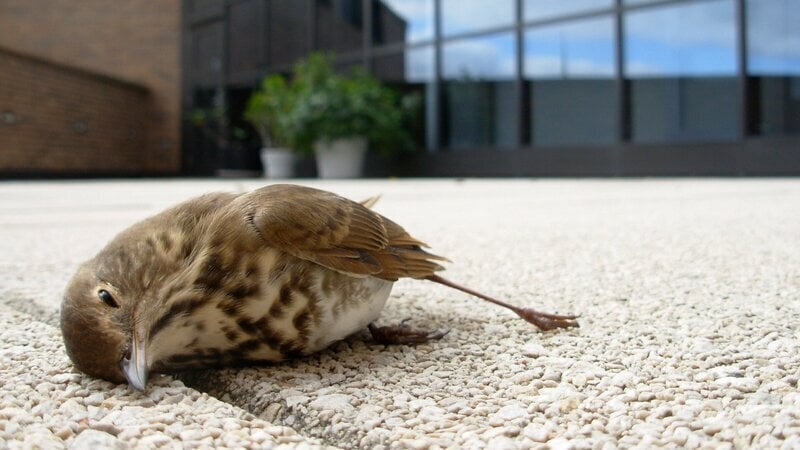
According to the Cornell Lab of Ornithology, up to one billion birds die from window collisions in the U.S. each year. Reflective glass windows and buildings often mirror the sky and landscape around it. Birds aren't able to differentiate between the two. Birds might also see vegetation on the other side of clear glass and attempt to fly through it. More often than not, birds do not survive these collisions. A recent New York Times article highlights this issue after nearly 1,000 birds died in one night after striking a Chicago building.
Currently, 500-1,000 birds, mostly neotropical migratory species, perish each year at the University of Cincinnati (U.C.) due to window collisions. As U.C. continues to expand and modernize more glass buildings each year, we will see an increase in the number of avian mortalities on campus. Mitigation is necessary to reduce these losses.
Research by organizations such as the American Bird Conservancy and other universities supports evidence for the effectiveness of glass-application products like the 'Ferro Dot Pattern' and 'Feather Friendly Patterns'. If U.C. were to adopt these bird-friendly practices at buildings with large numbers of window collisions, we would see a decrease in the number of avian mortalities on campus. The Audubon Society of Ohio (Cincinnati Audubon) supports this effort and we hope you will too. We're asking for signatures to encourage U.C. to make their buildings safer for migrating birds.
*Please note that any donations made will go to Change.org*

3,190
The Issue
According to the Cornell Lab of Ornithology, up to one billion birds die from window collisions in the U.S. each year. Reflective glass windows and buildings often mirror the sky and landscape around it. Birds aren't able to differentiate between the two. Birds might also see vegetation on the other side of clear glass and attempt to fly through it. More often than not, birds do not survive these collisions. A recent New York Times article highlights this issue after nearly 1,000 birds died in one night after striking a Chicago building.
Currently, 500-1,000 birds, mostly neotropical migratory species, perish each year at the University of Cincinnati (U.C.) due to window collisions. As U.C. continues to expand and modernize more glass buildings each year, we will see an increase in the number of avian mortalities on campus. Mitigation is necessary to reduce these losses.
Research by organizations such as the American Bird Conservancy and other universities supports evidence for the effectiveness of glass-application products like the 'Ferro Dot Pattern' and 'Feather Friendly Patterns'. If U.C. were to adopt these bird-friendly practices at buildings with large numbers of window collisions, we would see a decrease in the number of avian mortalities on campus. The Audubon Society of Ohio (Cincinnati Audubon) supports this effort and we hope you will too. We're asking for signatures to encourage U.C. to make their buildings safer for migrating birds.
*Please note that any donations made will go to Change.org*
Supporter Voices
Petition Updates
Share this petition
Petition created on October 16, 2023