

Maintain the 30-metre watercourse setback for Kidston Lake
Maintain the 30-metre watercourse setback for Kidston Lake
The Issue
The Issue
As a resident, community member, mother, and someone deeply invested in our shared environment, I feel compelled to speak out about the importance of maintaining the 30-metre watercourse setback around Kidston Lake, which the Province has recently pushed to reduce. This lake is a cherished part of daily life in Spryfield. It’s where we swim, gather, rest, and connect with nature — one of the reasons many of us choose to call this community home.
This concern is not mine alone. A group of us formed the Kidston Lake Conservation Society (KLCS) because we share a deep commitment to protecting this lake. Each of us has our own connection: long-time residents, families whose ties to the lake go back generations, people who grew up swimming here, and newcomers who found Kidston Lake welcoming. Kidston Lake means something different to each of us — but all of us agree it must be protected.
Kidston Lake is a living ecosystem, home to fish, birds, amphibians, plants, and a network of habitats that depend on clean, resilient water. It also has deep historical and social importance, serving for generations as a beloved gathering place long before this area was named Spryfield.
Why This Matters
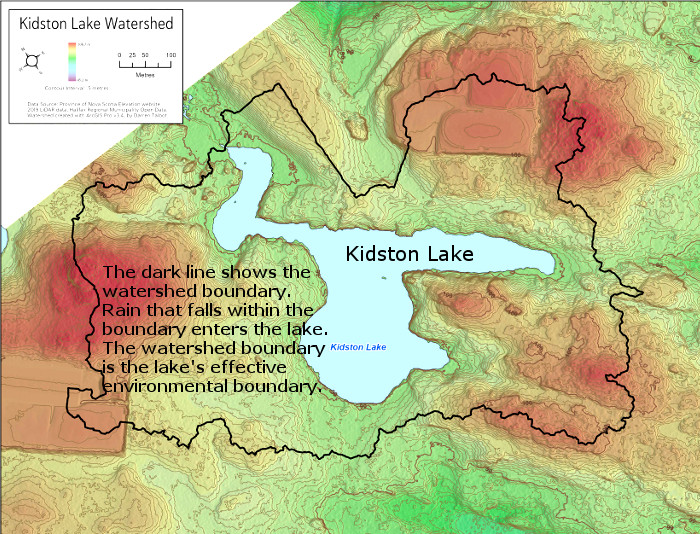
Kidston Lake is one of the most vulnerable lakes in HRM. It sits at the very top of a small, tightly defined watershed, which means everything that happens in that area flows directly into the lake. This makes the lake extremely sensitive to land disturbance, runoff, and development pressures.
Recently, the Province of Nova Scotia instructed HRM to reconsider parts of the Regional Plan, including a request to reduce watercourse setbacks from 30 metres to 20 metres. For a lake as sensitive as Kidston, 20 metres is not enough.
Decades of research show that 30 metres is the minimum buffer needed to:
- filter pollutants
- prevent erosion
- support biodiversity
- reduce algae blooms
- protect shorelines during major rain events
And because Kidston Lake’s watershed is so small, a watershed-based protection approach — with a buffer around the watershed boundary — is essential.
We have already seen other HRM lakes face costly closures and water-quality issues. We cannot afford to let that happen here.
A Watershed-Based Approach
Protecting Kidston Lake requires more than a shoreline rule. A healthy watershed supports clean water, wildlife habitat, forest cover, and the natural processes that keep the lake stable. Maintaining the 30-metre setback and protecting the full watershed are the most effective ways to ensure long-term ecological and community health.
What We’re Asking For
We call on Halifax Regional Council to:
- Maintain the 30-metre watercourse setback as a minimum
- Protect the entire Kidston Lake watershed plus a protective buffer
- Consider Kidston Lake’s unique vulnerability as a top-of-watershed lake
- And Ensure development decisions support long-term environmental and community well-being
Take Action
Kidston Lake is a natural treasure — a place where community life and ecological life are deeply connected. By protecting the lake and its watershed, we safeguard both a vibrant ecosystem and a cherished gathering place for generations to come.
Please sign this petition to help protect Kidston Lake.

485
The Issue
The Issue
As a resident, community member, mother, and someone deeply invested in our shared environment, I feel compelled to speak out about the importance of maintaining the 30-metre watercourse setback around Kidston Lake, which the Province has recently pushed to reduce. This lake is a cherished part of daily life in Spryfield. It’s where we swim, gather, rest, and connect with nature — one of the reasons many of us choose to call this community home.
This concern is not mine alone. A group of us formed the Kidston Lake Conservation Society (KLCS) because we share a deep commitment to protecting this lake. Each of us has our own connection: long-time residents, families whose ties to the lake go back generations, people who grew up swimming here, and newcomers who found Kidston Lake welcoming. Kidston Lake means something different to each of us — but all of us agree it must be protected.
Kidston Lake is a living ecosystem, home to fish, birds, amphibians, plants, and a network of habitats that depend on clean, resilient water. It also has deep historical and social importance, serving for generations as a beloved gathering place long before this area was named Spryfield.
Why This Matters
Kidston Lake is one of the most vulnerable lakes in HRM. It sits at the very top of a small, tightly defined watershed, which means everything that happens in that area flows directly into the lake. This makes the lake extremely sensitive to land disturbance, runoff, and development pressures.
Recently, the Province of Nova Scotia instructed HRM to reconsider parts of the Regional Plan, including a request to reduce watercourse setbacks from 30 metres to 20 metres. For a lake as sensitive as Kidston, 20 metres is not enough.
Decades of research show that 30 metres is the minimum buffer needed to:
- filter pollutants
- prevent erosion
- support biodiversity
- reduce algae blooms
- protect shorelines during major rain events
And because Kidston Lake’s watershed is so small, a watershed-based protection approach — with a buffer around the watershed boundary — is essential.
We have already seen other HRM lakes face costly closures and water-quality issues. We cannot afford to let that happen here.
A Watershed-Based Approach
Protecting Kidston Lake requires more than a shoreline rule. A healthy watershed supports clean water, wildlife habitat, forest cover, and the natural processes that keep the lake stable. Maintaining the 30-metre setback and protecting the full watershed are the most effective ways to ensure long-term ecological and community health.
What We’re Asking For
We call on Halifax Regional Council to:
- Maintain the 30-metre watercourse setback as a minimum
- Protect the entire Kidston Lake watershed plus a protective buffer
- Consider Kidston Lake’s unique vulnerability as a top-of-watershed lake
- And Ensure development decisions support long-term environmental and community well-being
Take Action
Kidston Lake is a natural treasure — a place where community life and ecological life are deeply connected. By protecting the lake and its watershed, we safeguard both a vibrant ecosystem and a cherished gathering place for generations to come.
Please sign this petition to help protect Kidston Lake.
485
The Decision Makers

Supporter Voices
Petition Updates
Share this petition
Petition created on November 29, 2025