

LET INDIANA STUDENTS EXPRESS THEIR CIVIC RIGHTS!
The Issue
“In our system, state-operated schools may not be enclaves of totalitarianism.”
(Tinker vs Des Moines Independent)
An Open Letter To Indiana High School District Administrations and Members of the Community:
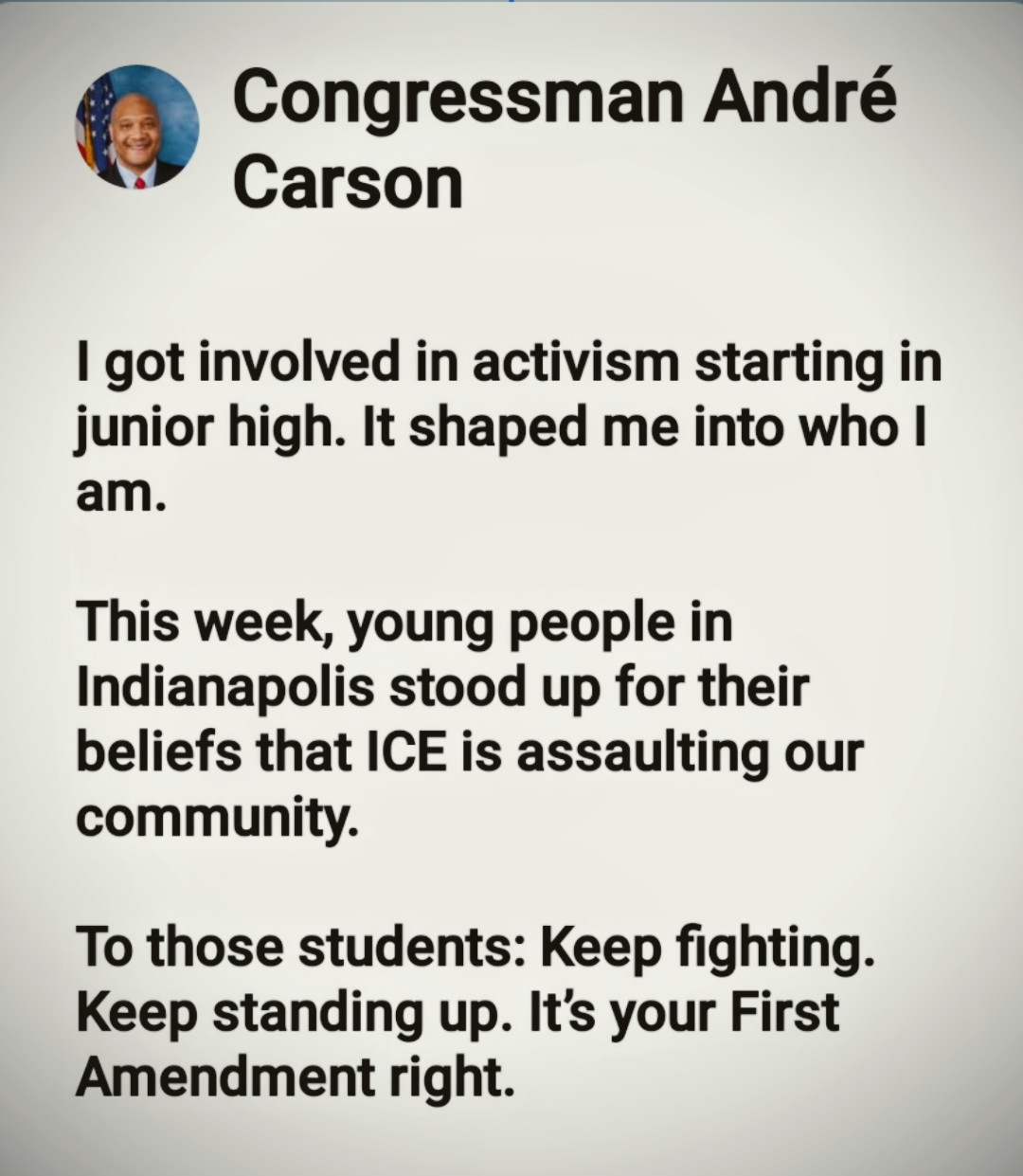
Regarding recent and planned student walkouts organized in connection with concerns about immigration enforcement policy and its impact on members of our community, there is a desire to curb unnecessary confusion, to foster clarity, and above all to protect and preserve the involved students’ rights (and your duty) to the fullest definition of “education.”
The students participating in these actions have engaged in peaceful, time-limited expressive activity regarding a matter of public concern. Their conduct falls squarely within protections recognized by the United States Supreme Court.
The Court has drawn boundaries between protected political speech and unprotected expression.
>In Bethel School District v. Fraser, 478 U.S. 675 (1986), the Court upheld discipline for lewd speech, distinguishing it from political protest protected in Tinker.
>In Hazelwood School District v. Kuhlmeier, 484 U.S. 260 (1988), the Court recognized administrative authority over school-sponsored publications, while preserving protection for independent student political expression.
>In Tinker v. Des Moines Independent Community School District, 393 U.S. 503 (1969), the Supreme Court held:
“It can hardly be argued that either students or teachers shed their constitutional rights to freedom of speech or expression at the schoolhouse gate.”
The Court further made clear that student expression may not be suppressed unless school officials can demonstrate that the speech/action would “materially and substantially interfere with the requirements of appropriate discipline in the operation of the school” or invade the rights of others.
The Court rejected mere apprehension of disturbance as conjectured and inaccurate
“In our system, undifferentiated fear or apprehension of disturbance is not enough to overcome the right to freedom of expression.”
In West Virginia State Board of Education v. Barnette, 319 U.S. 624 (1943), the Court declared:
“The vigilant protection of constitutional freedoms is nowhere more vital than in the community of American schools.”
And further:
“If there is any fixed star in our constitutional constellation, it is that no official… can prescribe what shall be orthodox in politics, nationalism, religion, or other matters of opinion.”
While attendance policies serve important purposes, disciplinary measures such as suspension or expulsion imposed in response to peaceful civic protest risk crossing constitutional lines. Furthermore, if any measures in this vein are motivated (in part or total) by disagreement with viewpoint rather than demonstrable, substantial disruption: serious constitutional concerns arise.
Public schools exist to provide an EDUCATION: not only to transmit knowledge, but to prepare students for participation in a democratic society. Civic engagement, peaceful protest, and the expression of political beliefs are evidence of that preparation.
We respectfully urge districts to:
1. Refrain from imposing suspensions or expulsions based solely on participation in peaceful political walkouts.
2. Ensure that any disciplinary response is viewpoint-neutral and tied to demonstrable, substantial disruption.
3. Engage students constructively by creating opportunities for dialogue consistent with the educational mission of the district.
The Constitution does not end at the schoolhouse gate. Neither should our commitment to teaching students how to live within it.
Respectfully,

324
The Issue
“In our system, state-operated schools may not be enclaves of totalitarianism.”
(Tinker vs Des Moines Independent)
An Open Letter To Indiana High School District Administrations and Members of the Community:
Regarding recent and planned student walkouts organized in connection with concerns about immigration enforcement policy and its impact on members of our community, there is a desire to curb unnecessary confusion, to foster clarity, and above all to protect and preserve the involved students’ rights (and your duty) to the fullest definition of “education.”
The students participating in these actions have engaged in peaceful, time-limited expressive activity regarding a matter of public concern. Their conduct falls squarely within protections recognized by the United States Supreme Court.
The Court has drawn boundaries between protected political speech and unprotected expression.
>In Bethel School District v. Fraser, 478 U.S. 675 (1986), the Court upheld discipline for lewd speech, distinguishing it from political protest protected in Tinker.
>In Hazelwood School District v. Kuhlmeier, 484 U.S. 260 (1988), the Court recognized administrative authority over school-sponsored publications, while preserving protection for independent student political expression.
>In Tinker v. Des Moines Independent Community School District, 393 U.S. 503 (1969), the Supreme Court held:
“It can hardly be argued that either students or teachers shed their constitutional rights to freedom of speech or expression at the schoolhouse gate.”
The Court further made clear that student expression may not be suppressed unless school officials can demonstrate that the speech/action would “materially and substantially interfere with the requirements of appropriate discipline in the operation of the school” or invade the rights of others.
The Court rejected mere apprehension of disturbance as conjectured and inaccurate
“In our system, undifferentiated fear or apprehension of disturbance is not enough to overcome the right to freedom of expression.”
In West Virginia State Board of Education v. Barnette, 319 U.S. 624 (1943), the Court declared:
“The vigilant protection of constitutional freedoms is nowhere more vital than in the community of American schools.”
And further:
“If there is any fixed star in our constitutional constellation, it is that no official… can prescribe what shall be orthodox in politics, nationalism, religion, or other matters of opinion.”
While attendance policies serve important purposes, disciplinary measures such as suspension or expulsion imposed in response to peaceful civic protest risk crossing constitutional lines. Furthermore, if any measures in this vein are motivated (in part or total) by disagreement with viewpoint rather than demonstrable, substantial disruption: serious constitutional concerns arise.
Public schools exist to provide an EDUCATION: not only to transmit knowledge, but to prepare students for participation in a democratic society. Civic engagement, peaceful protest, and the expression of political beliefs are evidence of that preparation.
We respectfully urge districts to:
1. Refrain from imposing suspensions or expulsions based solely on participation in peaceful political walkouts.
2. Ensure that any disciplinary response is viewpoint-neutral and tied to demonstrable, substantial disruption.
3. Engage students constructively by creating opportunities for dialogue consistent with the educational mission of the district.
The Constitution does not end at the schoolhouse gate. Neither should our commitment to teaching students how to live within it.
Respectfully,
The Decision Makers

Supporter Voices
Petition Updates
Share this petition
Petition created on February 6, 2026