
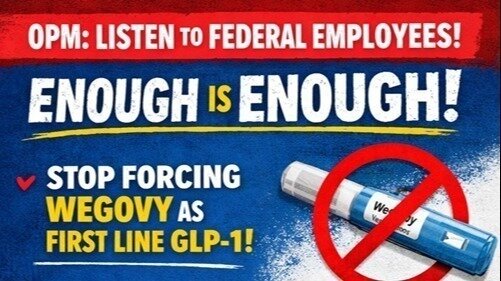
Let Federal Employees Choose Their GLP-1: End Rebates, Digital Weigh-Ins, Unfair BMI Rules
The Issue
Federal employees rely on the Federal Employees Health Benefits (FEHB) Program to provide access to clinically appropriate, evidence‑based care. Federal employees deserve the right to make informed choices about their healthcare without external pressures from rebate-driven practices or unscientific arbiter measures. GLP‑1 medications are not interchangeable for every patient. For many of federal employees, WEGOVY is not the right option due to side effects, lack of efficacy, contraindications, prior treatment history, or provider‑documented medical necessity for a different GLP‑1 medication. Arbitrary digital weigh-in mandates, with no explanation of use, based on outdated BMI standards, ignores the latest FDA guidance.
GLP-1 medications play a crucial role in the management of diabetes, obesity-related conditions, and sleep apnea. However, the current system incentivizes healthcare providers to prescribe WEGOVY based on rebates rather than patient health needs. This rebate-driven practice not only limits choices for federal employees but can also compromise their health by denying access to more effective or suitable medications. Patient care should be determined by medical necessity and personal health needs, not corporate profit margins.
Our concerns:
Mandatory step therapy that forces patients to try older or less effective medications, such as WEGOVY and SAXENDA, is not clinically appropriate for many patients. SAXENDA is a daily injectable GLP-1 with significantly lower long-term success and adherence rates compared to newer, once-weekly GLP-1 medications.
Requiring SAXENDA and WEGOVY first wastes critical time. Many patients discontinue treatment due to the daily injection burden, side effects, or inadequate weight loss, only to be required to “fail” the medication on paper before accessing a more appropriate therapy. This practice delays effective treatment, increases patient frustration, and contributes to poorer health outcomes. As noted by the FSBP CEO Kyle Longton, there is a high discontinuation count for GLP1s, this is one of the primary reasons.- OPM remains committed to ensuring that FEHB carriers offer comprehensive obesity benefits that reflect current evidence-based management. ZEPBOUND clinical data shows significantly higher faster weight loss than ALL available GLP1 and less side effects.
- Forced switching disrupts care. Many patients are stable and successful on a specific GLP-1 and face setbacks when required to change.
The prior authorization and formulary exception process is excessively burdensome. Physicians and their staff are required to complete countless forms, duplicative questions, and non‑transparent requirements, often with repeated denials or requests for resubmission. This process gets repeated annually. - Providers are not compensated for this administrative workload, forcing medical practices to absorb significant time and cost simply to maintain medically necessary treatment for their patients. The reimbursements are not rising enough to cover this workload.
The administrative burden is forcing many practices to no longer prescribe these medications, or to no longer accept insurance. - Coverage requirements that exceed FDA labeling are unfair and medically unjustified. The FDA indication for GLP-1 medications for weight management begins at a BMI of 30, or 27 with qualifying comorbidities. Requiring a higher BMI threshold such as 32 creates unnecessary delays in care and forces patients to worsen before qualifying for treatment. (Aetna, FSBP).
OPM has acknowledged that BMI alone is not the best or sole measure of health or obesity risk, yet FEHB plans continue to treat BMI as the end-all, be-all criterion for access to care.
Some FEHB plans require the use of digital or connected scales as a condition of coverage, yet the purpose, use, and oversight of the collected weight data have not been clearly explained to patients. (FSBP, AETNA) - In 2026, WEGOVY is still $1300-$1400 a month cost to the plan, while ZEPBOUND is currently $900-$1100. Significant savings can be made by allowing patients access to the lower costing GLP1 ZEPBOUND.
- The data collected through mandatory digital scales has unclear clinical value. Weight alone, captured outside of a clinical context, does not account for body composition, metabolic changes, medication response, or overall health outcomes.
Some FEHB plans require patients to use Teladoc or similar third-party platforms as a condition of accessing GLP-1 coverage, despite well-documented concerns about past data privacy and security incidents. Patients are given little to no choice, transparency, or assurance about how their sensitive health data is protected, shared, or retained, raising serious concerns about privacy, consent, and trust. (FSBP, AETNA, BCBS).
What we are asking OPM to do:
- End any requirement or pressure that effectively mandates WEGOVY and/or SAXENDA as the default or sole GLP‑1 option for weight management or related indications on all plans that offer GLP1s.
- Restore and protect coverage choice among FDA‑approved GLP‑1 medications within FEHB plans.
- Allow physicians to determine the most appropriate GLP‑1 medication based on individual patient needs without unnecessary barriers.
- Restore BMI requirements that align with OPM Carrier letters and FDA guidance to all plans which begins at a BMI of 30, or 27 with qualifying comorbidities.
- Immediate removal of mandatory weight measurements via digital scales as a condition for accessing GLP-1 therapies, and clarification on how any weight data collected will be used, stored, and reported.
- Implement a prior authorization process for ongoing GLP-1 therapy that is separate from first-time users, ensuring continued care and treatment stability without unnecessary re-evaluation or interruptions.
By making these changes, we can ensure a fairer and more just healthcare system for federal employees. Sign this petition to advocate for healthcare choices driven by integrity and scientific evidence, not profit or outdated standards.

144
The Issue
Federal employees rely on the Federal Employees Health Benefits (FEHB) Program to provide access to clinically appropriate, evidence‑based care. Federal employees deserve the right to make informed choices about their healthcare without external pressures from rebate-driven practices or unscientific arbiter measures. GLP‑1 medications are not interchangeable for every patient. For many of federal employees, WEGOVY is not the right option due to side effects, lack of efficacy, contraindications, prior treatment history, or provider‑documented medical necessity for a different GLP‑1 medication. Arbitrary digital weigh-in mandates, with no explanation of use, based on outdated BMI standards, ignores the latest FDA guidance.
GLP-1 medications play a crucial role in the management of diabetes, obesity-related conditions, and sleep apnea. However, the current system incentivizes healthcare providers to prescribe WEGOVY based on rebates rather than patient health needs. This rebate-driven practice not only limits choices for federal employees but can also compromise their health by denying access to more effective or suitable medications. Patient care should be determined by medical necessity and personal health needs, not corporate profit margins.
Our concerns:
Mandatory step therapy that forces patients to try older or less effective medications, such as WEGOVY and SAXENDA, is not clinically appropriate for many patients. SAXENDA is a daily injectable GLP-1 with significantly lower long-term success and adherence rates compared to newer, once-weekly GLP-1 medications.
Requiring SAXENDA and WEGOVY first wastes critical time. Many patients discontinue treatment due to the daily injection burden, side effects, or inadequate weight loss, only to be required to “fail” the medication on paper before accessing a more appropriate therapy. This practice delays effective treatment, increases patient frustration, and contributes to poorer health outcomes. As noted by the FSBP CEO Kyle Longton, there is a high discontinuation count for GLP1s, this is one of the primary reasons.- OPM remains committed to ensuring that FEHB carriers offer comprehensive obesity benefits that reflect current evidence-based management. ZEPBOUND clinical data shows significantly higher faster weight loss than ALL available GLP1 and less side effects.
- Forced switching disrupts care. Many patients are stable and successful on a specific GLP-1 and face setbacks when required to change.
The prior authorization and formulary exception process is excessively burdensome. Physicians and their staff are required to complete countless forms, duplicative questions, and non‑transparent requirements, often with repeated denials or requests for resubmission. This process gets repeated annually. - Providers are not compensated for this administrative workload, forcing medical practices to absorb significant time and cost simply to maintain medically necessary treatment for their patients. The reimbursements are not rising enough to cover this workload.
The administrative burden is forcing many practices to no longer prescribe these medications, or to no longer accept insurance. - Coverage requirements that exceed FDA labeling are unfair and medically unjustified. The FDA indication for GLP-1 medications for weight management begins at a BMI of 30, or 27 with qualifying comorbidities. Requiring a higher BMI threshold such as 32 creates unnecessary delays in care and forces patients to worsen before qualifying for treatment. (Aetna, FSBP).
OPM has acknowledged that BMI alone is not the best or sole measure of health or obesity risk, yet FEHB plans continue to treat BMI as the end-all, be-all criterion for access to care.
Some FEHB plans require the use of digital or connected scales as a condition of coverage, yet the purpose, use, and oversight of the collected weight data have not been clearly explained to patients. (FSBP, AETNA) - In 2026, WEGOVY is still $1300-$1400 a month cost to the plan, while ZEPBOUND is currently $900-$1100. Significant savings can be made by allowing patients access to the lower costing GLP1 ZEPBOUND.
- The data collected through mandatory digital scales has unclear clinical value. Weight alone, captured outside of a clinical context, does not account for body composition, metabolic changes, medication response, or overall health outcomes.
Some FEHB plans require patients to use Teladoc or similar third-party platforms as a condition of accessing GLP-1 coverage, despite well-documented concerns about past data privacy and security incidents. Patients are given little to no choice, transparency, or assurance about how their sensitive health data is protected, shared, or retained, raising serious concerns about privacy, consent, and trust. (FSBP, AETNA, BCBS).
What we are asking OPM to do:
- End any requirement or pressure that effectively mandates WEGOVY and/or SAXENDA as the default or sole GLP‑1 option for weight management or related indications on all plans that offer GLP1s.
- Restore and protect coverage choice among FDA‑approved GLP‑1 medications within FEHB plans.
- Allow physicians to determine the most appropriate GLP‑1 medication based on individual patient needs without unnecessary barriers.
- Restore BMI requirements that align with OPM Carrier letters and FDA guidance to all plans which begins at a BMI of 30, or 27 with qualifying comorbidities.
- Immediate removal of mandatory weight measurements via digital scales as a condition for accessing GLP-1 therapies, and clarification on how any weight data collected will be used, stored, and reported.
- Implement a prior authorization process for ongoing GLP-1 therapy that is separate from first-time users, ensuring continued care and treatment stability without unnecessary re-evaluation or interruptions.
By making these changes, we can ensure a fairer and more just healthcare system for federal employees. Sign this petition to advocate for healthcare choices driven by integrity and scientific evidence, not profit or outdated standards.
The Decision Makers


Supporter Voices
Petition Updates
Share this petition
Petition created on January 27, 2026