

Legalize RVs and Tiny Homes as compassionate dwellings in Oceanside in the Housing Crisis
The Issue
Dear Local Governments and Planning Departments in Oceanside,
We are here to advocate for local residents who are looking for dignified ways to live while navigating an impossible housing market in the Oceanside region. Across British Columbia, local governments continue to refuse to legalize Recreational Vehicles (RVs) and moveable tiny homes (ie: tiny homes on wheels) as housing in the worst housing crisis of our generation. In the Oceanside region of Vancouver Island, where starting single family home prices are nearly $900,000 (up from $655,000 in autumn 2020), and long-term rental stock is decreasing (in part due to the boom in illegal short-term rentals across the region), there are many people throughout the area who have been living longterm in RVs and Tiny Homes in RV Parks and residential properties for years and even decades in order to stay afloat. Far too many people in Oceanside are one paycheque or bylaw complaint away from homelessness, and current government solutions are inadequate to meet the immense housing need. Local governments state that they cannot legalize RVs or Tiny Homes on Wheels as full-time dwellings due to the BC Building Code, but the code means very little if the alternative is for people to become homeless. We invite the Regional District of Nanaimo (RDN) and local municipalities of Parksville, Qualicum Beach, and Lantzville to take a compassionate approach to recreational vehicle and tiny house living in the housing crisis, in line with best practices being developed in similar regions in the province, and to work with local advocates and experts in lived-experiences of houselessness and affordable housing to draft meaningful, responsive solutions that protect local RV and Tiny Home dwelling residents from becoming homeless.
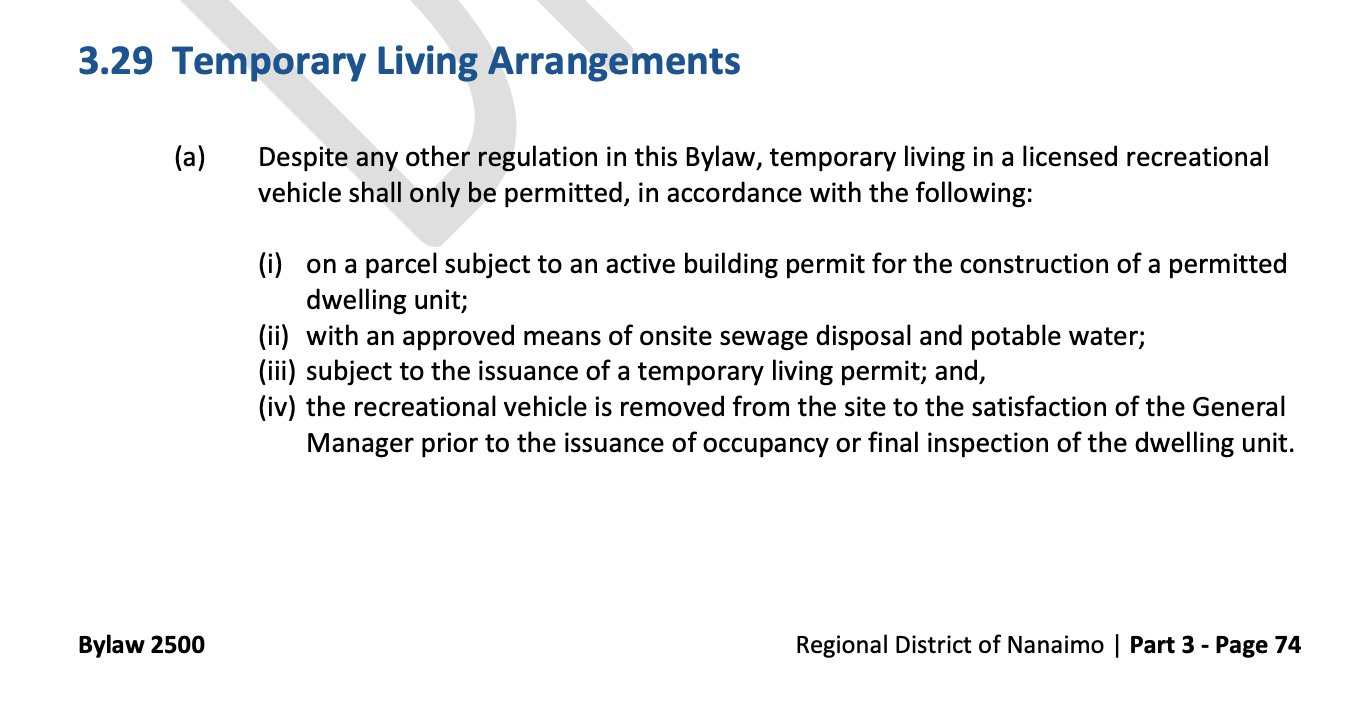
Despite promises since 2020 to review RV and Tiny Home Dwelling as affordable housing options in a future 'Phase 2' of the current zoning bylaw review, and despite public feedback in the current Phase 1 review demonstrating interest in the RDN legalizing tiny homes on wheels and full-time RV living, the RDN is currently quietly incorporating what can be interpreted as anti-RV and anti-Tiny Home clauses in its upcoming final readings of Draft Bylaw 2500, including a new clause that will formally restrict the only legal form of multi-year RV dwelling to individuals who have an open building permit on their property and reinforcing a 6 month stay in crucially important, and often wait-listed, local RV Parks (and officially defining Tiny Homes as RVs, subjecting them to the same restrictive bylaws).
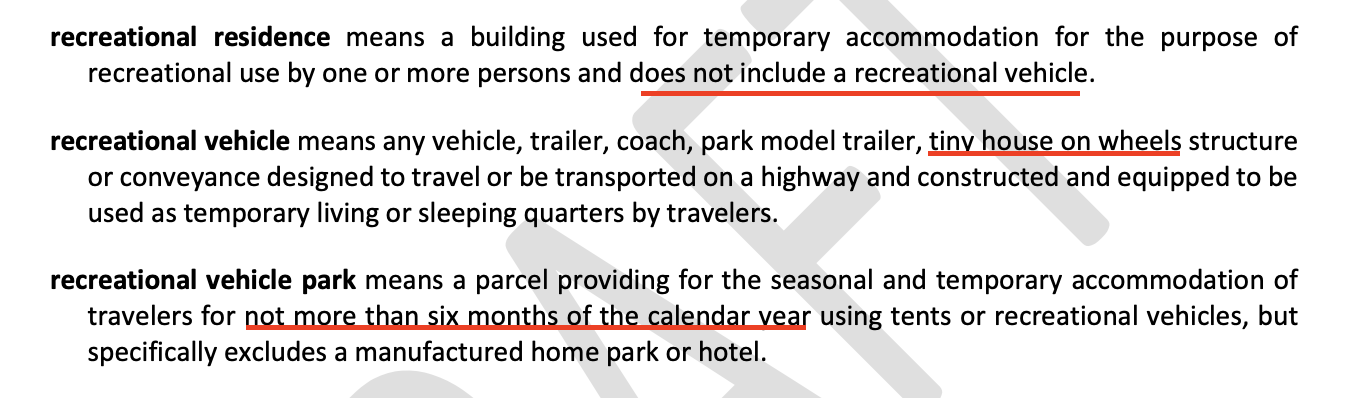
In practice, these new proposed RV bylaws and definitions risk further criminalizing and/or evicting vulnerable individuals who have been living out of necessity in RVs and Tiny Homes on Wheels on private properties longterm and/or those who have been living longterm in campgrounds and RV Parks in the RDN. We also remind the RDN that RV dwellers in campgrounds and RV Parks in British Columbia have tenancy rights in certain contexts, and that current bylaw approaches to full-time RV use in these spaces may conflict with provincial guidelines on housing rights.
Therefore, We call upon the RDN to:
1) rescind the anti-RV and anti-Tiny Home clauses (including but not limited to Section 3.29 and the definitions for RVs, Recreational Residence, and RV Parks applied in the document) from Draft Bylaw 2500 and to carry out meaningful, transparent, and responsive consultation on the matter of tiny homes on wheels and RVs as compassionate housing options for local residents in the housing crisis before formalizing bylaws on this matter
We invite all local governments to:
2) adopt best practices being used in the housing crisis in other regions in BC, including Temporary Use Permits to allow RV and Tiny House on Wheels as dwellings in Valemount, Grand Forks, Naramata, among other locales. We invite the RDN to consider best practices implemented in Halifax to support year round RV Park space in the housing crisis. We also call upon the RDN to acknowledge that Vernon was recently forced to acknowledge RVs are allowable housing in the Agricultural Land Reserve (ALR).
3) recognize that Tiny Homes on Wheels and RVs have an important role to play in our region as 'flexible density' in residential zones as caregiver suites to support aging in place; housing for family while attending school; and support for family members in times of need.
Signed,

1,340
The Issue
Dear Local Governments and Planning Departments in Oceanside,
We are here to advocate for local residents who are looking for dignified ways to live while navigating an impossible housing market in the Oceanside region. Across British Columbia, local governments continue to refuse to legalize Recreational Vehicles (RVs) and moveable tiny homes (ie: tiny homes on wheels) as housing in the worst housing crisis of our generation. In the Oceanside region of Vancouver Island, where starting single family home prices are nearly $900,000 (up from $655,000 in autumn 2020), and long-term rental stock is decreasing (in part due to the boom in illegal short-term rentals across the region), there are many people throughout the area who have been living longterm in RVs and Tiny Homes in RV Parks and residential properties for years and even decades in order to stay afloat. Far too many people in Oceanside are one paycheque or bylaw complaint away from homelessness, and current government solutions are inadequate to meet the immense housing need. Local governments state that they cannot legalize RVs or Tiny Homes on Wheels as full-time dwellings due to the BC Building Code, but the code means very little if the alternative is for people to become homeless. We invite the Regional District of Nanaimo (RDN) and local municipalities of Parksville, Qualicum Beach, and Lantzville to take a compassionate approach to recreational vehicle and tiny house living in the housing crisis, in line with best practices being developed in similar regions in the province, and to work with local advocates and experts in lived-experiences of houselessness and affordable housing to draft meaningful, responsive solutions that protect local RV and Tiny Home dwelling residents from becoming homeless.
Despite promises since 2020 to review RV and Tiny Home Dwelling as affordable housing options in a future 'Phase 2' of the current zoning bylaw review, and despite public feedback in the current Phase 1 review demonstrating interest in the RDN legalizing tiny homes on wheels and full-time RV living, the RDN is currently quietly incorporating what can be interpreted as anti-RV and anti-Tiny Home clauses in its upcoming final readings of Draft Bylaw 2500, including a new clause that will formally restrict the only legal form of multi-year RV dwelling to individuals who have an open building permit on their property and reinforcing a 6 month stay in crucially important, and often wait-listed, local RV Parks (and officially defining Tiny Homes as RVs, subjecting them to the same restrictive bylaws).
In practice, these new proposed RV bylaws and definitions risk further criminalizing and/or evicting vulnerable individuals who have been living out of necessity in RVs and Tiny Homes on Wheels on private properties longterm and/or those who have been living longterm in campgrounds and RV Parks in the RDN. We also remind the RDN that RV dwellers in campgrounds and RV Parks in British Columbia have tenancy rights in certain contexts, and that current bylaw approaches to full-time RV use in these spaces may conflict with provincial guidelines on housing rights.
Therefore, We call upon the RDN to:
1) rescind the anti-RV and anti-Tiny Home clauses (including but not limited to Section 3.29 and the definitions for RVs, Recreational Residence, and RV Parks applied in the document) from Draft Bylaw 2500 and to carry out meaningful, transparent, and responsive consultation on the matter of tiny homes on wheels and RVs as compassionate housing options for local residents in the housing crisis before formalizing bylaws on this matter
We invite all local governments to:
2) adopt best practices being used in the housing crisis in other regions in BC, including Temporary Use Permits to allow RV and Tiny House on Wheels as dwellings in Valemount, Grand Forks, Naramata, among other locales. We invite the RDN to consider best practices implemented in Halifax to support year round RV Park space in the housing crisis. We also call upon the RDN to acknowledge that Vernon was recently forced to acknowledge RVs are allowable housing in the Agricultural Land Reserve (ALR).
3) recognize that Tiny Homes on Wheels and RVs have an important role to play in our region as 'flexible density' in residential zones as caregiver suites to support aging in place; housing for family while attending school; and support for family members in times of need.
Signed,
The Decision Makers

Petition Updates
Share this petition
Petition created on May 16, 2024