

Keep Canada Competitive with a National Startup Strategy
The Issue
We call on the Government of Canada to establish 1) a National Startup Taskforce and 2) National Startup Strategy to ensure Canada remains a globally competitive place to found, build, and scale companies.
______________ Note From the Author _____________
"Nostalgia is not a strategy."
Having actively participated in the startup ecosystem across Canada for decades and helping launch over 100 emerging innovation companies from coast to coast, I've witnessed firsthand the struggles faced by Canadian founders.🇨🇦
Now, with the recent news of the world's top tech accelerator Y Combinator no longer investing in Canadian headquartered companies, it's a signal that we need to change.🚨
We build great founders but lose their startup. In another policy and government relations multiverse, Uber ($170 billion), Ethereum ($365 billion), or Instacart ($10 billion) could have been incorporated in Canada. The lost opportunity has cost Canada trillions in GDP.📉
If incorporating a startup in Canada were a consumer product, then it's reaching the end of its life cycle. The system is outdated and failing founders and investors. Users are leaving. Sales are dying.
We need a blank slate. A brand new user experience.
Let talented Canadian founders build anywhere in the world. Just give them terms that make incorporating a startup in Canada, a globally competitive advantage. Make a Canadian incorporation the best in the world. Think of it as a pilot program.
Go to the Valley. Just stay Canadian, eh!
Jordan (from Waterloo)
P.S. Thank you for your support.
______________________________________

GOAL
MAKE CANADA THE BEST PLACE IN THE WORLD TO INCORPORATE A STARTUP.
THE PROBLEM
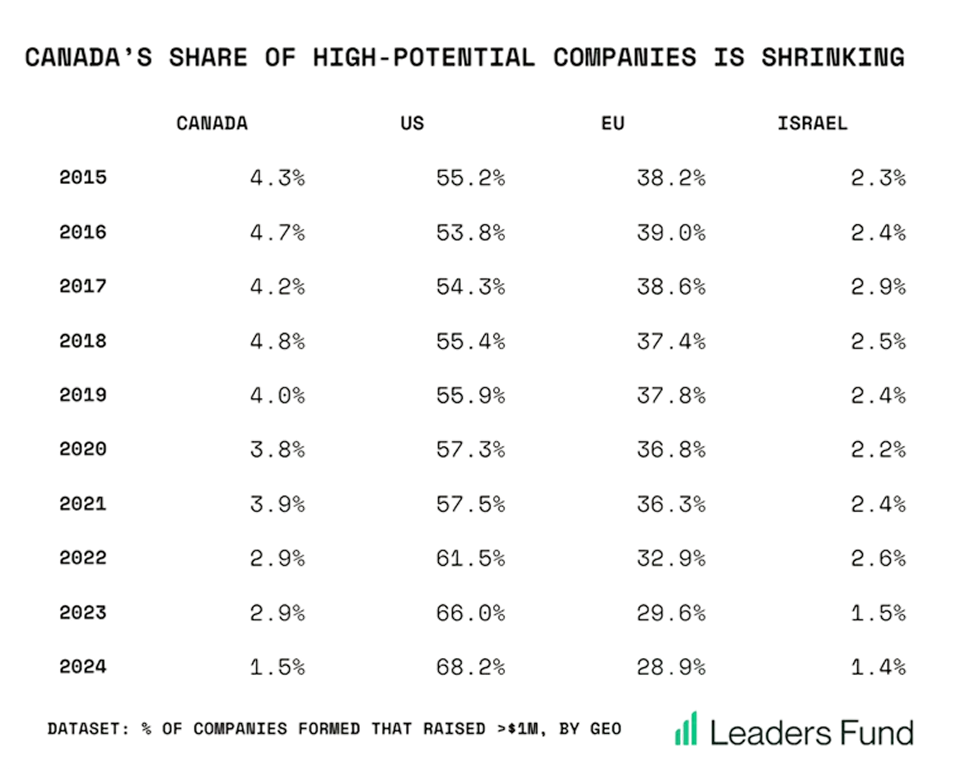
Canada is losing its best startups. Toronto venture-capital firm Leaders Fund found that 67 per cent of startups launched by Canadians last year were set up outside Canada.
A "STARTUP" in "TECH"
"A startup is a newly formed company built to develop and scale an innovative product or service under conditions of high uncertainty."
An innovation-driven, high-growth company typically falls into one of the following stages:
• Pre-revenue: Founders incorporating a company
• Startup: 1–20 employees
• Scaleup: 20–500 employees
This distinction matters because startups and scaleups are not simply small businesses — they are strategic economic assets with outsized long-term impact.
WHY THIS MATTERS: A Strategic Moment for Canada 🇨🇦
Canada stands at a crossroads. Globally, powerful nations are reshaping economic and trade systems and middle powers like Canada must strengthen their own foundations to thrive.
As Prime Minister Mark Carney recently emphasized at the World Economic Forum in Davos, the world is experiencing a “rupture in the world order,” and countries like Canada must strengthen their domestic foundations to remain competitive and sovereign.
Elected leaders have repeatedly emphasized the need to:
- Reduce economic leakage.
- Build economic sovereignty.
- Demonstrate leadership in the emerging global innovation economy.
At the same time, Canada’s startup ecosystem is deteriorating:
- Of the top 20 global startup ecosystems, Canada is dropping down the ranking the fastest of all countries (Source: StartupBlink).
- The world's top startup accelerator Y Combinator will no longer invest in Canadian-based companies (Source: The Logic).
- Nearly half of Canadian founders who raised $1M+ were based in the US (Source: Leaders Fund).
These are not just statistics but a brain drain, investment drain, and economic opportunity cost that erodes Canada’s future.
These are not abstract statistics. They represent a brain drain, a wealth drain, and a massive opportunity cost.
Canada continues to educate, incubate, and subsidize innovation—only to export its most successful outcomes abroad.
We are losing our most valuable resource: our future generations of builders and leaders.
WHAT WE ARE ASKING FOR:
1. Establish a Public National Startup Taskforce
We urge the Government of Canada to convene a National Startup Taskforce, modeled on the AI Strategy Taskforce, with the mandate to:
- Diagnose why Canadian founders increasingly incorporate abroad.
- Benchmark Canada against leading startup nations.
- Recommend structural reforms, funding frameworks, regulatory modernization, and talent strategies.
- Deliver a time-bound roadmap for a globally competitive startup nation.
Composition: Canadian founders, venture capital (VC) investors, economists, technologists, provincial leaders, Indigenous innovators, and ecosystem builders.
2. Develop a National Startup Strategy
The National Startup Strategy should explore the structural, policy, and economic conditions that make Canada competitive for startups. Areas for the Startup Taskforce to examine include:
A. Company Stage Definitions (National Language)
Clear terms would allow policies and funding to be tailored appropriately. Suggested categories (to be refined by the Taskforce):
- Pre-Startup: Individuals or teams pre-incorporation or pre-revenue.
- Early-Stage Startups: Founders.
- Startups: 1-20 employees.
- Scaleups: 20-500 employees.
- Global Companies: 500+ employees.
B. Economic Zoning and Innovation Districts OR Classifications
The Startup Taskforce should examine whether Startup Economic Zones, National Innovation Districts, or Innovation Classifications could provide differentiated frameworks like unique regulatory, tax, or immigration policies to attract and retain founders. Zones could be physical, virtual, or hybrid, and aligned with sectoral strengths or superclusters like AI, climate tech, biotech, quantum, advanced manufacturing, fintech, agri-tech, etc.
C. National Innovation Hubs, Regional Innovation Centres, Ecosystem Networks, and Higher Education Integration
The Task Force should examine the current models and look at new models, where Innovation Hubs serve as:
- Centralized interfaces for founders.
- Capital aggregation points.
- Regulatory navigation centres.
- Talent and immigration gateways.
- Global market access nodes.
These hubs can help unify Canada’s ecosystem while enabling regional strengths.
D. Capital Formation and Retention
Explore why capital migrates abroad, and how Canada could structure public-private partnerships to retain investment without crowding out private VC. Examine:
- Co-investment strategies.
- Solve the capital gain flight of investors.
- Public fund leverage for early, growth, and late-stage rounds.
- Mechanisms to prevent forced relocation during scaleup phases.
E. Incorporation, Tax, and Regulatory Friction
Examine globally competitive markets like the US, Singapore, and Cayman Islands and emerging markets like Estonia, United Arab Emirates (UAE), and Bermuda to assess:
- Speed and ease of incorporation.
- Founder equity frameworks.
- Employee stock option regimes.
- Cross-border IP mobility.
- R&D monetization and commercialization efficiency.
- Administrative burdens by growth stage.
- Streamline legal, accounting, and banking.
The Startup Taskforce should identify gaps where Canada is less competitive globally.
F. Talent Mobility and Founder Immigration
Explore policies to attract and retain global founders and top technical talent:
- Founder and startups visas.
- Higher Education student visas.
- Fast-track immigration for key roles.
- Retention programs for graduates and researchers.
G. Structure, Measurement, Accountability, and National Targets
The strategy should define benchmark metrics and yearly tracking, such as:
- Determine the best structure to become the fastest government.
- Consider new models like a National Chief Entrepreneur.
- Track domestic incorporation rates and closures, for Canadian-founded startups, including their incubation/accelerator path.
- Measure capital retained in Canada vs lost abroad, scaleups graduating to global firms, time to incorporation and first institutional funding, founder net retention rates, etc.
THE STAKES
Startups are strategic national assets, not just small businesses. For example, Uber could have been a Canadian company but the founder moved to Silicon Valley and incorporated in the US. Uber quickly became the most valuable startup in the world.
Without a cohesive program:
- More founders will headquarter outside Canada.
- Capital will continue to flow abroad.
- Canada will fall behind in innovation and economic influence.
CONCLUSION
Canada has world-class talent, research institutions, and growing startup clusters. But without a national startup strategy our founders, capital, and ideas will continue to flow abroad.
We call on the Government of Canada to establish a National Startup Taskforce and design a bold National Startup Strategy. Canada needs a framework that ensures Canada is a first-choice destination for founders, investment, and global scaling.
Please sign this petition to demand that Canada act strategically, decisively, and collectively to secure its innovation future.

1,001
The Issue
We call on the Government of Canada to establish 1) a National Startup Taskforce and 2) National Startup Strategy to ensure Canada remains a globally competitive place to found, build, and scale companies.
______________ Note From the Author _____________
"Nostalgia is not a strategy."
Having actively participated in the startup ecosystem across Canada for decades and helping launch over 100 emerging innovation companies from coast to coast, I've witnessed firsthand the struggles faced by Canadian founders.🇨🇦
Now, with the recent news of the world's top tech accelerator Y Combinator no longer investing in Canadian headquartered companies, it's a signal that we need to change.🚨
We build great founders but lose their startup. In another policy and government relations multiverse, Uber ($170 billion), Ethereum ($365 billion), or Instacart ($10 billion) could have been incorporated in Canada. The lost opportunity has cost Canada trillions in GDP.📉
If incorporating a startup in Canada were a consumer product, then it's reaching the end of its life cycle. The system is outdated and failing founders and investors. Users are leaving. Sales are dying.
We need a blank slate. A brand new user experience.
Let talented Canadian founders build anywhere in the world. Just give them terms that make incorporating a startup in Canada, a globally competitive advantage. Make a Canadian incorporation the best in the world. Think of it as a pilot program.
Go to the Valley. Just stay Canadian, eh!
Jordan (from Waterloo)
P.S. Thank you for your support.
______________________________________
GOAL
MAKE CANADA THE BEST PLACE IN THE WORLD TO INCORPORATE A STARTUP.
THE PROBLEM
Canada is losing its best startups. Toronto venture-capital firm Leaders Fund found that 67 per cent of startups launched by Canadians last year were set up outside Canada.
A "STARTUP" in "TECH"
"A startup is a newly formed company built to develop and scale an innovative product or service under conditions of high uncertainty."
An innovation-driven, high-growth company typically falls into one of the following stages:
• Pre-revenue: Founders incorporating a company
• Startup: 1–20 employees
• Scaleup: 20–500 employees
This distinction matters because startups and scaleups are not simply small businesses — they are strategic economic assets with outsized long-term impact.
WHY THIS MATTERS: A Strategic Moment for Canada 🇨🇦
Canada stands at a crossroads. Globally, powerful nations are reshaping economic and trade systems and middle powers like Canada must strengthen their own foundations to thrive.
As Prime Minister Mark Carney recently emphasized at the World Economic Forum in Davos, the world is experiencing a “rupture in the world order,” and countries like Canada must strengthen their domestic foundations to remain competitive and sovereign.
Elected leaders have repeatedly emphasized the need to:
- Reduce economic leakage.
- Build economic sovereignty.
- Demonstrate leadership in the emerging global innovation economy.
At the same time, Canada’s startup ecosystem is deteriorating:
- Of the top 20 global startup ecosystems, Canada is dropping down the ranking the fastest of all countries (Source: StartupBlink).
- The world's top startup accelerator Y Combinator will no longer invest in Canadian-based companies (Source: The Logic).
- Nearly half of Canadian founders who raised $1M+ were based in the US (Source: Leaders Fund).
These are not just statistics but a brain drain, investment drain, and economic opportunity cost that erodes Canada’s future.
These are not abstract statistics. They represent a brain drain, a wealth drain, and a massive opportunity cost.
Canada continues to educate, incubate, and subsidize innovation—only to export its most successful outcomes abroad.
We are losing our most valuable resource: our future generations of builders and leaders.
WHAT WE ARE ASKING FOR:
1. Establish a Public National Startup Taskforce
We urge the Government of Canada to convene a National Startup Taskforce, modeled on the AI Strategy Taskforce, with the mandate to:
- Diagnose why Canadian founders increasingly incorporate abroad.
- Benchmark Canada against leading startup nations.
- Recommend structural reforms, funding frameworks, regulatory modernization, and talent strategies.
- Deliver a time-bound roadmap for a globally competitive startup nation.
Composition: Canadian founders, venture capital (VC) investors, economists, technologists, provincial leaders, Indigenous innovators, and ecosystem builders.
2. Develop a National Startup Strategy
The National Startup Strategy should explore the structural, policy, and economic conditions that make Canada competitive for startups. Areas for the Startup Taskforce to examine include:
A. Company Stage Definitions (National Language)
Clear terms would allow policies and funding to be tailored appropriately. Suggested categories (to be refined by the Taskforce):
- Pre-Startup: Individuals or teams pre-incorporation or pre-revenue.
- Early-Stage Startups: Founders.
- Startups: 1-20 employees.
- Scaleups: 20-500 employees.
- Global Companies: 500+ employees.
B. Economic Zoning and Innovation Districts OR Classifications
The Startup Taskforce should examine whether Startup Economic Zones, National Innovation Districts, or Innovation Classifications could provide differentiated frameworks like unique regulatory, tax, or immigration policies to attract and retain founders. Zones could be physical, virtual, or hybrid, and aligned with sectoral strengths or superclusters like AI, climate tech, biotech, quantum, advanced manufacturing, fintech, agri-tech, etc.
C. National Innovation Hubs, Regional Innovation Centres, Ecosystem Networks, and Higher Education Integration
The Task Force should examine the current models and look at new models, where Innovation Hubs serve as:
- Centralized interfaces for founders.
- Capital aggregation points.
- Regulatory navigation centres.
- Talent and immigration gateways.
- Global market access nodes.
These hubs can help unify Canada’s ecosystem while enabling regional strengths.
D. Capital Formation and Retention
Explore why capital migrates abroad, and how Canada could structure public-private partnerships to retain investment without crowding out private VC. Examine:
- Co-investment strategies.
- Solve the capital gain flight of investors.
- Public fund leverage for early, growth, and late-stage rounds.
- Mechanisms to prevent forced relocation during scaleup phases.
E. Incorporation, Tax, and Regulatory Friction
Examine globally competitive markets like the US, Singapore, and Cayman Islands and emerging markets like Estonia, United Arab Emirates (UAE), and Bermuda to assess:
- Speed and ease of incorporation.
- Founder equity frameworks.
- Employee stock option regimes.
- Cross-border IP mobility.
- R&D monetization and commercialization efficiency.
- Administrative burdens by growth stage.
- Streamline legal, accounting, and banking.
The Startup Taskforce should identify gaps where Canada is less competitive globally.
F. Talent Mobility and Founder Immigration
Explore policies to attract and retain global founders and top technical talent:
- Founder and startups visas.
- Higher Education student visas.
- Fast-track immigration for key roles.
- Retention programs for graduates and researchers.
G. Structure, Measurement, Accountability, and National Targets
The strategy should define benchmark metrics and yearly tracking, such as:
- Determine the best structure to become the fastest government.
- Consider new models like a National Chief Entrepreneur.
- Track domestic incorporation rates and closures, for Canadian-founded startups, including their incubation/accelerator path.
- Measure capital retained in Canada vs lost abroad, scaleups graduating to global firms, time to incorporation and first institutional funding, founder net retention rates, etc.
THE STAKES
Startups are strategic national assets, not just small businesses. For example, Uber could have been a Canadian company but the founder moved to Silicon Valley and incorporated in the US. Uber quickly became the most valuable startup in the world.
Without a cohesive program:
- More founders will headquarter outside Canada.
- Capital will continue to flow abroad.
- Canada will fall behind in innovation and economic influence.
CONCLUSION
Canada has world-class talent, research institutions, and growing startup clusters. But without a national startup strategy our founders, capital, and ideas will continue to flow abroad.
We call on the Government of Canada to establish a National Startup Taskforce and design a bold National Startup Strategy. Canada needs a framework that ensures Canada is a first-choice destination for founders, investment, and global scaling.
Please sign this petition to demand that Canada act strategically, decisively, and collectively to secure its innovation future.
The Decision Makers

Supporter Voices
Petition Updates
Share this petition
Petition created on January 27, 2026