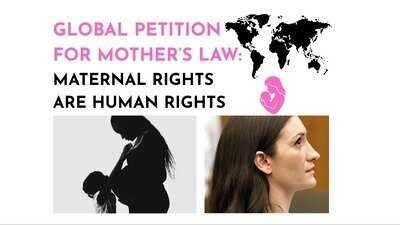

Introduce “Mother’s Law” worldwide
The Issue
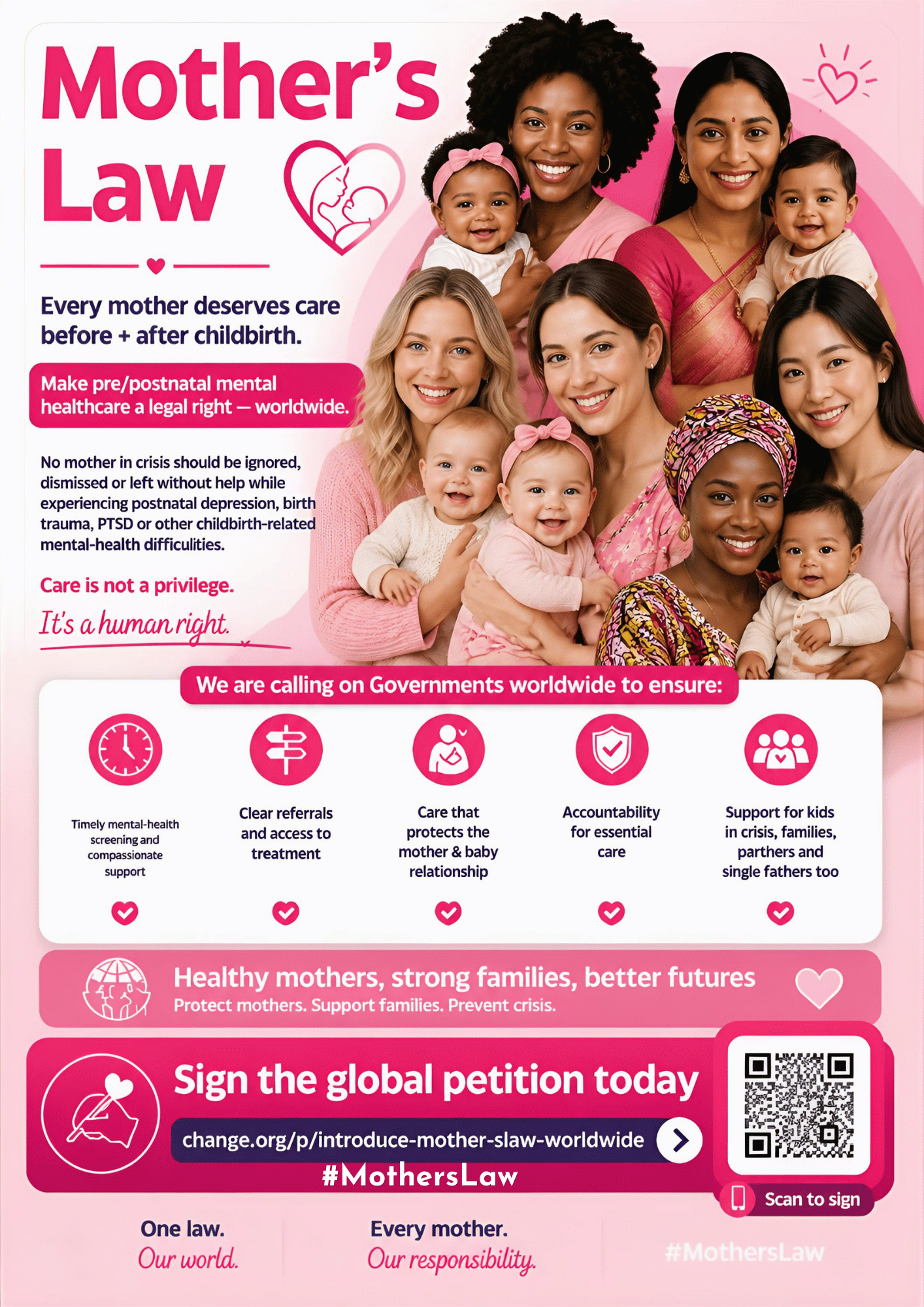
Sign this GLOBAL petition for EVERY country in the world to:
- protect mothers, support families and make prenatal and postnatal mental healthcare a LEGAL RIGHT
- protect mothers, support families from being neglected and abandoned.
My name is Yasmin.
I call on all Governments around the world to introduce Mother’s Law, guaranteeing every woman and birthing parent timely access to appropriate medical and psychological care after postnatal depression, birth trauma or other childbirth-related mental-health difficulties.
Sign this petition to advocate for the implementation of “Mother’s Law” in your country and ensure that all mothers receive the care they desperately need and deserve.
No mother should be ignored, dismissed or left without help during one of the most vulnerable periods of her life. Giving birth to life.
And so where a partner or provider deliberately or seriously neglects this legal duty, there must also be meaningful sanctions (unless there is due cause), including personal/professional and—where the evidence supports it—criminal accountability.
Mother’s Law would require
- Maternity and healthcare providers to identify postnatal depression and birth trauma, provide clear referral pathways, ensure timely treatment, and investigate failures in care.
- Fathers to get the support they need to help their partners who are in crisis as mothers.
- Children in crisis to be supported and kept with loving parents struggling.
- Partners to face sever criminal penalties for abandoning their own children by abusing and neglecting them including financial abandonment. (Yes - even those mothers who walk out on, or abuse their kids)
- Single father's to also be protected under this law.
Mothers's Law will give the right to (more details at the end of this page):
- Mental-health screening and compassionate assessment after childbirth.
- Clear information about postnatal depression, PTSD and birth trauma.
- Referral to FREE appropriate medical, psychological or psychiatric services.
- Treatment within a legally defined maximum timeframe. (eg free medicine or therapy).
- Continuity of care and consideration of the mother–baby relationship.
- Independent complaints, scrutiny and investigation procedures.
- Accountability where a provider knowingly or recklessly fails to provide required care.
- Joined up care. All agencies and providers to work together, to deliver comprehensive wraparound care. Rather than a single service provider operating in silo of others.
Why Sign This Petition?
This petition seeks to establish “Mother’s Law,” a legal framework in every country to ensure comprehensive care and support for mothers dealing with postnatal depression and birth trauma. Postnatal depression affects approximately 10-20% of new mothers, according to studies by reputable sources like the World Health Organisation.
These women, often overlooked, battle debilitating exhaustion, anxiety, and depression, which can severely impact their ability to care for themselves and their newborns. Birth trauma, too, leaves lasting psychological scars that require urgent intervention.
“Mother’s Law” would mandate that healthcare systems worldwide recognize postnatal depression and birth trauma as critical health issues. It would ensure that every mother has access to mental health screenings during pregnancy and postpartum care, regardless of her background. Furthermore, it would provide funding for therapy, support groups, and parental education programs designed to help mothers and families navigate the challenges posed by these conditions.
Implementing “Mother’s Law” is a step towards safeguarding maternal mental health globally. We need our governments to acknowledge maternal mental health not simply as an adjunct to physical health, but as its foundation. Every mother deserves the support necessary to thrive after childbirth without fear, isolation, or stigma.
Join us in demanding change.
Sign the petition NOW to protect mothers, support families and make postnatal mental healthcare a legal right.
A caveat
The ideas in this petition is not a silver bullet. It will need to be discussed. By professionals and expert law makers but it is a start. So that we never have abandon any mother or her kids in crisis.
Together, we can transform the past personal tragedies of abused and neglected mothers into a powerful movement for global maternal health change. NOW.
____________________________________________________________________________________________________________
MORE INFO - Background of Petition Creator
My name is Yasmin, a British single mother. Born, bred and based in London, UK.
I am one of the millions of mothers, women, fathers and good men around the world who have been devastated by a criminal trial in Massachusetts, USA, that has been discussing postnatal depression, psychosis and birth trauma in an American criminal court.
All of this has become a talking point involving Lindsay Clancy, an American stay-at-home mother and nurse, who is on trial relating to the deaths of her three beloved children, Callum (8 months), Dawson (3) and Cora (5).
Lindsay has been diagnosed with bipolar disorder and postpartum depression and psychosis.
See NBC article: "Lindsay Clancy chronicled her desperation and 'brain fog' in her diary before the killings".
You may not agree with or support Lindsay Clancy, but this petition is not about the legal case. It is about changing how the law treats mothers and kids in crisis.
I am sure we can all agree that MORE can be done to give mothers the treatment they need, under a separate, specific, recognised law that enshrines their rights.
_____________________________________________________________________________________
____________________________________________________________________________________________________
What international practice shows
The strongest model is usually a comprehensive, joined up, multi-agency care pathway. The World Health Organisation recommends integrating perinatal mental-health identification and treatment into maternal and child-health services, with trained staff, referral systems, evidence-based interventions and monitoring.
A workable Mother’s Law could therefore require:
- Routine information and compassionate assessment during pregnancy and after birth.
- Assessment for postnatal depression, anxiety, PTSD and birth trauma.
- A clear referral route to appropriate treatment.
- Maximum waiting times for assessment and treatment.
- Services that consider the mother and baby together where clinically safe.
- Interpreters, disability adjustments and culturally and income class appropriate support.
- Written reasons where care is refused or delayed.
- Independent complaints, investigation and review.
- Public reporting on access, waiting times and outcomes.
- Professional or organisational sanctions for serious failures.
- Criminal accountability
- Criminal prosecution should probably apply only where there is deliberate, reckless or grossly negligent conduct, particularly where a provider knowingly ignores a serious risk of suicide, self-harm or harm to the baby. Other failures—such as inadequate staffing, unreasonable delay or poor communication—could lead to regulatory action, compensation, disciplinary consequences or mandatory service improvement.
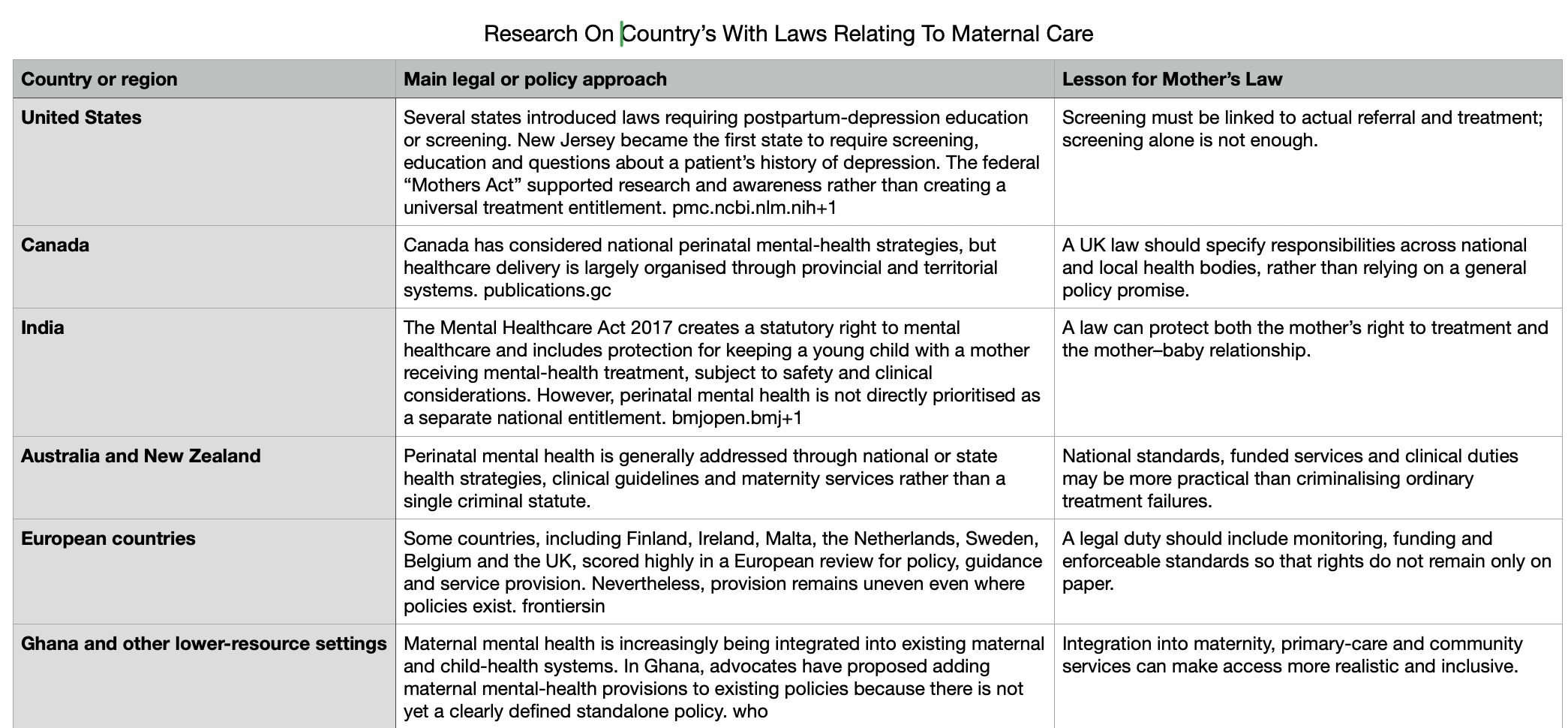
Countries generally do not have one comprehensive “postpartum mental-health law” that automatically criminalises failures to provide care.
Instead, research shows they use a mixture of mental-health rights, maternity policies, screening requirements, healthcare standards, insurance rules and professional accountability. A 2024 review found that, across 53 WHO European countries, only 25 had policies specifically addressing perinatal mental health, while only 10 had established screening programmes and 11 offered some specific perinatal treatment service. (Source: "State of perinatal mental health care in the WHO region of Europe: a scoping review" published in Frontiers of Pyschiatry)
Here is some research I found interesting. That could help inspire lawmakers to introduce the change we all want to see.
Yasmin's Story: "Why I Care"
(Trigger warning — mention of suicide.)
Like Lindsay Clancy, my life took a drastic turn when I became a mother, following a traumatic pregnancy and emergency birth in July 2001 as a new mother.
Despite being two individuals who have never met, our journeys echo one another, both derailed by poor postpartum mental health.
The difference, though, is that when I gave birth, unlike Lindsay, I immediately got the help I needed from expert medical professionals in the UK.
I suffered so badly that, at times, I even wanted to end my own life.
In July 2001, I was under the care of the excellent late private midwife Mary Cronk MBE (rest in peace), paid for by the father of my child.
I would find myself unexpectedly give birth to a premature baby at 23 weeks. Mary had spotted the danger at my first check in appointment with her. I think it was the next day, a Sunday when I was rushed in an ambulance ordered by Mary who demanded I be picked up and taken to the local hospital: Royal County Sussex Hospital. I had no clean clothes, underwear, nothing with me. A friend of the father of my child had been told of my emergency and he was kind enough to bring me emergency clothes.
All alone on a Monday afternoon, my waters broke. I cried after having been told I would have to have the baby out. I had been working for a British bank and had expected to have been at work, the same day I ended up giving birth. I even called in to work, while they were rushing me on a bed to the operating theatre.
Mary, though, never left my side. She held my hand, stroked my hair and whispered words of encouragement with her kind eyes. While I lay on an operating table awaiting my impending emergency Caesarean. I chose to have an epidural and stay awake. My surgeon, a lovely Black female medic, swept in and looked down at my sobbing tear stained face, body shaking in fear. She winked at me and said: “Hey, shhhh, it will be OK. You know what? How about I make sure the scar is a thin sliver of a line. And I promise you Yasmin, it will feel as though I am just rummaging in a handbag. I've done loads of these.”
The surgeon made us laugh and, together with her operating team, and Mary by my side, overlooking the twinkling blue sea and blue skies, my daughter came into the world.
My baby was immediately taken and put into a life-saving incubator. In the Trevor Mann Baby Unit.
The father of my child, who was on a family holiday in South Of France at the time, arrived, but he was too late and had missed the birth. There were no smartphones back then. Mary soon had to return to her other clients. After I gave birth, my baby's father flew out to resume his family holiday.
I was left with silence. A few friends came on the day as well as tons of flowers on the day of the birth. Within a few days I hardly had any visitors.
I was constantly scared my baby might die. I worried about brain injury or development issues she was so early at 24 weeks. I had to wait it out.
I felt ashamed that I had nobody and I missed Mary being by my side.
I struggled to breastfeed. I had to pump milk. I felt ugly. I felt lonely. Nervous.
I had nobody to turn to.
I felt I had no control.
I felt everything had been taken from me.
I had strange thoughts. All my plans had gone up in smoke. I did not even have a baby shower and had been slowly getting accustomed to being pregnant.
I quickly spiralled. I lost control of my mind. I felt I was going “crazy” and, while I did not suffer psychosis, I often did not want to live.
I would cry and cry until my hospital pillows were soaked. Nurses would come and sit and hold my hand.
It was while I was in hospital that senior UK NHS medical professionals intervened at the Royal Sussex County Hospital maternity ward, while the Trevor Mann Baby Unit cared for my baby.
Hospital staff had found out that I had also been abandoned by my own blood family and left alone in hospital by the father of my child. So British medics took care of me. I was desolate and alone. They became my family.
They, along with many other professionals, including a psychiatrist, psychotherapist, a team of round-the-clock nurses and a community psychiatric nurse, kept a close eye on me and gave me wraparound care. As an in-patient on the maternity ward in the hospital, until I left to go home and after that too.
Eventually when I returned home the hospital arranged for a lovely local gentleman, a grandfather who was retired. He would pick me up every day so I could visit my daughter in the intensive care unit. When I asked him why he helped me he replied "I can't bear to see a mother and baby separated".
My baby would be in intensive care for a few months. I even remember when news of the twin towers bombing broke, the nurses and I had a life affirming chat.
Each and every one of them helped turn me into a fantastic mother, after I had been left feeling wobbly and distraught following this traumatic emergency birth in July 2001.
When my baby eventually joined me at home, the father of my child initially tried to help me, but I continued to decline.
I just kept crying and soon everyone got fed up with me - even my friends fell away. The invitations dried up.
By the following year, 2002 I was also made redundant - the only person in my department who also happened to have become a mother - from the job I loved. I took their redundancy payment. I signed up to go to drama school to become a professional actress. I had an au pair.
By end of May 2002 - while I was now a mother of a baby who was just 8 months old. I became a victim of very serious abuse. It all took its toll on me. Slowly I patched myself up. Got a part time job. By July 2003 I became a single mother living alone in my own flat which I had to purchase.
But it was the NHS literally who saved my life and that of my daughter, who is now a healthy and beautiful woman aged 25. I did not pay a single penny of bills to the medical team. They gave me, a new first time mother, the tools to survive when it got tough. I now want that for EVERY mother in the world.
I was lucky. Not everyone can afford a private midwife. Nor do they live in a country with free healthcare. Nor does every country provide free healthcare for pregnant mothers in pre-post natal crisis.
Today, I truly believe Lindsay lacked the support and understanding surrounding postpartum mental health.
It is my sincere opinion that had Lyndsay been given access to the same level of professional support that I received, I wonder if she and her children could have been rescued? What if I had not gotten the help. I could have had psychosis too.
Now I keep thinking of the mothers who are not getting the help they need. I cannot sleep. I am that feverish with worry.
While the world could not save Cora, Dawson and baby Callum. Here is an idea for all of us to action: we can save other women and their kids. Not just now but in the future. Save the mother, we can save her kids too.
Let's start rescuing the millions of mothers in, or entering into a pre or post natal crisis.
Thank you
Yasmin

10
The Issue
Sign this GLOBAL petition for EVERY country in the world to:
- protect mothers, support families and make prenatal and postnatal mental healthcare a LEGAL RIGHT
- protect mothers, support families from being neglected and abandoned.
My name is Yasmin.
I call on all Governments around the world to introduce Mother’s Law, guaranteeing every woman and birthing parent timely access to appropriate medical and psychological care after postnatal depression, birth trauma or other childbirth-related mental-health difficulties.
Sign this petition to advocate for the implementation of “Mother’s Law” in your country and ensure that all mothers receive the care they desperately need and deserve.
No mother should be ignored, dismissed or left without help during one of the most vulnerable periods of her life. Giving birth to life.
And so where a partner or provider deliberately or seriously neglects this legal duty, there must also be meaningful sanctions (unless there is due cause), including personal/professional and—where the evidence supports it—criminal accountability.
Mother’s Law would require
- Maternity and healthcare providers to identify postnatal depression and birth trauma, provide clear referral pathways, ensure timely treatment, and investigate failures in care.
- Fathers to get the support they need to help their partners who are in crisis as mothers.
- Children in crisis to be supported and kept with loving parents struggling.
- Partners to face sever criminal penalties for abandoning their own children by abusing and neglecting them including financial abandonment. (Yes - even those mothers who walk out on, or abuse their kids)
- Single father's to also be protected under this law.
Mothers's Law will give the right to (more details at the end of this page):
- Mental-health screening and compassionate assessment after childbirth.
- Clear information about postnatal depression, PTSD and birth trauma.
- Referral to FREE appropriate medical, psychological or psychiatric services.
- Treatment within a legally defined maximum timeframe. (eg free medicine or therapy).
- Continuity of care and consideration of the mother–baby relationship.
- Independent complaints, scrutiny and investigation procedures.
- Accountability where a provider knowingly or recklessly fails to provide required care.
- Joined up care. All agencies and providers to work together, to deliver comprehensive wraparound care. Rather than a single service provider operating in silo of others.
Why Sign This Petition?
This petition seeks to establish “Mother’s Law,” a legal framework in every country to ensure comprehensive care and support for mothers dealing with postnatal depression and birth trauma. Postnatal depression affects approximately 10-20% of new mothers, according to studies by reputable sources like the World Health Organisation.
These women, often overlooked, battle debilitating exhaustion, anxiety, and depression, which can severely impact their ability to care for themselves and their newborns. Birth trauma, too, leaves lasting psychological scars that require urgent intervention.
“Mother’s Law” would mandate that healthcare systems worldwide recognize postnatal depression and birth trauma as critical health issues. It would ensure that every mother has access to mental health screenings during pregnancy and postpartum care, regardless of her background. Furthermore, it would provide funding for therapy, support groups, and parental education programs designed to help mothers and families navigate the challenges posed by these conditions.
Implementing “Mother’s Law” is a step towards safeguarding maternal mental health globally. We need our governments to acknowledge maternal mental health not simply as an adjunct to physical health, but as its foundation. Every mother deserves the support necessary to thrive after childbirth without fear, isolation, or stigma.
Join us in demanding change.
Sign the petition NOW to protect mothers, support families and make postnatal mental healthcare a legal right.
A caveat
The ideas in this petition is not a silver bullet. It will need to be discussed. By professionals and expert law makers but it is a start. So that we never have abandon any mother or her kids in crisis.
Together, we can transform the past personal tragedies of abused and neglected mothers into a powerful movement for global maternal health change. NOW.
____________________________________________________________________________________________________________
MORE INFO - Background of Petition Creator
My name is Yasmin, a British single mother. Born, bred and based in London, UK.
I am one of the millions of mothers, women, fathers and good men around the world who have been devastated by a criminal trial in Massachusetts, USA, that has been discussing postnatal depression, psychosis and birth trauma in an American criminal court.
All of this has become a talking point involving Lindsay Clancy, an American stay-at-home mother and nurse, who is on trial relating to the deaths of her three beloved children, Callum (8 months), Dawson (3) and Cora (5).
Lindsay has been diagnosed with bipolar disorder and postpartum depression and psychosis.
See NBC article: "Lindsay Clancy chronicled her desperation and 'brain fog' in her diary before the killings".
You may not agree with or support Lindsay Clancy, but this petition is not about the legal case. It is about changing how the law treats mothers and kids in crisis.
I am sure we can all agree that MORE can be done to give mothers the treatment they need, under a separate, specific, recognised law that enshrines their rights.
_____________________________________________________________________________________
____________________________________________________________________________________________________
What international practice shows
The strongest model is usually a comprehensive, joined up, multi-agency care pathway. The World Health Organisation recommends integrating perinatal mental-health identification and treatment into maternal and child-health services, with trained staff, referral systems, evidence-based interventions and monitoring.
A workable Mother’s Law could therefore require:
- Routine information and compassionate assessment during pregnancy and after birth.
- Assessment for postnatal depression, anxiety, PTSD and birth trauma.
- A clear referral route to appropriate treatment.
- Maximum waiting times for assessment and treatment.
- Services that consider the mother and baby together where clinically safe.
- Interpreters, disability adjustments and culturally and income class appropriate support.
- Written reasons where care is refused or delayed.
- Independent complaints, investigation and review.
- Public reporting on access, waiting times and outcomes.
- Professional or organisational sanctions for serious failures.
- Criminal accountability
- Criminal prosecution should probably apply only where there is deliberate, reckless or grossly negligent conduct, particularly where a provider knowingly ignores a serious risk of suicide, self-harm or harm to the baby. Other failures—such as inadequate staffing, unreasonable delay or poor communication—could lead to regulatory action, compensation, disciplinary consequences or mandatory service improvement.
Countries generally do not have one comprehensive “postpartum mental-health law” that automatically criminalises failures to provide care.
Instead, research shows they use a mixture of mental-health rights, maternity policies, screening requirements, healthcare standards, insurance rules and professional accountability. A 2024 review found that, across 53 WHO European countries, only 25 had policies specifically addressing perinatal mental health, while only 10 had established screening programmes and 11 offered some specific perinatal treatment service. (Source: "State of perinatal mental health care in the WHO region of Europe: a scoping review" published in Frontiers of Pyschiatry)
Here is some research I found interesting. That could help inspire lawmakers to introduce the change we all want to see.
Yasmin's Story: "Why I Care"
(Trigger warning — mention of suicide.)
Like Lindsay Clancy, my life took a drastic turn when I became a mother, following a traumatic pregnancy and emergency birth in July 2001 as a new mother.
Despite being two individuals who have never met, our journeys echo one another, both derailed by poor postpartum mental health.
The difference, though, is that when I gave birth, unlike Lindsay, I immediately got the help I needed from expert medical professionals in the UK.
I suffered so badly that, at times, I even wanted to end my own life.
In July 2001, I was under the care of the excellent late private midwife Mary Cronk MBE (rest in peace), paid for by the father of my child.
I would find myself unexpectedly give birth to a premature baby at 23 weeks. Mary had spotted the danger at my first check in appointment with her. I think it was the next day, a Sunday when I was rushed in an ambulance ordered by Mary who demanded I be picked up and taken to the local hospital: Royal County Sussex Hospital. I had no clean clothes, underwear, nothing with me. A friend of the father of my child had been told of my emergency and he was kind enough to bring me emergency clothes.
All alone on a Monday afternoon, my waters broke. I cried after having been told I would have to have the baby out. I had been working for a British bank and had expected to have been at work, the same day I ended up giving birth. I even called in to work, while they were rushing me on a bed to the operating theatre.
Mary, though, never left my side. She held my hand, stroked my hair and whispered words of encouragement with her kind eyes. While I lay on an operating table awaiting my impending emergency Caesarean. I chose to have an epidural and stay awake. My surgeon, a lovely Black female medic, swept in and looked down at my sobbing tear stained face, body shaking in fear. She winked at me and said: “Hey, shhhh, it will be OK. You know what? How about I make sure the scar is a thin sliver of a line. And I promise you Yasmin, it will feel as though I am just rummaging in a handbag. I've done loads of these.”
The surgeon made us laugh and, together with her operating team, and Mary by my side, overlooking the twinkling blue sea and blue skies, my daughter came into the world.
My baby was immediately taken and put into a life-saving incubator. In the Trevor Mann Baby Unit.
The father of my child, who was on a family holiday in South Of France at the time, arrived, but he was too late and had missed the birth. There were no smartphones back then. Mary soon had to return to her other clients. After I gave birth, my baby's father flew out to resume his family holiday.
I was left with silence. A few friends came on the day as well as tons of flowers on the day of the birth. Within a few days I hardly had any visitors.
I was constantly scared my baby might die. I worried about brain injury or development issues she was so early at 24 weeks. I had to wait it out.
I felt ashamed that I had nobody and I missed Mary being by my side.
I struggled to breastfeed. I had to pump milk. I felt ugly. I felt lonely. Nervous.
I had nobody to turn to.
I felt I had no control.
I felt everything had been taken from me.
I had strange thoughts. All my plans had gone up in smoke. I did not even have a baby shower and had been slowly getting accustomed to being pregnant.
I quickly spiralled. I lost control of my mind. I felt I was going “crazy” and, while I did not suffer psychosis, I often did not want to live.
I would cry and cry until my hospital pillows were soaked. Nurses would come and sit and hold my hand.
It was while I was in hospital that senior UK NHS medical professionals intervened at the Royal Sussex County Hospital maternity ward, while the Trevor Mann Baby Unit cared for my baby.
Hospital staff had found out that I had also been abandoned by my own blood family and left alone in hospital by the father of my child. So British medics took care of me. I was desolate and alone. They became my family.
They, along with many other professionals, including a psychiatrist, psychotherapist, a team of round-the-clock nurses and a community psychiatric nurse, kept a close eye on me and gave me wraparound care. As an in-patient on the maternity ward in the hospital, until I left to go home and after that too.
Eventually when I returned home the hospital arranged for a lovely local gentleman, a grandfather who was retired. He would pick me up every day so I could visit my daughter in the intensive care unit. When I asked him why he helped me he replied "I can't bear to see a mother and baby separated".
My baby would be in intensive care for a few months. I even remember when news of the twin towers bombing broke, the nurses and I had a life affirming chat.
Each and every one of them helped turn me into a fantastic mother, after I had been left feeling wobbly and distraught following this traumatic emergency birth in July 2001.
When my baby eventually joined me at home, the father of my child initially tried to help me, but I continued to decline.
I just kept crying and soon everyone got fed up with me - even my friends fell away. The invitations dried up.
By the following year, 2002 I was also made redundant - the only person in my department who also happened to have become a mother - from the job I loved. I took their redundancy payment. I signed up to go to drama school to become a professional actress. I had an au pair.
By end of May 2002 - while I was now a mother of a baby who was just 8 months old. I became a victim of very serious abuse. It all took its toll on me. Slowly I patched myself up. Got a part time job. By July 2003 I became a single mother living alone in my own flat which I had to purchase.
But it was the NHS literally who saved my life and that of my daughter, who is now a healthy and beautiful woman aged 25. I did not pay a single penny of bills to the medical team. They gave me, a new first time mother, the tools to survive when it got tough. I now want that for EVERY mother in the world.
I was lucky. Not everyone can afford a private midwife. Nor do they live in a country with free healthcare. Nor does every country provide free healthcare for pregnant mothers in pre-post natal crisis.
Today, I truly believe Lindsay lacked the support and understanding surrounding postpartum mental health.
It is my sincere opinion that had Lyndsay been given access to the same level of professional support that I received, I wonder if she and her children could have been rescued? What if I had not gotten the help. I could have had psychosis too.
Now I keep thinking of the mothers who are not getting the help they need. I cannot sleep. I am that feverish with worry.
While the world could not save Cora, Dawson and baby Callum. Here is an idea for all of us to action: we can save other women and their kids. Not just now but in the future. Save the mother, we can save her kids too.
Let's start rescuing the millions of mothers in, or entering into a pre or post natal crisis.
Thank you
Yasmin


Petition Updates
Share this petition
Petition created on 14 August 2026