Increase Transparency, Oversight, and Accountability in Arizona Behavioral Health
Increase Transparency, Oversight, and Accountability in Arizona Behavioral Health
The Issue
FAMILIES AND PATIENTS DESERVE TRANSPARENCY AND ACCOUNTABILITY IN ARIZONA'S MEDICAID BEHAVIORAL HEALTH SYSTEM!!!
(And not just Medicaid! All insurances! I am only talking about Medicaid specifically in this petition because there is proof of statewide Medicaid fraud.)
BRIEF SUMMARY
Arizona has suspended more than 100 behavioral health providers in recent years as part of statewide Medicaid fraud investigations and oversight efforts.
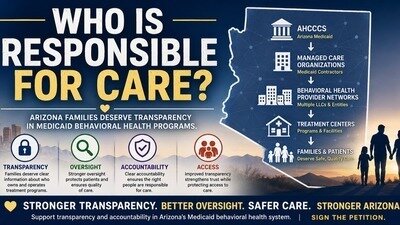
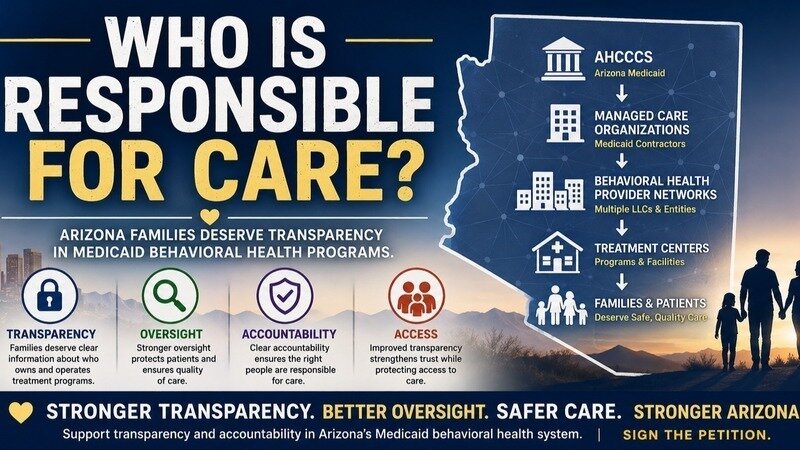
At the same time, many behavioral health programs operate through multiple LLCs, billing entities, and facility names, making it difficult for families, patients, and staff to understand who is ultimately responsible for care.
This petition is not about shutting down treatment programs.
This petition asks Arizona officials to require:
- Greater transparency in behavioral health ownership structures
- Clear disclosure of LLC relationships and parent companies
- Easier public access to accountability information
- Strong oversight while protecting access to care
Families deserve to know who is responsible for the care of vulnerable children and adults.
PETITION DESCRIPTION
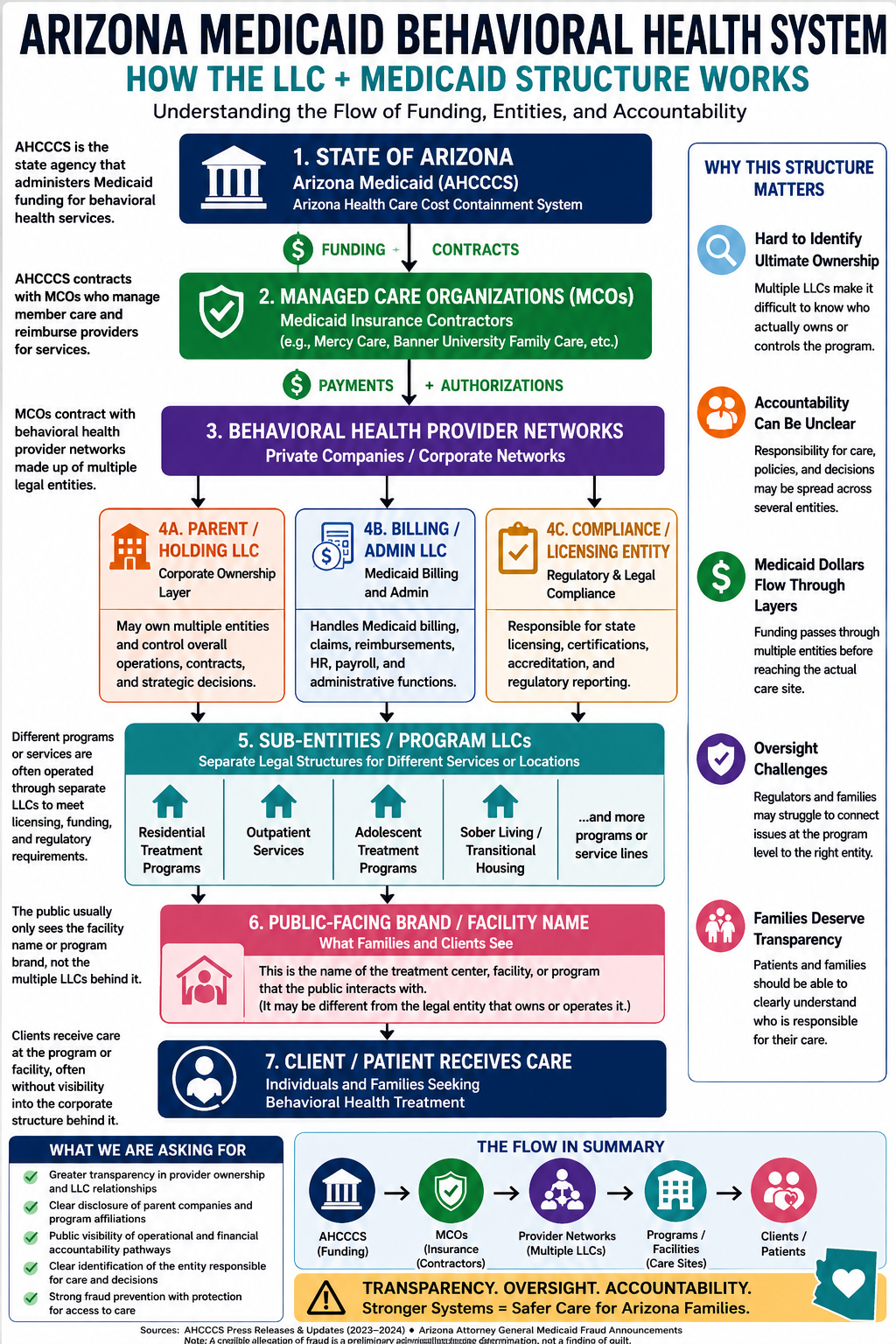
Arizona’s Medicaid behavioral health system (AHCCCS) relies heavily on privately operated treatment providers to deliver residential, outpatient, and adolescent behavioral health care. While this system is intended to expand access to treatment for vulnerable populations, it is structured through highly complex provider networks that often operate under multiple LLCs, program names, and billing entities.
Facilities such as Artemis Adolescent Healing Center, along with related entities operating under broader behavioral health networks including Progressing at Recovery LLC and Maiden Voyage LLC, reflect this structural model. These organizations frequently separate clinical programming, licensing structures, billing operations, and public facing branding across different legal entities under Arizona Medicaid contracting requirements.
While this multi entity structure may be legally permitted, it can make it difficult for patients, families, and staff to clearly understand:
- Who ultimately owns or governs a treatment program
- How clinical leadership connects to corporate or financial control
- Which entity is responsible for care decisions and accountability
- How Medicaid funding flows through layered organizational systems
- Where final authority and oversight actually resides within provider networks
Similar structural patterns appear across other Medicaid funded behavioral health providers in Arizona, including Emerald Isle Health & Recovery, where organizational structure, program branding, and licensing entities may not always be clearly aligned in publicly available records.
STATEWIDE MEDICAID FRAUD CONTEXT AND SYSTEM OVERSIGHT
Arizona has experienced significant statewide enforcement actions related to Medicaid behavioral health oversight in recent years. In 2023, the Arizona Health Care Cost Containment System (AHCCCS), in coordination with the Arizona Attorney General’s Office and federal partners, announced payment suspensions affecting more than 100 behavioral health providers.
These actions were issued under federal Medicaid rules governing “credible allegations of fraud (CAF)”, which require states to temporarily suspend payments when credible evidence of potential fraud is identified while investigations are ongoing.
Importantly, a credible allegation of fraud is a preliminary administrative determination and not a final finding of guilt or wrongdoing. Providers subject to these actions may remain under investigation by state and federal agencies, and outcomes can vary depending on final determinations.
Subsequent AHCCCS updates and enforcement reports indicate that additional suspensions and compliance actions have occurred as investigations expanded, reflecting ongoing efforts to address fraud risks, billing irregularities, and systemic vulnerabilities within portions of Arizona’s Medicaid behavioral health system.
At the same time, state officials have emphasized that these enforcement actions are part of broader reforms intended to strengthen program integrity, protect Medicaid members, and ensure continued access to behavioral health services during ongoing oversight activities.
SYSTEMIC STRUCTURE CONCERNS IN ARIZONA BEHAVIORAL HEALTH CARE
Across Arizona’s Medicaid funded behavioral health system, several structural patterns are commonly observed:
Layered organizational systems
- Providers often operate through:
- Parent LLCs (corporate and billing authority)
- Sub-LLCs (site licensing or legal employer entities)
- Program names (public-facing branding such as treatment centers)
- Accreditation listings (e.g., Joint Commission or state licensing frameworks)
This creates a system where clinical care delivery, billing operations, and legal governance may exist in separate organizational layers.
2. Separation of authority roles
Within many behavioral health provider systems:
- Clinical directors oversee treatment programs and care delivery
- Executive leadership manages facility operations
- Corporate entities control billing, contracts, and compliance
- Ownership or ultimate authority may not be clearly visible in public-facing documentation
This separation can create differences between perceived hierarchy in daily operations and formal corporate or legal structures.
3. Medicaid-driven structural complexity
Because Arizona behavioral health providers rely heavily on AHCCCS funding:
- Different services require different billing codes and licenses
- Providers often expand into multiple entities to meet regulatory categories
- Billing, compliance, and clinical operations are frequently distributed across separate structures
While this may be consistent with regulatory frameworks, it can make provider networks difficult to interpret from the perspective of patients, families, and staff.
4. Transparency and accountability concerns
Because of these layered structures:
- Organizational accountability can be difficult to trace
- Public-facing information may not clearly reflect internal governance
- Internal hierarchy may not align with licensing records or external documentation
- Families and patients may face challenges understanding who is responsible for care decisions
REQUEST FOR ACTION
We respectfully call on the Arizona Department of Health Services (ADHS) and AHCCCS to:
- Strengthen transparency requirements for behavioral health provider ownership structures
- Require clearer disclosure of parent companies, LLC relationships, and program affiliations
- Improve public visibility of operational and financial accountability pathways
- Ensure patients and families can clearly identify responsible entities for care delivery
- Maintain strong fraud prevention systems while protecting continuity of care and access to services
WHY THIS MATTERS
Individuals entering behavioral health treatment, especially adolescents and vulnerable populations, deserve clarity, safety, and accountability in the systems responsible for their care. Families should not have to navigate complex layers of corporate entities to understand who is making treatment decisions or how care systems are structured.
Improving transparency does not reduce access to care.
It strengthens:
- Trust
- Oversight
- Safety within Arizona’s Medicaid behavioral health system
APPENDIX A — TIMELINE (SYSTEM CONTEXT)
2023
- AHCCCS and Arizona state authorities announce major Medicaid behavioral health enforcement actions
- More than 100 providers are placed under payment suspension or review under “credible allegation of fraud” standards
- Statewide review begins into billing practices in residential and recovery-based behavioral health programs
2023–2024
- Continued Medicaid behavioral health reforms implemented
- Additional provider suspensions and compliance actions reported as investigations expand
- Increased public awareness of structural vulnerabilities in Arizona behavioral health billing systems
Ongoing (Present)
- AHCCCS continues oversight and fraud prevention efforts
- Behavioral health providers operate under increased compliance scrutiny
- Calls for improved transparency in ownership and provider structure continue across advocacy and policy discussions
SUMMARY OF PUBLICLY AVAILABLE RECORDS AND OBSERVED OPERATIONAL CONNECTIONS
The purpose of this summary is to document information identified through publicly available records and my personal observations during my employment. This summary is not intended to accuse any individual or entity of fraud, criminal conduct, regulatory violations, or other unlawful activity. It is not intended to make legal conclusions regarding ownership, control, liability, or wrongdoing. Readers are encouraged to review the underlying public records independently and draw their own conclusions.
PUBLIC RECORD FINDINGS
Maiden Voyage LLC and Artemis Adolescent Healing Center
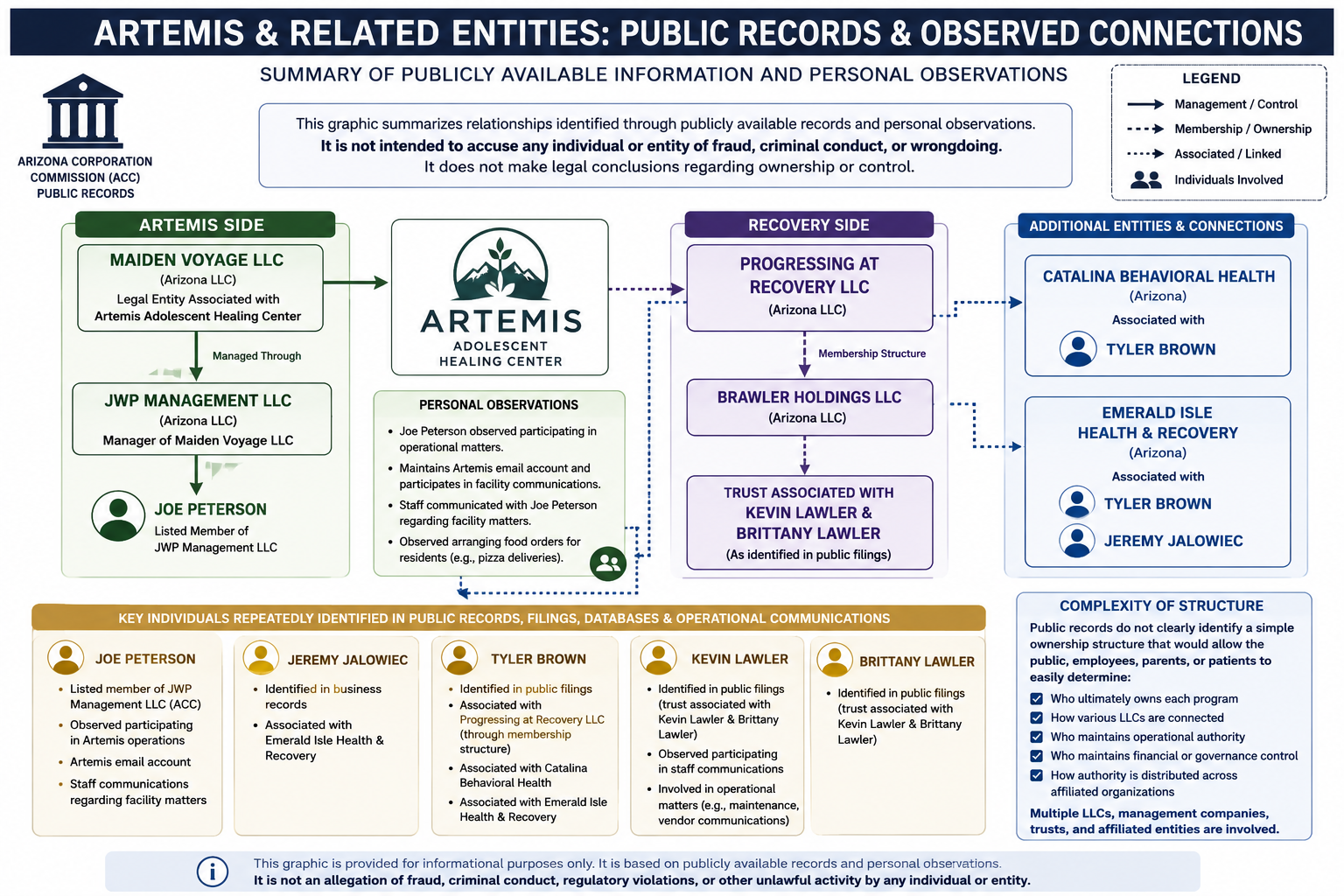
Public records identify Maiden Voyage LLC as the legal entity associated with Artemis Adolescent Healing Center.
Arizona Corporation Commission records reviewed indicate that Maiden Voyage LLC is managed through JWP Management LLC.
Arizona Corporation Commission records for JWP Management LLC identify Joe Peterson as the listed member of that company.
Progressing at Recovery LLC
Arizona Corporation Commission records identify Progressing at Recovery LLC as a separate Arizona limited liability company.
Public filings reviewed indicate that Progressing at Recovery LLC is associated with Brawler Holdings LLC through its membership structure.
Additional public filings reviewed identify Tyler Brown as a principal associated with entities connected to this organizational structure.
Public records also identify a trust associated with Kevin Lawler and Brittany Lawler in related business filings.
Additional Public Information
Additional business information reviewed identifies Tyler Brown as being associated with Catalina Behavioral Health and Emerald Isle Health & Recovery.
Additional business information reviewed identifies Jeremy Jalowiec as being associated with Emerald Isle Health & Recovery.
While third-party business databases should not be considered definitive proof of ownership, these records suggest organizational and operational relationships among individuals involved in multiple behavioral health organizations operating in Arizona.
The public records reviewed do not clearly identify a simple ownership structure that would allow an average member of the public, employee, parent, or patient to easily determine:
• Who ultimately owns each behavioral health program
• How various LLCs are connected
• Which individuals maintain operational authority
• Which entities maintain financial or governance control
• How authority is distributed across affiliated organizations
Instead, the records reflect multiple LLCs, management companies, trusts, and affiliated business entities.
PERSONAL OBSERVATIONS
During my employment at Artemis Adolescent Healing Center, I personally observed Joe Peterson participating in operational matters involving the facility.
Joe Peterson maintained an Artemis-associated email account and was included in communications involving facility operations. Staff members communicated with Joe Peterson regarding facility matters. I personally observed situations in which staff contacted Joe Peterson to arrange food orders for residents, including pizza deliveries. Joe Peterson was treated by staff as someone involved in operational decision-making and support functions for the facility.
I also personally observed Kevin Lawler participating in Artemis staff communications. Kevin Lawler was included in an Artemis group chat used for operational matters. In one communication, Kevin Lawler informed staff that a window company had arrived to provide a quote for unbreakable windows. These communications reflected involvement in facility operations and maintenance matters.
Based upon my observations, Kevin Lawler’s participation in facility communications extended beyond occasional contact and included involvement in operational matters affecting the facility.
Individuals whose names repeatedly appear throughout public records, business filings, organizational records, business databases, and operational communications include:
• Jeremy Jalowiec
• Joe Peterson
• Tyler Brown
• Kevin Lawler
• Brittany Lawler
This summary is intended solely to document publicly available information and personal observations. It should not be interpreted as an allegation of fraud, criminal conduct, regulatory violations, or unlawful activity by any individual or entity.

31
The Issue
FAMILIES AND PATIENTS DESERVE TRANSPARENCY AND ACCOUNTABILITY IN ARIZONA'S MEDICAID BEHAVIORAL HEALTH SYSTEM!!!
(And not just Medicaid! All insurances! I am only talking about Medicaid specifically in this petition because there is proof of statewide Medicaid fraud.)
BRIEF SUMMARY
Arizona has suspended more than 100 behavioral health providers in recent years as part of statewide Medicaid fraud investigations and oversight efforts.
At the same time, many behavioral health programs operate through multiple LLCs, billing entities, and facility names, making it difficult for families, patients, and staff to understand who is ultimately responsible for care.
This petition is not about shutting down treatment programs.
This petition asks Arizona officials to require:
- Greater transparency in behavioral health ownership structures
- Clear disclosure of LLC relationships and parent companies
- Easier public access to accountability information
- Strong oversight while protecting access to care
Families deserve to know who is responsible for the care of vulnerable children and adults.
PETITION DESCRIPTION
Arizona’s Medicaid behavioral health system (AHCCCS) relies heavily on privately operated treatment providers to deliver residential, outpatient, and adolescent behavioral health care. While this system is intended to expand access to treatment for vulnerable populations, it is structured through highly complex provider networks that often operate under multiple LLCs, program names, and billing entities.
Facilities such as Artemis Adolescent Healing Center, along with related entities operating under broader behavioral health networks including Progressing at Recovery LLC and Maiden Voyage LLC, reflect this structural model. These organizations frequently separate clinical programming, licensing structures, billing operations, and public facing branding across different legal entities under Arizona Medicaid contracting requirements.
While this multi entity structure may be legally permitted, it can make it difficult for patients, families, and staff to clearly understand:
- Who ultimately owns or governs a treatment program
- How clinical leadership connects to corporate or financial control
- Which entity is responsible for care decisions and accountability
- How Medicaid funding flows through layered organizational systems
- Where final authority and oversight actually resides within provider networks
Similar structural patterns appear across other Medicaid funded behavioral health providers in Arizona, including Emerald Isle Health & Recovery, where organizational structure, program branding, and licensing entities may not always be clearly aligned in publicly available records.
STATEWIDE MEDICAID FRAUD CONTEXT AND SYSTEM OVERSIGHT
Arizona has experienced significant statewide enforcement actions related to Medicaid behavioral health oversight in recent years. In 2023, the Arizona Health Care Cost Containment System (AHCCCS), in coordination with the Arizona Attorney General’s Office and federal partners, announced payment suspensions affecting more than 100 behavioral health providers.
These actions were issued under federal Medicaid rules governing “credible allegations of fraud (CAF)”, which require states to temporarily suspend payments when credible evidence of potential fraud is identified while investigations are ongoing.
Importantly, a credible allegation of fraud is a preliminary administrative determination and not a final finding of guilt or wrongdoing. Providers subject to these actions may remain under investigation by state and federal agencies, and outcomes can vary depending on final determinations.
Subsequent AHCCCS updates and enforcement reports indicate that additional suspensions and compliance actions have occurred as investigations expanded, reflecting ongoing efforts to address fraud risks, billing irregularities, and systemic vulnerabilities within portions of Arizona’s Medicaid behavioral health system.
At the same time, state officials have emphasized that these enforcement actions are part of broader reforms intended to strengthen program integrity, protect Medicaid members, and ensure continued access to behavioral health services during ongoing oversight activities.
SYSTEMIC STRUCTURE CONCERNS IN ARIZONA BEHAVIORAL HEALTH CARE
Across Arizona’s Medicaid funded behavioral health system, several structural patterns are commonly observed:
Layered organizational systems
- Providers often operate through:
- Parent LLCs (corporate and billing authority)
- Sub-LLCs (site licensing or legal employer entities)
- Program names (public-facing branding such as treatment centers)
- Accreditation listings (e.g., Joint Commission or state licensing frameworks)
This creates a system where clinical care delivery, billing operations, and legal governance may exist in separate organizational layers.
2. Separation of authority roles
Within many behavioral health provider systems:
- Clinical directors oversee treatment programs and care delivery
- Executive leadership manages facility operations
- Corporate entities control billing, contracts, and compliance
- Ownership or ultimate authority may not be clearly visible in public-facing documentation
This separation can create differences between perceived hierarchy in daily operations and formal corporate or legal structures.
3. Medicaid-driven structural complexity
Because Arizona behavioral health providers rely heavily on AHCCCS funding:
- Different services require different billing codes and licenses
- Providers often expand into multiple entities to meet regulatory categories
- Billing, compliance, and clinical operations are frequently distributed across separate structures
While this may be consistent with regulatory frameworks, it can make provider networks difficult to interpret from the perspective of patients, families, and staff.
4. Transparency and accountability concerns
Because of these layered structures:
- Organizational accountability can be difficult to trace
- Public-facing information may not clearly reflect internal governance
- Internal hierarchy may not align with licensing records or external documentation
- Families and patients may face challenges understanding who is responsible for care decisions
REQUEST FOR ACTION
We respectfully call on the Arizona Department of Health Services (ADHS) and AHCCCS to:
- Strengthen transparency requirements for behavioral health provider ownership structures
- Require clearer disclosure of parent companies, LLC relationships, and program affiliations
- Improve public visibility of operational and financial accountability pathways
- Ensure patients and families can clearly identify responsible entities for care delivery
- Maintain strong fraud prevention systems while protecting continuity of care and access to services
WHY THIS MATTERS
Individuals entering behavioral health treatment, especially adolescents and vulnerable populations, deserve clarity, safety, and accountability in the systems responsible for their care. Families should not have to navigate complex layers of corporate entities to understand who is making treatment decisions or how care systems are structured.
Improving transparency does not reduce access to care.
It strengthens:
- Trust
- Oversight
- Safety within Arizona’s Medicaid behavioral health system
APPENDIX A — TIMELINE (SYSTEM CONTEXT)
2023
- AHCCCS and Arizona state authorities announce major Medicaid behavioral health enforcement actions
- More than 100 providers are placed under payment suspension or review under “credible allegation of fraud” standards
- Statewide review begins into billing practices in residential and recovery-based behavioral health programs
2023–2024
- Continued Medicaid behavioral health reforms implemented
- Additional provider suspensions and compliance actions reported as investigations expand
- Increased public awareness of structural vulnerabilities in Arizona behavioral health billing systems
Ongoing (Present)
- AHCCCS continues oversight and fraud prevention efforts
- Behavioral health providers operate under increased compliance scrutiny
- Calls for improved transparency in ownership and provider structure continue across advocacy and policy discussions
SUMMARY OF PUBLICLY AVAILABLE RECORDS AND OBSERVED OPERATIONAL CONNECTIONS
The purpose of this summary is to document information identified through publicly available records and my personal observations during my employment. This summary is not intended to accuse any individual or entity of fraud, criminal conduct, regulatory violations, or other unlawful activity. It is not intended to make legal conclusions regarding ownership, control, liability, or wrongdoing. Readers are encouraged to review the underlying public records independently and draw their own conclusions.
PUBLIC RECORD FINDINGS
Maiden Voyage LLC and Artemis Adolescent Healing Center
Public records identify Maiden Voyage LLC as the legal entity associated with Artemis Adolescent Healing Center.
Arizona Corporation Commission records reviewed indicate that Maiden Voyage LLC is managed through JWP Management LLC.
Arizona Corporation Commission records for JWP Management LLC identify Joe Peterson as the listed member of that company.
Progressing at Recovery LLC
Arizona Corporation Commission records identify Progressing at Recovery LLC as a separate Arizona limited liability company.
Public filings reviewed indicate that Progressing at Recovery LLC is associated with Brawler Holdings LLC through its membership structure.
Additional public filings reviewed identify Tyler Brown as a principal associated with entities connected to this organizational structure.
Public records also identify a trust associated with Kevin Lawler and Brittany Lawler in related business filings.
Additional Public Information
Additional business information reviewed identifies Tyler Brown as being associated with Catalina Behavioral Health and Emerald Isle Health & Recovery.
Additional business information reviewed identifies Jeremy Jalowiec as being associated with Emerald Isle Health & Recovery.
While third-party business databases should not be considered definitive proof of ownership, these records suggest organizational and operational relationships among individuals involved in multiple behavioral health organizations operating in Arizona.
The public records reviewed do not clearly identify a simple ownership structure that would allow an average member of the public, employee, parent, or patient to easily determine:
• Who ultimately owns each behavioral health program
• How various LLCs are connected
• Which individuals maintain operational authority
• Which entities maintain financial or governance control
• How authority is distributed across affiliated organizations
Instead, the records reflect multiple LLCs, management companies, trusts, and affiliated business entities.
PERSONAL OBSERVATIONS
During my employment at Artemis Adolescent Healing Center, I personally observed Joe Peterson participating in operational matters involving the facility.
Joe Peterson maintained an Artemis-associated email account and was included in communications involving facility operations. Staff members communicated with Joe Peterson regarding facility matters. I personally observed situations in which staff contacted Joe Peterson to arrange food orders for residents, including pizza deliveries. Joe Peterson was treated by staff as someone involved in operational decision-making and support functions for the facility.
I also personally observed Kevin Lawler participating in Artemis staff communications. Kevin Lawler was included in an Artemis group chat used for operational matters. In one communication, Kevin Lawler informed staff that a window company had arrived to provide a quote for unbreakable windows. These communications reflected involvement in facility operations and maintenance matters.
Based upon my observations, Kevin Lawler’s participation in facility communications extended beyond occasional contact and included involvement in operational matters affecting the facility.
Individuals whose names repeatedly appear throughout public records, business filings, organizational records, business databases, and operational communications include:
• Jeremy Jalowiec
• Joe Peterson
• Tyler Brown
• Kevin Lawler
• Brittany Lawler
This summary is intended solely to document publicly available information and personal observations. It should not be interpreted as an allegation of fraud, criminal conduct, regulatory violations, or unlawful activity by any individual or entity.
31
The Decision Makers


Petition Updates
Share this petition
Petition created on May 31, 2026