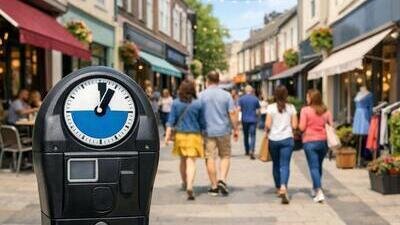
Implement minimum 60 minutes free parking in Croydon shopping areas
The Issue
The Hidden Cost of a Quick Errand "Croydon Means Business?"
Imagine this. You are a resident of Croydon, and you decide to pop into the local high street on a Saturday morning.
You need to pick up a birthday card, grab a bag of onions from the greengrocer, and maybe treat yourself to a pastry from that new bakery you have been meaning to try. You find a parking spot, feeling a small victory.
Then you see the tariff board. £2.50+ for just 30 minutes. Suddenly, that pleasant morning errand feels like a high-stakes race against the clock.
You rush into the card shop, skip the queue for the bakery because you do not have time, and forget the onions entirely. You drive home with a card, no pastry, and £2.50+ taken from your account for the privilege of parking for 25 minutes.
This is the hidden cost of a quick errand in Croydon. It is not just the money; it is the stress.
It is the psychological barrier that turns a leisurely browse into a frantic dash. When parking charges are that high for such a short window, the council is actively telling you that your visit is not welcome unless you are willing to pay a premium.
The problem is clear. A charge of £2.50+ for half an hour does not just cover the council's costs. It acts as a tollbooth on the local economy.
It discourages the very thing that makes a high street thrive: spontaneous, relaxed spending. When you are watching the clock, you do not stop for an impulse buy.
You do not sit down for a coffee and a chat. You do not decide to grab lunch because you saw a nice menu in the window.
You just get in and get out. This dynamic hits local businesses hard.
They lose out on those incremental sales that make up a healthy trading day. The bakery loses a customer because the queue is too long.
The greengrocer loses a sale because you had to rush. The result is a high street that feels transactional rather than communal.
And this leads to a bigger problem, which is that Croydon's shopping streets are slowly losing the spark that makes them special.
Why Croydon's High Streets Are Losing Their Spark
You rush into the card shop, grab the first acceptable birthday card you see, and skip the greengrocer entirely because you do not have time to queue. The bakery gets a miss too, because the thought of spending £2.50+ on parking just for a pastry feels absurd. This is the reality for too many shoppers in Croydon.
The high parking charges do not just create inconvenience. They actively reshape behaviour.
When people feel rushed, they make different choices. They prioritise speed over quality.
They choose the supermarket with the free car park over the independent butcher. They click "add to basket" on Amazon instead of driving to the high street, because delivery is free and there is no meter running in their head.
The result is a slow bleed. Out-of-town retail parks, with their acres of free parking, become the default destination.
They offer convenience, predictability, and no anxiety about returning to a ticket on your windscreen. But here is the real loss.
It is not just about the money that leaves Croydon's local tills. It is about what disappears from the borough's character.
Think about the shops that make Croydon feel like Croydon. The family-run fabric shop where the owner remembers your name.
The Caribbean takeaway with recipes passed down through generations. The little record store where you can spend an hour flipping through vinyl.
These businesses operate on thin margins. They cannot afford to lose even a handful of customers each week because those customers got priced out of a parking space.
When they close, they are rarely replaced by something equally unique. More often, it is another chain, another vape shop, or another boarded-up frontage.
The diversity of Croydon's high streets is not an accident. It is a product of people having the time and the incentive to explore.
When parking costs force every visit to be a quick dash, that exploration stops. The culture of browsing, of discovering something unexpected, of stopping for a chat with a shopkeeper, it all erodes.
This is how a vibrant shopping street becomes a ghost strip. One missed customer at a time, one rushed errand at a time, one closed shop at a time.
The knock-on effect is not just economic. It is cultural.
And it is happening right now, across Croydon.
The Financial Squeeze on Shoppers and Shopkeepers Alike
Let's put a real number on it. A parent taking two children into Croydon for a lunchtime treat and a bit of browsing can easily spend £5 to £10 on parking alone.
That is not an exaggeration. That £5 or £10 is money they were planning to spend on a sandwich, a coffee, or a new book for the kids.
Instead, it goes straight into a council machine. This creates a perverse dynamic where the act of visiting the high street feels like a financial loss before you have even bought anything.
The psychological barrier is significant. Once you have paid that fee, the clock is ticking in your head.
You are not relaxed. You are not browsing.
You are calculating. “If I stay another hour, that is another £5+ Is that new candle really worth it?
” This kind of mental arithmetic kills spontaneous spending, the very thing that makes a shopping district profitable. A family that feels rushed will skip the dessert.
They will skip the window shopping that leads to an unplanned purchase. They will skip the gift shop entirely because the kids are getting restless and the parking meter is about to expire.
The local businesses lose not just the parking fee, but the entire economic value of that visit. Think about the difference between a ten-minute dash and a ninety-minute experience.
In ten minutes, you might buy a loaf of bread. In ninety minutes, you have lunch at a café, you buy the bread, you pick up a bottle of wine from the off-licence, and you stop for a coffee on the way back to the car.
That is the difference between a £3 transaction and a £30 transaction. The current parking system actively prevents that second scenario from happening.
It is a tax on the very behaviour Croydon needs to encourage. This financial squeeze does not just hurt the family’s wallet.
It starves the local economy of the longer dwell times and higher transaction values it desperately needs to survive.
A Simple Solution: 60 Minutes of Free Parking
Here is section 4, written to flow naturally from the financial squeeze described in section 3. The solution is staring us in the face, and it is remarkably simple.
We need a minimum of 60 minutes of free parking across all of Croydon’s shopping streets. Not just a few parades here and there.
Not a complex voucher scheme that requires a smartphone app to validate. A straightforward, universal policy: one hour, free, for everyone.
Why sixty minutes specifically? Because that is the golden window for a proper high street visit.
Think about what you can accomplish in sixty minutes. You can walk into the butcher’s, have a brief chat about the weekend joint, and pick it up.
You can wander into the independent bookshop and browse the new releases without your heart rate climbing. You can sit down for a proper coffee, not just a takeaway cup you gulp down on the pavement.
You can even queue for a minute or two without feeling like you are burning cash. Thirty minutes, by contrast, is a trap.
It forces you to become a speed shopper. You cannot browse.
You cannot make impulse purchases. You certainly cannot stop to talk to a shopkeeper about their products, which is precisely the kind of interaction that builds loyalty and keeps people coming back.
With a full hour of free parking, the psychology shifts completely. The mental timer stops ticking.
You arrive feeling like a welcome guest, not a trespasser who needs to pay for the privilege of spending money. That small change in mindset can transform a rushed chore into a relaxed experience.
This policy would apply to every single shopping street in the borough. From the bustling centre of South Croydon to the quieter parades in Upper Norwood and Coulsdon.
Every local business deserves the same chance to attract customers without the barrier of a parking fee. When we limit free parking to a few token spots, we send a message that only certain parts of Croydon are worth visiting.
That is not good enough. We need a blanket policy that says the entire borough is open for business.
The evidence from other areas, which we will explore next, shows that this simple change does not just make shoppers feel better. It actually rebuilds the local economy from the ground up.
Evidence That Free Parking Boosts Local Economies
You do not have to take this on blind faith. The evidence that free parking boosts local economies is not theoretical.
It is already playing out in towns and cities across the country, and the results are hard to argue with. Look at what happened in Uxbridge.
When the local council introduced free parking for the first hour, foot traffic increased by 15 percent within the first year. Businesses reported a noticeable lift in sales, particularly for independent cafes and shops that rely on impulse visits.
The scheme did not just help shoppers. It helped the people behind the counters too.
Then there is the example of Sutton. They piloted a similar policy on their high street, and the data was clear.
Average dwell times increased from 45 minutes to nearly 90 minutes. That extra half hour matters enormously.
It is the difference between someone grabbing a sandwich and running back to the car, versus sitting down for lunch, browsing the bookshop next door, and buying a candle they did not plan to purchase. The pattern repeats in Bromley, where shorter paid parking periods were scrapped in favour of longer free windows.
Local trade associations reported a direct correlation between the policy change and rising revenues for small businesses. When people stay longer, they spend more.
It is that simple. Some might argue that these are just anecdotes.
But the underlying economics support them. Parking charges create a psychological stopwatch in the shopper’s mind.
When that stopwatch is removed, people relax. They browse.
They make unplanned purchases. And those unplanned purchases are often the highest margin items for small retailers.
The lesson for Croydon is clear. We do not need to reinvent the wheel.
Our neighbours have already shown us what works. The question is whether we are willing to follow their lead.
This evidence sets the stage for a bigger vision. Because free parking is not just about avoiding a fee.
It is about transforming how people experience Croydon’s streets.
Making Croydon a Destination, Not a Drive-Through
Picture Croydon on a sunny Saturday afternoon. The streets are busy, but not with the frantic energy of people rushing back to their cars.
Instead, you see someone sitting outside a cafe with a proper coffee, reading a book. A couple wanders from the vintage shop to the cheese monger, comparing finds.
Kids are actually eating ice cream on a bench, not being dragged by the hand toward a ticking meter. This is the vision.
This is what happens when you remove the clock from the shopping experience. Free parking for 60 minutes transforms a high street from a place you pass through into a place you actually want to be.
It changes the psychology of the visit entirely. Instead of asking “how quickly can I get out of here?
” shoppers start asking “what else is around here that I might enjoy?” That shift is everything for Croydon’s unique character.
Our borough has something that the big retail parks will never replicate. We have independent bookshops with curated selections.
We have family-run restaurants serving food you cannot find anywhere else. We have bakeries, galleries, and specialist stores that give Croydon its identity.
These places do not survive on drive-through trade. They survive on people who linger, browse, and discover.
They need the kind of customer who walks past a shop window, stops, turns around, and goes inside on a whim. That spontaneous decision does not happen when you are watching the clock.
When parking is free for an hour, you free people to explore. You give them permission to wander into a side street they have never noticed before.
You allow them to say yes to that impulse purchase or that second coffee with a friend. This is how community ties strengthen.
Not through council leaflets or regeneration schemes, but through repeated, unhurried interactions on the pavement outside local businesses. When people feel welcome to stay, they start to belong.
Making Croydon a destination rather than a drive-through is not just about economics. It is about preserving the soul of our shopping streets before they become just another row of shuttered windows and charity shops.
Overcoming the Objections: Revenue and Enforcement
Let’s address the elephant in the room. The council will argue that parking charges are a vital source of revenue, and that giving away an hour for free would punch a hole in the budget.
They are not wrong to worry about the bottom line. Local authorities are under immense financial pressure, and every penny from those parking meters is accounted for somewhere.
But this argument assumes that the current system is the most profitable one, and that is a dangerous assumption. The money lost from parking fees is not disappearing.
It is being reinvested into the local economy in a far more effective way. When a shopper saves £2.50+ on parking, they spend that £2.50 in a local shop, which then pays business rates, VAT, and employs local staff.
Those thriving businesses generate higher overall tax receipts for the council than a parking meter ever could. The net gain to the public purse is almost certainly positive.
Then there is the enforcement challenge. The council might say that managing free parking zones is too complicated, that it invites abuse from commuters or all-day parkers.
But this is a solved problem. Other towns have implemented simple, low-cost models.
A one-hour maximum stay with a simple disc system or a number plate recognition camera at the entrance and exit works perfectly well. You do not need a team of traffic wardens on every corner.
You just need a clear rule and a fair penalty for those who break it. The complexity argument is a red herring.
The real complexity is in the current system of confusing zones, app-based payments, and absurdly short time limits that punish honest shoppers. By shifting the focus from parking revenue to business rates and local tax receipts, the council can actually increase its income while doing something genuinely popular.
That is not a compromise. That is good governance.
A Call to Action for Croydon's Future
This brings us to the moment of decision. We have laid out the problem, the solution, the evidence, and the vision.
Now it is up to us to make it happen. This is not a policy change that will arrive by accident.
It requires pressure, persistence, and a unified voice from the people who actually use Croydon’s shopping streets. To the local councillors reading this: we understand your budget constraints.
We know you have hard choices to make. But ask yourself this question.
Is the revenue from those first 30 minutes of parking worth the slow decline of your high streets? Is it worth watching another independent bookshop close, another greengrocer give up, another cafe shutter its windows?
Because that is the trajectory we are on. You can choose a different path.
To the business owners: you have the most to gain and the most to lose. Organise yourselves.
Speak to your neighbours, your trade associations, your local Chamber of Commerce. Present a united front to the council.
Show them the data from Uxbridge and other towns that have made this change work. Show them your empty seats at lunchtime and ask them to help fill them.
To the residents: your voice matters more than you think. Write to your local councillor.
Sign petitions. Talk to your neighbours about why you choose the retail park over the high street.
Make it clear that affordable parking is not a luxury. It is a basic requirement for a functioning local economy.
The choice before Croydon is stark. We can cling to the short-term income from parking meters, watching our high streets hollow out year after year.
Or we can take a bold step. We can invest in the long-term cultural and economic vitality of this borough by making it easy, affordable, and enjoyable for people to visit, linger, and spend.
Sixty minutes of free parking will not solve every problem Croydon faces. But it is a start.
It is a signal that we value our local businesses. It is a declaration that we want our high streets to be places of community, not just transit corridors.
The future of Croydon’s shopping streets is not yet written. Let’s pick up the pen and write it together.
49
The Issue
The Hidden Cost of a Quick Errand "Croydon Means Business?"
Imagine this. You are a resident of Croydon, and you decide to pop into the local high street on a Saturday morning.
You need to pick up a birthday card, grab a bag of onions from the greengrocer, and maybe treat yourself to a pastry from that new bakery you have been meaning to try. You find a parking spot, feeling a small victory.
Then you see the tariff board. £2.50+ for just 30 minutes. Suddenly, that pleasant morning errand feels like a high-stakes race against the clock.
You rush into the card shop, skip the queue for the bakery because you do not have time, and forget the onions entirely. You drive home with a card, no pastry, and £2.50+ taken from your account for the privilege of parking for 25 minutes.
This is the hidden cost of a quick errand in Croydon. It is not just the money; it is the stress.
It is the psychological barrier that turns a leisurely browse into a frantic dash. When parking charges are that high for such a short window, the council is actively telling you that your visit is not welcome unless you are willing to pay a premium.
The problem is clear. A charge of £2.50+ for half an hour does not just cover the council's costs. It acts as a tollbooth on the local economy.
It discourages the very thing that makes a high street thrive: spontaneous, relaxed spending. When you are watching the clock, you do not stop for an impulse buy.
You do not sit down for a coffee and a chat. You do not decide to grab lunch because you saw a nice menu in the window.
You just get in and get out. This dynamic hits local businesses hard.
They lose out on those incremental sales that make up a healthy trading day. The bakery loses a customer because the queue is too long.
The greengrocer loses a sale because you had to rush. The result is a high street that feels transactional rather than communal.
And this leads to a bigger problem, which is that Croydon's shopping streets are slowly losing the spark that makes them special.
Why Croydon's High Streets Are Losing Their Spark
You rush into the card shop, grab the first acceptable birthday card you see, and skip the greengrocer entirely because you do not have time to queue. The bakery gets a miss too, because the thought of spending £2.50+ on parking just for a pastry feels absurd. This is the reality for too many shoppers in Croydon.
The high parking charges do not just create inconvenience. They actively reshape behaviour.
When people feel rushed, they make different choices. They prioritise speed over quality.
They choose the supermarket with the free car park over the independent butcher. They click "add to basket" on Amazon instead of driving to the high street, because delivery is free and there is no meter running in their head.
The result is a slow bleed. Out-of-town retail parks, with their acres of free parking, become the default destination.
They offer convenience, predictability, and no anxiety about returning to a ticket on your windscreen. But here is the real loss.
It is not just about the money that leaves Croydon's local tills. It is about what disappears from the borough's character.
Think about the shops that make Croydon feel like Croydon. The family-run fabric shop where the owner remembers your name.
The Caribbean takeaway with recipes passed down through generations. The little record store where you can spend an hour flipping through vinyl.
These businesses operate on thin margins. They cannot afford to lose even a handful of customers each week because those customers got priced out of a parking space.
When they close, they are rarely replaced by something equally unique. More often, it is another chain, another vape shop, or another boarded-up frontage.
The diversity of Croydon's high streets is not an accident. It is a product of people having the time and the incentive to explore.
When parking costs force every visit to be a quick dash, that exploration stops. The culture of browsing, of discovering something unexpected, of stopping for a chat with a shopkeeper, it all erodes.
This is how a vibrant shopping street becomes a ghost strip. One missed customer at a time, one rushed errand at a time, one closed shop at a time.
The knock-on effect is not just economic. It is cultural.
And it is happening right now, across Croydon.
The Financial Squeeze on Shoppers and Shopkeepers Alike
Let's put a real number on it. A parent taking two children into Croydon for a lunchtime treat and a bit of browsing can easily spend £5 to £10 on parking alone.
That is not an exaggeration. That £5 or £10 is money they were planning to spend on a sandwich, a coffee, or a new book for the kids.
Instead, it goes straight into a council machine. This creates a perverse dynamic where the act of visiting the high street feels like a financial loss before you have even bought anything.
The psychological barrier is significant. Once you have paid that fee, the clock is ticking in your head.
You are not relaxed. You are not browsing.
You are calculating. “If I stay another hour, that is another £5+ Is that new candle really worth it?
” This kind of mental arithmetic kills spontaneous spending, the very thing that makes a shopping district profitable. A family that feels rushed will skip the dessert.
They will skip the window shopping that leads to an unplanned purchase. They will skip the gift shop entirely because the kids are getting restless and the parking meter is about to expire.
The local businesses lose not just the parking fee, but the entire economic value of that visit. Think about the difference between a ten-minute dash and a ninety-minute experience.
In ten minutes, you might buy a loaf of bread. In ninety minutes, you have lunch at a café, you buy the bread, you pick up a bottle of wine from the off-licence, and you stop for a coffee on the way back to the car.
That is the difference between a £3 transaction and a £30 transaction. The current parking system actively prevents that second scenario from happening.
It is a tax on the very behaviour Croydon needs to encourage. This financial squeeze does not just hurt the family’s wallet.
It starves the local economy of the longer dwell times and higher transaction values it desperately needs to survive.
A Simple Solution: 60 Minutes of Free Parking
Here is section 4, written to flow naturally from the financial squeeze described in section 3. The solution is staring us in the face, and it is remarkably simple.
We need a minimum of 60 minutes of free parking across all of Croydon’s shopping streets. Not just a few parades here and there.
Not a complex voucher scheme that requires a smartphone app to validate. A straightforward, universal policy: one hour, free, for everyone.
Why sixty minutes specifically? Because that is the golden window for a proper high street visit.
Think about what you can accomplish in sixty minutes. You can walk into the butcher’s, have a brief chat about the weekend joint, and pick it up.
You can wander into the independent bookshop and browse the new releases without your heart rate climbing. You can sit down for a proper coffee, not just a takeaway cup you gulp down on the pavement.
You can even queue for a minute or two without feeling like you are burning cash. Thirty minutes, by contrast, is a trap.
It forces you to become a speed shopper. You cannot browse.
You cannot make impulse purchases. You certainly cannot stop to talk to a shopkeeper about their products, which is precisely the kind of interaction that builds loyalty and keeps people coming back.
With a full hour of free parking, the psychology shifts completely. The mental timer stops ticking.
You arrive feeling like a welcome guest, not a trespasser who needs to pay for the privilege of spending money. That small change in mindset can transform a rushed chore into a relaxed experience.
This policy would apply to every single shopping street in the borough. From the bustling centre of South Croydon to the quieter parades in Upper Norwood and Coulsdon.
Every local business deserves the same chance to attract customers without the barrier of a parking fee. When we limit free parking to a few token spots, we send a message that only certain parts of Croydon are worth visiting.
That is not good enough. We need a blanket policy that says the entire borough is open for business.
The evidence from other areas, which we will explore next, shows that this simple change does not just make shoppers feel better. It actually rebuilds the local economy from the ground up.
Evidence That Free Parking Boosts Local Economies
You do not have to take this on blind faith. The evidence that free parking boosts local economies is not theoretical.
It is already playing out in towns and cities across the country, and the results are hard to argue with. Look at what happened in Uxbridge.
When the local council introduced free parking for the first hour, foot traffic increased by 15 percent within the first year. Businesses reported a noticeable lift in sales, particularly for independent cafes and shops that rely on impulse visits.
The scheme did not just help shoppers. It helped the people behind the counters too.
Then there is the example of Sutton. They piloted a similar policy on their high street, and the data was clear.
Average dwell times increased from 45 minutes to nearly 90 minutes. That extra half hour matters enormously.
It is the difference between someone grabbing a sandwich and running back to the car, versus sitting down for lunch, browsing the bookshop next door, and buying a candle they did not plan to purchase. The pattern repeats in Bromley, where shorter paid parking periods were scrapped in favour of longer free windows.
Local trade associations reported a direct correlation between the policy change and rising revenues for small businesses. When people stay longer, they spend more.
It is that simple. Some might argue that these are just anecdotes.
But the underlying economics support them. Parking charges create a psychological stopwatch in the shopper’s mind.
When that stopwatch is removed, people relax. They browse.
They make unplanned purchases. And those unplanned purchases are often the highest margin items for small retailers.
The lesson for Croydon is clear. We do not need to reinvent the wheel.
Our neighbours have already shown us what works. The question is whether we are willing to follow their lead.
This evidence sets the stage for a bigger vision. Because free parking is not just about avoiding a fee.
It is about transforming how people experience Croydon’s streets.
Making Croydon a Destination, Not a Drive-Through
Picture Croydon on a sunny Saturday afternoon. The streets are busy, but not with the frantic energy of people rushing back to their cars.
Instead, you see someone sitting outside a cafe with a proper coffee, reading a book. A couple wanders from the vintage shop to the cheese monger, comparing finds.
Kids are actually eating ice cream on a bench, not being dragged by the hand toward a ticking meter. This is the vision.
This is what happens when you remove the clock from the shopping experience. Free parking for 60 minutes transforms a high street from a place you pass through into a place you actually want to be.
It changes the psychology of the visit entirely. Instead of asking “how quickly can I get out of here?
” shoppers start asking “what else is around here that I might enjoy?” That shift is everything for Croydon’s unique character.
Our borough has something that the big retail parks will never replicate. We have independent bookshops with curated selections.
We have family-run restaurants serving food you cannot find anywhere else. We have bakeries, galleries, and specialist stores that give Croydon its identity.
These places do not survive on drive-through trade. They survive on people who linger, browse, and discover.
They need the kind of customer who walks past a shop window, stops, turns around, and goes inside on a whim. That spontaneous decision does not happen when you are watching the clock.
When parking is free for an hour, you free people to explore. You give them permission to wander into a side street they have never noticed before.
You allow them to say yes to that impulse purchase or that second coffee with a friend. This is how community ties strengthen.
Not through council leaflets or regeneration schemes, but through repeated, unhurried interactions on the pavement outside local businesses. When people feel welcome to stay, they start to belong.
Making Croydon a destination rather than a drive-through is not just about economics. It is about preserving the soul of our shopping streets before they become just another row of shuttered windows and charity shops.
Overcoming the Objections: Revenue and Enforcement
Let’s address the elephant in the room. The council will argue that parking charges are a vital source of revenue, and that giving away an hour for free would punch a hole in the budget.
They are not wrong to worry about the bottom line. Local authorities are under immense financial pressure, and every penny from those parking meters is accounted for somewhere.
But this argument assumes that the current system is the most profitable one, and that is a dangerous assumption. The money lost from parking fees is not disappearing.
It is being reinvested into the local economy in a far more effective way. When a shopper saves £2.50+ on parking, they spend that £2.50 in a local shop, which then pays business rates, VAT, and employs local staff.
Those thriving businesses generate higher overall tax receipts for the council than a parking meter ever could. The net gain to the public purse is almost certainly positive.
Then there is the enforcement challenge. The council might say that managing free parking zones is too complicated, that it invites abuse from commuters or all-day parkers.
But this is a solved problem. Other towns have implemented simple, low-cost models.
A one-hour maximum stay with a simple disc system or a number plate recognition camera at the entrance and exit works perfectly well. You do not need a team of traffic wardens on every corner.
You just need a clear rule and a fair penalty for those who break it. The complexity argument is a red herring.
The real complexity is in the current system of confusing zones, app-based payments, and absurdly short time limits that punish honest shoppers. By shifting the focus from parking revenue to business rates and local tax receipts, the council can actually increase its income while doing something genuinely popular.
That is not a compromise. That is good governance.
A Call to Action for Croydon's Future
This brings us to the moment of decision. We have laid out the problem, the solution, the evidence, and the vision.
Now it is up to us to make it happen. This is not a policy change that will arrive by accident.
It requires pressure, persistence, and a unified voice from the people who actually use Croydon’s shopping streets. To the local councillors reading this: we understand your budget constraints.
We know you have hard choices to make. But ask yourself this question.
Is the revenue from those first 30 minutes of parking worth the slow decline of your high streets? Is it worth watching another independent bookshop close, another greengrocer give up, another cafe shutter its windows?
Because that is the trajectory we are on. You can choose a different path.
To the business owners: you have the most to gain and the most to lose. Organise yourselves.
Speak to your neighbours, your trade associations, your local Chamber of Commerce. Present a united front to the council.
Show them the data from Uxbridge and other towns that have made this change work. Show them your empty seats at lunchtime and ask them to help fill them.
To the residents: your voice matters more than you think. Write to your local councillor.
Sign petitions. Talk to your neighbours about why you choose the retail park over the high street.
Make it clear that affordable parking is not a luxury. It is a basic requirement for a functioning local economy.
The choice before Croydon is stark. We can cling to the short-term income from parking meters, watching our high streets hollow out year after year.
Or we can take a bold step. We can invest in the long-term cultural and economic vitality of this borough by making it easy, affordable, and enjoyable for people to visit, linger, and spend.
Sixty minutes of free parking will not solve every problem Croydon faces. But it is a start.
It is a signal that we value our local businesses. It is a declaration that we want our high streets to be places of community, not just transit corridors.
The future of Croydon’s shopping streets is not yet written. Let’s pick up the pen and write it together.
The Decision Makers

Petition Updates
Share this petition
Petition created on 28 May 2026