

Immediate Competitive Ban of HADI CHOOPAN Under International Sport Ethics Standards
The Issue
" Immediate Competitive Ban of HADI CHOOPAN Under International Sport Ethics Standards"
A. Introduction
This petition is respectfully submitted to international bodybuilding governing bodies, event organizers, promoters, and affiliated sponsors operating across North America and Europe. It seeks immediate institutional action to safeguard the ethical neutrality and global integrity of international sport.
The petition arises from widespread public controversy surrounding imagery publicly associated with "Mr. Hadi Choopan" that many observers interpreted as symbolic endorsement of the leadership of the Islamic Republic of Iran during an ongoing and highly documented human-rights crisis. The concern is not rooted in nationality or ethnicity; rather, it concerns the responsibility of global sporting institutions when a world-recognized champion becomes publicly connected with political symbolism tied to a government currently subject to extensive international condemnation.
International sport does not exist outside society. Athletes elevated to world-champion status inevitably become representatives of the values embodied by the competitions that promote them. When conduct or symbolism creates a reasonable perception that international sport is serving as a vehicle for political legitimacy during a period of alleged repression and violence, governing bodies must act to preserve neutrality, credibility, and public trust.
B. Global Human-Rights Context
Recent years have witnessed escalating international concern regarding the situation in Iran. United Nations mechanisms, human-rights organizations, and numerous democratic governments have reported large-scale suppression of protests, lethal force against civilians, arbitrary detentions, and systemic restrictions on freedoms. For millions of Iranians worldwide particularly members of the diaspora residing in Europe, Canada, and the United States symbols connected with Iranian state leadership are inseparable from deeply personal experiences of loss, persecution, or displacement. In this context, the public appearance of such symbolism through an internationally celebrated athlete carries consequences far beyond individual expression.
The issue before sporting bodies is therefore not ideological disagreement; it is whether global competitions should risk appearing indifferent to suffering widely recognized by international institutions.
C. The Incident and Resulting Public Controversy
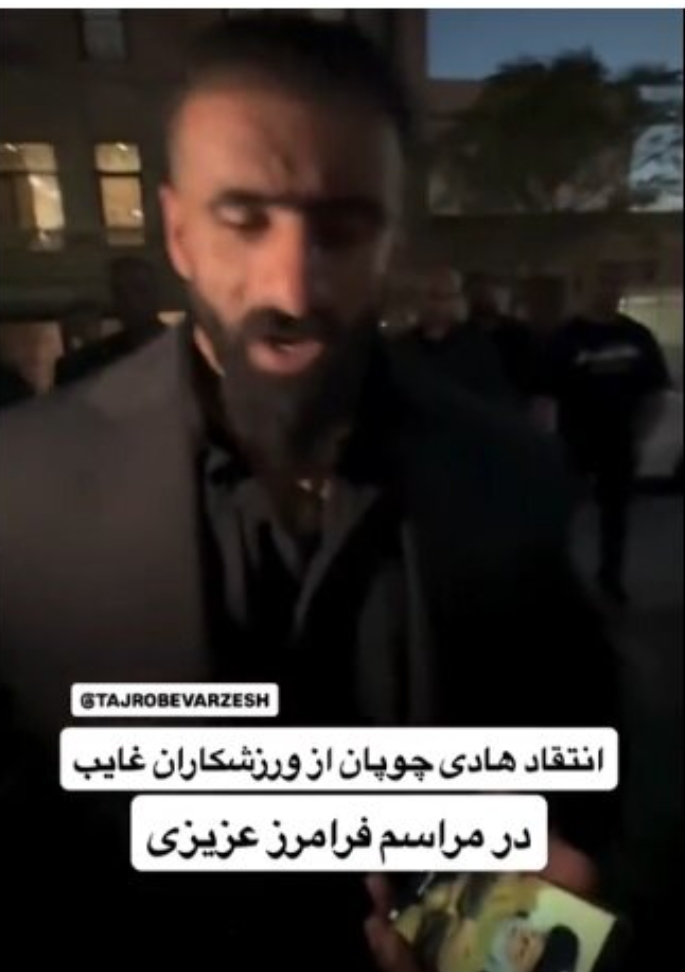
Widely circulated footage and images across bodybuilding media communities show Mr. Choopan’s mobile phone lock screen appearing to display an image of Iran’s Supreme Leader. The visibility of this image during a public interview triggered immediate and significant backlash among fans and observers worldwide.
The controversy rapidly expanded beyond bodybuilding circles into broader diaspora discussion, where many interpreted the imagery as an implicit endorsement of political authority during an active human-rights crisis. Public responses attributed to Mr. Choopan acknowledged the scale of reaction, demonstrating that the incident was neither isolated nor insignificant.
Whether intentional or not, the result was the same: a global sporting champion became publicly associated with politically charged symbolism connected to a government under active international scrutiny.
D.Ethical Responsibility of International Sporting Institutions
Modern sport organizations are not merely event coordinators; they are multinational commercial and cultural actors operating across legal systems. Their legitimacy depends on public confidence that competitions remain neutral spaces unconnected to state propaganda or political endorsement.
When controversy reaches a level capable of alienating audiences, provoking protest, or damaging sponsor confidence, governing bodies possess both the authority and obligation to intervene through ethics review mechanisms.
Failure to act does not preserve neutrality; it signals institutional tolerance of reputational risk and undermines claims that sport promotes universal values.
E. Legal and Regulatory Frameworks Supporting Institutional Action
1.United States
Where competitions, sponsorships, or commercial operations occur within the United States, organizations operate in a legal culture that strongly emphasizes accountability concerning human-rights issues. U.S. policy instruments addressing serious international abuses demonstrate that associations perceived as legitimizing oppressive conduct carry significant reputational and regulatory consequences. Even absent sanctions against an individual athlete, institutions are expected to avoid preventable associations that could appear to normalize or endorse abuses.
2.Canada
Canadian institutions and public policy strongly emphasize protection of human dignity and international human-rights advocacy. Canadian audiences and sponsors are particularly sensitive to perceived endorsement of authoritarian repression. Event organizers operating within Canada therefore bear heightened reputational responsibilities when controversies arise involving symbolic political alignment connected to alleged violence against civilians.
3.Europe
Europe represents one of the most significant operational environments for international bodybuilding competitions and sponsorship markets. European legal culture places exceptional emphasis on human rights, democratic values, and institutional responsibility.
Under the European Convention on Human Rights, public and private institutions operating within member states are expected to respect principles of human dignity and social responsibility. While freedom of expression is protected, European jurisprudence consistently recognizes that organizations may impose proportional restrictions where conduct threatens public order, undermines institutional integrity, or causes serious social harm.
Additionally, European Union governance increasingly applies human-rights due diligence expectations to organizations and commercial actors. Sporting institutions hosting events or maintaining sponsorship arrangements within EU jurisdictions face growing pressure to ensure they are not perceived as facilitating reputational rehabilitation or symbolic legitimacy for actors linked — even indirectly to regimes accused of grave abuses.
European sporting federations have repeatedly demonstrated willingness to suspend or exclude participants where geopolitical or ethical concerns threaten the credibility of competition. The expectation across Europe is clear: neutrality requires proactive action when controversy risks transforming sport into political messaging.
In practical terms, European promoters, venues, and sponsors must consider public-order risks, protest exposure, and reputational liability if audiences perceive that competitions celebrate figures associated with controversial political symbolism during an ongoing humanitarian crisis.
Grounds for Immediate Review
The controversy surrounding Mr. Choopan satisfies multiple recognized thresholds for ethics intervention:
- substantial international backlash affecting public perception;
- visible political symbolism connected to leadership under global scrutiny;
- emotional harm reported by affected diaspora communities;
- measurable reputational risk to competitions, sponsors, and venues;
- risk of protests or disruption at international events.
These factors collectively justify urgent institutional review independent of any criminal determination.
Requested Institutional Action
Petitioners respectfully request that governing bodies:
- Initiate an independent Ethics and Eligibility Review examining whether continued participation is compatible with neutrality and integrity standards.
- Impose an immediate provisional suspension from international competitions and promotional activities pending completion of that review.
- Require a formal ethical neutrality undertaking as a condition of reinstatement, ensuring international sporting platforms are not used for perceived political endorsement.
- Adopt and publish strengthened policies confirming that international bodybuilding competitions will not serve as vehicles for political propaganda linked to governments accused of severe human-rights abuses.
- Where findings confirm conduct incompatible with ethical obligations, impose sanctions up to and including full competitive disqualification.
International champions symbolize more than physical achievement; they embody the moral identity of the institutions that elevate them. When a champion becomes publicly connected with political symbolism tied to alleged repression, silence from governing bodies risks transforming neutrality into complicity.
This petition therefore calls upon international bodybuilding organizations As follows :
- IFBB Pro League (Professional Bodybuilding Governing Body)
- Mr. Olympia Organization (Olympia Productions LLC)
- Arnold Sports Festival / Arnold Classic Global Management
- IFBB Professional League Europe Promoters
- IFBB Professional League UK
- IFBB Professional League Spain
- IFBB Professional League Italy
- IFBB Professional League Germany
- EVLS Prague Pro (Czech Republic Organizer)
- Romania Muscle Fest Pro
- Dubai Pro Show Organizers
- British Grand Prix Bodybuilding Promoters
- Italy Yamamoto Cup Organizers
- Spain Bigman Weekend Pro Show
- European Olympic Committees (EOC) – Ethics & Integrity Division
- Council of Europe – Sport Division (Enlarged Partial Agreement on Sport – EPAS)
- European Commission – Sport Unit (DG Education, Youth, Sport & Culture)
- Sport Integrity Global Alliance (SIGA)
- International Partnership Against Corruption in Sport (IPACS)
- United States Center for SafeSport
- U.S. Department of State – Bureau of Democracy, Human Rights & Labor
- U.S. Commission on International Religious Freedom (USCIRF)
- Congressional Human Rights Caucus
- Global Affairs Canada – Human Rights Division
- Canadian Heritage – Sport Canada Directorate
- Canadian Centre for Ethics in Sport (CCES)
- Office of the Sport Integrity Commissioner (OSIC)
- United Nations Human Rights Council (UNHRC)
- Office of the UN High Commissioner for Human Rights (OHCHR)
- Amnesty International
- Human Rights Watch
- International Federation for Human Rights (FIDH)
- Official Mr. Olympia Sponsors (supplement brands & partners)
- Major bodybuilding supplement companies sponsoring IFBB events
- Event venue operators in Europe, USA, and Canada
- Broadcasting and streaming partners covering Olympia/Arnold events
Across North America and Europe to act decisively, transparently, and responsibly to preserve the integrity of sport and the trust of global audiences.
________________________________________________ ترجمه فارسی ________________________________________________

243
The Issue
" Immediate Competitive Ban of HADI CHOOPAN Under International Sport Ethics Standards"
A. Introduction
This petition is respectfully submitted to international bodybuilding governing bodies, event organizers, promoters, and affiliated sponsors operating across North America and Europe. It seeks immediate institutional action to safeguard the ethical neutrality and global integrity of international sport.
The petition arises from widespread public controversy surrounding imagery publicly associated with "Mr. Hadi Choopan" that many observers interpreted as symbolic endorsement of the leadership of the Islamic Republic of Iran during an ongoing and highly documented human-rights crisis. The concern is not rooted in nationality or ethnicity; rather, it concerns the responsibility of global sporting institutions when a world-recognized champion becomes publicly connected with political symbolism tied to a government currently subject to extensive international condemnation.
International sport does not exist outside society. Athletes elevated to world-champion status inevitably become representatives of the values embodied by the competitions that promote them. When conduct or symbolism creates a reasonable perception that international sport is serving as a vehicle for political legitimacy during a period of alleged repression and violence, governing bodies must act to preserve neutrality, credibility, and public trust.
B. Global Human-Rights Context
Recent years have witnessed escalating international concern regarding the situation in Iran. United Nations mechanisms, human-rights organizations, and numerous democratic governments have reported large-scale suppression of protests, lethal force against civilians, arbitrary detentions, and systemic restrictions on freedoms. For millions of Iranians worldwide particularly members of the diaspora residing in Europe, Canada, and the United States symbols connected with Iranian state leadership are inseparable from deeply personal experiences of loss, persecution, or displacement. In this context, the public appearance of such symbolism through an internationally celebrated athlete carries consequences far beyond individual expression.
The issue before sporting bodies is therefore not ideological disagreement; it is whether global competitions should risk appearing indifferent to suffering widely recognized by international institutions.
C. The Incident and Resulting Public Controversy
Widely circulated footage and images across bodybuilding media communities show Mr. Choopan’s mobile phone lock screen appearing to display an image of Iran’s Supreme Leader. The visibility of this image during a public interview triggered immediate and significant backlash among fans and observers worldwide.
The controversy rapidly expanded beyond bodybuilding circles into broader diaspora discussion, where many interpreted the imagery as an implicit endorsement of political authority during an active human-rights crisis. Public responses attributed to Mr. Choopan acknowledged the scale of reaction, demonstrating that the incident was neither isolated nor insignificant.
Whether intentional or not, the result was the same: a global sporting champion became publicly associated with politically charged symbolism connected to a government under active international scrutiny.
D.Ethical Responsibility of International Sporting Institutions
Modern sport organizations are not merely event coordinators; they are multinational commercial and cultural actors operating across legal systems. Their legitimacy depends on public confidence that competitions remain neutral spaces unconnected to state propaganda or political endorsement.
When controversy reaches a level capable of alienating audiences, provoking protest, or damaging sponsor confidence, governing bodies possess both the authority and obligation to intervene through ethics review mechanisms.
Failure to act does not preserve neutrality; it signals institutional tolerance of reputational risk and undermines claims that sport promotes universal values.
E. Legal and Regulatory Frameworks Supporting Institutional Action
1.United States
Where competitions, sponsorships, or commercial operations occur within the United States, organizations operate in a legal culture that strongly emphasizes accountability concerning human-rights issues. U.S. policy instruments addressing serious international abuses demonstrate that associations perceived as legitimizing oppressive conduct carry significant reputational and regulatory consequences. Even absent sanctions against an individual athlete, institutions are expected to avoid preventable associations that could appear to normalize or endorse abuses.
2.Canada
Canadian institutions and public policy strongly emphasize protection of human dignity and international human-rights advocacy. Canadian audiences and sponsors are particularly sensitive to perceived endorsement of authoritarian repression. Event organizers operating within Canada therefore bear heightened reputational responsibilities when controversies arise involving symbolic political alignment connected to alleged violence against civilians.
3.Europe
Europe represents one of the most significant operational environments for international bodybuilding competitions and sponsorship markets. European legal culture places exceptional emphasis on human rights, democratic values, and institutional responsibility.
Under the European Convention on Human Rights, public and private institutions operating within member states are expected to respect principles of human dignity and social responsibility. While freedom of expression is protected, European jurisprudence consistently recognizes that organizations may impose proportional restrictions where conduct threatens public order, undermines institutional integrity, or causes serious social harm.
Additionally, European Union governance increasingly applies human-rights due diligence expectations to organizations and commercial actors. Sporting institutions hosting events or maintaining sponsorship arrangements within EU jurisdictions face growing pressure to ensure they are not perceived as facilitating reputational rehabilitation or symbolic legitimacy for actors linked — even indirectly to regimes accused of grave abuses.
European sporting federations have repeatedly demonstrated willingness to suspend or exclude participants where geopolitical or ethical concerns threaten the credibility of competition. The expectation across Europe is clear: neutrality requires proactive action when controversy risks transforming sport into political messaging.
In practical terms, European promoters, venues, and sponsors must consider public-order risks, protest exposure, and reputational liability if audiences perceive that competitions celebrate figures associated with controversial political symbolism during an ongoing humanitarian crisis.
Grounds for Immediate Review
The controversy surrounding Mr. Choopan satisfies multiple recognized thresholds for ethics intervention:
- substantial international backlash affecting public perception;
- visible political symbolism connected to leadership under global scrutiny;
- emotional harm reported by affected diaspora communities;
- measurable reputational risk to competitions, sponsors, and venues;
- risk of protests or disruption at international events.
These factors collectively justify urgent institutional review independent of any criminal determination.
Requested Institutional Action
Petitioners respectfully request that governing bodies:
- Initiate an independent Ethics and Eligibility Review examining whether continued participation is compatible with neutrality and integrity standards.
- Impose an immediate provisional suspension from international competitions and promotional activities pending completion of that review.
- Require a formal ethical neutrality undertaking as a condition of reinstatement, ensuring international sporting platforms are not used for perceived political endorsement.
- Adopt and publish strengthened policies confirming that international bodybuilding competitions will not serve as vehicles for political propaganda linked to governments accused of severe human-rights abuses.
- Where findings confirm conduct incompatible with ethical obligations, impose sanctions up to and including full competitive disqualification.
International champions symbolize more than physical achievement; they embody the moral identity of the institutions that elevate them. When a champion becomes publicly connected with political symbolism tied to alleged repression, silence from governing bodies risks transforming neutrality into complicity.
This petition therefore calls upon international bodybuilding organizations As follows :
- IFBB Pro League (Professional Bodybuilding Governing Body)
- Mr. Olympia Organization (Olympia Productions LLC)
- Arnold Sports Festival / Arnold Classic Global Management
- IFBB Professional League Europe Promoters
- IFBB Professional League UK
- IFBB Professional League Spain
- IFBB Professional League Italy
- IFBB Professional League Germany
- EVLS Prague Pro (Czech Republic Organizer)
- Romania Muscle Fest Pro
- Dubai Pro Show Organizers
- British Grand Prix Bodybuilding Promoters
- Italy Yamamoto Cup Organizers
- Spain Bigman Weekend Pro Show
- European Olympic Committees (EOC) – Ethics & Integrity Division
- Council of Europe – Sport Division (Enlarged Partial Agreement on Sport – EPAS)
- European Commission – Sport Unit (DG Education, Youth, Sport & Culture)
- Sport Integrity Global Alliance (SIGA)
- International Partnership Against Corruption in Sport (IPACS)
- United States Center for SafeSport
- U.S. Department of State – Bureau of Democracy, Human Rights & Labor
- U.S. Commission on International Religious Freedom (USCIRF)
- Congressional Human Rights Caucus
- Global Affairs Canada – Human Rights Division
- Canadian Heritage – Sport Canada Directorate
- Canadian Centre for Ethics in Sport (CCES)
- Office of the Sport Integrity Commissioner (OSIC)
- United Nations Human Rights Council (UNHRC)
- Office of the UN High Commissioner for Human Rights (OHCHR)
- Amnesty International
- Human Rights Watch
- International Federation for Human Rights (FIDH)
- Official Mr. Olympia Sponsors (supplement brands & partners)
- Major bodybuilding supplement companies sponsoring IFBB events
- Event venue operators in Europe, USA, and Canada
- Broadcasting and streaming partners covering Olympia/Arnold events
Across North America and Europe to act decisively, transparently, and responsibly to preserve the integrity of sport and the trust of global audiences.
________________________________________________ ترجمه فارسی ________________________________________________
Supporter Voices
Petition Updates
Share this petition
Petition created on February 18, 2026