

IDPs in Nigeria deserves a legal framework that protects their rights and future.
The Issue
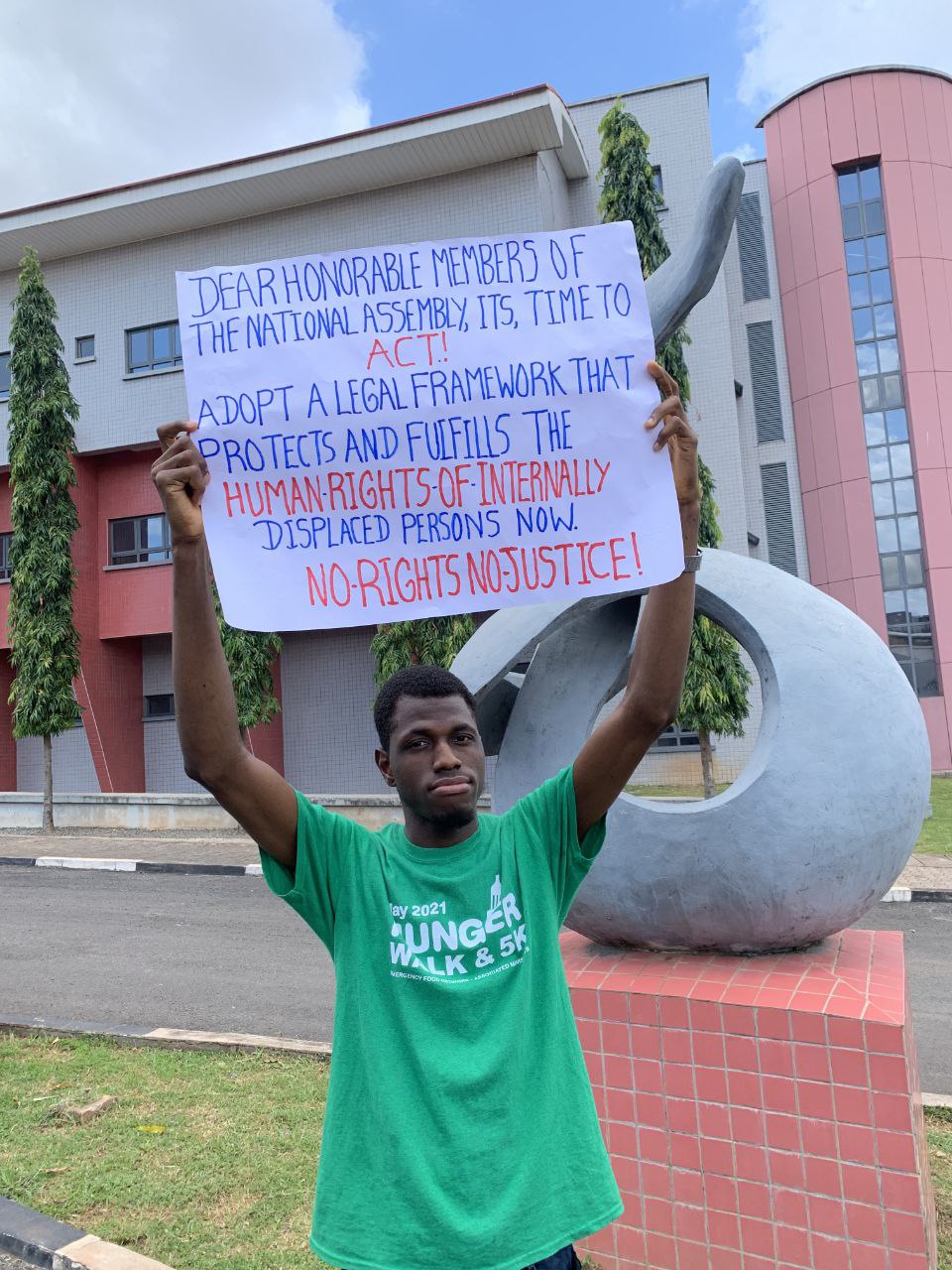
In my journey as a human rights advocate, no vulnerable population has fueled my empathy more to their situation than that of the plights of the internally displaced persons in Nigeria. I have been privileged to research on their challenges as a project in fulfillment of my LLB degree earlier this year, and it should move every Nigerian to the verge of action as a result of my discovery. The issue is a concerning one if you must know.
For the sake of clarification, an internally displaced person is not a refugee as a lot of persons mistake their status. An internally displaced persons also known as IDPs is a person or group of persons who are forced to flee their homes as a result of or to avoid the effects of armed conflict, situation of generalized violence, human rights violation or natural or man made disaster, and who remains in their country of origin. While a refugee is a person who flees their country of origin to another country as a result of fear of persecution for reasons of race, nationality, membership of a social group or political opinion. Under international law, internally displaced persons have no single convention that specifically protects their rights and future unlike refugees that do.
This is worrisome on the international level, but even more precarious in the national level as a result of government’s failure and neglect.
Africa as a region has had the liberty of enacting a convention that protects internally displaced persons (Kampala Convention), but Nigeria is yet to ratify nor domesticate that regional convention.
As at 2023, there are more than four million internally displaced persons in Nigeria. Their challenges are not limited to the following;
- education inequality.
- chronic poverty, hunger and acute malnutrition.
- Mental health degradation.
- Poor, unhygienic and unsafe living conditions.
- Lack of medical care.
- Protracted displacement situation and camp shutdowns.
These hardships constitute severe human rights deprivations and violations, a direct consequence of structural inequalities and systemic failures. The neglect by the Nigerian government intensifies these issues, and it's been ongoing for nearly a decade.
Lets remind the honorable members of the national assembly that their work is not just for show, but for actual change.
What are my demands:
The adoption of a legal framework for internally displaced persons in Nigeria: This framework must encompass four key components.
1. National Law for Internally Displaced Persons: this refers to a specific law that the national assembly must enact that outlines the human rights of internally displaced persons as well as responsibilities and the protection mechanisms. It would establish the legal basis for ensuring that the rights and well-being of IDPs are safeguarded. Nigeria is yet to have a specific law for IDPs over the years and the enactment of this law would be a land mark achievement for this vulnerable population.
2. Commission for Internally Displaced Persons: There’s a saying that ‘too many cooks spoil the food.’ The national commission for refugees, migrants and internally displaced persons (NCFRMI) was originally established as a national commission for refugees alone in 1989, but its purpose was expanded to include the affairs of migrants and internally displaced persons in 2004. 19 years later, this commission has accomplished next to nothing.
This unnecessary expansion with intent on power scramble and resource control, has led it to undermine the sterling work of the UN refugees agency in Nigeria, whose focus has now shifted from refugees to IDPs as well.
There is a need for the national assembly to delimit such expansion of 19 years ago back to refugees and refugees alone as they complement the efforts of the UN refugee agency. This is because when multiple entities like the NCFRMI and even the NEMA all scramble to address refugees, IDPs and even migrants at the same time without a clear established vision board on their roles, it can only lead to confusion, inefficiency and a lack of a coherent response which we still see till this day.
Internally displaced persons must have a commission of their own, that specifically addresses their concerns and complements their enacted national law. This commission would be responsible for overseeing the implementation of the legal framework, coordinating efforts to support IDPs, and ensuring that their human rights are upheld. By having this commission for internally displaced persons alone, the national assembly would make it possible for this vulnerable group to receive more targeted and focused assistance.
3. Eradication of Encampment policies for internally displaced persons : The encampment policy of IDPs in Nigeria so far has been more harmful than good. IDPs regardless of their status are Nigerian citizens and are entitled to the right to housing and movement.
This encampment policy although have the intention of keeping records of this vulnerable groups as well as providing them with basic services, they end up violating IDPs rights more. Due to the government neglect, overcrowding, inadequate living conditions and many more are parts of the challenges IDPs face in these camps.
Replace this harmful encampment policies with housing schemes that provide adequate housing for IDPs, and an enabling environment that will guarantee their freedom of movement in alignment with human rights law.
4. Human Rights Centered: The enacted national law for internally displaced persons must be human rights focused in the sense that it must address key areas such as:
1. Protection and prevention of internal displacement.
2. Adequate provision of humanitarian assistance, such as, food, water, healthcare, and education for Internally displaced persons.
3. Access to justice and remedies for violations of the rights of IDPs.
4. Inclusion of durable solutions, including safe return, local integration, or resettlement of IDPs.
5. Promotion of coordination and cooperation among relevant stakeholders in human rights and humanitarian field, to ensure effective implementation of the law.
6. The national law must finally embody the 30 principles of the guiding principles on internal displacement as well as the Kampala regional convention.
I ask for the attention of :
1. All Honorable Members of the National Assembly.
2. Imaan Sulaiman ibrahim Federal Commissioner for the National Commission of refugees, migrants and IDPs (NCFRMI).
3. Mustapha Habib Director General National Emergency Management Agency (NEMA).
4. Nasir Sani Gwarzo Acting Minister of Humanitatrian Affairs, Disaster Management and Social Development.
Let us all unite to make the respect, protection and the fulfillment of the human rights of internally displaced persons in Nigeria a reality.
Sign this petition.
#NoRightsNoJustice

200
The Issue
In my journey as a human rights advocate, no vulnerable population has fueled my empathy more to their situation than that of the plights of the internally displaced persons in Nigeria. I have been privileged to research on their challenges as a project in fulfillment of my LLB degree earlier this year, and it should move every Nigerian to the verge of action as a result of my discovery. The issue is a concerning one if you must know.
For the sake of clarification, an internally displaced person is not a refugee as a lot of persons mistake their status. An internally displaced persons also known as IDPs is a person or group of persons who are forced to flee their homes as a result of or to avoid the effects of armed conflict, situation of generalized violence, human rights violation or natural or man made disaster, and who remains in their country of origin. While a refugee is a person who flees their country of origin to another country as a result of fear of persecution for reasons of race, nationality, membership of a social group or political opinion. Under international law, internally displaced persons have no single convention that specifically protects their rights and future unlike refugees that do.
This is worrisome on the international level, but even more precarious in the national level as a result of government’s failure and neglect.
Africa as a region has had the liberty of enacting a convention that protects internally displaced persons (Kampala Convention), but Nigeria is yet to ratify nor domesticate that regional convention.
As at 2023, there are more than four million internally displaced persons in Nigeria. Their challenges are not limited to the following;
- education inequality.
- chronic poverty, hunger and acute malnutrition.
- Mental health degradation.
- Poor, unhygienic and unsafe living conditions.
- Lack of medical care.
- Protracted displacement situation and camp shutdowns.
These hardships constitute severe human rights deprivations and violations, a direct consequence of structural inequalities and systemic failures. The neglect by the Nigerian government intensifies these issues, and it's been ongoing for nearly a decade.
Lets remind the honorable members of the national assembly that their work is not just for show, but for actual change.
What are my demands:
The adoption of a legal framework for internally displaced persons in Nigeria: This framework must encompass four key components.
1. National Law for Internally Displaced Persons: this refers to a specific law that the national assembly must enact that outlines the human rights of internally displaced persons as well as responsibilities and the protection mechanisms. It would establish the legal basis for ensuring that the rights and well-being of IDPs are safeguarded. Nigeria is yet to have a specific law for IDPs over the years and the enactment of this law would be a land mark achievement for this vulnerable population.
2. Commission for Internally Displaced Persons: There’s a saying that ‘too many cooks spoil the food.’ The national commission for refugees, migrants and internally displaced persons (NCFRMI) was originally established as a national commission for refugees alone in 1989, but its purpose was expanded to include the affairs of migrants and internally displaced persons in 2004. 19 years later, this commission has accomplished next to nothing.
This unnecessary expansion with intent on power scramble and resource control, has led it to undermine the sterling work of the UN refugees agency in Nigeria, whose focus has now shifted from refugees to IDPs as well.
There is a need for the national assembly to delimit such expansion of 19 years ago back to refugees and refugees alone as they complement the efforts of the UN refugee agency. This is because when multiple entities like the NCFRMI and even the NEMA all scramble to address refugees, IDPs and even migrants at the same time without a clear established vision board on their roles, it can only lead to confusion, inefficiency and a lack of a coherent response which we still see till this day.
Internally displaced persons must have a commission of their own, that specifically addresses their concerns and complements their enacted national law. This commission would be responsible for overseeing the implementation of the legal framework, coordinating efforts to support IDPs, and ensuring that their human rights are upheld. By having this commission for internally displaced persons alone, the national assembly would make it possible for this vulnerable group to receive more targeted and focused assistance.
3. Eradication of Encampment policies for internally displaced persons : The encampment policy of IDPs in Nigeria so far has been more harmful than good. IDPs regardless of their status are Nigerian citizens and are entitled to the right to housing and movement.
This encampment policy although have the intention of keeping records of this vulnerable groups as well as providing them with basic services, they end up violating IDPs rights more. Due to the government neglect, overcrowding, inadequate living conditions and many more are parts of the challenges IDPs face in these camps.
Replace this harmful encampment policies with housing schemes that provide adequate housing for IDPs, and an enabling environment that will guarantee their freedom of movement in alignment with human rights law.
4. Human Rights Centered: The enacted national law for internally displaced persons must be human rights focused in the sense that it must address key areas such as:
1. Protection and prevention of internal displacement.
2. Adequate provision of humanitarian assistance, such as, food, water, healthcare, and education for Internally displaced persons.
3. Access to justice and remedies for violations of the rights of IDPs.
4. Inclusion of durable solutions, including safe return, local integration, or resettlement of IDPs.
5. Promotion of coordination and cooperation among relevant stakeholders in human rights and humanitarian field, to ensure effective implementation of the law.
6. The national law must finally embody the 30 principles of the guiding principles on internal displacement as well as the Kampala regional convention.
I ask for the attention of :
1. All Honorable Members of the National Assembly.
2. Imaan Sulaiman ibrahim Federal Commissioner for the National Commission of refugees, migrants and IDPs (NCFRMI).
3. Mustapha Habib Director General National Emergency Management Agency (NEMA).
4. Nasir Sani Gwarzo Acting Minister of Humanitatrian Affairs, Disaster Management and Social Development.
Let us all unite to make the respect, protection and the fulfillment of the human rights of internally displaced persons in Nigeria a reality.
Sign this petition.
#NoRightsNoJustice
The Decision Makers

Petition Updates
Share this petition
Petition created on August 8, 2023