

Help bring an Ideal Cancer Treatment – effective, non-toxic & low-cost – to light.
The Issue
Cancer is a dreaded disease. Despite an enormous amount of funding, effective treatments remain unavailable for most cancers.
As an independent scientist – who has published three scientific papers on cancer – permit me to assert that an effective, non-toxic, scientific and universal cancer therapy has been known since 1994. It still languishes simply because it is dirt-cheap and non-patentable. Hard to believe, but very true.
It is a BIG claim, seemingly outlandish, but please give me 10 minutes so I can prove, with supporting evidence, that my above proclamation is indeed correct.
I will make my case in 4 sections:
- the scientific basis of this (Gentle Electrotherapy) treatment
- the inaction of cancer institutions despite conceding the validity and promise of the treatment
- my long struggle to prove that this treatment works for human patients (even without a clinical setting) – and notable successes
- how market forces are against this therapy, but it can still be established.
1. Understanding the scientific basis of this ideal cancer treatment
Two concepts of chemistry and biochemistry must be understood to see how this remarkable cancer treatment works: (1) free-radicals and (2) enzymes.
(1) All chemical compounds contain bonds, which connect various atoms. All these bonds consist of a pair of electrons. A very rare exception occurs when an electron is alone or unpaired. These molecules are called ‘free-radicals’ — and are very reactive and unstable.
(2) Enzymes are specialized proteins that act as catalysts. They carry out almost all transformations in a biological cell.
The critical enzyme for cancer growth is RnR (Ribonucleotide Reductase), which converts building blocks of RNA into those of DNA. (A cell needs to copy its DNA to multiply.) The activity of RnR is most closely associated – by far – with cancer growth. (See this table.) Please note that the core structure of RnR is unique, as it contains a free-radical (unpaired electron) – essential for its activity.
Obviously, this enzyme is a very attractive target for anti-cancer chemotherapeutic drugs. Such drugs have been synthesized for more than 50 years, but unfortunately, they only partially and temporarily block the activity of RnR and are all very toxic.
In 1994, I came up with an innovative way of arresting the activity of RnR by passing a mild electric current through the cancerous tissue. Electricity is nothing but a flow of electrons, and some of those electrons would interact with the unpaired electron of RnR and quench it. This should disable RnR and halt cancer growth. Till then, about 10 scientific reports had been published where cancer was treated with electricity in animal studies. They all confirmed my proposition that a gentle current (at low voltage) would stop cancer growth. In a 1985 study, there was up to 98% tumor-shrinkage – virtual cure – after only 5 hours of gentle electrotherapy. (About half the studies did not report positive results because they used higher voltage, where toxic electrochemistry takes place.)
2. Validation from Top Cancer Institutions – and their Inaction
I wrote to all the major cancer institutions in the USA. The top two institutions, MD Anderson Cancer Center and the National Cancer Institute (NCI), replied. (See their letters in the links.) Both acknowledged that this therapy is “very interesting” and deserving of further investigation. But, even after 30+ years, they have refused to explore and establish it.
NCI sent me to the City of Hope Medical Center near Los Angeles, where a doctor, working on RnR enzyme, fully agreed with gentle electrotherapy ideas, but the management vetoed the collaboration. The reason seems simple: this therapy is non-patentable and very low-cost, making it financially unattractive to medical institutions. NCI itself has extensive research facilities, but they have not taken any initiative, despite my pleas, to advance this therapy.
In 1997, when a scientific article about this novel cancer treatment was published, I sent it to all cancer institutions worldwide, requesting its exploration. Only Tata Memorial of Mumbai – the top cancer hospital of India – showed interest in collaboration. But they suddenly stopped communicating in a few months. (See details here.)
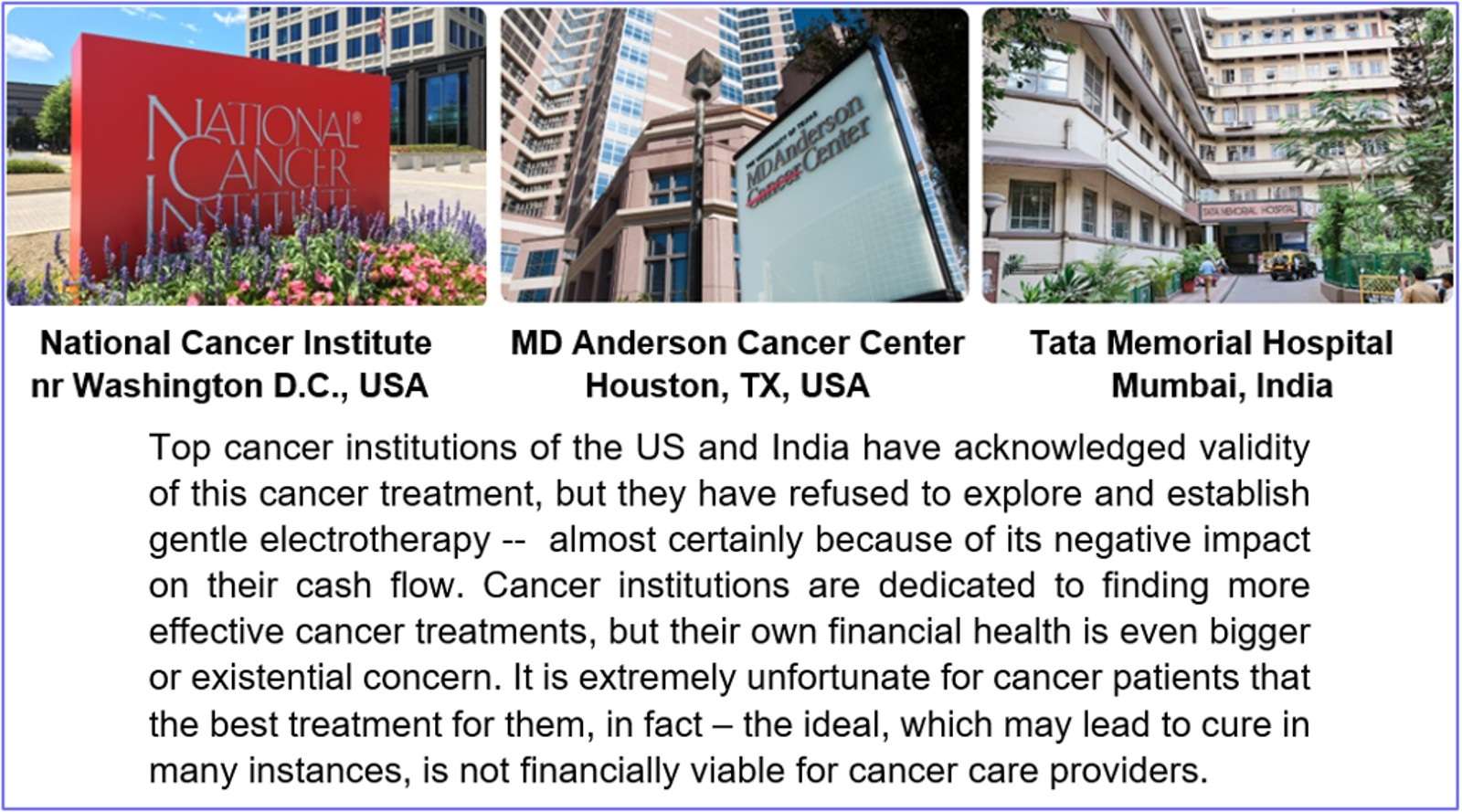
In 1994, I had spoken to Dr. Robert O. Becker, author of the book “Cross Currents: The Perils of Electropollution, the Promise of Electromedicine”. He listened to my therapy ideas, agreed, but said that such an inexpensive treatment would never see the light of day. No cancer organization will touch it. “Cancer supports more people than it kills.” His views seemed prescient now.
3. Lone Struggle to establish this breakthrough cancer treatment
So it was left for me to show that this new therapy actually works for humans.
On my own, during the last 3 decades, I built and continuously improved an electrotherapy device and patch/needle electrodes. The treatment was given the name GEIPE: Gentle Electrotherapy to Inhibit (block) a Pivotal Enzyme. A website www.cancer-treatment.net was established, and an IRS-approved NonProfit organization was started.
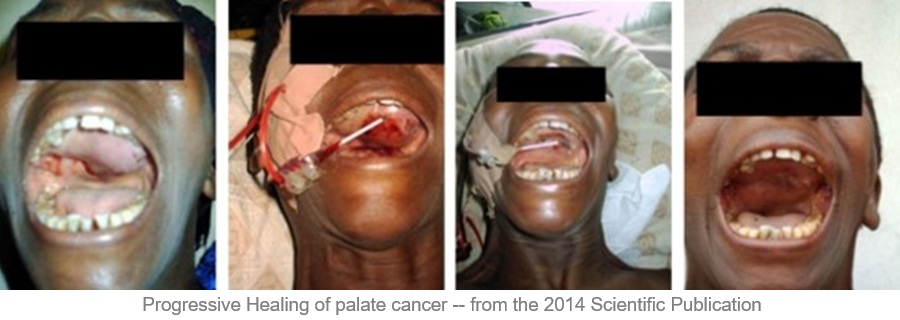
Around 2005, a Nigerian doctor acquired my rudimentary device and improved it with an electrician friend. She was able to successfully treat carcinoma of the sinus/palate. See photos below:
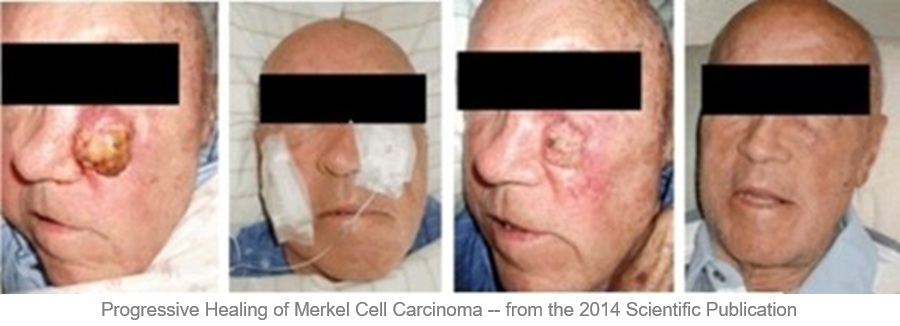
In mid-2008, Robert Hill, an engineer in Florida, built a suitable electronic GEIPE device to treat Merkel cell carcinoma of his father-in-law, as shown below:
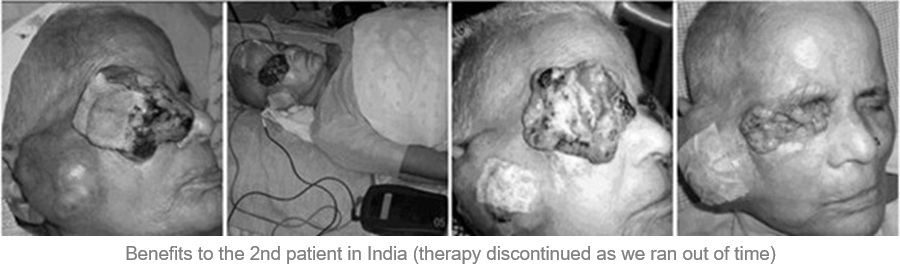
I got an electronics GEIPE device manufactured and went to India. Only one cancer doctor was willing to work with me and gave patients whom he could not help. However, when two patients began showing clear improvement, his cooperation stopped.
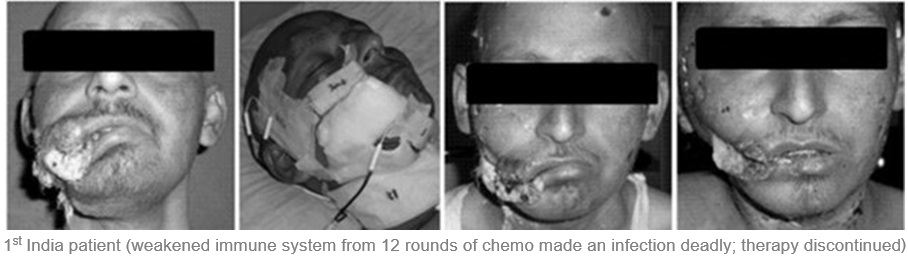
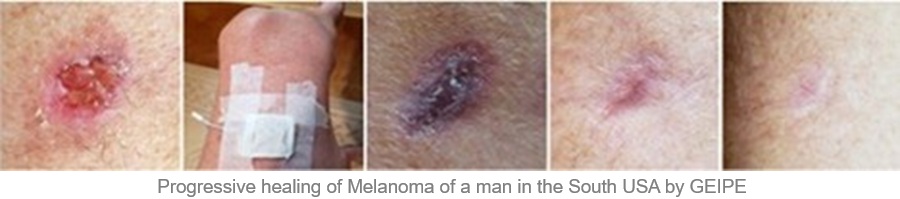
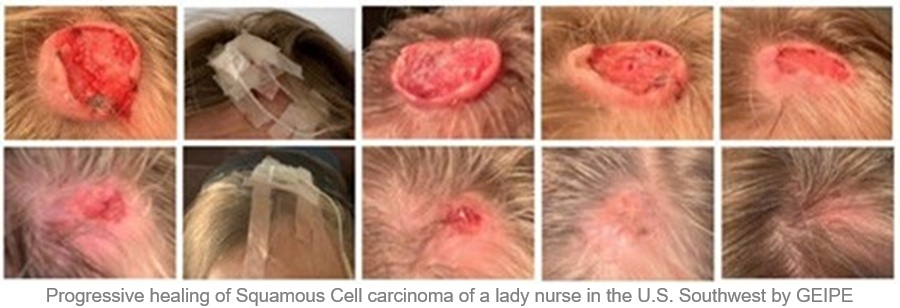
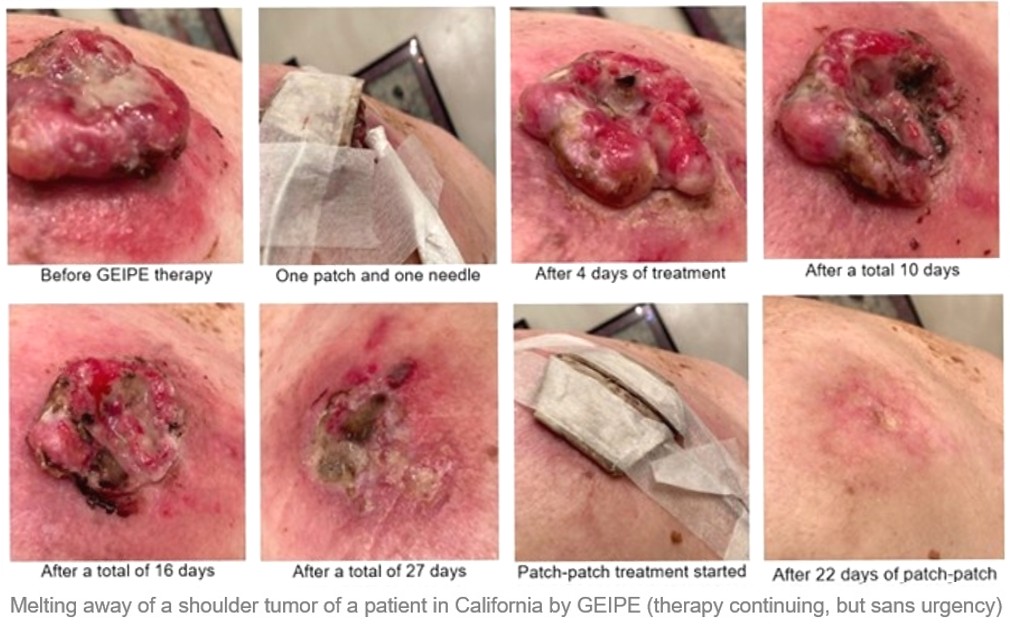
Back in the USA, through the website, we get a few patients with near-surface tumors, who are willing to try GEIPE as a home-remedy. (Only a few stick with it due to dissuasion by oncologists, or attraction of other alternatives. Many others are in advanced stages where we can only relieve pain. More than 90% see benefits. See exceptions here.) All 4 kinds of skin cancers have been successfully treated. Here are photos of some patients who have been cured in recent years.

This is a Universal Cancer Treatment. All cancer cells need to replicate their DNA to grow, and the enzyme RnR controls the bottleneck step of that process. Thus, this treatment, based on biochemistry, applies to all types of cancer.
Furthermore, unlike chemo and radiation, which indiscriminately damage both cancerous and healthy cells, this therapy selectively destroys only cancerous cells where RnR is in overdrive. Even skin hair follicles remain unharmed. Hence, truly nontoxic.
As a home remedy, GEIPE therapy is limited to treating cancers that are close to the surface. But in a clinical setting, various internal tumors would be just as treatable. (Electricity is already being successfully used by Novocure to treat glioblastoma – a brain cancer.)
GEIPE should control metastatic cancers as well if mild current can be flown through the entire body. Benefits to a leukemia patient, Kanzius, as reported by “60 Minutes”, show promise of such a setup.
4a. Market Forces – as an exception – Unhelpful to Cancer Sufferers
I contacted Tata Memorial Hospital for the 2nd time with evidence of the effectiveness of GEIPE in human patients. They again showed interest, but unfortunately, after exchanging 16 emails, they stopped responding. Déjà vu. (See details here.)
This behavior suggests that cancer institutions seek a better treatment for cancer and find my GEIPE treatment promising and rational, but when they consider all the consequences of establishing this groundbreaking treatment, they get anxious and withdraw. It is a matter of concern for any hospital if the most expensive treatments become the least expensive. Who would like such a huge drop in income? What will the providers of chemo and radiation do? How many will need to find a new job?
All ethical arguments are in favor of cancer patients. The economic upheaval of cancer institutions, once this treatment is established, will last only one or two years. People will get new jobs. Which country has a surplus of doctors? Also, note that most cancers occur in internal tissues. For them, there will always be a need for hospitals and doctors.
A Recent Development:
In March 2026, a UCLA urologist/oncologist, after reading my 3 articles – and seeing healing of many patients – was impressed enough to apply with me for a grant for phase I/II clinical trials of the Gentle Electrotherapy treatment for prostate cancer. In the cover letter, he wrote, “…it has the potential to introduce a transformative method for treating solid organ tumors, advancing the field in truly meaningful ways.” However, the granting organization declined our request, apparently because our therapy did not involve any new drug.
4b. How this ideal cancer treatment may be established
Clinical trials (Phase 3) are not possible for this cancer therapy, as they cost tens to hundreds of millions of dollars. No one will spend such an amount when there is no patentable protocol to be had at the conclusion of the trials.
However, it can be offered to those patients who are averse to, or not suitable for, traditional toxic cancer treatments. There is no downside to this inexpensive, non-toxic treatment. If a high percentage of them see benefits, as is likely, the word would spread. More and more patients will opt for it. The key is to find a cancer clinic that is willing to embark on this path, and/or a non-profit that is willing to fund Phase 1/2 clinical trials. We are still looking after more than 3 decades.
CALL TO ACTION:
The status quo of cancer care must change, and can change with this remarkable new treatment!
Please sign and share this petition. Also, write emails and make phone calls to the relevant authorities. In general, please spread the awareness of the existence of this transformative universal cancer treatment, so that
- Some investigative journalists may start asking cancer institutions why this scientific treatment is not being explored and established.
- Some nonprofit may support this cancer treatment, despite opposition or indifference from oncologists.
- Some people in power may ask the National Institute of Health (NIH) to fund exploration of this therapy. (The National Cancer Institute falls under the NIH.) The same applies to the top Health authorities in other countries like India.
- Maybe, just maybe, there are some cancer clinicians in the world who care more for cancer patients than profits, and start offering this low-cost, effective treatment.
- At a minimum, let patients with near-surface tumors (including all skin cancers) know about this treatment, so they do not undergo Mohs surgery that may result in uncomfortable open wounds.
Readers, if you have any questions/doubts, please see the FAQ on the GEIPE website. You may also contact us from there.
References:
Three scientific reports regarding this cancer treatment have been published:
Biochemistry — Not Oncogenes — May Demystify and Defeat Cancer (2023)
Low-level electric current and cancer — a promising, but languishing non-toxic cancer therapy (2014)
Targeting a key enzyme in cell growth: a novel therapy for cancer (1997)

618
The Issue
Cancer is a dreaded disease. Despite an enormous amount of funding, effective treatments remain unavailable for most cancers.
As an independent scientist – who has published three scientific papers on cancer – permit me to assert that an effective, non-toxic, scientific and universal cancer therapy has been known since 1994. It still languishes simply because it is dirt-cheap and non-patentable. Hard to believe, but very true.
It is a BIG claim, seemingly outlandish, but please give me 10 minutes so I can prove, with supporting evidence, that my above proclamation is indeed correct.
I will make my case in 4 sections:
- the scientific basis of this (Gentle Electrotherapy) treatment
- the inaction of cancer institutions despite conceding the validity and promise of the treatment
- my long struggle to prove that this treatment works for human patients (even without a clinical setting) – and notable successes
- how market forces are against this therapy, but it can still be established.
1. Understanding the scientific basis of this ideal cancer treatment
Two concepts of chemistry and biochemistry must be understood to see how this remarkable cancer treatment works: (1) free-radicals and (2) enzymes.
(1) All chemical compounds contain bonds, which connect various atoms. All these bonds consist of a pair of electrons. A very rare exception occurs when an electron is alone or unpaired. These molecules are called ‘free-radicals’ — and are very reactive and unstable.
(2) Enzymes are specialized proteins that act as catalysts. They carry out almost all transformations in a biological cell.
The critical enzyme for cancer growth is RnR (Ribonucleotide Reductase), which converts building blocks of RNA into those of DNA. (A cell needs to copy its DNA to multiply.) The activity of RnR is most closely associated – by far – with cancer growth. (See this table.) Please note that the core structure of RnR is unique, as it contains a free-radical (unpaired electron) – essential for its activity.
Obviously, this enzyme is a very attractive target for anti-cancer chemotherapeutic drugs. Such drugs have been synthesized for more than 50 years, but unfortunately, they only partially and temporarily block the activity of RnR and are all very toxic.
In 1994, I came up with an innovative way of arresting the activity of RnR by passing a mild electric current through the cancerous tissue. Electricity is nothing but a flow of electrons, and some of those electrons would interact with the unpaired electron of RnR and quench it. This should disable RnR and halt cancer growth. Till then, about 10 scientific reports had been published where cancer was treated with electricity in animal studies. They all confirmed my proposition that a gentle current (at low voltage) would stop cancer growth. In a 1985 study, there was up to 98% tumor-shrinkage – virtual cure – after only 5 hours of gentle electrotherapy. (About half the studies did not report positive results because they used higher voltage, where toxic electrochemistry takes place.)
2. Validation from Top Cancer Institutions – and their Inaction
I wrote to all the major cancer institutions in the USA. The top two institutions, MD Anderson Cancer Center and the National Cancer Institute (NCI), replied. (See their letters in the links.) Both acknowledged that this therapy is “very interesting” and deserving of further investigation. But, even after 30+ years, they have refused to explore and establish it.
NCI sent me to the City of Hope Medical Center near Los Angeles, where a doctor, working on RnR enzyme, fully agreed with gentle electrotherapy ideas, but the management vetoed the collaboration. The reason seems simple: this therapy is non-patentable and very low-cost, making it financially unattractive to medical institutions. NCI itself has extensive research facilities, but they have not taken any initiative, despite my pleas, to advance this therapy.
In 1997, when a scientific article about this novel cancer treatment was published, I sent it to all cancer institutions worldwide, requesting its exploration. Only Tata Memorial of Mumbai – the top cancer hospital of India – showed interest in collaboration. But they suddenly stopped communicating in a few months. (See details here.)
In 1994, I had spoken to Dr. Robert O. Becker, author of the book “Cross Currents: The Perils of Electropollution, the Promise of Electromedicine”. He listened to my therapy ideas, agreed, but said that such an inexpensive treatment would never see the light of day. No cancer organization will touch it. “Cancer supports more people than it kills.” His views seemed prescient now.
3. Lone Struggle to establish this breakthrough cancer treatment
So it was left for me to show that this new therapy actually works for humans.
On my own, during the last 3 decades, I built and continuously improved an electrotherapy device and patch/needle electrodes. The treatment was given the name GEIPE: Gentle Electrotherapy to Inhibit (block) a Pivotal Enzyme. A website www.cancer-treatment.net was established, and an IRS-approved NonProfit organization was started.
Around 2005, a Nigerian doctor acquired my rudimentary device and improved it with an electrician friend. She was able to successfully treat carcinoma of the sinus/palate. See photos below:
In mid-2008, Robert Hill, an engineer in Florida, built a suitable electronic GEIPE device to treat Merkel cell carcinoma of his father-in-law, as shown below:
I got an electronics GEIPE device manufactured and went to India. Only one cancer doctor was willing to work with me and gave patients whom he could not help. However, when two patients began showing clear improvement, his cooperation stopped.
Back in the USA, through the website, we get a few patients with near-surface tumors, who are willing to try GEIPE as a home-remedy. (Only a few stick with it due to dissuasion by oncologists, or attraction of other alternatives. Many others are in advanced stages where we can only relieve pain. More than 90% see benefits. See exceptions here.) All 4 kinds of skin cancers have been successfully treated. Here are photos of some patients who have been cured in recent years.
This is a Universal Cancer Treatment. All cancer cells need to replicate their DNA to grow, and the enzyme RnR controls the bottleneck step of that process. Thus, this treatment, based on biochemistry, applies to all types of cancer.
Furthermore, unlike chemo and radiation, which indiscriminately damage both cancerous and healthy cells, this therapy selectively destroys only cancerous cells where RnR is in overdrive. Even skin hair follicles remain unharmed. Hence, truly nontoxic.
As a home remedy, GEIPE therapy is limited to treating cancers that are close to the surface. But in a clinical setting, various internal tumors would be just as treatable. (Electricity is already being successfully used by Novocure to treat glioblastoma – a brain cancer.)
GEIPE should control metastatic cancers as well if mild current can be flown through the entire body. Benefits to a leukemia patient, Kanzius, as reported by “60 Minutes”, show promise of such a setup.
4a. Market Forces – as an exception – Unhelpful to Cancer Sufferers
I contacted Tata Memorial Hospital for the 2nd time with evidence of the effectiveness of GEIPE in human patients. They again showed interest, but unfortunately, after exchanging 16 emails, they stopped responding. Déjà vu. (See details here.)
This behavior suggests that cancer institutions seek a better treatment for cancer and find my GEIPE treatment promising and rational, but when they consider all the consequences of establishing this groundbreaking treatment, they get anxious and withdraw. It is a matter of concern for any hospital if the most expensive treatments become the least expensive. Who would like such a huge drop in income? What will the providers of chemo and radiation do? How many will need to find a new job?
All ethical arguments are in favor of cancer patients. The economic upheaval of cancer institutions, once this treatment is established, will last only one or two years. People will get new jobs. Which country has a surplus of doctors? Also, note that most cancers occur in internal tissues. For them, there will always be a need for hospitals and doctors.
A Recent Development:
In March 2026, a UCLA urologist/oncologist, after reading my 3 articles – and seeing healing of many patients – was impressed enough to apply with me for a grant for phase I/II clinical trials of the Gentle Electrotherapy treatment for prostate cancer. In the cover letter, he wrote, “…it has the potential to introduce a transformative method for treating solid organ tumors, advancing the field in truly meaningful ways.” However, the granting organization declined our request, apparently because our therapy did not involve any new drug.
4b. How this ideal cancer treatment may be established
Clinical trials (Phase 3) are not possible for this cancer therapy, as they cost tens to hundreds of millions of dollars. No one will spend such an amount when there is no patentable protocol to be had at the conclusion of the trials.
However, it can be offered to those patients who are averse to, or not suitable for, traditional toxic cancer treatments. There is no downside to this inexpensive, non-toxic treatment. If a high percentage of them see benefits, as is likely, the word would spread. More and more patients will opt for it. The key is to find a cancer clinic that is willing to embark on this path, and/or a non-profit that is willing to fund Phase 1/2 clinical trials. We are still looking after more than 3 decades.
CALL TO ACTION:
The status quo of cancer care must change, and can change with this remarkable new treatment!
Please sign and share this petition. Also, write emails and make phone calls to the relevant authorities. In general, please spread the awareness of the existence of this transformative universal cancer treatment, so that
- Some investigative journalists may start asking cancer institutions why this scientific treatment is not being explored and established.
- Some nonprofit may support this cancer treatment, despite opposition or indifference from oncologists.
- Some people in power may ask the National Institute of Health (NIH) to fund exploration of this therapy. (The National Cancer Institute falls under the NIH.) The same applies to the top Health authorities in other countries like India.
- Maybe, just maybe, there are some cancer clinicians in the world who care more for cancer patients than profits, and start offering this low-cost, effective treatment.
- At a minimum, let patients with near-surface tumors (including all skin cancers) know about this treatment, so they do not undergo Mohs surgery that may result in uncomfortable open wounds.
Readers, if you have any questions/doubts, please see the FAQ on the GEIPE website. You may also contact us from there.
References:
Three scientific reports regarding this cancer treatment have been published:
Biochemistry — Not Oncogenes — May Demystify and Defeat Cancer (2023)
Low-level electric current and cancer — a promising, but languishing non-toxic cancer therapy (2014)
Targeting a key enzyme in cell growth: a novel therapy for cancer (1997)
The Decision Makers

Petition Updates
Share this petition
Petition created on September 13, 2025