
Government's “Women’s Safety Micro-Flats” for Girls Entering Arranged Marriages in India
The Issue
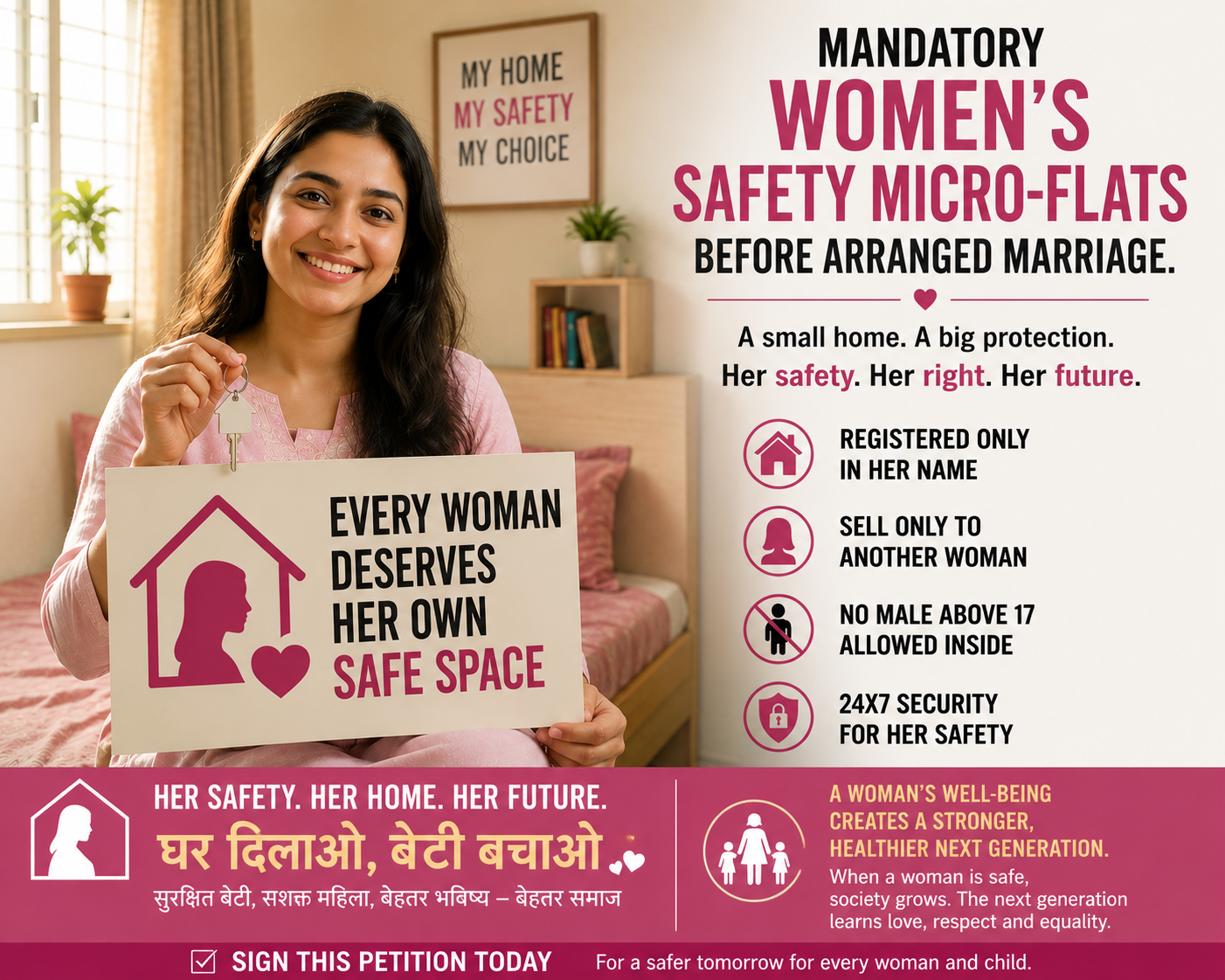
In India, thousands of women enter arranged marriages without any guaranteed space of safety, independence, or refuge if things become abusive, controlling, or unsafe. When emotional, psychological, financial, or domestic abuse occurs, most women have nowhere to go except back to unsafe families or to shelters that are overcrowded and temporary.
To protect women’s long-term safety, dignity, and autonomy, I request the Government of India to create a national program called Women’s Safety Micro-Flats (WSMFP).
This program should guarantee that every woman entering an arranged marriage receives access to a secure micro-flat registered exclusively in her name.
We demand the following:
1. Mandatory allocation before arranged marriage
Each woman must be allotted or registered for a government micro-flat before an arranged marriage is legally approved. This ensures she has a guaranteed fallback safety space.
2. Ownership only in the woman’s name
The flat must be legally non-transferable to husband, in-laws, or any male relative under any circumstance, protecting her from property coercion and manipulation.
3. Women-to-women resale only
If the woman decides to sell her micro-flat, it must be sold only to another woman, keeping the ecosystem permanently women-owned and safe.
4. No adult male entry
No male above 17 years of age should be allowed inside the residential floors of these micro-flat societies.
Only minor sons (under 17) may enter, and only when accompanied by their mother.
5. High-security, women-only environmentThese societies should include:
Women security guards
Biometric entry
CCTV surveillance
Panic buttons connected to local police stations
Common areas monitored by women staff only
Locations in busy, public, well-lit areas (never isolated)
6. Low-cost, survival-oriented design
Compact, simple safety spaces— not luxury apartments—so the project stays financially sustainable and scalable.
Psychologist’s Perspective:-
Abusive households don’t only harm women—they deeply damage children in ways that last a lifetime.
Research and decades of clinical experience show that:
1. Children in abusive homes develop chronic, complex trauma (C-PTSD)
Exposure to shouting, violence, emotional manipulation, silent treatment, stonewalling, or coercive control wires a child’s brain for fear and hypervigilance.
This leads to:
anxiety
depression
aggression
emotional dysregulation
sleep problems
trust issues
lifelong attachment difficulties
2. Children learn the abusive family system as “normal”
Sons may internalize dominance; daughters internalize silence, obedience, and self-blame.
Generational trauma continues.
3. A child’s brain physically changes
Toxic stress shrinks areas involved in learning, emotional control, and memory.
This directly affects school performance, intelligence, and long-term mental health.
4. Children often believe the abuse is their fault
This creates lifelong guilt, shame, people-pleasing, and low self-worth.
5. Without a safe alternative, children remain trapped
Most women stay in abusive marriages because leaving means homelessness or returning to another unsafe family system.
A secure micro-flat gives the child:
a safe bed
predictable routines
emotional stability
the ability to escape chaos
a mother who can protect them
a chance to break the cycle of trauma
A stable home is not a luxury for a child.
It is the foundation of their psychological survival.
Why this matters
A woman’s safety should not depend on her husband, his family, or her own birth family.
A child’s safety should not depend on the “good mood” of adults in the home.
A small, secure, independent home—protected by law and exclusively owned by the woman—can save lives, prevent abuse, and protect a child’s brain, future, and emotional development.
We urge the Government of India to introduce this program urgently and make India a safer nation for women and children.

40
The Issue
In India, thousands of women enter arranged marriages without any guaranteed space of safety, independence, or refuge if things become abusive, controlling, or unsafe. When emotional, psychological, financial, or domestic abuse occurs, most women have nowhere to go except back to unsafe families or to shelters that are overcrowded and temporary.
To protect women’s long-term safety, dignity, and autonomy, I request the Government of India to create a national program called Women’s Safety Micro-Flats (WSMFP).
This program should guarantee that every woman entering an arranged marriage receives access to a secure micro-flat registered exclusively in her name.
We demand the following:
1. Mandatory allocation before arranged marriage
Each woman must be allotted or registered for a government micro-flat before an arranged marriage is legally approved. This ensures she has a guaranteed fallback safety space.
2. Ownership only in the woman’s name
The flat must be legally non-transferable to husband, in-laws, or any male relative under any circumstance, protecting her from property coercion and manipulation.
3. Women-to-women resale only
If the woman decides to sell her micro-flat, it must be sold only to another woman, keeping the ecosystem permanently women-owned and safe.
4. No adult male entry
No male above 17 years of age should be allowed inside the residential floors of these micro-flat societies.
Only minor sons (under 17) may enter, and only when accompanied by their mother.
5. High-security, women-only environmentThese societies should include:
Women security guards
Biometric entry
CCTV surveillance
Panic buttons connected to local police stations
Common areas monitored by women staff only
Locations in busy, public, well-lit areas (never isolated)
6. Low-cost, survival-oriented design
Compact, simple safety spaces— not luxury apartments—so the project stays financially sustainable and scalable.
Psychologist’s Perspective:-
Abusive households don’t only harm women—they deeply damage children in ways that last a lifetime.
Research and decades of clinical experience show that:
1. Children in abusive homes develop chronic, complex trauma (C-PTSD)
Exposure to shouting, violence, emotional manipulation, silent treatment, stonewalling, or coercive control wires a child’s brain for fear and hypervigilance.
This leads to:
anxiety
depression
aggression
emotional dysregulation
sleep problems
trust issues
lifelong attachment difficulties
2. Children learn the abusive family system as “normal”
Sons may internalize dominance; daughters internalize silence, obedience, and self-blame.
Generational trauma continues.
3. A child’s brain physically changes
Toxic stress shrinks areas involved in learning, emotional control, and memory.
This directly affects school performance, intelligence, and long-term mental health.
4. Children often believe the abuse is their fault
This creates lifelong guilt, shame, people-pleasing, and low self-worth.
5. Without a safe alternative, children remain trapped
Most women stay in abusive marriages because leaving means homelessness or returning to another unsafe family system.
A secure micro-flat gives the child:
a safe bed
predictable routines
emotional stability
the ability to escape chaos
a mother who can protect them
a chance to break the cycle of trauma
A stable home is not a luxury for a child.
It is the foundation of their psychological survival.
Why this matters
A woman’s safety should not depend on her husband, his family, or her own birth family.
A child’s safety should not depend on the “good mood” of adults in the home.
A small, secure, independent home—protected by law and exclusively owned by the woman—can save lives, prevent abuse, and protect a child’s brain, future, and emotional development.
We urge the Government of India to introduce this program urgently and make India a safer nation for women and children.
The Decision Makers

Petition Updates
Share this petition
Petition created on 27 May 2026