

Funding Our Own Digital Prisons: Stop Theft of Working-Class Retirement for Tech Tyranny!
The Issue
Digital Prisons: Stop Tech Theft of Clark County Retirement!
Wake up America! We are funding our own digital prisons.
It's time to realize we are at a major turning point. While our oil refineries, food supply, drinking water, breathable air, and communities are being destroyed, they are building massive digital prisons for us all.
And guess who is paying for all of it? YOU ARE.
BlackRock CEO Larry Fink dropped the ultimate bombshell, admitting that the capital for this mandatory AI infrastructure boom will be taken directly from the working class.
His exact words: "Much of this will come from savings accounts and pension accounts."
They are using your hard-earned retirement funds and life savings to build a system of total control. If we don’t draw a line in the sand and fight back today, tomorrow will be too late.
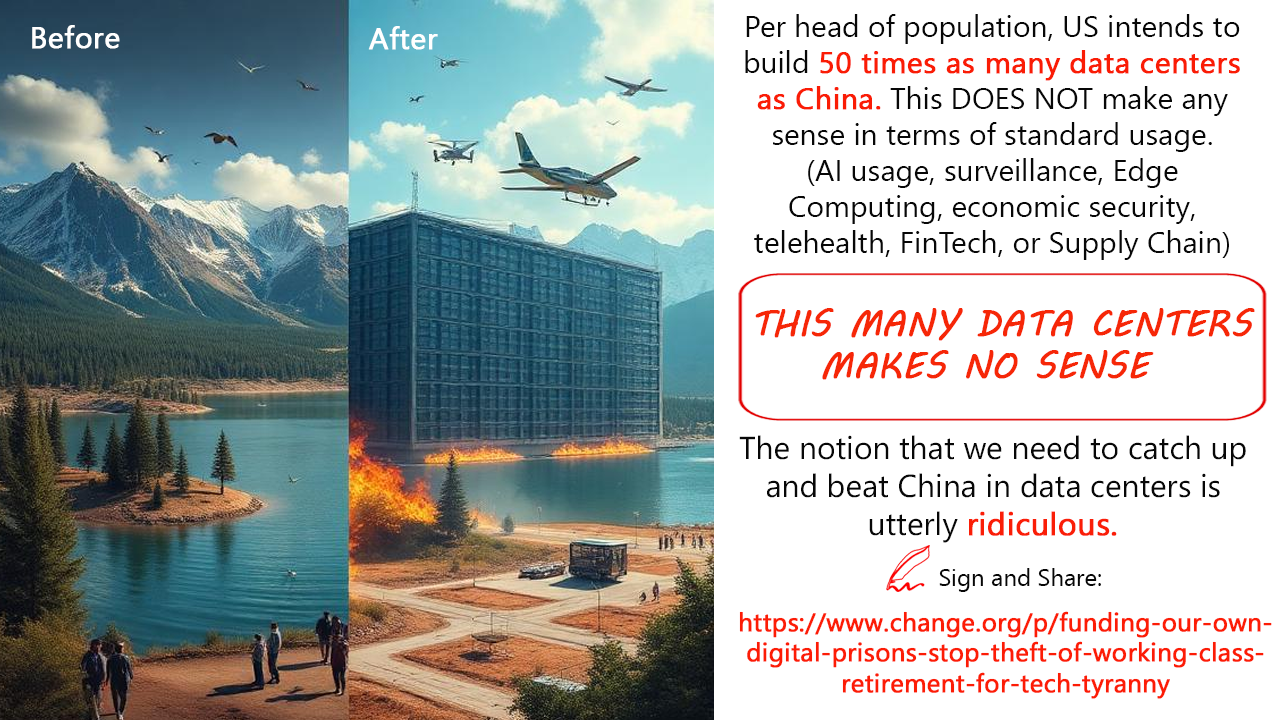
While the U.S., with a 320 million population, has about 4,000 data centers and is planning to build 10,000 more, China—with nearly 5 times the population—has only 365 data centers and is planning to build total 500.
This is not just AI usage, or surveillance, Edge Computing, economic security, telehealth, FinTech, or Supply Chain => This MANY DATA CENTERS MAKES NO SENSE.
Environmental nightmares of Data centers:========================================
The rapid expansion of "hyperscale" data centers—the massive warehouses powering everything from your social media feed to advanced AI—has created a complex set of environmental and social challenges.
Nightmares for local residents, the environment, and the long-term stability of our infrastructure:
Resource Exhaustion:
Massive Local Water Depletion: A single large data center can consume up to 5 million gallons of water a day—the same amount used by a city of 50,000 people—often pulling from the same drinking water reservoirs as residents.
Grid Overload and Brownouts: Data centers can consume more electricity than 100,000 homes. In some regions, this demand is so high it threatens the stability of the local power grid, increasing the risk of blackouts for families.
Rising Utility Bills: When utilities build new transmission lines or power plants to serve a data center, those billion-dollar costs are often passed down to regular ratepayers through higher monthly bills.
Land "Grab" via Eminent Domain: The miles of high-voltage transmission lines needed to power these sites often require seizing private land or cutting through protected parks and trails.
Community & Health Impacts
Chronic Noise Pollution: The massive industrial fans and cooling systems run 24/7, creating a constant, low-frequency hum that has been linked to sleep deprivation and mental health issues for nearby residents.
Diesel Exhaust from Backup Generators: To ensure they never go offline, data centers keep thousands of gallons of diesel on-site. Testing these massive generators releases nitrogen oxides and particulates into the local air.
Wastewater Contamination: Cooling water is often treated with biocides and corrosion inhibitors. When this "blowdown" water is discharged, it can carry heavy metals and chemicals into local sewer systems or streams.
Thermal Pollution: Water returned to local ecosystems is often much warmer than the natural ambient temperature, which can kill local fish and trigger toxic algae blooms.
Salt Dust Deposits: Evaporative cooling towers can release a fine mist of salt and mineral "drift" that settles on nearby soil and cars, potentially damaging local vegetation and property.
Long-Term Environmental "Nightmares"
E-Waste Avalanches: The average lifespan of a server is only 3–5 years. This leads to a massive, ongoing stream of toxic electronic waste (lead, mercury, cadmium) that is difficult to recycle.
Carbon Footprint "Stealth": While many tech companies buy "green credits," the physical data centers often still rely on local fossil-fuel plants, effectively undoing regional climate goals.
The "Soda Straw" Effect on Aquifers: Many centers tap into deep underground aquifers. Once these are depleted, they can take centuries to refill, permanently lowering the water table for local farmers.
Impermeable Surfaces & Flooding: Building hundreds of acres of concrete and steel prevents rainwater from soaking into the ground, drastically increasing the risk of flash flooding in surrounding neighborhoods.
Stranded Asset Risk: If AI demand shifts or a company goes under, communities are left with massive, specialized concrete shells and specialized power infrastructure that are nearly impossible to repurpose.
Loss of Agricultural Land: Data centers are often built on "greenfield" sites—prime farmland that is permanently removed from the food production cycle.
Social & Transparency Issues:
"Secret" Water Use: Many data center operators use Non-Disclosure Agreements (NDAs) to prevent local governments from revealing exactly how much water they are "drinking" from the public supply.
Low Job Density: Despite their massive physical footprint and resource use, data centers employ very few people—often fewer than a typical grocery store—offering little long-term economic "lift" for the resources they take.
Microclimate Heating: The sheer amount of heat exhausted into the atmosphere can create localized "urban heat islands," making the immediate area significantly hotter than the surrounding countryside.
Threats to Heritage Sites: In places like Northern Virginia, data center expansion has encroached on historic battlefields and indigenous cultural sites.
Public Health Burdens: Long-term exposure to the combined air, noise, and water stressors can lead to higher rates of cardiovascular and respiratory issues in "frontline" communities.
We urge Clark County commissioners, governor, lawmakers, policymakers, and stakeholders to halt all investments in mandatory AI infrastructure projects funded by the American populace and Clark County residents. Instead, prioritize transparency, democratic consent, and the redirection of funds towards sustainable, community-based initiatives that genuinely improve the quality of life for all Americans.
Let's reclaim our future. Demand accountability, demand oversight, and demand that capital investments serve the people, not imprison them. We call upon fellow citizens, community leaders, and influencers to stand united in revisiting and revising federal and local funding guidelines to ensure they reflect our democratic values.
Join us in this crucial movement to protect our freedoms and resources from being overshadowed by burgeoning AI empires.
Sign this petition today to make our collective voice heard and to take a stand against funding our own digital confinement. Together, we can pivot towards an equitable and just society that values human rights and the common good above technological tyranny.

188
The Issue
Digital Prisons: Stop Tech Theft of Clark County Retirement!
Wake up America! We are funding our own digital prisons.
It's time to realize we are at a major turning point. While our oil refineries, food supply, drinking water, breathable air, and communities are being destroyed, they are building massive digital prisons for us all.
And guess who is paying for all of it? YOU ARE.
BlackRock CEO Larry Fink dropped the ultimate bombshell, admitting that the capital for this mandatory AI infrastructure boom will be taken directly from the working class.
His exact words: "Much of this will come from savings accounts and pension accounts."
They are using your hard-earned retirement funds and life savings to build a system of total control. If we don’t draw a line in the sand and fight back today, tomorrow will be too late.
While the U.S., with a 320 million population, has about 4,000 data centers and is planning to build 10,000 more, China—with nearly 5 times the population—has only 365 data centers and is planning to build total 500.
This is not just AI usage, or surveillance, Edge Computing, economic security, telehealth, FinTech, or Supply Chain => This MANY DATA CENTERS MAKES NO SENSE.
Environmental nightmares of Data centers:========================================
The rapid expansion of "hyperscale" data centers—the massive warehouses powering everything from your social media feed to advanced AI—has created a complex set of environmental and social challenges.
Nightmares for local residents, the environment, and the long-term stability of our infrastructure:
Resource Exhaustion:
Massive Local Water Depletion: A single large data center can consume up to 5 million gallons of water a day—the same amount used by a city of 50,000 people—often pulling from the same drinking water reservoirs as residents.
Grid Overload and Brownouts: Data centers can consume more electricity than 100,000 homes. In some regions, this demand is so high it threatens the stability of the local power grid, increasing the risk of blackouts for families.
Rising Utility Bills: When utilities build new transmission lines or power plants to serve a data center, those billion-dollar costs are often passed down to regular ratepayers through higher monthly bills.
Land "Grab" via Eminent Domain: The miles of high-voltage transmission lines needed to power these sites often require seizing private land or cutting through protected parks and trails.
Community & Health Impacts
Chronic Noise Pollution: The massive industrial fans and cooling systems run 24/7, creating a constant, low-frequency hum that has been linked to sleep deprivation and mental health issues for nearby residents.
Diesel Exhaust from Backup Generators: To ensure they never go offline, data centers keep thousands of gallons of diesel on-site. Testing these massive generators releases nitrogen oxides and particulates into the local air.
Wastewater Contamination: Cooling water is often treated with biocides and corrosion inhibitors. When this "blowdown" water is discharged, it can carry heavy metals and chemicals into local sewer systems or streams.
Thermal Pollution: Water returned to local ecosystems is often much warmer than the natural ambient temperature, which can kill local fish and trigger toxic algae blooms.
Salt Dust Deposits: Evaporative cooling towers can release a fine mist of salt and mineral "drift" that settles on nearby soil and cars, potentially damaging local vegetation and property.
Long-Term Environmental "Nightmares"
E-Waste Avalanches: The average lifespan of a server is only 3–5 years. This leads to a massive, ongoing stream of toxic electronic waste (lead, mercury, cadmium) that is difficult to recycle.
Carbon Footprint "Stealth": While many tech companies buy "green credits," the physical data centers often still rely on local fossil-fuel plants, effectively undoing regional climate goals.
The "Soda Straw" Effect on Aquifers: Many centers tap into deep underground aquifers. Once these are depleted, they can take centuries to refill, permanently lowering the water table for local farmers.
Impermeable Surfaces & Flooding: Building hundreds of acres of concrete and steel prevents rainwater from soaking into the ground, drastically increasing the risk of flash flooding in surrounding neighborhoods.
Stranded Asset Risk: If AI demand shifts or a company goes under, communities are left with massive, specialized concrete shells and specialized power infrastructure that are nearly impossible to repurpose.
Loss of Agricultural Land: Data centers are often built on "greenfield" sites—prime farmland that is permanently removed from the food production cycle.
Social & Transparency Issues:
"Secret" Water Use: Many data center operators use Non-Disclosure Agreements (NDAs) to prevent local governments from revealing exactly how much water they are "drinking" from the public supply.
Low Job Density: Despite their massive physical footprint and resource use, data centers employ very few people—often fewer than a typical grocery store—offering little long-term economic "lift" for the resources they take.
Microclimate Heating: The sheer amount of heat exhausted into the atmosphere can create localized "urban heat islands," making the immediate area significantly hotter than the surrounding countryside.
Threats to Heritage Sites: In places like Northern Virginia, data center expansion has encroached on historic battlefields and indigenous cultural sites.
Public Health Burdens: Long-term exposure to the combined air, noise, and water stressors can lead to higher rates of cardiovascular and respiratory issues in "frontline" communities.
We urge Clark County commissioners, governor, lawmakers, policymakers, and stakeholders to halt all investments in mandatory AI infrastructure projects funded by the American populace and Clark County residents. Instead, prioritize transparency, democratic consent, and the redirection of funds towards sustainable, community-based initiatives that genuinely improve the quality of life for all Americans.
Let's reclaim our future. Demand accountability, demand oversight, and demand that capital investments serve the people, not imprison them. We call upon fellow citizens, community leaders, and influencers to stand united in revisiting and revising federal and local funding guidelines to ensure they reflect our democratic values.
Join us in this crucial movement to protect our freedoms and resources from being overshadowed by burgeoning AI empires.
Sign this petition today to make our collective voice heard and to take a stand against funding our own digital confinement. Together, we can pivot towards an equitable and just society that values human rights and the common good above technological tyranny.
The Decision Makers


Supporter Voices
Petition Updates
Share this petition
Petition created on May 25, 2026