

For a federal Government inquiry into a safe transition to a steady state economy
The issue
To the Honourable Speaker and members of the House of Representatives assembled:
The petition created by the NSW Centre for the Advancement of the Steady State Economy, points out that:
Globally there is a growing concern over unrestrained physical growth of the economy. It is clear that it is impossible to have infinite economic growth on a planet or in a nation of finite material resources. The seriousness of this situation has been highlighted:
- as far back as 1972 with the publication of the “Limits to Growth” report Club of Rome (1972), and by the more recent studies (2019), of Gaya Harrington, showing the reliability of the report,
- via the research carried out by Stockholm Resilience Centre, which in 2023, indicated that we have now transgressed the safe operating space in six of the nine main categories of environmental impacts and almost encroached into a seventh, (see Figure).
- by the research carried out by the Global Footprint Network, demonstrating the growing proximity over the years of World Overshoot Day.
The necessity of safely transitioning to a steady state economy can hardly be exaggerated.
The key features of the steady state economy as outlined by Herman Daly (a founder of ecological economics) can be summarised as:
- A constant and sustainable population,
- A consumption of renewable resources at a rate not greater than the rate at which they are renewed,
- Processing of non-renewable resources at a rate no greater than they can be recycled,
- The preservation of natural ecosystems, their biodiversity and the services they provide,
- A relatively constant consumption of renewable energy.
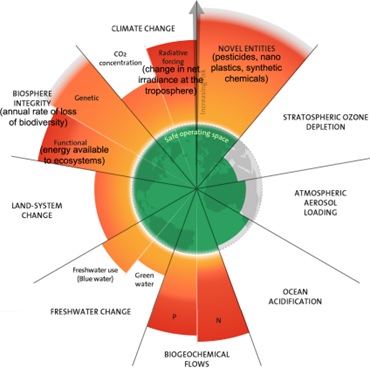
Figure: 9 boundaries assessed, 6 crossed.
Azote for Stockholm Resilience Centre, Stockholm University.
A fair distribution of wealth and a good quality of life for all.
In summary, as H. Daly notes: “A steady state economy is one that develops qualitatively (by improvement in science, technology, and ethics) without growing quantitatively in physical dimensions”.
Accordingly, the New South Wales Chapter of the Centre for the Advancement of the Steady State Economy, the supporting agencies listed below and the petitioners request that the House:
Establish an inquiry into the transition of Australia from a growth economy to a steady state economy for the purposes of:
- Outlining the features of an Australian steady state economy,
- Establishing what mechanisms are available to the Federal Government to promote a socially just transition to a steady state economy, such as those related to:
- Fiscal policy
- Monetary policy
- Tax policy
- Introduction of the Genuine Progress Indicator (GPI) to replace GDP as a better measure for government’s policy successes.
- Immigration Policy, looking to our regions carrying capacity.
- Laws ensuring conservation of natural habitats, the essential support for life as we know it.
- Assessing the need of community education required to facilitate the transition to the steady state economy, and the educational needs of specific sectors of the Australian community, (industry, school, tertiary, media, and different levels of government, etc.),
- Determining the role of the finance industry to facilitate a just transition to a steady state economy, particularly with regards encouraging new sustainable industries, recycling, refurbishing and reusing,
- The impact of transitioning to sustainable industries upon working hours and incomes,
- The recycling of waste phosphates and research into practical and effective use of regenerative agriculture.
- How government debt, (federal, state and local), can or should be managed during this transition,
- The impact of a steady state economy on the petroleum and petroleum products industries,
- Outlining the international implications of Australia’s transition to a steady state economy, in such areas of:
- Trade, including currently established free trade agreements,
- International investment,
- Leadership in international institutions such as the UN,
- Listing ways the Australian government can influence and assist other nations to adopt the concept of a steady state economy.
This petition has been made on behalf of the NSW Chapter for the Advancement of the Steady State Economy. https://www.casse-nsw.org.au/
Supporting Agencies:




701
The issue
To the Honourable Speaker and members of the House of Representatives assembled:
The petition created by the NSW Centre for the Advancement of the Steady State Economy, points out that:
Globally there is a growing concern over unrestrained physical growth of the economy. It is clear that it is impossible to have infinite economic growth on a planet or in a nation of finite material resources. The seriousness of this situation has been highlighted:
- as far back as 1972 with the publication of the “Limits to Growth” report Club of Rome (1972), and by the more recent studies (2019), of Gaya Harrington, showing the reliability of the report,
- via the research carried out by Stockholm Resilience Centre, which in 2023, indicated that we have now transgressed the safe operating space in six of the nine main categories of environmental impacts and almost encroached into a seventh, (see Figure).
- by the research carried out by the Global Footprint Network, demonstrating the growing proximity over the years of World Overshoot Day.
The necessity of safely transitioning to a steady state economy can hardly be exaggerated.
The key features of the steady state economy as outlined by Herman Daly (a founder of ecological economics) can be summarised as:
- A constant and sustainable population,
- A consumption of renewable resources at a rate not greater than the rate at which they are renewed,
- Processing of non-renewable resources at a rate no greater than they can be recycled,
- The preservation of natural ecosystems, their biodiversity and the services they provide,
- A relatively constant consumption of renewable energy.
Figure: 9 boundaries assessed, 6 crossed.
Azote for Stockholm Resilience Centre, Stockholm University.
A fair distribution of wealth and a good quality of life for all.
In summary, as H. Daly notes: “A steady state economy is one that develops qualitatively (by improvement in science, technology, and ethics) without growing quantitatively in physical dimensions”.
Accordingly, the New South Wales Chapter of the Centre for the Advancement of the Steady State Economy, the supporting agencies listed below and the petitioners request that the House:
Establish an inquiry into the transition of Australia from a growth economy to a steady state economy for the purposes of:
- Outlining the features of an Australian steady state economy,
- Establishing what mechanisms are available to the Federal Government to promote a socially just transition to a steady state economy, such as those related to:
- Fiscal policy
- Monetary policy
- Tax policy
- Introduction of the Genuine Progress Indicator (GPI) to replace GDP as a better measure for government’s policy successes.
- Immigration Policy, looking to our regions carrying capacity.
- Laws ensuring conservation of natural habitats, the essential support for life as we know it.
- Assessing the need of community education required to facilitate the transition to the steady state economy, and the educational needs of specific sectors of the Australian community, (industry, school, tertiary, media, and different levels of government, etc.),
- Determining the role of the finance industry to facilitate a just transition to a steady state economy, particularly with regards encouraging new sustainable industries, recycling, refurbishing and reusing,
- The impact of transitioning to sustainable industries upon working hours and incomes,
- The recycling of waste phosphates and research into practical and effective use of regenerative agriculture.
- How government debt, (federal, state and local), can or should be managed during this transition,
- The impact of a steady state economy on the petroleum and petroleum products industries,
- Outlining the international implications of Australia’s transition to a steady state economy, in such areas of:
- Trade, including currently established free trade agreements,
- International investment,
- Leadership in international institutions such as the UN,
- Listing ways the Australian government can influence and assist other nations to adopt the concept of a steady state economy.
This petition has been made on behalf of the NSW Chapter for the Advancement of the Steady State Economy. https://www.casse-nsw.org.au/
Supporting Agencies:
The Decision Makers

Petition Updates
Share this petition
Petition created on 31 July 2024