

Food Systems Researchers and Experts Unite: End Gaza's Man-Made Famine
The Issue
As food systems researchers, nutrition scientists, agricultural economists, food policy experts and industry professionals committed to food security and sustainable food futures, we cannot remain silent while over half a million people face famine conditions in Gaza.
Famine has been confirmed for the first time in Gaza. On August 22nd, The Integrated Food Security Phase Classification (IPC) Famine Review Committee - the UN-backed global authority on famine classification - has officially determined that Famine (IPC Phase 5) is currently occurring in the Gaza Governorate. This affects over 500,000 people experiencing extreme food deprivation, acute malnutrition and starvation-related deaths, with famine conditions spreading rapidly across Gaza. By the end of September, the IPC predicts more than 640,000 people will face Catastrophic levels of food insecurity (IPC Phase 5), with an additional 1.14 million in Emergency (IPC Phase 4) conditions.
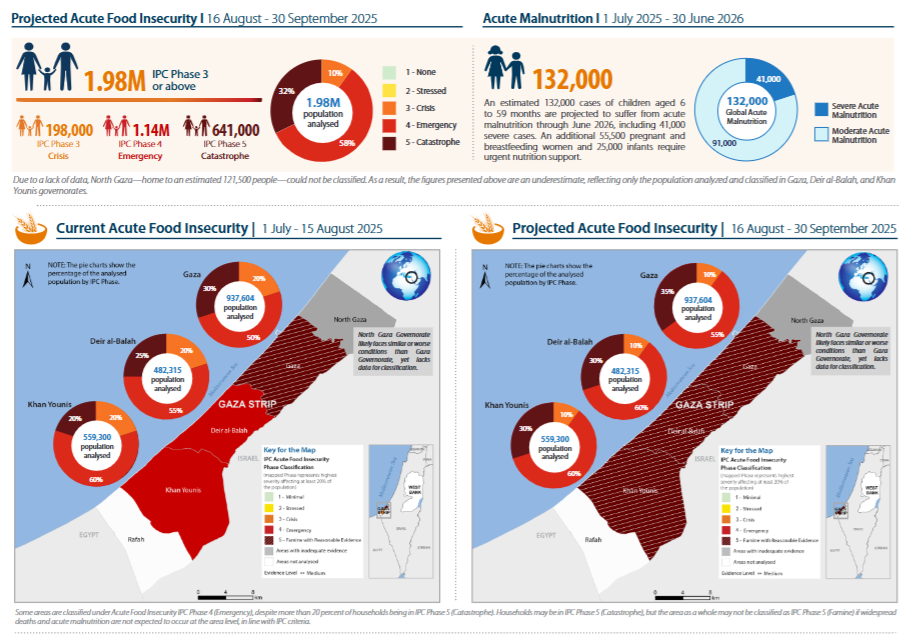
The IPC Famine Review Committee's urgent warning is clear: "As this Famine is entirely man-made, it can be halted and reversed. The time for debate and hesitation has passed, starvation is present and is rapidly spreading. There should be no doubt in anyone’s mind that an immediate, at-scale response is needed. Any further delay - even by days - will result in a totally unacceptable escalation of Famine-related mortality."
For detailed data and analysis, see the full IPC reports at: https://www.ipcinfo.org/ipcinfo-website/countries-in-focus-archive/issue-134/en/
Global leaders have already condemned the deliberate starvation of the population in Gaza. Foreign ministers of 24 countries - including the UK, Japan, Canada, Australia, France, Belgium, Denmark, the Netherlands and Germany - have signed a joint statement addressing Israeli restrictions that prevent NGOs from providing life-saving aid and urging immediate action for unimpeded humanitarian access to Gaza. FAO, UNICEF, WFP and WHO have already reiterated their call for immediate and unhindered humanitarian access to curb deaths from hunger and malnutrition.
Why food experts must act
Beyond the obvious humanitarian catastrophe that this represents, our expertise in food security, nutrition and food systems gives us unique insight into the deliberate nature of what is happening in Gaza. We know the difference between natural food crises and engineered starvation. This is not drought, crop failure or natural disaster - this is the systematic use of hunger as a weapon.
Every day, children are dying from malnutrition in a region where food warehouses sit full just few kilometres away. Mothers are watching their babies waste away not because food does not exist, but because it is deliberately blocked. Agricultural land that could feed families is being destroyed, not by nature, but by design.
We witness the methodical destruction unfolding. We see the deliberate targeting of food systems being systematically destroyed. We watch hunger being weaponised as our food security principles are inverted into tools for starvation. We see decades of agricultural development, the kind we research and advocate for, reduced to rubble in what amounts to the erasure of food futures. This represents not just a humanitarian catastrophe, but a direct assault on everything our work stands for.
Our demands
We call on academic institutions, universities, research councils, professional associations, food businesses and industry leaders, policymaking groups and international NGOs to pressure the Israeli government to:
- Allow immediate, large-scale and completely unobstructed humanitarian access through all entry points (land, air and sea) to deliver lifesaving assistance including food, nutrition, medical supplies, shelter materials, fuel, cooking gas, clean water and agricultural inputs to all people across the Gaza Strip
- Stop targeting civilians, humanitarian workers and critical food infrastructure including bakeries, agricultural facilities and distribution sites across the Gaza Strip
- Agree to immediate and sustained ceasefire to prevent further loss of life and famine from spreading further
Long-term commitments
- Restore and allow rebuilding of local food production, commercial flows, market systems and essential services
- Facilitate support for Palestinian researchers and agricultural experts in documenting and rebuilding food systems
- Cooperate with investigations into war crimes related to the deliberate starvation of civilians and ensure full accountability for the use of food as a weapon of war
The precedent this sets
If the international community allows food to be weaponised with impunity in Gaza, it sets a dangerous precedent for conflicts worldwide. Hunger is often both a cause and consequence of conflict and breaking this cycle requires decisive action now.
Who we are
This petition is signed by:
- Food systems researchers and scholars
- Nutrition scientists and public health experts
- Agricultural economists and policy analysts
- Graduate students in food-related disciplines
- Professionals in food security and development
- Food industry executives and representatives
- Restaurant and hospitality professionals
- Agricultural producers and farmers
- Allied researchers in environmental science, sociology and anthropology, social and political psychology, public policy and public health, international relations, war studies and human rights law
The time for statements of concern has passed. We demand immediate action to end this man-made famine and ensure that food is never again used as a weapon of war.
Sign this petition if you work in food systems, nutrition, agriculture, food policy or related fields - including food business and food service industry - and believe that our professional expertise obligates us to speak out against the weaponisation of hunger.
Share this petition with colleagues in your department, professional networks and academic associations. Tag your institution and professional organisations when sharing.
#FoodResearchersAgainstFamine #AcademicResponsibility #GazaFamine #FoodSecurity #HumanRights

3,654
The Issue
As food systems researchers, nutrition scientists, agricultural economists, food policy experts and industry professionals committed to food security and sustainable food futures, we cannot remain silent while over half a million people face famine conditions in Gaza.
Famine has been confirmed for the first time in Gaza. On August 22nd, The Integrated Food Security Phase Classification (IPC) Famine Review Committee - the UN-backed global authority on famine classification - has officially determined that Famine (IPC Phase 5) is currently occurring in the Gaza Governorate. This affects over 500,000 people experiencing extreme food deprivation, acute malnutrition and starvation-related deaths, with famine conditions spreading rapidly across Gaza. By the end of September, the IPC predicts more than 640,000 people will face Catastrophic levels of food insecurity (IPC Phase 5), with an additional 1.14 million in Emergency (IPC Phase 4) conditions.
The IPC Famine Review Committee's urgent warning is clear: "As this Famine is entirely man-made, it can be halted and reversed. The time for debate and hesitation has passed, starvation is present and is rapidly spreading. There should be no doubt in anyone’s mind that an immediate, at-scale response is needed. Any further delay - even by days - will result in a totally unacceptable escalation of Famine-related mortality."
For detailed data and analysis, see the full IPC reports at: https://www.ipcinfo.org/ipcinfo-website/countries-in-focus-archive/issue-134/en/
Global leaders have already condemned the deliberate starvation of the population in Gaza. Foreign ministers of 24 countries - including the UK, Japan, Canada, Australia, France, Belgium, Denmark, the Netherlands and Germany - have signed a joint statement addressing Israeli restrictions that prevent NGOs from providing life-saving aid and urging immediate action for unimpeded humanitarian access to Gaza. FAO, UNICEF, WFP and WHO have already reiterated their call for immediate and unhindered humanitarian access to curb deaths from hunger and malnutrition.
Why food experts must act
Beyond the obvious humanitarian catastrophe that this represents, our expertise in food security, nutrition and food systems gives us unique insight into the deliberate nature of what is happening in Gaza. We know the difference between natural food crises and engineered starvation. This is not drought, crop failure or natural disaster - this is the systematic use of hunger as a weapon.
Every day, children are dying from malnutrition in a region where food warehouses sit full just few kilometres away. Mothers are watching their babies waste away not because food does not exist, but because it is deliberately blocked. Agricultural land that could feed families is being destroyed, not by nature, but by design.
We witness the methodical destruction unfolding. We see the deliberate targeting of food systems being systematically destroyed. We watch hunger being weaponised as our food security principles are inverted into tools for starvation. We see decades of agricultural development, the kind we research and advocate for, reduced to rubble in what amounts to the erasure of food futures. This represents not just a humanitarian catastrophe, but a direct assault on everything our work stands for.
Our demands
We call on academic institutions, universities, research councils, professional associations, food businesses and industry leaders, policymaking groups and international NGOs to pressure the Israeli government to:
- Allow immediate, large-scale and completely unobstructed humanitarian access through all entry points (land, air and sea) to deliver lifesaving assistance including food, nutrition, medical supplies, shelter materials, fuel, cooking gas, clean water and agricultural inputs to all people across the Gaza Strip
- Stop targeting civilians, humanitarian workers and critical food infrastructure including bakeries, agricultural facilities and distribution sites across the Gaza Strip
- Agree to immediate and sustained ceasefire to prevent further loss of life and famine from spreading further
Long-term commitments
- Restore and allow rebuilding of local food production, commercial flows, market systems and essential services
- Facilitate support for Palestinian researchers and agricultural experts in documenting and rebuilding food systems
- Cooperate with investigations into war crimes related to the deliberate starvation of civilians and ensure full accountability for the use of food as a weapon of war
The precedent this sets
If the international community allows food to be weaponised with impunity in Gaza, it sets a dangerous precedent for conflicts worldwide. Hunger is often both a cause and consequence of conflict and breaking this cycle requires decisive action now.
Who we are
This petition is signed by:
- Food systems researchers and scholars
- Nutrition scientists and public health experts
- Agricultural economists and policy analysts
- Graduate students in food-related disciplines
- Professionals in food security and development
- Food industry executives and representatives
- Restaurant and hospitality professionals
- Agricultural producers and farmers
- Allied researchers in environmental science, sociology and anthropology, social and political psychology, public policy and public health, international relations, war studies and human rights law
The time for statements of concern has passed. We demand immediate action to end this man-made famine and ensure that food is never again used as a weapon of war.
Sign this petition if you work in food systems, nutrition, agriculture, food policy or related fields - including food business and food service industry - and believe that our professional expertise obligates us to speak out against the weaponisation of hunger.
Share this petition with colleagues in your department, professional networks and academic associations. Tag your institution and professional organisations when sharing.
#FoodResearchersAgainstFamine #AcademicResponsibility #GazaFamine #FoodSecurity #HumanRights
Supporter Voices
Petition Updates
Share this petition
Petition created on 26 August 2025