

FNB App Academy & IT Varsity: Petition for Accountability and Regulatory Oversight
The Issue
1. Who is affected?
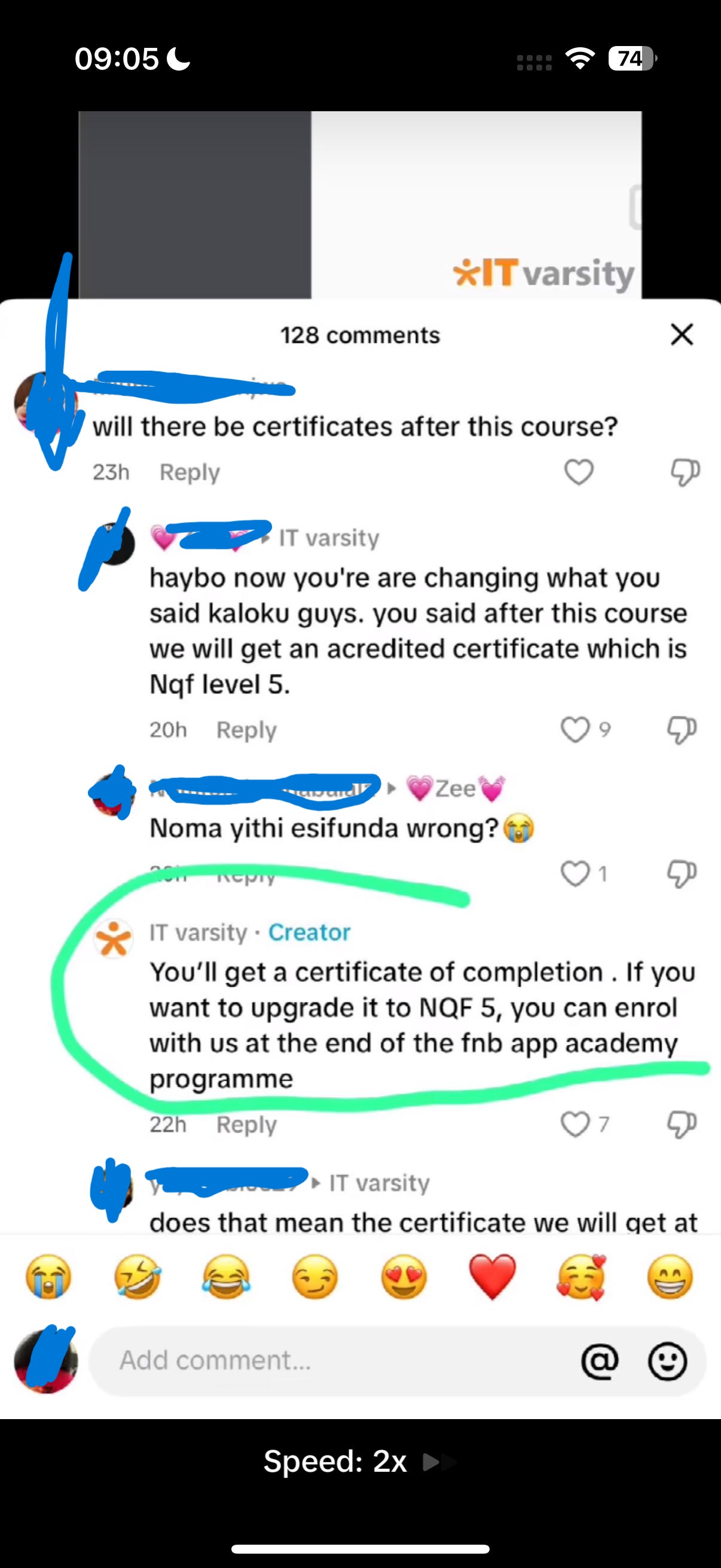
Approximately 250,000 South Africans, predominantly from economically disadvantaged backgrounds, enrolled in the FNB App Academy's 9-week online coding program, co-hosted by IT Varsity. The program was widely advertised as free and promised participants a nationally recognized NQF Level 5 certificate upon completion. Many participants invested significant personal resources, including borrowing money and incurring data costs, based on these assurances. However, during the program, participants were informed that obtaining the promised certificate required additional payment, contradicting the initial representations.
2. What is at stake?
The integrity of South Africa's educational and consumer protection systems is at risk. If such misrepresentations go unaddressed, it sets a dangerous precedent, allowing institutions to exploit vulnerable populations under the guise of free education. This undermines public trust in educational programs and the regulatory bodies meant to oversee them. Furthermore, it jeopardizes the credibility of genuine qualifications and the National Qualifications Framework (NQF) system.
3. Why is now the time to act?
Immediate action is imperative to prevent further exploitation and to uphold the principles enshrined in South African law. The Consumer Protection Act (CPA) and the National Qualifications Framework Amendment Act provide mechanisms to address such misconduct. Delaying action not only prolongs the harm to affected individuals but also erodes confidence in the nation's commitment to fair and honest dealings in education and consumer services.DTIC
4. Legal Framework and Potential Violations
a. Consumer Protection Act (CPA) No. 68 of 2008:
- Section 29: Prohibits false, misleading, or deceptive representations in marketing.
- Section 41: Addresses false, misleading, or deceptive representations regarding services.
- Section 48: Prohibits unfair, unreasonable, or unjust contract terms.
b. National Qualifications Framework (NQF) Amendment Act No. 12 of 2019:
- Section 32B(2): Makes it an offense for an institution to claim to offer a qualification registered on the NQF when it is not so registered.
- Section 32B(3): Makes it an offense to falsely or fraudulently claim to hold a qualification registered on the NQF.
- Section 32B(6): Stipulates penalties for offenses, including fines or imprisonment for up to five years.SAQA
5. Demands
We, the undersigned, call for the following actions:
a. Investigation by FNB Team:
Conduct a thorough internal investigation into the discrepancies between the program's promotional materials and the actual offerings.
Publicly disclose the findings and outline steps to rectify the situation.
b. Accountability from IT Varsity:
Issue a public apology acknowledging the misrepresentation and its impact on participants.
Provide the promised NQF Level 5 certificates to eligible participants at no additional cost.
c. Oversight by MICT SETA and SAQA:
Review IT Varsity's accreditation status and compliance with NQF standards.
Ensure that all educational institutions adhere to transparent and truthful marketing practices.
d. Regulatory Action by DHET and NCC:
Investigate potential violations of the CPA and NQF Amendment Act.
Implement measures to prevent similar occurrences in the future, including stricter regulations on educational program marketing.
6. Conclusion
The actions of FNB App Academy and IT Varsity have not only misled thousands of aspiring learners but have also caused financial and emotional distress. It is imperative that responsible parties are held accountable, and measures are put in place to protect consumers from such deceptive practices in the future.
Signatories:
The People of SOUTH AFRICA
Attachments:
Screenshots of promotional materials promising NQF Level 5 certification.
Correspondence between participants and program administrators.

Victory
The Issue
1. Who is affected?
Approximately 250,000 South Africans, predominantly from economically disadvantaged backgrounds, enrolled in the FNB App Academy's 9-week online coding program, co-hosted by IT Varsity. The program was widely advertised as free and promised participants a nationally recognized NQF Level 5 certificate upon completion. Many participants invested significant personal resources, including borrowing money and incurring data costs, based on these assurances. However, during the program, participants were informed that obtaining the promised certificate required additional payment, contradicting the initial representations.
2. What is at stake?
The integrity of South Africa's educational and consumer protection systems is at risk. If such misrepresentations go unaddressed, it sets a dangerous precedent, allowing institutions to exploit vulnerable populations under the guise of free education. This undermines public trust in educational programs and the regulatory bodies meant to oversee them. Furthermore, it jeopardizes the credibility of genuine qualifications and the National Qualifications Framework (NQF) system.
3. Why is now the time to act?
Immediate action is imperative to prevent further exploitation and to uphold the principles enshrined in South African law. The Consumer Protection Act (CPA) and the National Qualifications Framework Amendment Act provide mechanisms to address such misconduct. Delaying action not only prolongs the harm to affected individuals but also erodes confidence in the nation's commitment to fair and honest dealings in education and consumer services.DTIC
4. Legal Framework and Potential Violations
a. Consumer Protection Act (CPA) No. 68 of 2008:
- Section 29: Prohibits false, misleading, or deceptive representations in marketing.
- Section 41: Addresses false, misleading, or deceptive representations regarding services.
- Section 48: Prohibits unfair, unreasonable, or unjust contract terms.
b. National Qualifications Framework (NQF) Amendment Act No. 12 of 2019:
- Section 32B(2): Makes it an offense for an institution to claim to offer a qualification registered on the NQF when it is not so registered.
- Section 32B(3): Makes it an offense to falsely or fraudulently claim to hold a qualification registered on the NQF.
- Section 32B(6): Stipulates penalties for offenses, including fines or imprisonment for up to five years.SAQA
5. Demands
We, the undersigned, call for the following actions:
a. Investigation by FNB Team:
Conduct a thorough internal investigation into the discrepancies between the program's promotional materials and the actual offerings.
Publicly disclose the findings and outline steps to rectify the situation.
b. Accountability from IT Varsity:
Issue a public apology acknowledging the misrepresentation and its impact on participants.
Provide the promised NQF Level 5 certificates to eligible participants at no additional cost.
c. Oversight by MICT SETA and SAQA:
Review IT Varsity's accreditation status and compliance with NQF standards.
Ensure that all educational institutions adhere to transparent and truthful marketing practices.
d. Regulatory Action by DHET and NCC:
Investigate potential violations of the CPA and NQF Amendment Act.
Implement measures to prevent similar occurrences in the future, including stricter regulations on educational program marketing.
6. Conclusion
The actions of FNB App Academy and IT Varsity have not only misled thousands of aspiring learners but have also caused financial and emotional distress. It is imperative that responsible parties are held accountable, and measures are put in place to protect consumers from such deceptive practices in the future.
Signatories:
The People of SOUTH AFRICA
Attachments:
Screenshots of promotional materials promising NQF Level 5 certification.
Correspondence between participants and program administrators.
Petition Updates
Share this petition
Petition created on 23 May 2025