
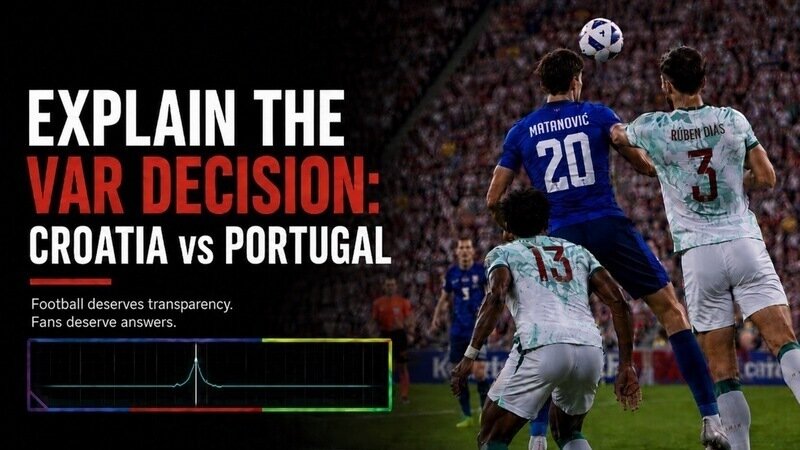
FIFA & IFAB: Explain the VAR Decision That Disallowed Croatia’s Goal
The Issue
We are calling on FIFA and IFAB to publicly explain the VAR/offside decision that disallowed Croatia’s goal against Portugal, and to clarify the standard for minimal contact, especially possible hair contact, in offside decisions.
This petition does not allege match-fixing, bad faith, or intentional wrongdoing. It is not an attack on Portugal, the referees, the players, FIFA, or IFAB. It is also not asking for the result of the match to be changed.
It is about one clear question:
What exact contact was judged, what evidence confirmed it, and how did that contact meet the standard required to disallow the goal?
FIFA’s public guidance states that a player’s hair should only be considered part of the body if it affects the movement or trajectory of the ball.
In the Croatia vs Portugal incident, the publicly available footage does not appear to show a clear change in the ball’s direction, speed, spin, or trajectory caused by Igor Matanović before the ball reaches the Portuguese player. Based on the footage available to fans, the visible change in the ball’s path appears to occur after contact with the Portuguese player, not clearly from Matanović.
If connected ball technology or sensor data was used to detect contact, that still does not fully answer the central question. Fans deserve to know what kind of contact was judged and how that contact satisfied the rule standard.
This petition is not asking FIFA to simply repeat that a touch was detected. It is asking FIFA and IFAB to clarify:
Was the alleged contact judged as hair contact, head contact, body contact, or something else?
If it was judged as head or body contact, what visual and/or sensor evidence confirmed that conclusion?
If it was judged as hair contact, how did that hair contact affect the movement or trajectory of the ball?
Can hair contact that does not affect the ball’s movement or trajectory be used to disallow a goal for offside?
Are sensor-detected impulses alone enough when the visible footage does not show a meaningful change in the ball’s path?
We respectfully request that FIFA and IFAB publish a clear explanation of the decision, including the evidence used and the rule standard applied.
This is about protecting trust in football.
If a decision is correct, it should be possible to explain it clearly. If a goal can be disallowed because of a barely visible or disputed touch, fans deserve to understand what was judged, what evidence was used, and how the rule was applied.
A goal should not be disallowed because of hair contact unless that hair contact actually affects the ball.
Clarify the rule. Show the evidence. Protect the game.

4
The Issue
We are calling on FIFA and IFAB to publicly explain the VAR/offside decision that disallowed Croatia’s goal against Portugal, and to clarify the standard for minimal contact, especially possible hair contact, in offside decisions.
This petition does not allege match-fixing, bad faith, or intentional wrongdoing. It is not an attack on Portugal, the referees, the players, FIFA, or IFAB. It is also not asking for the result of the match to be changed.
It is about one clear question:
What exact contact was judged, what evidence confirmed it, and how did that contact meet the standard required to disallow the goal?
FIFA’s public guidance states that a player’s hair should only be considered part of the body if it affects the movement or trajectory of the ball.
In the Croatia vs Portugal incident, the publicly available footage does not appear to show a clear change in the ball’s direction, speed, spin, or trajectory caused by Igor Matanović before the ball reaches the Portuguese player. Based on the footage available to fans, the visible change in the ball’s path appears to occur after contact with the Portuguese player, not clearly from Matanović.
If connected ball technology or sensor data was used to detect contact, that still does not fully answer the central question. Fans deserve to know what kind of contact was judged and how that contact satisfied the rule standard.
This petition is not asking FIFA to simply repeat that a touch was detected. It is asking FIFA and IFAB to clarify:
Was the alleged contact judged as hair contact, head contact, body contact, or something else?
If it was judged as head or body contact, what visual and/or sensor evidence confirmed that conclusion?
If it was judged as hair contact, how did that hair contact affect the movement or trajectory of the ball?
Can hair contact that does not affect the ball’s movement or trajectory be used to disallow a goal for offside?
Are sensor-detected impulses alone enough when the visible footage does not show a meaningful change in the ball’s path?
We respectfully request that FIFA and IFAB publish a clear explanation of the decision, including the evidence used and the rule standard applied.
This is about protecting trust in football.
If a decision is correct, it should be possible to explain it clearly. If a goal can be disallowed because of a barely visible or disputed touch, fans deserve to understand what was judged, what evidence was used, and how the rule was applied.
A goal should not be disallowed because of hair contact unless that hair contact actually affects the ball.
Clarify the rule. Show the evidence. Protect the game.
The Decision Makers
Petition Updates
Share this petition
Petition created on July 3, 2026