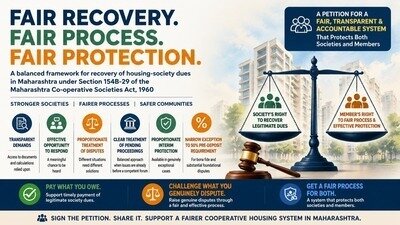

FAIR RECOVERY. FAIR PROCESS. FAIR PROTECTION.
The Issue
FAIR RECOVERY. FAIR PROCESS. FAIR PROTECTION.
A petition for a balanced, accountable system for recovering housing-society dues in Maharashtra
To:
The Government of Maharashtra, Department of Cooperation, Marketing and Textiles
The Commissioner for Cooperation and Registrar of Cooperative Societies, Maharashtra
The Minister of Cooperation, Government of Maharashtra
It usually starts with a letter
You open your inbox/ letter box one day and there's a notice from your housing society. It says you owe money — maybe a lot of money. Maybe you genuinely do. Maybe the calculation is wrong, or a payment you made was never recorded, or a repair charge was slapped on without anyone showing you the breakup. Maybe you're going through a rough patch financially and just need three more months.
Whatever it is, here's the question that decides what happens next: does the law give you a fair, timely way to say "wait, let's check this" — without treating you like someone trying to dodge a bill?
Right now, in Maharashtra, the honest answer is: not really.
This petition is about fixing that — without making it easier for people who are dodging their bills to keep dodging them.
We're not against recovery. We're for fairness in how it happens.
Section 154B-29 of the Maharashtra Co-operative Societies Act, 1960 gives housing societies a fast-track way to recover dues. That's necessary — a society can't run without maintenance, security, water, electricity, and upkeep being paid for on time, and someone who simply refuses to pay shouldn't be able to stall that forever using paperwork.
We agree with all of that. We are not asking for Section 154B-29 to be scrapped, for legitimate dues to be waived, or for anyone to get a free pass on maintenance.
What we're asking is simpler: build a process that can tell the difference between someone who won't pay and someone who is disputing what they're being asked to pay — and give the second person a real chance to be heard before recovery steamrolls the question.
Why this isn't a small technical point
A recovery process that can't distinguish a genuine dispute from a genuine default ends up punishing both kinds of people the same way. And because the process is largely paper-based, discretionary, and closed-door — the outcome in any individual case can end up depending less on the merits and more on who had better access, better documentation, or simply more time to push. That's not a comment on any one authority or any one case — it's what happens whenever a system runs on wide discretion with very little transparency built in. Tightening the process protects everyone, including the authorities who have to apply it.
Six situations that are NOT the same as "I just don't want to pay"
- Temporary hardship — a job loss, a medical emergency, retirement — where the person doesn't dispute owing the money, just needs a realistic payment plan instead of a lump-sum ultimatum.
- An accounting mix-up — a payment that was made but never credited, a duplicate charge, a wrong interest calculation. (Example: society says ₹1,50,000. Your records show ₹1,00,000 already paid. That's a ₹50,000 disagreement to sort out — not a ₹1,50,000 default.)
A dispute over one specific charge — you're not refusing to pay maintenance, you're disputing this one line item because of a documented service failure. - A dispute over whether the demand is even legal — was the Managing Committee actually authorised to levy this charge under the Act, the Rules, or the society's own Bye-laws? A majority vote doesn't automatically make a decision lawful.
- The same issue is already in front of a court or authority — recovery shouldn't proceed as if that pending case doesn't exist, but it also shouldn't automatically freeze just because someone filed something.
- Actual wilful non-payment — no dispute, no objection, just refusal. This is the one case where fast recovery should stay exactly as fast as it is today.
The current framework barely distinguishes between these. That's the gap.
What we're asking the Government of Maharashtra to do
1. Show the paperwork before recovery starts. A member should be able to see the statement of account, the calculation, the resolution, and the legal basis being relied on — not find out for the first time at the hearing.
2. Make the hearing a real hearing. Documents shared days before, and enough time to actually respond, not a formality that exists on paper only.
3. Sort disputes by type instead of one-size-fits-all. Undisputed dues → recover quickly. Accounting disputes → verify and correct. Hardship → structured payment plan. Legal disputes → proper adjudication.
4. Deal with pending court cases sensibly. A clear rule for what happens to recovery when the same issue is already before a court or authority — instead of leaving it to case-by-case discretion.
5. Allow proportionate interim relief in genuine cases — with reasons recorded, and only where the dispute is substantial, not just claimed.
6. Fix the 50% deposit trap. Right now, Section 154(2A) requires a member to deposit 50% of the disputed amount before a revision can even be heard on merits or granted interim relief — even in cases where the entire basis of the demand is what's being challenged. The Bombay High Court has already flagged that a revision can't be thrown out purely for non-deposit, but without one, no interim relief is possible either (Savitha Dinesh Shetty v. State of Maharashtra). We're asking for a narrow, reasoned exception for genuinely serious disputes — not a blanket waiver.
(The Bombay High Court's decisions in Sudhir Mangelal Agarwal v. Deputy Registrar and Vidya Niwas Co-operative Housing Society Ltd. show the same pattern repeating across cases: members struggling to get complete records, and registrars walking a fine line between a quick summary process and one that still has to genuinely apply its mind.)
What we are absolutely NOT asking for
❌ Abolishing Section 154B-29 ❌ Cancelling legitimate dues ❌ Letting anyone stop paying maintenance ❌ Automatic stays on every recovery case ❌ Automatic exemption from the 50% deposit ❌ Any protection for people who are simply refusing to pay
Why this affects you even if you've never gotten a notice
Most members never will. But nearly every long-time resident of a housing society has, at some point, disagreed with a maintenance bill, questioned a repair charge, or wondered whether a General Body resolution was actually valid. The question this petition asks isn't "are you a defaulter" — it's:
"If you genuinely disagree with what you're being asked to pay, does the system actually let you say so — and be heard?"
Right now, for most members, the honest answer is no. We think it should be yes.
PAY WHAT YOU OWE. CHALLENGE WHAT YOU GENUINELY DISPUTE. GET A FAIR PROCESS FOR BOTH.
FAIR RECOVERY. FAIR PROCESS. FAIR PROTECTION.
Please sign and share — a healthy cooperative housing system should protect societies from defaulters, and members from unfair recovery, at the same time.

38
The Issue
FAIR RECOVERY. FAIR PROCESS. FAIR PROTECTION.
A petition for a balanced, accountable system for recovering housing-society dues in Maharashtra
To:
The Government of Maharashtra, Department of Cooperation, Marketing and Textiles
The Commissioner for Cooperation and Registrar of Cooperative Societies, Maharashtra
The Minister of Cooperation, Government of Maharashtra
It usually starts with a letter
You open your inbox/ letter box one day and there's a notice from your housing society. It says you owe money — maybe a lot of money. Maybe you genuinely do. Maybe the calculation is wrong, or a payment you made was never recorded, or a repair charge was slapped on without anyone showing you the breakup. Maybe you're going through a rough patch financially and just need three more months.
Whatever it is, here's the question that decides what happens next: does the law give you a fair, timely way to say "wait, let's check this" — without treating you like someone trying to dodge a bill?
Right now, in Maharashtra, the honest answer is: not really.
This petition is about fixing that — without making it easier for people who are dodging their bills to keep dodging them.
We're not against recovery. We're for fairness in how it happens.
Section 154B-29 of the Maharashtra Co-operative Societies Act, 1960 gives housing societies a fast-track way to recover dues. That's necessary — a society can't run without maintenance, security, water, electricity, and upkeep being paid for on time, and someone who simply refuses to pay shouldn't be able to stall that forever using paperwork.
We agree with all of that. We are not asking for Section 154B-29 to be scrapped, for legitimate dues to be waived, or for anyone to get a free pass on maintenance.
What we're asking is simpler: build a process that can tell the difference between someone who won't pay and someone who is disputing what they're being asked to pay — and give the second person a real chance to be heard before recovery steamrolls the question.
Why this isn't a small technical point
A recovery process that can't distinguish a genuine dispute from a genuine default ends up punishing both kinds of people the same way. And because the process is largely paper-based, discretionary, and closed-door — the outcome in any individual case can end up depending less on the merits and more on who had better access, better documentation, or simply more time to push. That's not a comment on any one authority or any one case — it's what happens whenever a system runs on wide discretion with very little transparency built in. Tightening the process protects everyone, including the authorities who have to apply it.
Six situations that are NOT the same as "I just don't want to pay"
- Temporary hardship — a job loss, a medical emergency, retirement — where the person doesn't dispute owing the money, just needs a realistic payment plan instead of a lump-sum ultimatum.
- An accounting mix-up — a payment that was made but never credited, a duplicate charge, a wrong interest calculation. (Example: society says ₹1,50,000. Your records show ₹1,00,000 already paid. That's a ₹50,000 disagreement to sort out — not a ₹1,50,000 default.)
A dispute over one specific charge — you're not refusing to pay maintenance, you're disputing this one line item because of a documented service failure. - A dispute over whether the demand is even legal — was the Managing Committee actually authorised to levy this charge under the Act, the Rules, or the society's own Bye-laws? A majority vote doesn't automatically make a decision lawful.
- The same issue is already in front of a court or authority — recovery shouldn't proceed as if that pending case doesn't exist, but it also shouldn't automatically freeze just because someone filed something.
- Actual wilful non-payment — no dispute, no objection, just refusal. This is the one case where fast recovery should stay exactly as fast as it is today.
The current framework barely distinguishes between these. That's the gap.
What we're asking the Government of Maharashtra to do
1. Show the paperwork before recovery starts. A member should be able to see the statement of account, the calculation, the resolution, and the legal basis being relied on — not find out for the first time at the hearing.
2. Make the hearing a real hearing. Documents shared days before, and enough time to actually respond, not a formality that exists on paper only.
3. Sort disputes by type instead of one-size-fits-all. Undisputed dues → recover quickly. Accounting disputes → verify and correct. Hardship → structured payment plan. Legal disputes → proper adjudication.
4. Deal with pending court cases sensibly. A clear rule for what happens to recovery when the same issue is already before a court or authority — instead of leaving it to case-by-case discretion.
5. Allow proportionate interim relief in genuine cases — with reasons recorded, and only where the dispute is substantial, not just claimed.
6. Fix the 50% deposit trap. Right now, Section 154(2A) requires a member to deposit 50% of the disputed amount before a revision can even be heard on merits or granted interim relief — even in cases where the entire basis of the demand is what's being challenged. The Bombay High Court has already flagged that a revision can't be thrown out purely for non-deposit, but without one, no interim relief is possible either (Savitha Dinesh Shetty v. State of Maharashtra). We're asking for a narrow, reasoned exception for genuinely serious disputes — not a blanket waiver.
(The Bombay High Court's decisions in Sudhir Mangelal Agarwal v. Deputy Registrar and Vidya Niwas Co-operative Housing Society Ltd. show the same pattern repeating across cases: members struggling to get complete records, and registrars walking a fine line between a quick summary process and one that still has to genuinely apply its mind.)
What we are absolutely NOT asking for
❌ Abolishing Section 154B-29 ❌ Cancelling legitimate dues ❌ Letting anyone stop paying maintenance ❌ Automatic stays on every recovery case ❌ Automatic exemption from the 50% deposit ❌ Any protection for people who are simply refusing to pay
Why this affects you even if you've never gotten a notice
Most members never will. But nearly every long-time resident of a housing society has, at some point, disagreed with a maintenance bill, questioned a repair charge, or wondered whether a General Body resolution was actually valid. The question this petition asks isn't "are you a defaulter" — it's:
"If you genuinely disagree with what you're being asked to pay, does the system actually let you say so — and be heard?"
Right now, for most members, the honest answer is no. We think it should be yes.
PAY WHAT YOU OWE. CHALLENGE WHAT YOU GENUINELY DISPUTE. GET A FAIR PROCESS FOR BOTH.
FAIR RECOVERY. FAIR PROCESS. FAIR PROTECTION.
Please sign and share — a healthy cooperative housing system should protect societies from defaulters, and members from unfair recovery, at the same time.
The Decision Makers

Petition Updates
Share this petition
Petition created on 3 August 2026