
Expand Evanston's leaf blower ban!
The Issue
Evanston's seasonal leaf blower ban is not enforced and does not do enough to support the City's Climate Action and Resilience Plan. Leaf blowers are terrible for our health and our world, and it's time for Evanston to expand the seasonal ban, shorten blower hours, include electric- and propane-powered blowers, and penalize homeowners who violate the ordinance.
Signers of this petition support the City Council's adoption of Ordinance 19-O-21, Amending the City of Evanston's Leaf Blower Policy. Changes to the ordinance include:
1. Shortening the hours of use for leaf blowers on weekdays and weekends.
2. Eliminating use on holidays.
3. Reducing the number of days a year leaf blowers can be used.
4. Eliminating the terms “gasoline powered" and "backpack mounted or handheld" from the ordinance.
6. Establishing that the property owner will be the primary target for enforcement.
Public safety and health risks of leaf blowers:
1. Leaf blowers expose children, landscapers, and others to high levels of toxic and carcinogenic emissions, including benzene, 1,3 butadiene, and formaldehyde, which are among the four top cancer-causing compounds.
2. Short-term leaf blower exposure can increase the risks of asthma and respiratory problems, cancer, heart attack, stroke, congestive heart failure, chronic obstructive lung disease, central nervous system effects, dementia, reproductive and developmental harm, and early death. Children are especially at risk because of their developing lungs.
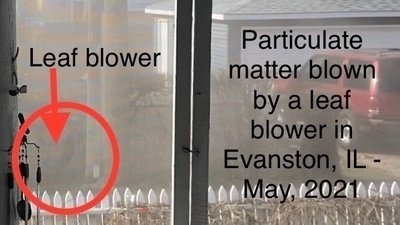
3. Gas and electric leaf blowers spray particulate matter (PM 2.5), which includes animal feces, fertilizers, pesticides, allergens, and more. A single leaf blower emits tens of millions of micrograms of PM 2.5 every hour at ground level. PM 2.5 can remain suspended in the air for a week. Once inhaled, it lodges deep in the lungs and never leaves the body. Breathing particle pollution causes lung cancer. The number of deaths attributable to PM 2.5 in 2019 was 47,800 in the U.S.
4. Gas blowers produce high levels of noise (115 decibels) that are literally deafening and have been deemed unsafe for workers and the public by OSHA, EPA, WHO, and NIOSH. The noise poses serious health risks, hearing loss, hypertension, headaches, and productivity loss. Leaf blower noise also has a negative impact on learning and cognitive development in children.
Acceleration of climate change:
1. Besides releasing high levels of toxic and carcinogenic emissions, leaf blowers also release pollutants that create ground-level ozone, the major component of smog and a pollutant that inhibits plant growth and impairs lung function.
2. Leaf blowers account for 90% of fine particulate matter emissions from lawn equipment. The American Lung Association gave Cook County an "F" for air pollution and ranked the Chicago area #16 of 229 for most polluted by ozone, #15 of 204 for most annual particle pollution, and #50 of 216 for most 24-hour particle pollution.
3. Gas-powered leaf blowers burn fossil fuels. Emissions from burning fossil fuels are the primary cause of climate change. One hour of leaf blower use emits smog-forming pollution comparable to driving a 2017 Toyota Camry 1100 miles from Evanston to Houston, Texas. That's because gas leaf blowers use obsolete technology: the two-stroke engine. A two-stroke engine doesn't have a catalytic converter like your car does, so it spews out one-third of its fuel as an unburned aerosol.
Environmental disaster:
1. Gas and electric leaf blowers are an eco-disaster. Their 200 mph winds destroy pollinator habitats and beneficial insects that keep the world going -- we cannot survive without them! Mass insect die-off is having a direct effect on declining numbers of birds, and scientists have sounded the alarm of an insect Armageddon: current estimated losses of 2.5% per year mean that all insect life could vanish from Earth within 100 years.
2. The winds generated by leaf blowers also deplete topsoil, which covers tree roots and helps plants grow. The same winds dehydrate plants and cause soil compaction, which makes growing conditions difficult.
3. Songbirds' reproductive success is ultimately diminished by noise, which can also make caterpillar's hearts beat faster.
Join our cause! Sign our petition and tell City Council that it's time to expand the ban!
For more information, please read "What's Wrong with Leaf Blowers," written by Allison Sloan of Natural Habitat Evanston. You can also review Evanston's Climate Action and Resilience Plan, which aims to phase out gas- and propane-powered leaf blowers.

Petition Closed
The Issue
Evanston's seasonal leaf blower ban is not enforced and does not do enough to support the City's Climate Action and Resilience Plan. Leaf blowers are terrible for our health and our world, and it's time for Evanston to expand the seasonal ban, shorten blower hours, include electric- and propane-powered blowers, and penalize homeowners who violate the ordinance.
Signers of this petition support the City Council's adoption of Ordinance 19-O-21, Amending the City of Evanston's Leaf Blower Policy. Changes to the ordinance include:
1. Shortening the hours of use for leaf blowers on weekdays and weekends.
2. Eliminating use on holidays.
3. Reducing the number of days a year leaf blowers can be used.
4. Eliminating the terms “gasoline powered" and "backpack mounted or handheld" from the ordinance.
6. Establishing that the property owner will be the primary target for enforcement.
Public safety and health risks of leaf blowers:
1. Leaf blowers expose children, landscapers, and others to high levels of toxic and carcinogenic emissions, including benzene, 1,3 butadiene, and formaldehyde, which are among the four top cancer-causing compounds.
2. Short-term leaf blower exposure can increase the risks of asthma and respiratory problems, cancer, heart attack, stroke, congestive heart failure, chronic obstructive lung disease, central nervous system effects, dementia, reproductive and developmental harm, and early death. Children are especially at risk because of their developing lungs.
3. Gas and electric leaf blowers spray particulate matter (PM 2.5), which includes animal feces, fertilizers, pesticides, allergens, and more. A single leaf blower emits tens of millions of micrograms of PM 2.5 every hour at ground level. PM 2.5 can remain suspended in the air for a week. Once inhaled, it lodges deep in the lungs and never leaves the body. Breathing particle pollution causes lung cancer. The number of deaths attributable to PM 2.5 in 2019 was 47,800 in the U.S.
4. Gas blowers produce high levels of noise (115 decibels) that are literally deafening and have been deemed unsafe for workers and the public by OSHA, EPA, WHO, and NIOSH. The noise poses serious health risks, hearing loss, hypertension, headaches, and productivity loss. Leaf blower noise also has a negative impact on learning and cognitive development in children.
Acceleration of climate change:
1. Besides releasing high levels of toxic and carcinogenic emissions, leaf blowers also release pollutants that create ground-level ozone, the major component of smog and a pollutant that inhibits plant growth and impairs lung function.
2. Leaf blowers account for 90% of fine particulate matter emissions from lawn equipment. The American Lung Association gave Cook County an "F" for air pollution and ranked the Chicago area #16 of 229 for most polluted by ozone, #15 of 204 for most annual particle pollution, and #50 of 216 for most 24-hour particle pollution.
3. Gas-powered leaf blowers burn fossil fuels. Emissions from burning fossil fuels are the primary cause of climate change. One hour of leaf blower use emits smog-forming pollution comparable to driving a 2017 Toyota Camry 1100 miles from Evanston to Houston, Texas. That's because gas leaf blowers use obsolete technology: the two-stroke engine. A two-stroke engine doesn't have a catalytic converter like your car does, so it spews out one-third of its fuel as an unburned aerosol.
Environmental disaster:
1. Gas and electric leaf blowers are an eco-disaster. Their 200 mph winds destroy pollinator habitats and beneficial insects that keep the world going -- we cannot survive without them! Mass insect die-off is having a direct effect on declining numbers of birds, and scientists have sounded the alarm of an insect Armageddon: current estimated losses of 2.5% per year mean that all insect life could vanish from Earth within 100 years.
2. The winds generated by leaf blowers also deplete topsoil, which covers tree roots and helps plants grow. The same winds dehydrate plants and cause soil compaction, which makes growing conditions difficult.
3. Songbirds' reproductive success is ultimately diminished by noise, which can also make caterpillar's hearts beat faster.
Join our cause! Sign our petition and tell City Council that it's time to expand the ban!
For more information, please read "What's Wrong with Leaf Blowers," written by Allison Sloan of Natural Habitat Evanston. You can also review Evanston's Climate Action and Resilience Plan, which aims to phase out gas- and propane-powered leaf blowers.
The Decision Makers
Petition Updates
Share this petition
Petition created on May 21, 2021