
End the Use of Stigmatizing HIV Language at NIAID
The Issue
Jeanne Marrazzo, MD, MPH
Director of NIAID
Bethesda, MD 20814
Re: Eliminating Stigmatizing HIV Language at NIAID
Dear Dr. Marrazzo:
We wish to welcome you to NIAID and hope that we will have a long and successful collegial relationship. To that end, the undersigned are writing to request that important changes in HIV-related language policy be established across NIAID to create continuing respect for clinical trial participants and to promote uniformity across NIAID and the overall research community. The HIV community has frequently endured the use of terms that many people find offensive and dehumanizing, like “HIV-infected person, people, individual(s), populations” and “subjects” in NIAID published documents, including grant-related documents, NIAID-funded meeting material, and by NIAID-funded researchers at other public meetings when referring to people with HIV and research participants. More affirmative People First language is required to reduce stigma, show respect for individuals who are living with HIV, and promote trust between scientists and community members. It is crucial for scientists to be mindful of their language choices. Trust and respectful relationships with the public and the communities from which they wish to recruit for clinical trials are essential.
At first glance, our request may seem like unnecessary political correctness to many researchers. But using stigmatizing language, such as “HIV-infected person, people, individual(s), populations,” and “subjects” to describe people with HIV, or in HIV research terminology, increases the stigma and stress people experience daily and further engenders community mistrust. The term “sterilizing” cure for HIV also harkens back to Nazi experiments and even heinous practices in our own country experienced by women in recent times. The horrible examples of Tuskegee and Henrietta Lacks have also created lingering mistrust of scientific research among women and people of color disproportionately affected by HIV. Such offensive terminology continues to cause a chilling effect on the enrollment of women and BIPOC individuals in trials, an essential goal that so many of us have worked so diligently to increase over many years.
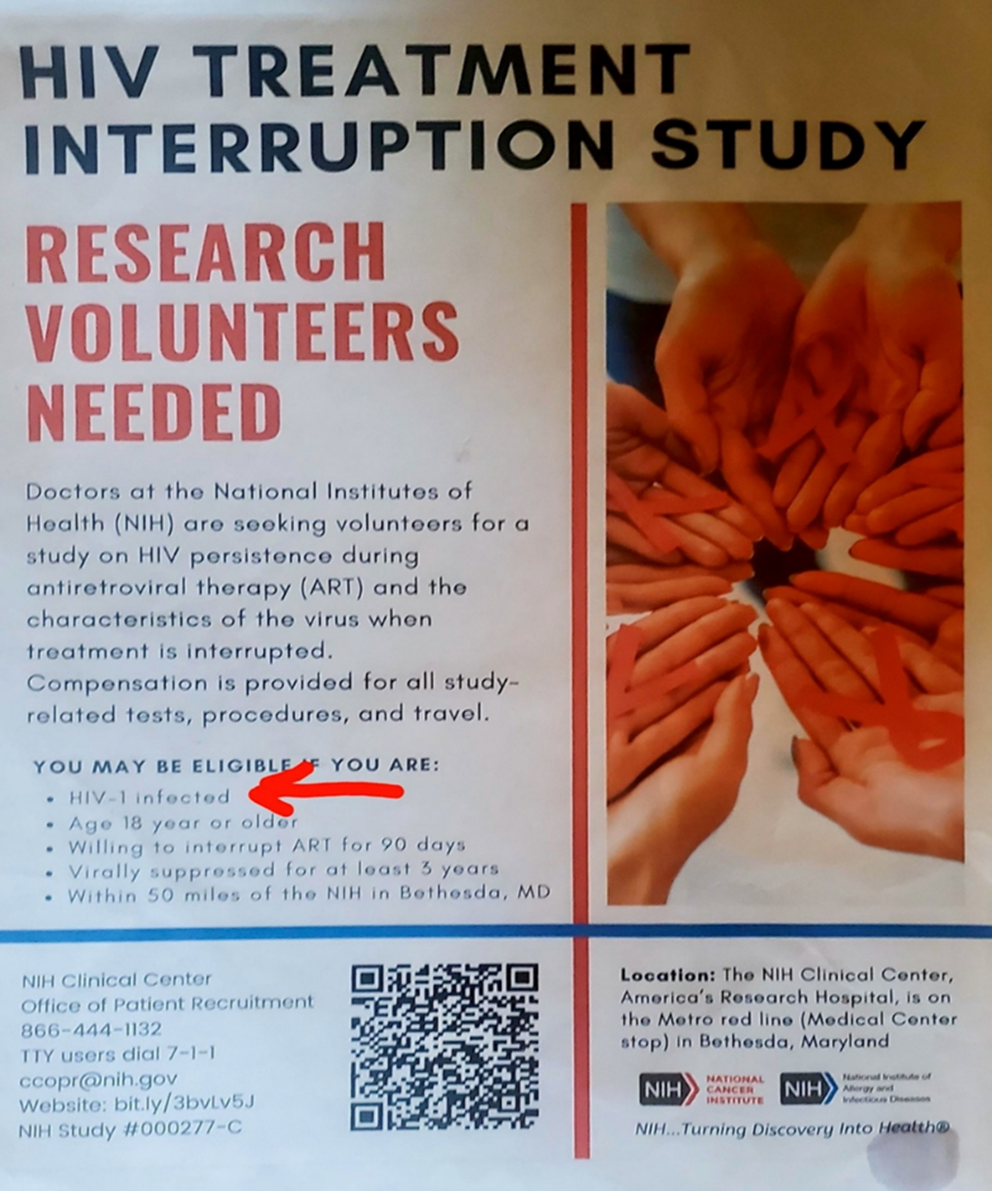
Because the use of these terms continues to be used in NIAID grant documents and publications, at NIAID-sponsored meetings, and by NIAID-funded investigators, promoting stigma and mistrust, we are calling on you as the new NIAID Director to create a new era, fostering the use of appropriate and person-centered language for a new generation. Stigmatizing HIV language generally takes three forms: (1) marking or labeling someone as “other,” (2) assigning responsibility or blame, and (3) invoking danger or peril. Many NIAID employees and NIAID-funded investigators refrain from using offensive language. Others do not. The use of “subjects” and/or “HIV-infected person, people, individual(s), populations” in the NIAID meeting announcement and by various NIAID-funded researchers at the recent 2023 Strategies for an HIV Cure meeting held on October 12–13, 2023, is strong evidence that there is at best a poor understanding of the importance of never labelling people with these offensive terms and of using "people-first" language, which acknowledges that a person is so much more than a disease or condition. A flyer for a cure-related study at the NIH Clinical Center presented at the same meeting uses the term "HIV-infected" which we as advocates and the NIAID Language Guide explicitly recommend avoiding. 1
There is currently no written requirement by NIAID to use non-stigmatizing HIV language in grant submissions, meeting presentations, or abstracts, nor is there any formal review for offensive language in presentations, abstracts, or publications. Formal abstract review for offensive language is simple enough to include in the current review process.
Many people do not realize many terms are offensive and stigmatizing to people with HIV and affected communities, and they use old terms out of habit. They are not purposefully trying to be offensive. That is exactly why we are making our requests directly to you, since you can help effect the necessary changes much more expeditiously across NIAID.
We have been working with both the Conference for Retroviruses and Opportunistic Infections (CROI) and the International AIDS Society (IAS) to create a language policy.2 NIAID leadership creating clear, concise, and transparent efforts to minimize the use of stigmatizing language will significantly help improve community trust in government and the research endeavors. Ensuring appropriate and accurate language at NIAID and for NIAID-funded research projects would be a huge step towards reducing barriers to clinical research, including the accrual and retention of people with HIV.
NIAID has created an excellent HIV language preference guide, which is in the process of being updated. 3 Although this guide outlines very appropriate non-stigmatizing person-first language, it is not always used by the NIAID in grants, publications, or by NIAID-funded scientists. The NIAID language guide lists examples of stigmatizing language and provides suggestions for preferred alternatives for NIAID employees. We are requesting that a version of the NIAID language preferences guide, including, but not limited to, the following, become the required language policy for NIAID employees, grants, abstracts, and publications, as well as NIAID-funded research projects and researchers. Such mandatory requirements might be listed separately for other “guidelines” provisions as well.
o Using affirmative person-based language, such as people with HIV, instead of HIV-infected subjects.
o Using participants or volunteers instead of subjects
o Not using the word sterilizing to describe any aspect of HIV cure research
The first era of NIAID/community collaboration championed by Dr. Anthony Fauci in collaboration with the HIV-affected community changed the face of research forever. We, the undersigned members of the HIV community and HIV advocates, hope you will be guided by that marvelous example when considering the important requests submitted by members of the first wave of community activists, along with a new generation of community members who look forward to hearing from you and working with you in this regard and on other future projects.
Thank you for considering our requests. We wish you the very best of health and success in all your endeavors as NIAID Director and hope to receive a response from you at your earliest convenience.
Attachment and citations:
1. The flyer for a cure-related study at the NIH Clinical Center.
2. CROI HIV language policies:
https://www.croiconference.org/appropriate-terminology/
and correspondence link: https://shorturl.at/loRS6
IAS HIV language policies: https://www.iasociety.org/language-matters
3. NIAID Language Guide: https://www.niaid.nih.gov/sites/default/files/NIAID%20HIV%20Language%20Guide%20071520%20revised_%20updated.pdf

Victory
The Issue
Jeanne Marrazzo, MD, MPH
Director of NIAID
Bethesda, MD 20814
Re: Eliminating Stigmatizing HIV Language at NIAID
Dear Dr. Marrazzo:
We wish to welcome you to NIAID and hope that we will have a long and successful collegial relationship. To that end, the undersigned are writing to request that important changes in HIV-related language policy be established across NIAID to create continuing respect for clinical trial participants and to promote uniformity across NIAID and the overall research community. The HIV community has frequently endured the use of terms that many people find offensive and dehumanizing, like “HIV-infected person, people, individual(s), populations” and “subjects” in NIAID published documents, including grant-related documents, NIAID-funded meeting material, and by NIAID-funded researchers at other public meetings when referring to people with HIV and research participants. More affirmative People First language is required to reduce stigma, show respect for individuals who are living with HIV, and promote trust between scientists and community members. It is crucial for scientists to be mindful of their language choices. Trust and respectful relationships with the public and the communities from which they wish to recruit for clinical trials are essential.
At first glance, our request may seem like unnecessary political correctness to many researchers. But using stigmatizing language, such as “HIV-infected person, people, individual(s), populations,” and “subjects” to describe people with HIV, or in HIV research terminology, increases the stigma and stress people experience daily and further engenders community mistrust. The term “sterilizing” cure for HIV also harkens back to Nazi experiments and even heinous practices in our own country experienced by women in recent times. The horrible examples of Tuskegee and Henrietta Lacks have also created lingering mistrust of scientific research among women and people of color disproportionately affected by HIV. Such offensive terminology continues to cause a chilling effect on the enrollment of women and BIPOC individuals in trials, an essential goal that so many of us have worked so diligently to increase over many years.
Because the use of these terms continues to be used in NIAID grant documents and publications, at NIAID-sponsored meetings, and by NIAID-funded investigators, promoting stigma and mistrust, we are calling on you as the new NIAID Director to create a new era, fostering the use of appropriate and person-centered language for a new generation. Stigmatizing HIV language generally takes three forms: (1) marking or labeling someone as “other,” (2) assigning responsibility or blame, and (3) invoking danger or peril. Many NIAID employees and NIAID-funded investigators refrain from using offensive language. Others do not. The use of “subjects” and/or “HIV-infected person, people, individual(s), populations” in the NIAID meeting announcement and by various NIAID-funded researchers at the recent 2023 Strategies for an HIV Cure meeting held on October 12–13, 2023, is strong evidence that there is at best a poor understanding of the importance of never labelling people with these offensive terms and of using "people-first" language, which acknowledges that a person is so much more than a disease or condition. A flyer for a cure-related study at the NIH Clinical Center presented at the same meeting uses the term "HIV-infected" which we as advocates and the NIAID Language Guide explicitly recommend avoiding. 1
There is currently no written requirement by NIAID to use non-stigmatizing HIV language in grant submissions, meeting presentations, or abstracts, nor is there any formal review for offensive language in presentations, abstracts, or publications. Formal abstract review for offensive language is simple enough to include in the current review process.
Many people do not realize many terms are offensive and stigmatizing to people with HIV and affected communities, and they use old terms out of habit. They are not purposefully trying to be offensive. That is exactly why we are making our requests directly to you, since you can help effect the necessary changes much more expeditiously across NIAID.
We have been working with both the Conference for Retroviruses and Opportunistic Infections (CROI) and the International AIDS Society (IAS) to create a language policy.2 NIAID leadership creating clear, concise, and transparent efforts to minimize the use of stigmatizing language will significantly help improve community trust in government and the research endeavors. Ensuring appropriate and accurate language at NIAID and for NIAID-funded research projects would be a huge step towards reducing barriers to clinical research, including the accrual and retention of people with HIV.
NIAID has created an excellent HIV language preference guide, which is in the process of being updated. 3 Although this guide outlines very appropriate non-stigmatizing person-first language, it is not always used by the NIAID in grants, publications, or by NIAID-funded scientists. The NIAID language guide lists examples of stigmatizing language and provides suggestions for preferred alternatives for NIAID employees. We are requesting that a version of the NIAID language preferences guide, including, but not limited to, the following, become the required language policy for NIAID employees, grants, abstracts, and publications, as well as NIAID-funded research projects and researchers. Such mandatory requirements might be listed separately for other “guidelines” provisions as well.
o Using affirmative person-based language, such as people with HIV, instead of HIV-infected subjects.
o Using participants or volunteers instead of subjects
o Not using the word sterilizing to describe any aspect of HIV cure research
The first era of NIAID/community collaboration championed by Dr. Anthony Fauci in collaboration with the HIV-affected community changed the face of research forever. We, the undersigned members of the HIV community and HIV advocates, hope you will be guided by that marvelous example when considering the important requests submitted by members of the first wave of community activists, along with a new generation of community members who look forward to hearing from you and working with you in this regard and on other future projects.
Thank you for considering our requests. We wish you the very best of health and success in all your endeavors as NIAID Director and hope to receive a response from you at your earliest convenience.
Attachment and citations:
1. The flyer for a cure-related study at the NIH Clinical Center.
2. CROI HIV language policies:
https://www.croiconference.org/appropriate-terminology/
and correspondence link: https://shorturl.at/loRS6
IAS HIV language policies: https://www.iasociety.org/language-matters
3. NIAID Language Guide: https://www.niaid.nih.gov/sites/default/files/NIAID%20HIV%20Language%20Guide%20071520%20revised_%20updated.pdf
The Decision Makers

Supporter Voices
Petition Updates
Share this petition
Petition created on February 5, 2024