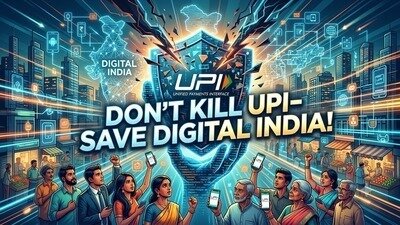

Don't Kill UPI-Save Digital India!
The Issue
Save Digital India: Protect Consumers & Small Businesses by Reversing the Proposed 0.4% UPI MDR Fee
Executive Summary & Call to Action
We, the citizens, small business owners, traders, wholesalers, and consumers of India, petition the Government of India, the Reserve Bank of India (RBI), and the National Payments Corporation of India (NPCI) to immediately scrap the proposed 0.4% Merchant Discount Rate (MDR) on UPI transactions above ₹2,000.
Unified Payments Interface (UPI) is the crown jewel of India's digital transformation. Its mass adoption was built on a single, unwavering promise: free, seamless, and transparent digital payments for all. Taxing commercial UPI transactions threatens to dismantle a decade of progress, fuel price inflation, and force Indian commerce back into the shadow economy of cash.
Key Arguments Against the Proposed 0.4% UPI MDR
1. Existential Threat to Low-Margin Businesses (Superstockists, Wholesalers, Distributors)
In supply chains across FMCG, electronics, textiles, and pharmaceuticals, businesses like superstockists and wholesalers operate on extremely thin profit margins—often between 1% and 2%. Imposing a 0.4% levy on transactions above ₹2,000 erodes between 20% to 40% of their net operating margins.
These businesses rely on high-volume, low-margin transactions. Absorbing this fee is mathematically unsustainable for them.
2. Inevitable Reversion to Cash (Uncontrollable Shadow Economy)
When transaction costs exceed profit margins, businesses are incentivized to bypass digital channels altogether. Wholesalers and retailers will systematically request cash payments for high-value transactions to avoid the fee.
No system enforcement or regulatory monitoring can realistically track or control informal cash deals at the counter level.
Re-igniting a cash-heavy economy weakens tax compliance, undermines financial inclusion, and reverses the gains of a formal digital economy.
3. The Illusion of "Merchant-Only" Fees: Direct Consumer Burden & Inflation
The narrative that MDR only impacts merchants is economically flawed. Merchants operating on thin margins cannot absorb additional operational costs. These expenses will inevitably be passed on to end-consumers via higher retail prices.
What is framed as a corporate service charge acts, in practice, as an indirect tax on digital commerce, driving up the cost of living and everyday goods for everyday citizens.
4. Distortion of Market Competition & Scaling Penalties
Setting arbitrary thresholds (such as zero-MDR for small vendors up to ₹1 lakh/month versus charges for larger transactions) creates unfair distortions in the marketplace. It penalizes growing businesses for scaling up. It adds compliance complexity and creates friction between different layers of the supply chain.
5. Erosion of Public Trust in Public Digital Infrastructure
UPI succeeded because it was treated as public digital infrastructure—akin to roads and bridges. Monetizing public utilities at the transaction level breaks public trust and sends a message that digital convenience comes with hidden costs once market dominance is established.
OUR DEMANDS TO THE AUTHORITIES
Complete Waiver of MDR on UPI: Maintain a strict 0% Merchant Discount Rate across all B2C, B2B, P2P, and P2M UPI transactions regardless of transaction size or monthly turnover.
Government Backing for Digital Public Goods: Continue funding the operational infrastructure of NPCI and UPI through budgetary allocation for digital public infrastructure rather than extracting fees from commerce.
Formal Policy Commitment: Issue an unequivocal statement reassuring Indian businesses and citizens that UPI will remain a free, tax-free digital public good.
WHY YOUR SIGNATURE MATTERS
Whether you are a local shopkeeper paying a wholesaler, a distributor managing high-volume inventory, or an everyday consumer purchasing household goods, this fee affects your pocket.
If we allow digital payments to be taxed today, the cost of living will rise tomorrow, and India's cash-free revolution will stall.
Sign this petition today to keep UPI free, transparent, and fair for every Indian.
#no2upicharges
Thank you,
no2UPIcharges (Instagram)

20
The Issue
Save Digital India: Protect Consumers & Small Businesses by Reversing the Proposed 0.4% UPI MDR Fee
Executive Summary & Call to Action
We, the citizens, small business owners, traders, wholesalers, and consumers of India, petition the Government of India, the Reserve Bank of India (RBI), and the National Payments Corporation of India (NPCI) to immediately scrap the proposed 0.4% Merchant Discount Rate (MDR) on UPI transactions above ₹2,000.
Unified Payments Interface (UPI) is the crown jewel of India's digital transformation. Its mass adoption was built on a single, unwavering promise: free, seamless, and transparent digital payments for all. Taxing commercial UPI transactions threatens to dismantle a decade of progress, fuel price inflation, and force Indian commerce back into the shadow economy of cash.
Key Arguments Against the Proposed 0.4% UPI MDR
1. Existential Threat to Low-Margin Businesses (Superstockists, Wholesalers, Distributors)
In supply chains across FMCG, electronics, textiles, and pharmaceuticals, businesses like superstockists and wholesalers operate on extremely thin profit margins—often between 1% and 2%. Imposing a 0.4% levy on transactions above ₹2,000 erodes between 20% to 40% of their net operating margins.
These businesses rely on high-volume, low-margin transactions. Absorbing this fee is mathematically unsustainable for them.
2. Inevitable Reversion to Cash (Uncontrollable Shadow Economy)
When transaction costs exceed profit margins, businesses are incentivized to bypass digital channels altogether. Wholesalers and retailers will systematically request cash payments for high-value transactions to avoid the fee.
No system enforcement or regulatory monitoring can realistically track or control informal cash deals at the counter level.
Re-igniting a cash-heavy economy weakens tax compliance, undermines financial inclusion, and reverses the gains of a formal digital economy.
3. The Illusion of "Merchant-Only" Fees: Direct Consumer Burden & Inflation
The narrative that MDR only impacts merchants is economically flawed. Merchants operating on thin margins cannot absorb additional operational costs. These expenses will inevitably be passed on to end-consumers via higher retail prices.
What is framed as a corporate service charge acts, in practice, as an indirect tax on digital commerce, driving up the cost of living and everyday goods for everyday citizens.
4. Distortion of Market Competition & Scaling Penalties
Setting arbitrary thresholds (such as zero-MDR for small vendors up to ₹1 lakh/month versus charges for larger transactions) creates unfair distortions in the marketplace. It penalizes growing businesses for scaling up. It adds compliance complexity and creates friction between different layers of the supply chain.
5. Erosion of Public Trust in Public Digital Infrastructure
UPI succeeded because it was treated as public digital infrastructure—akin to roads and bridges. Monetizing public utilities at the transaction level breaks public trust and sends a message that digital convenience comes with hidden costs once market dominance is established.
OUR DEMANDS TO THE AUTHORITIES
Complete Waiver of MDR on UPI: Maintain a strict 0% Merchant Discount Rate across all B2C, B2B, P2P, and P2M UPI transactions regardless of transaction size or monthly turnover.
Government Backing for Digital Public Goods: Continue funding the operational infrastructure of NPCI and UPI through budgetary allocation for digital public infrastructure rather than extracting fees from commerce.
Formal Policy Commitment: Issue an unequivocal statement reassuring Indian businesses and citizens that UPI will remain a free, tax-free digital public good.
WHY YOUR SIGNATURE MATTERS
Whether you are a local shopkeeper paying a wholesaler, a distributor managing high-volume inventory, or an everyday consumer purchasing household goods, this fee affects your pocket.
If we allow digital payments to be taxed today, the cost of living will rise tomorrow, and India's cash-free revolution will stall.
Sign this petition today to keep UPI free, transparent, and fair for every Indian.
#no2upicharges
Thank you,
no2UPIcharges (Instagram)
The Decision Makers

Petition Updates
Share this petition
Petition created on 16 September 2026