

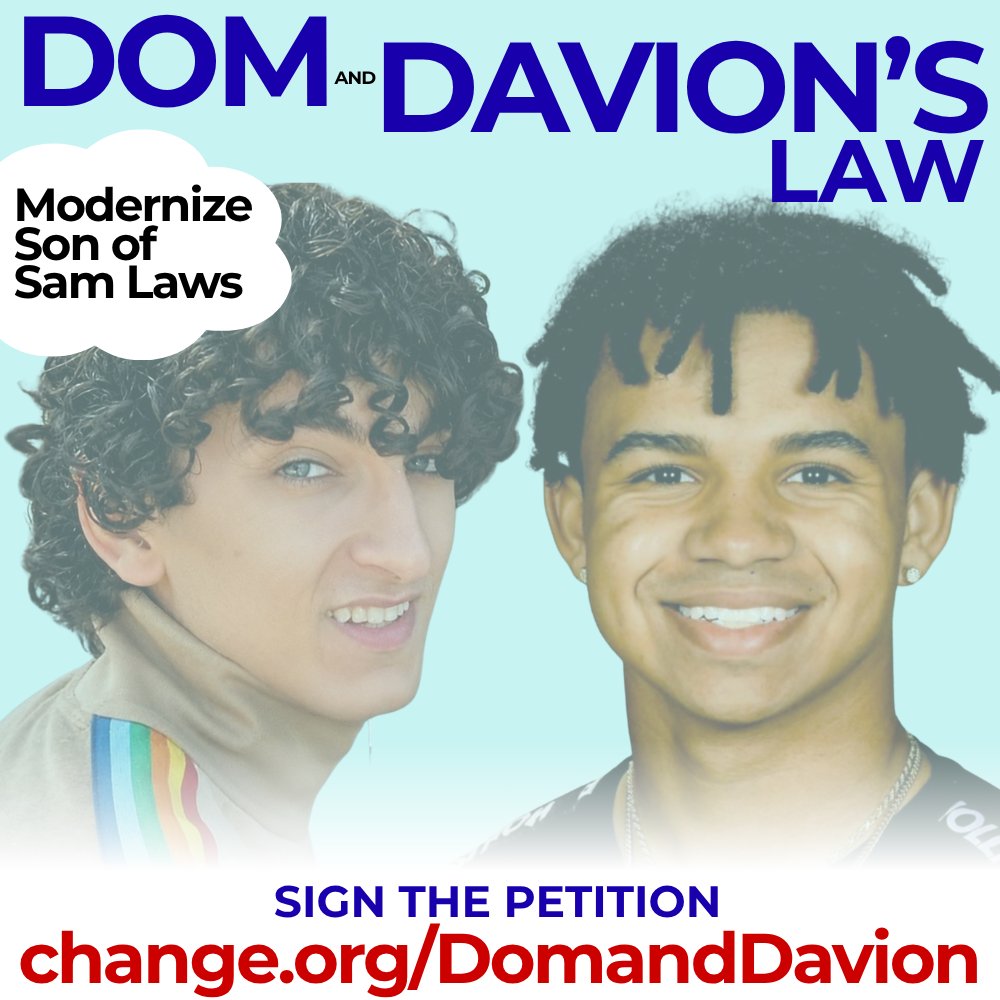
"Dom and Davion's Law" - Victims Before Influencers: Modernize Son of Sam Laws
The Issue
"My brother, Dominic Russo, was killed by Mackenzie Shirilla — a case that was recently brought to the public’s attention through the Netflix documentary *The Crash*. Since the documentary aired, our family has had to relive this tragedy publicly over and over again. What hurts even more is seeing how modern social media culture allows violent offenders to gain attention, followers, donations, publicity, and influence from the crimes that destroyed families like mine.(...)
I started this petition to call on lawmakers to modernize these laws for the digital age and close the loopholes that allow convicted violent offenders to turn tragedy into personal gain.Please sign and share my petition. It is completely FREE to sign, and every signature helps bring awareness and push for change for victims’ families everywhere. "--Christine Russo, sister of Dominic Russo
Victims Before Influencers: Modernize Son of Sam Laws for the Digital Era: No victim’s family should have to watch the person who killed their loved one turn that crime into attention, followers, donations, sponsorships, merchandise, paid interviews, documentaries, social media income, or other personal benefits.
"Son of Sam" laws were first created in the late 1970s after public outrage that serial killer David Berkowitz could profit from his crimes. At the time, lawmakers were primarily concerned about book deals, movie rights, interviews, and paid media contracts.
Today, criminals are able to profit long before a book or movie deal is ever signed. For notoriety-seeking offenders, attention itself is the ultimate currency. Certain convicted violent offenders can easily convert public attention into paid clicks, livestream gifts, merchandise, paid appearances, and crowdfunding—often hiding these profits behind family members, fan pages, LLCs, or other loopholes.
Our current laws are outdated because they were written long before TikTok, YouTube, Instagram, podcasts, and affiliate links were even thought about.
This petition calls on lawmakers to create a modern, constitutionally sound law that prevents certain convicted violent offenders — such as those convicted of homicide or crimes causing serious bodily injury — from turning crime-based notoriety into personal profit, perks, business opportunities, or indirect financial gain.
Plus, when a certain convicted violent offender is released on parole or supervised release, courts and parole boards should have clear authority to impose narrow, individualized conditions that prevent that person from using monetized social media, influencer platforms, crowdfunding, sponsorships, merchandise, paid content, or proxy accounts to profit from the notoriety of their crime.
*certain violent offender = such as those convicted of homicide or crimes causing serious bodily injury, and especially in high-publicity cases.
This is especially important in high-publicity homicide cases where the offender’s public attention is directly connected to the crime and creates a foreseeable risk that the offender may financially benefit from the harm they caused.
A modernized law should:
- Require disclosure of monetized social media accounts, paid interviews, sponsorships, documentaries, podcasts, merchandise, affiliate links, online fundraisers, appearance fees, and business arrangements connected to crime-based notoriety
- Allow courts and parole boards to impose case-specific restrictions on monetized social media features during parole or supervised release
- Prohibit offenders under supervision from receiving sponsorships, platform payouts, merchandise profits, subscription income, livestream gifts, paid appearances, or crowdfunding benefits tied to the notoriety of the covered offense
- Require any qualifying proceeds to be disclosed and, when appropriate, preserved, escrowed, garnished, or redirected toward restitution, victim compensation, or civil judgments
- Prevent offenders from hiding benefits through family members, fan pages, trusts, LLCs, management companies, third-party accounts, or supporter pages
- Include noncash benefits such as paid travel, housing, gifts, services, free merchandise, sponsored experiences, or other things of value
- Apply narrowly to murder, attempted murder, manslaughter, kidnapping resulting in serious injury or death, and other serious violent offenses
Because violent crime should not become a pathway to fame, money, influence, or opportunity.
Public attention should never become a reward for homicide. Notoriety should not become a business model.
Victims’ families deserve protection from being retraumatized while offenders, or those acting on their behalf, benefit from the public attention created by violent crime.
Modern platforms have changed how people become famous and how they make money. Our laws must catch up.
We urge Ohio lawmakers to build on HB 505 and pass a broader modernized Son of Sam law for the digital era — one that protects victims, closes crowdfunding and digital monetization loopholes, prevents indirect profiteering, and ensures that crime-based notoriety cannot be turned into personal gain.
We hope Ohio will lead the way, and that other states will follow.
Victims before influencers. Justice before profit.
In honor of Davion Flanagan and Dominic Russo.
If you are able, please consider supporting the nonprofit organizations established by their families. These organizations work to honor the boys’ legacies and create positive change in their names.
Davion Flanagan- Davion Flanagan’s Memorial Scholarship Fund
Dominic Russo- Change The Game for Dom
This petition was authored by Silver Lining of Hope, Inc. in direct collaboration with the family of Dominic Russo.

203,613
The Issue
"My brother, Dominic Russo, was killed by Mackenzie Shirilla — a case that was recently brought to the public’s attention through the Netflix documentary *The Crash*. Since the documentary aired, our family has had to relive this tragedy publicly over and over again. What hurts even more is seeing how modern social media culture allows violent offenders to gain attention, followers, donations, publicity, and influence from the crimes that destroyed families like mine.(...)
I started this petition to call on lawmakers to modernize these laws for the digital age and close the loopholes that allow convicted violent offenders to turn tragedy into personal gain.Please sign and share my petition. It is completely FREE to sign, and every signature helps bring awareness and push for change for victims’ families everywhere. "--Christine Russo, sister of Dominic Russo
Victims Before Influencers: Modernize Son of Sam Laws for the Digital Era: No victim’s family should have to watch the person who killed their loved one turn that crime into attention, followers, donations, sponsorships, merchandise, paid interviews, documentaries, social media income, or other personal benefits.
"Son of Sam" laws were first created in the late 1970s after public outrage that serial killer David Berkowitz could profit from his crimes. At the time, lawmakers were primarily concerned about book deals, movie rights, interviews, and paid media contracts.
Today, criminals are able to profit long before a book or movie deal is ever signed. For notoriety-seeking offenders, attention itself is the ultimate currency. Certain convicted violent offenders can easily convert public attention into paid clicks, livestream gifts, merchandise, paid appearances, and crowdfunding—often hiding these profits behind family members, fan pages, LLCs, or other loopholes.
Our current laws are outdated because they were written long before TikTok, YouTube, Instagram, podcasts, and affiliate links were even thought about.
This petition calls on lawmakers to create a modern, constitutionally sound law that prevents certain convicted violent offenders — such as those convicted of homicide or crimes causing serious bodily injury — from turning crime-based notoriety into personal profit, perks, business opportunities, or indirect financial gain.
Plus, when a certain convicted violent offender is released on parole or supervised release, courts and parole boards should have clear authority to impose narrow, individualized conditions that prevent that person from using monetized social media, influencer platforms, crowdfunding, sponsorships, merchandise, paid content, or proxy accounts to profit from the notoriety of their crime.
*certain violent offender = such as those convicted of homicide or crimes causing serious bodily injury, and especially in high-publicity cases.
This is especially important in high-publicity homicide cases where the offender’s public attention is directly connected to the crime and creates a foreseeable risk that the offender may financially benefit from the harm they caused.
A modernized law should:
- Require disclosure of monetized social media accounts, paid interviews, sponsorships, documentaries, podcasts, merchandise, affiliate links, online fundraisers, appearance fees, and business arrangements connected to crime-based notoriety
- Allow courts and parole boards to impose case-specific restrictions on monetized social media features during parole or supervised release
- Prohibit offenders under supervision from receiving sponsorships, platform payouts, merchandise profits, subscription income, livestream gifts, paid appearances, or crowdfunding benefits tied to the notoriety of the covered offense
- Require any qualifying proceeds to be disclosed and, when appropriate, preserved, escrowed, garnished, or redirected toward restitution, victim compensation, or civil judgments
- Prevent offenders from hiding benefits through family members, fan pages, trusts, LLCs, management companies, third-party accounts, or supporter pages
- Include noncash benefits such as paid travel, housing, gifts, services, free merchandise, sponsored experiences, or other things of value
- Apply narrowly to murder, attempted murder, manslaughter, kidnapping resulting in serious injury or death, and other serious violent offenses
Because violent crime should not become a pathway to fame, money, influence, or opportunity.
Public attention should never become a reward for homicide. Notoriety should not become a business model.
Victims’ families deserve protection from being retraumatized while offenders, or those acting on their behalf, benefit from the public attention created by violent crime.
Modern platforms have changed how people become famous and how they make money. Our laws must catch up.
We urge Ohio lawmakers to build on HB 505 and pass a broader modernized Son of Sam law for the digital era — one that protects victims, closes crowdfunding and digital monetization loopholes, prevents indirect profiteering, and ensures that crime-based notoriety cannot be turned into personal gain.
We hope Ohio will lead the way, and that other states will follow.
Victims before influencers. Justice before profit.
In honor of Davion Flanagan and Dominic Russo.
If you are able, please consider supporting the nonprofit organizations established by their families. These organizations work to honor the boys’ legacies and create positive change in their names.
Davion Flanagan- Davion Flanagan’s Memorial Scholarship Fund
Dominic Russo- Change The Game for Dom
This petition was authored by Silver Lining of Hope, Inc. in direct collaboration with the family of Dominic Russo.
The Decision Makers


Supporter Voices
Petition Updates
Share this petition
Petition created on May 24, 2026