Discontinue 50% duty on imported automotive paint products!

Discontinue 50% duty on imported automotive paint products!
The Issue
Who is Impacted?
The newly imposed 50% Common External Tariff (CET) on specific specialized automotive refinishing products—paints, spray paints, primers, clearcoats, bodyfillers, putties, caulking and sealants—has placed the entire automotive collision repair industry under immediate, existential pressure. Local auto body shops, overwhelmingly small- to medium-sized enterprises (SMEs), rely on these highly engineered, extra-regional materials because there are simply equivalent regional alternatives that meet the complex colour matching requirements and quality standards necessary to match the modern finishes on today’s cars.
The economic burden of this tariff will force body shops to contemplate using inferior substitutes which means the average car owner will immediately face serious consequences including post-repair failures that can lead to, leading to poor colour matching, cracked paint, delamination, and compromised corrosion protection, directly undermining vehicle appearance and longevity. This will inevitably lead to more rework, which in turn jeopardizes the reputations of these SMEs and compromises the longevity of vehicle appearance and repairs.
What is At Stake?
If this punitive 50% tariff remains in place, the negative consequences will be immediate and far-reaching. Firstly, this will have a disproportionately large and negative impact on smaller body shops, which are more vulnerable to cash flow disruptions than larger shops. All bodyshops will be forced to pass on exorbitant costs or risk voiding warranties by using substandard products. This directly jeopardizes thousands of jobs across the automotive collision repair sector.
For the consumer, every insurance claim will escalate due to rising material costs, driving up insurance premiums across the board. Furthermore, the mandatory use of only specified, high-quality primers and clearcoats is necessary to validate paint job warranties; if the tariff remains, widespread use of sub-standard substitutes will strip vehicle owners of this essential consumer protection. However, by securing a CET (Common External Tariff) waiver for these specialized, automotive refinish materials will safeguard the capacity of local businesses to deliver high-quality, safe repairs, keeping industry jobs secure and mitigating significant cost increases for every vehicle owner and insurance customer.
Why is Now the Time to Act?
The clock is ticking. This drastic increase in duty from 15% to 50% is effective immediately on incoming shipments, triggering imminent price hikes that threaten to significantly increase costs to the collision repair industry, and to consumers. Every day this tariff stands, the financial viability of local body shops erodes, increasing the pressure to compromise on quality and increase prices just to survive.
We must act now! —before the cost increases permeate all local automotive paint retailers and before widespread use of inferior products leads to irreversible long-term vehicle damage, increased costs and consumer frustration.
By signing and promoting this petition, we can send a clear, unified message to Barbados's Minister of Foreign Affairs and Foreign Trade, the Hon. Kerrie Symmonds, M.P. This message will highlight how the current broad application of the Common External Tariff (CET) is unsustainable and risks jeopardizing several key areas:
- The quality of vehicle repairs
- Increased costs for those repairs and vehicle insurance
- The livelihoods of many painting and bodywork professionals
We urge the government to grant an urgent waiver on automotive refinishing products to protect consumers, the collision repair industry, and the quality of repairs offered.
Additional Info:
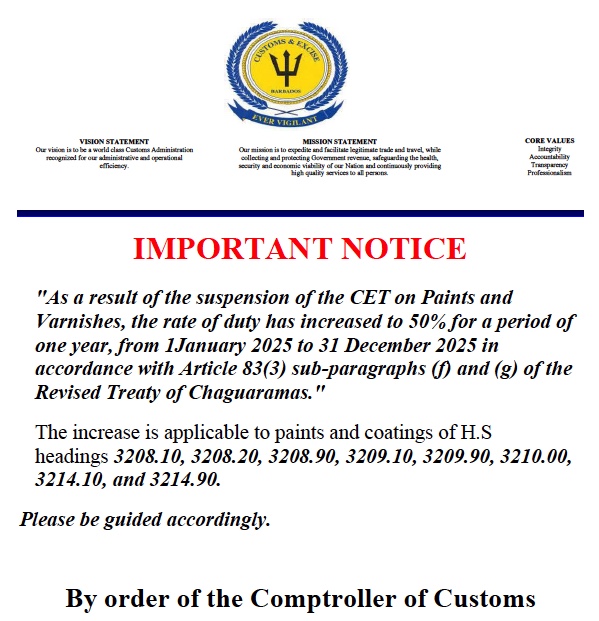
A notice from Barbados Customs (see below) states that new duties are effective from January 1, 2025, to December 30, 2025. However, the new duty regime, which was approved at the 59th Regular Meeting of the Council for Trade and Economic Development (COTED) in Georgetown, Guyana, on November 27-28, 2024, has only recently been enacted in Barbados.
Additionally, COTED has decided to implement the new Common External Tariff (CET) regionally, effective July 1, 2026.

1
The Issue
Who is Impacted?
The newly imposed 50% Common External Tariff (CET) on specific specialized automotive refinishing products—paints, spray paints, primers, clearcoats, bodyfillers, putties, caulking and sealants—has placed the entire automotive collision repair industry under immediate, existential pressure. Local auto body shops, overwhelmingly small- to medium-sized enterprises (SMEs), rely on these highly engineered, extra-regional materials because there are simply equivalent regional alternatives that meet the complex colour matching requirements and quality standards necessary to match the modern finishes on today’s cars.
The economic burden of this tariff will force body shops to contemplate using inferior substitutes which means the average car owner will immediately face serious consequences including post-repair failures that can lead to, leading to poor colour matching, cracked paint, delamination, and compromised corrosion protection, directly undermining vehicle appearance and longevity. This will inevitably lead to more rework, which in turn jeopardizes the reputations of these SMEs and compromises the longevity of vehicle appearance and repairs.
What is At Stake?
If this punitive 50% tariff remains in place, the negative consequences will be immediate and far-reaching. Firstly, this will have a disproportionately large and negative impact on smaller body shops, which are more vulnerable to cash flow disruptions than larger shops. All bodyshops will be forced to pass on exorbitant costs or risk voiding warranties by using substandard products. This directly jeopardizes thousands of jobs across the automotive collision repair sector.
For the consumer, every insurance claim will escalate due to rising material costs, driving up insurance premiums across the board. Furthermore, the mandatory use of only specified, high-quality primers and clearcoats is necessary to validate paint job warranties; if the tariff remains, widespread use of sub-standard substitutes will strip vehicle owners of this essential consumer protection. However, by securing a CET (Common External Tariff) waiver for these specialized, automotive refinish materials will safeguard the capacity of local businesses to deliver high-quality, safe repairs, keeping industry jobs secure and mitigating significant cost increases for every vehicle owner and insurance customer.
Why is Now the Time to Act?
The clock is ticking. This drastic increase in duty from 15% to 50% is effective immediately on incoming shipments, triggering imminent price hikes that threaten to significantly increase costs to the collision repair industry, and to consumers. Every day this tariff stands, the financial viability of local body shops erodes, increasing the pressure to compromise on quality and increase prices just to survive.
We must act now! —before the cost increases permeate all local automotive paint retailers and before widespread use of inferior products leads to irreversible long-term vehicle damage, increased costs and consumer frustration.
By signing and promoting this petition, we can send a clear, unified message to Barbados's Minister of Foreign Affairs and Foreign Trade, the Hon. Kerrie Symmonds, M.P. This message will highlight how the current broad application of the Common External Tariff (CET) is unsustainable and risks jeopardizing several key areas:
- The quality of vehicle repairs
- Increased costs for those repairs and vehicle insurance
- The livelihoods of many painting and bodywork professionals
We urge the government to grant an urgent waiver on automotive refinishing products to protect consumers, the collision repair industry, and the quality of repairs offered.
Additional Info:
A notice from Barbados Customs (see below) states that new duties are effective from January 1, 2025, to December 30, 2025. However, the new duty regime, which was approved at the 59th Regular Meeting of the Council for Trade and Economic Development (COTED) in Georgetown, Guyana, on November 27-28, 2024, has only recently been enacted in Barbados.
Additionally, COTED has decided to implement the new Common External Tariff (CET) regionally, effective July 1, 2026.
1
The Decision Makers

Petition Updates
Share this petition
Petition created on September 30, 2025