
Demand Improved Conditions at Alachua County Animal Resources
The Issue
Recently, reports of cruelty and neglect surfaced from several former employees and volunteers working at Alachua County Animal Resources (ACAR).
DISCLAIMER: It is important to acknowledge the issues are rooted in overpopulation, underfunding, understaffing and lack of appropriate guidance. The majority of the staff are not to blame for the shortcomings of the shelter.
Here are our demands:
1) We demand all American Guidelines for Standards of Care In Animal Shelters be followed. Based on current evidence, these guidelines directly conflict with ACAR’s current practices:
- Any animal observed to be experiencing pain, suffering, or distress; rapidly deteriorating health; life-threatening problems; or suspected zoonotic medical conditions must be promptly assessed and managed
- Animals must be reassessed frequently to determine the efficacy of pain relief provided
- A minimum of 18 ft2 (1.7 m2) of floor space per adult cat should be provided for cohousing
- A soft resting place that elevates animals off of the floor should be made available for all animals
- Isolation housing must meet the medical and behavioral needs of ill animals
- Sufficient personnel must be assigned to complete sanitation tasks promptly each day so that animals spend most of their time in sanitary conditions
- When medical treatment is necessary, it must be provided in a timely fashion
- Shelters must provide species-appropriate preventive health care; this includes implementing protocols that strengthen resistance to disease and minimize exposure to pathogens
- Shelters should have a protocol for the care of pregnant, nursing, and neonatal animals
- Shelters should strive to become workplaces that emphasize staff wellness through a positive organizational culture, fair pay, hours and expectations, provisions for self-care, and ready access to mental health support systems without repercussions
2) We demand better foster care support for medical situations, including responsive emergency phone lines after hours.
3) We demand that Director Julie Johnson and Lead Veterinarian Dr. Samantha Stephenson be put on immediate suspension until a third-party investigation can take place and appropriate actions are taken.
Background on the issue
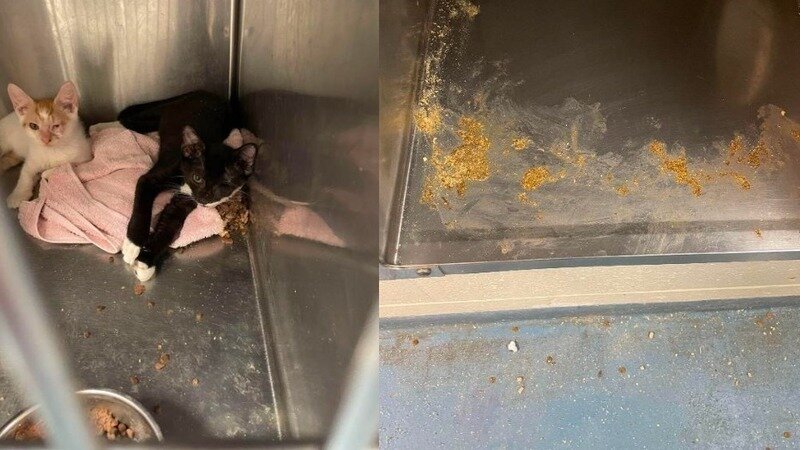
Despite the statement released by Alachua County claiming all appropriate protocols were followed, it is simply not true that the animals are getting appropriate care in accordance with the basic guidelines set forth by the American Guidelines for Standards of Care In Animal Shelters (AGSCAS). Multiple instances have been noted of clear violations of the guidelines, including overcrowding several adult cats in a small enclosure, and failing to sanitize soiled kennels.
Staff and volunteers are also deeply affected by the lack of proper support and clear protocols, with whistleblowers facing retaliation and discouragement when they attempt to advocate for better treatment of animals. Employees with genuine concern for the animals have been repeatedly dismissed by Director Julie Johnson and Attending Vet Dr. Samantha Stephenson. Several reports have stated that Julie Johnson and Samantha Stephenson have contributed to a hostile work environment.
Many former employees cite lack of support and an unhealthy work environment as the primary reason leading to their departure from ACAR. There is no doubt that this has contributed to the staff shortages.
In a report from a former vet tech who worked at the shelter for approximately a year, she sums up her experience with Dr. Stephenson as so "the treatment that both animals and staff endured by Dr. Samantha Stephenson was cruel, unethical, and incredibly unprofessional."
Dr. Stephenson has been the subject of many concerning incidents. During a recent demonstration for the UF Veterinary School, Dr. Stephenson amputated the wrong leg of a cat without taking any responsibility for it. Prior to the surgery, Stephenson was asked to check if the leg was correct, and reportedly refused because she could not palpitate the affected area. When she had already amputated the wrong leg she panicked, blamed the students who were only watching, euthanized the cat, and falsified medical records stating that the cat died under anesthesia. She has since blocked UF Veterinary students from returning to the shelter for their clinical rotations.
These testimonies only begin to reveal the issues encountered by staff and the community at large with ACAR. Without proper foster care support and a reliable emergency response system, vulnerable animals, especially neonatal kittens and stray animals, will continue to be at risk. The community's trust in the shelter's ability to protect and care for animals continues to erode, and the Alachua County Commission must be held accountable to ensure humane treatment and transparency.

288
The Issue
Recently, reports of cruelty and neglect surfaced from several former employees and volunteers working at Alachua County Animal Resources (ACAR).
DISCLAIMER: It is important to acknowledge the issues are rooted in overpopulation, underfunding, understaffing and lack of appropriate guidance. The majority of the staff are not to blame for the shortcomings of the shelter.
Here are our demands:
1) We demand all American Guidelines for Standards of Care In Animal Shelters be followed. Based on current evidence, these guidelines directly conflict with ACAR’s current practices:
- Any animal observed to be experiencing pain, suffering, or distress; rapidly deteriorating health; life-threatening problems; or suspected zoonotic medical conditions must be promptly assessed and managed
- Animals must be reassessed frequently to determine the efficacy of pain relief provided
- A minimum of 18 ft2 (1.7 m2) of floor space per adult cat should be provided for cohousing
- A soft resting place that elevates animals off of the floor should be made available for all animals
- Isolation housing must meet the medical and behavioral needs of ill animals
- Sufficient personnel must be assigned to complete sanitation tasks promptly each day so that animals spend most of their time in sanitary conditions
- When medical treatment is necessary, it must be provided in a timely fashion
- Shelters must provide species-appropriate preventive health care; this includes implementing protocols that strengthen resistance to disease and minimize exposure to pathogens
- Shelters should have a protocol for the care of pregnant, nursing, and neonatal animals
- Shelters should strive to become workplaces that emphasize staff wellness through a positive organizational culture, fair pay, hours and expectations, provisions for self-care, and ready access to mental health support systems without repercussions
2) We demand better foster care support for medical situations, including responsive emergency phone lines after hours.
3) We demand that Director Julie Johnson and Lead Veterinarian Dr. Samantha Stephenson be put on immediate suspension until a third-party investigation can take place and appropriate actions are taken.
Background on the issue
Despite the statement released by Alachua County claiming all appropriate protocols were followed, it is simply not true that the animals are getting appropriate care in accordance with the basic guidelines set forth by the American Guidelines for Standards of Care In Animal Shelters (AGSCAS). Multiple instances have been noted of clear violations of the guidelines, including overcrowding several adult cats in a small enclosure, and failing to sanitize soiled kennels.
Staff and volunteers are also deeply affected by the lack of proper support and clear protocols, with whistleblowers facing retaliation and discouragement when they attempt to advocate for better treatment of animals. Employees with genuine concern for the animals have been repeatedly dismissed by Director Julie Johnson and Attending Vet Dr. Samantha Stephenson. Several reports have stated that Julie Johnson and Samantha Stephenson have contributed to a hostile work environment.
Many former employees cite lack of support and an unhealthy work environment as the primary reason leading to their departure from ACAR. There is no doubt that this has contributed to the staff shortages.
In a report from a former vet tech who worked at the shelter for approximately a year, she sums up her experience with Dr. Stephenson as so "the treatment that both animals and staff endured by Dr. Samantha Stephenson was cruel, unethical, and incredibly unprofessional."
Dr. Stephenson has been the subject of many concerning incidents. During a recent demonstration for the UF Veterinary School, Dr. Stephenson amputated the wrong leg of a cat without taking any responsibility for it. Prior to the surgery, Stephenson was asked to check if the leg was correct, and reportedly refused because she could not palpitate the affected area. When she had already amputated the wrong leg she panicked, blamed the students who were only watching, euthanized the cat, and falsified medical records stating that the cat died under anesthesia. She has since blocked UF Veterinary students from returning to the shelter for their clinical rotations.
These testimonies only begin to reveal the issues encountered by staff and the community at large with ACAR. Without proper foster care support and a reliable emergency response system, vulnerable animals, especially neonatal kittens and stray animals, will continue to be at risk. The community's trust in the shelter's ability to protect and care for animals continues to erode, and the Alachua County Commission must be held accountable to ensure humane treatment and transparency.
The Decision Makers
Supporter Voices
Petition Updates
Share this petition
Petition created on December 3, 2024