Demand for clearer guidelines & legislation around the school practice of isolation
Demand for clearer guidelines & legislation around the school practice of isolation
The Issue
This is a demand for specific legislation, clearer guidelines and raised awareness to be put in place by our government to reduce the impact of mental and emotional harm that studies have proven the practice of isolation in schools causes children. This is particularly true of SEN children diagnosed, undiagnosed and awaiting diagnosis, who are commonly victim to this practice, especially within mainstream settings who commonly use, without any protective governance, isolation measures to manage symptoms of a child’s disability, learning difficulties and distress.
Currently this practice is executed at the whim of the school and can often be seen in their policies, but with no real clarity on what exactly the act of isolation under their watch will consist of for a child in their care. This is leaving an unchallenged open gate for child abuse to occur, of which it is.
Studies evidence that prolonged hours of isolation not only severely increase anxiety, emotional distress and dysregulation in children, but it affects them cognitively, physically, mentally, developmentally and depletes their learning ability and social skills. It further increases negative behaviour in the classroom as it breeds fear, resentment, frustration, anger and low self-esteem and inhibits a child’s true potential by also manifesting resentment towards future academic institutions such as going onto college or university.
It also breaks down the trust between learner and educator and can cause animosity between the parents and their child as well as the school, who have to watch the downward impact of such a negative practice rippling into their childs psyche affecting both home life as well as education. In fact it can be argued that the overall use of isolation on children impacts their learning potential far more than a few days off, on holiday within term time can.
As the extreme practice of isolation in our UK schools grows, it is no coincidence that so does child anxiety and declining mental and emotional health in children, as we also witness the rise in school anxiety and avoidance. This is placing growing pressure on CAMHS and similar local services, and home schooling has increased by over 22% in the last year alone. Over recent years there has been urgent calls by various psychiatric bodies and health institutions to ban the use of isolation in schools all together, or limit it to no more than 30 minutes, to reduce its detrimental health impact on children, but this has gone unrecognised or acted upon.
Currently whilst there are health and safety laws in place that highlight the importance of movement breaks by enforcing that working adults must take them, there are surprisingly none in place to protect children within our schools. Meaning there is no maximum number of school hours or days that an educational setting can choose to restrict a child’s movement, resulting in far too many children gratifying the schools daily attendance targets but then being placed immediately after registration into isolation for hours on end, day after day and academically falling behind as opposed to excelling.
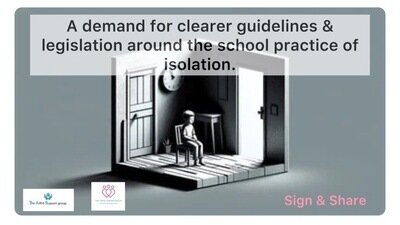
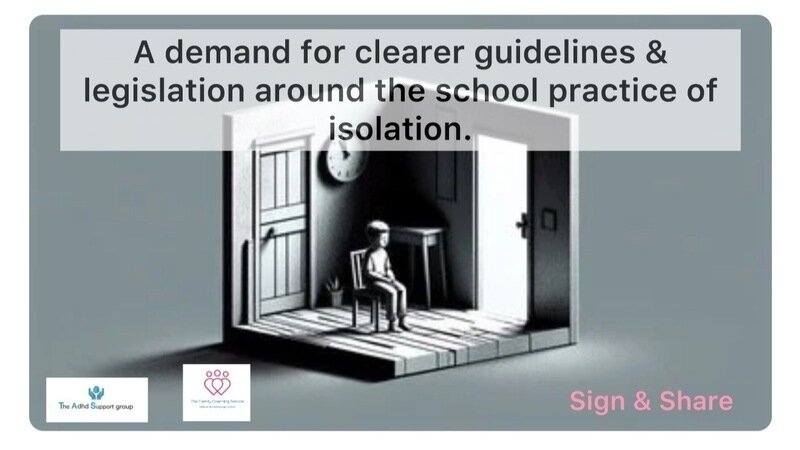
We are regularly hearing stories of children being held for up to 7.5 hrs daily with no movement breaks, no social interaction with their peers and (minimal) scheduled accompanied toilet breaks whether they need to go or not. We are further hearing stories of children having to sit in stress positions where they are placed in silence for hours on end on a chair or floor, facing forward with no clocks in the room, having lunch brought to them to further minimise their movement, often given no knowledge of why they are even in isolation or what the lesson is to be learned and with further detentions then added on at the end of school day already spent as an entirety in isolation, to deliberately maximise their punishment and distress.
We also far to often hear, that when parents have raised their concerns around the detrimental effect isolation is having on their child's mental health they are being threatened by schools with social services, fines, courts and even imprisonment, with this message often being sent via the child, stoking further fear in them and placing them under intensified, prolonged stress. This is an excessive abuse of power within an institutional power dynamic that schools have become far too comfortable with as they struggle to manage themselves.
As mainstream teachers become increasingly frustrated and wrestle with workloads, staffing shortages and lack of expertise especially around SEN children particularly those with ASD and ADHD, children and parents are reporting the practice of isolation tactically and tyrannically being used more and more. Hours of trauma inducing isolation are being given out to children for talking, simply forgetting a pen, for fidgeting, forgetting an item of uniform and for struggling to start set work, to concentrate or complete work and often in the name of managing children who through no fault of their own, find themselves in the wrong educational setting in which to support their needs.
To be clear, this is not a demand to reduce the powers of teachers being able to set boundaries in their schools. Setting boundaries can be beneficial in correcting children and encouraging them to reflect and make better choices. However, the Children Act (1989) and other legislations specify actions that can be deemed as abusive to a child, but these only appear to be relevant if such practice takes place in a child’s home. This has left schools for far too long in the position of being able to make up their own set of rules around isolating children and parents simply having to ‘trust’ that a school is acting in the best interest of their child and not causing them serious, often irreversible harm, under the guise of acceptable correction.
We are urging the government to act swiftly to end this ambiguity around isolation. We urge the government to put in place better guidelines for schools and to implement essential and urgent legislation to protect children from potential mental, emotional, physical abuse and harm in our UK schools. We need a government that protects our children by setting a clear message, that abuse and potential harm will never be accepted as a healthy way in which to correct any child’s behaviour.
64
The Issue
This is a demand for specific legislation, clearer guidelines and raised awareness to be put in place by our government to reduce the impact of mental and emotional harm that studies have proven the practice of isolation in schools causes children. This is particularly true of SEN children diagnosed, undiagnosed and awaiting diagnosis, who are commonly victim to this practice, especially within mainstream settings who commonly use, without any protective governance, isolation measures to manage symptoms of a child’s disability, learning difficulties and distress.
Currently this practice is executed at the whim of the school and can often be seen in their policies, but with no real clarity on what exactly the act of isolation under their watch will consist of for a child in their care. This is leaving an unchallenged open gate for child abuse to occur, of which it is.
Studies evidence that prolonged hours of isolation not only severely increase anxiety, emotional distress and dysregulation in children, but it affects them cognitively, physically, mentally, developmentally and depletes their learning ability and social skills. It further increases negative behaviour in the classroom as it breeds fear, resentment, frustration, anger and low self-esteem and inhibits a child’s true potential by also manifesting resentment towards future academic institutions such as going onto college or university.
It also breaks down the trust between learner and educator and can cause animosity between the parents and their child as well as the school, who have to watch the downward impact of such a negative practice rippling into their childs psyche affecting both home life as well as education. In fact it can be argued that the overall use of isolation on children impacts their learning potential far more than a few days off, on holiday within term time can.
As the extreme practice of isolation in our UK schools grows, it is no coincidence that so does child anxiety and declining mental and emotional health in children, as we also witness the rise in school anxiety and avoidance. This is placing growing pressure on CAMHS and similar local services, and home schooling has increased by over 22% in the last year alone. Over recent years there has been urgent calls by various psychiatric bodies and health institutions to ban the use of isolation in schools all together, or limit it to no more than 30 minutes, to reduce its detrimental health impact on children, but this has gone unrecognised or acted upon.
Currently whilst there are health and safety laws in place that highlight the importance of movement breaks by enforcing that working adults must take them, there are surprisingly none in place to protect children within our schools. Meaning there is no maximum number of school hours or days that an educational setting can choose to restrict a child’s movement, resulting in far too many children gratifying the schools daily attendance targets but then being placed immediately after registration into isolation for hours on end, day after day and academically falling behind as opposed to excelling.
We are regularly hearing stories of children being held for up to 7.5 hrs daily with no movement breaks, no social interaction with their peers and (minimal) scheduled accompanied toilet breaks whether they need to go or not. We are further hearing stories of children having to sit in stress positions where they are placed in silence for hours on end on a chair or floor, facing forward with no clocks in the room, having lunch brought to them to further minimise their movement, often given no knowledge of why they are even in isolation or what the lesson is to be learned and with further detentions then added on at the end of school day already spent as an entirety in isolation, to deliberately maximise their punishment and distress.
We also far to often hear, that when parents have raised their concerns around the detrimental effect isolation is having on their child's mental health they are being threatened by schools with social services, fines, courts and even imprisonment, with this message often being sent via the child, stoking further fear in them and placing them under intensified, prolonged stress. This is an excessive abuse of power within an institutional power dynamic that schools have become far too comfortable with as they struggle to manage themselves.
As mainstream teachers become increasingly frustrated and wrestle with workloads, staffing shortages and lack of expertise especially around SEN children particularly those with ASD and ADHD, children and parents are reporting the practice of isolation tactically and tyrannically being used more and more. Hours of trauma inducing isolation are being given out to children for talking, simply forgetting a pen, for fidgeting, forgetting an item of uniform and for struggling to start set work, to concentrate or complete work and often in the name of managing children who through no fault of their own, find themselves in the wrong educational setting in which to support their needs.
To be clear, this is not a demand to reduce the powers of teachers being able to set boundaries in their schools. Setting boundaries can be beneficial in correcting children and encouraging them to reflect and make better choices. However, the Children Act (1989) and other legislations specify actions that can be deemed as abusive to a child, but these only appear to be relevant if such practice takes place in a child’s home. This has left schools for far too long in the position of being able to make up their own set of rules around isolating children and parents simply having to ‘trust’ that a school is acting in the best interest of their child and not causing them serious, often irreversible harm, under the guise of acceptable correction.
We are urging the government to act swiftly to end this ambiguity around isolation. We urge the government to put in place better guidelines for schools and to implement essential and urgent legislation to protect children from potential mental, emotional, physical abuse and harm in our UK schools. We need a government that protects our children by setting a clear message, that abuse and potential harm will never be accepted as a healthy way in which to correct any child’s behaviour.
64

Petition Updates
Share this petition
Petition created on 12 March 2025