Demand Financial Transparency from VUSD

Demand Financial Transparency from VUSD
The Issue
Ventura Unified’s financial crisis did not happen overnight. It was the result of years of failed oversight, growing obligations, declining attendance, and repeated dependence on one-time or short-term funding that temporarily masked the district’s underlying financial weakness. The district’s own audits show that these warning signs were visible for years. The Board of Education had a duty to recognize them, act responsibly, and protect the district’s long-term stability. They failed to do so (CliftonLarsonAllen LLP, 2016, 2017, 2018, 2019, 2020, 2021, 2023, 2024, 2025).
This is not a case where the current Board can simply blame the past. According to Ventura Unified’s current board roster, the current Board members are James Forsythe, Sabrena Rodriguez, Jerry Dannenberg, Shannon Trani Fredericks, and Calvin Peterson (Ventura Unified School District, n.d.). Of those five, Forsythe, Rodriguez, Dannenberg, and Peterson served during the period when the district’s financial condition worsened and major salary-related obligations were approved. Only Shannon Trani Fredericks was not part of those earlier votes. That matters because accountability belongs with the people who were actually there, who had the power to ask questions, and who chose not to change course (Ventura Unified School District, n.d.).
For years, the district’s financial picture was propped up in part by temporary funding rather than sustained by true structural balance. The audits repeatedly reference one-time state allocations, temporary grants, pandemic-related funding, emergency block grants, and other short-term revenue sources. In 2016, the district reported that its improved position was tied to state-allocated one-time funding and grants received up front for multi-year programs (CliftonLarsonAllen LLP, 2016). In 2021, the district reported major increases tied to pandemic and learning-loss funding (CliftonLarsonAllen LLP, 2021). In 2023, the audit states the General Fund increased by $27.3 million because of pandemic-related funding and one-time emergency block grants (CliftonLarsonAllen LLP, 2023). In 2024 and 2025, those temporary supports began shrinking or were being spent down (CliftonLarsonAllen LLP, 2024, 2025). These were not signs of long-term fiscal strength. They were signs of a district being temporarily carried by short-term money while deeper problems remained unresolved.
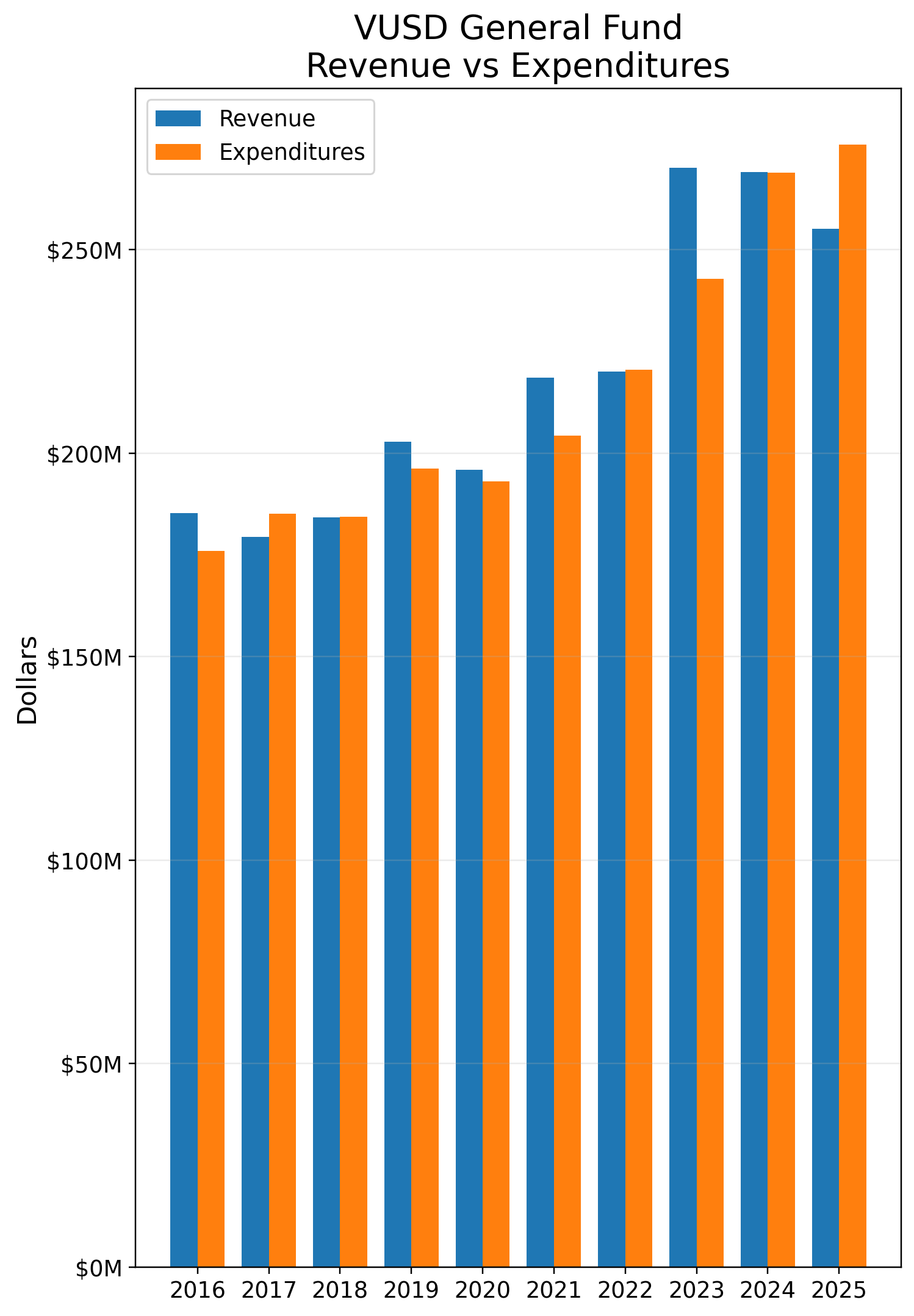
VUSD’s spending problem did not appear overnight. By 2025, expenditures had outrun revenues by about $20.8 million, exposing the consequences of years of failed oversight.
At the same time, the district’s attendance base kept weakening. The audits show average daily attendance steadily falling over time. ADA dropped from 16,462 in 2016 to 13,402.81 by 2025 (CliftonLarsonAllen LLP, 2016, 2025). That decline matters because attendance is tied directly to the district’s long-term funding base. A district with falling ADA should be governed with caution and long-range planning. Instead, General Fund expenditures rose from $176,056,300 in 2016 to $275.9 million in 2025, an increase of nearly $100 million while the attendance base moved in the opposite direction (CliftonLarsonAllen LLP, 2016, 2025). That is not responsible stewardship. That is a failure to align obligations with financial reality.
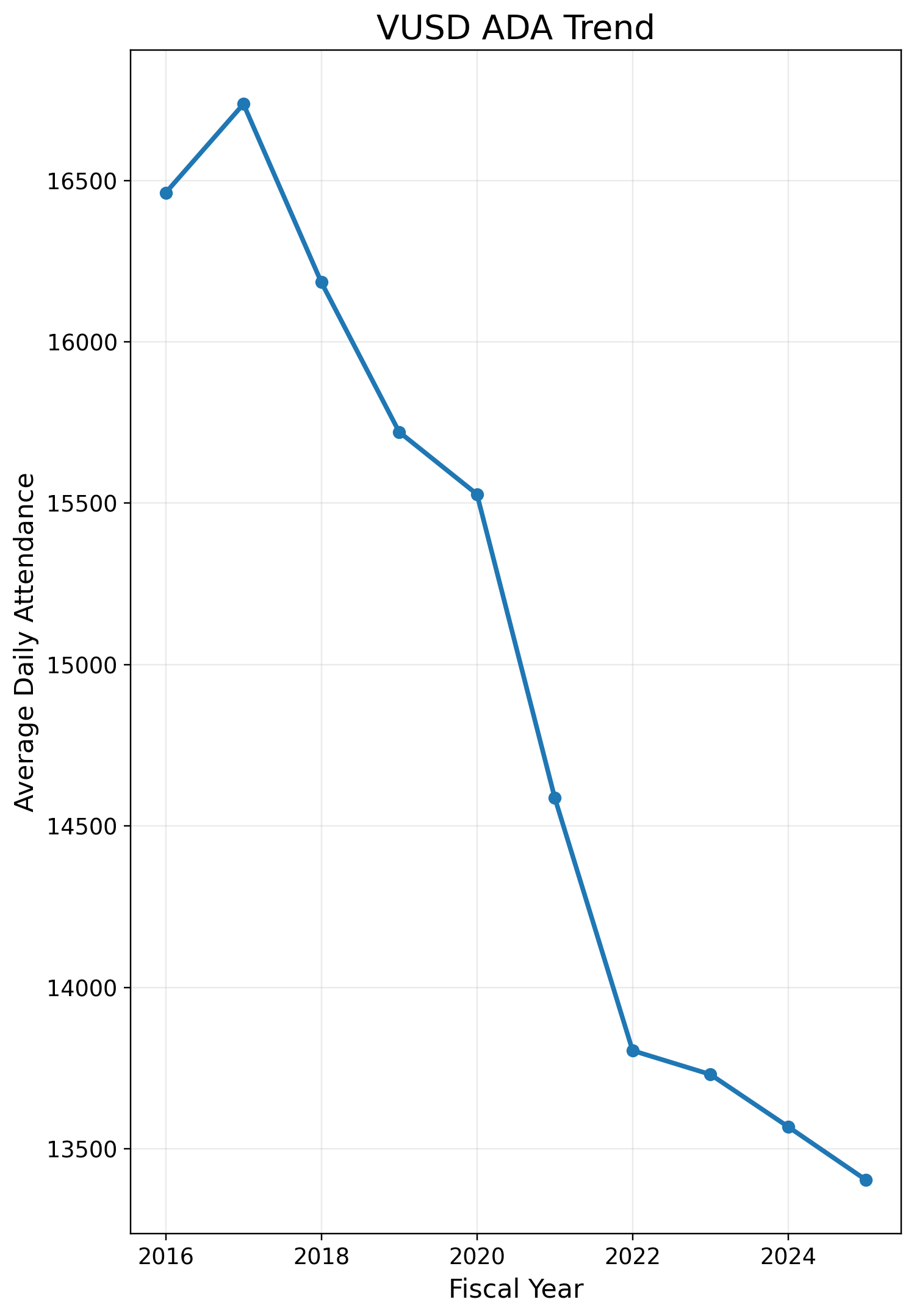
As attendance fell year after year, the district’s long-term funding base weakened. The Board should have adjusted to that reality long before the crisis became unavoidable.
The Board did not merely watch this happen. It approved new obligations while these warning signs were already visible. On January 3, 2023, the Board voted 5 to 0 to approve VESPA contract changes, benefit contributions, and salary schedules. The yes votes were Sabrena Rodriguez, Amy Callahan, Jerry Dannenberg, Calvin Peterson, and James Forsythe. That action included a 10% salary schedule increase retroactive to July 1, 2022, a 2% off-schedule bonus, and benefit-related changes. Four current board members — Rodriguez, Dannenberg, Peterson, and Forsythe — voted yes (CliftonLarsonAllen LLP, 2023).
Then, on February 13, 2024, the Board again voted 5 to 0 to approve VESPA contract changes and salary schedules for 2023 to 2024 and 2024 to 2025. The yes votes were Sabrena Rodriguez, Jerry Dannenberg, Calvin Peterson, James Forsythe, and Alicia Lavere. That package included a 4% increase retroactive to July 1, 2023 and an additional 2% increase effective January 1, 2024. Again, four current board members — Rodriguez, Dannenberg, Peterson, and Forsythe — voted yes (CliftonLarsonAllen LLP, 2024).
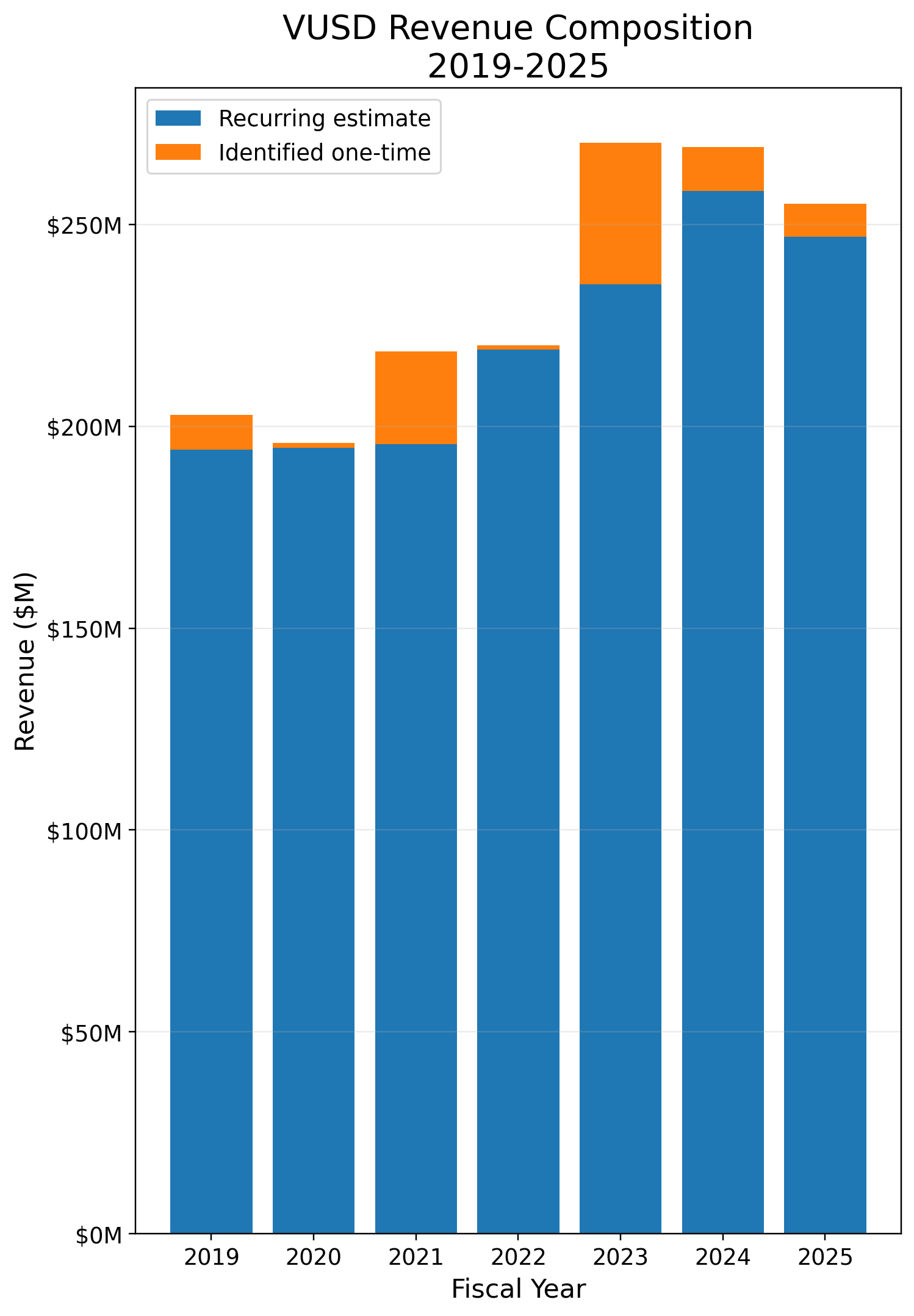
Temporary money helped prop up the books, but it was never a permanent solution. When that support faded, the underlying imbalance was exposed.
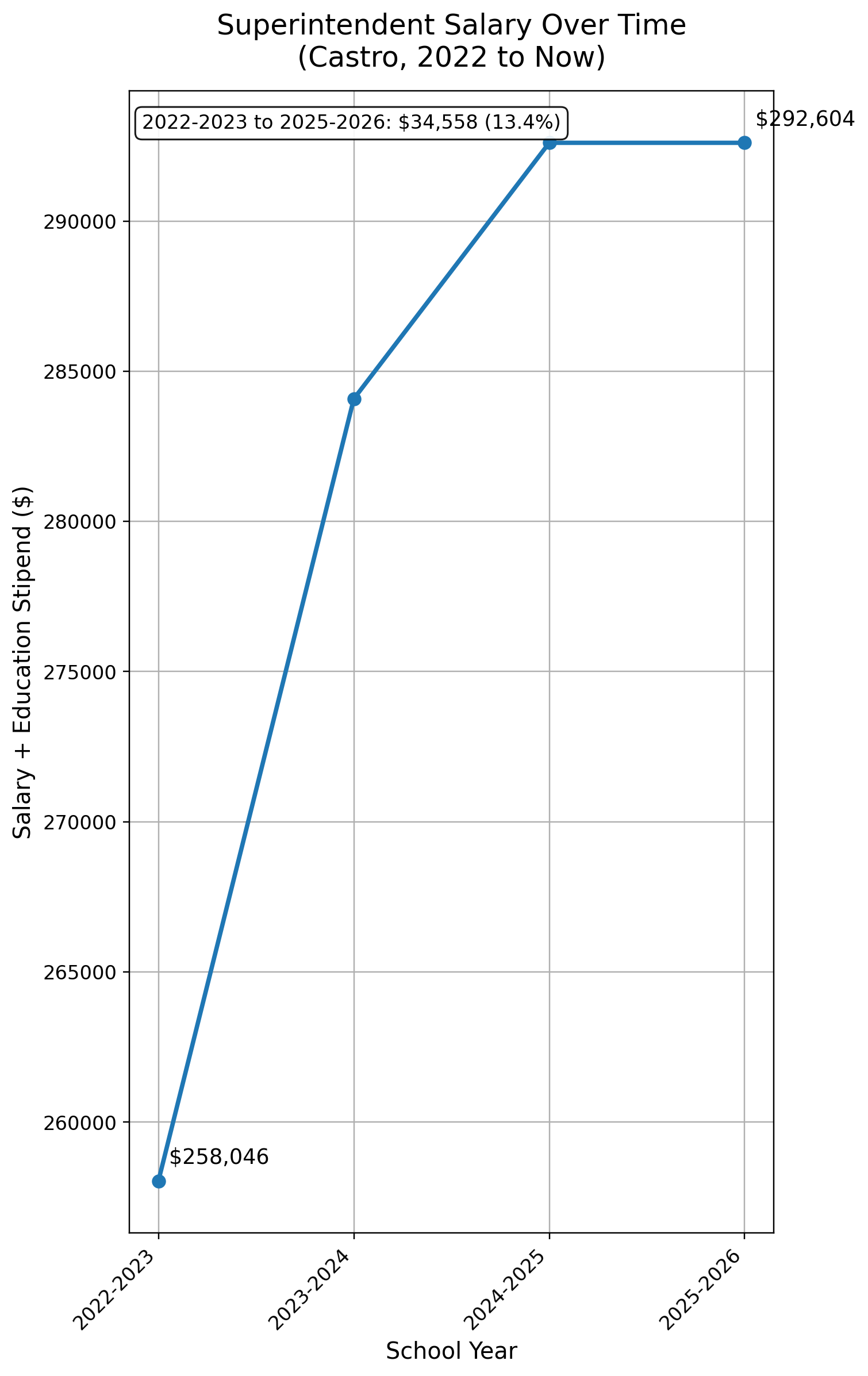
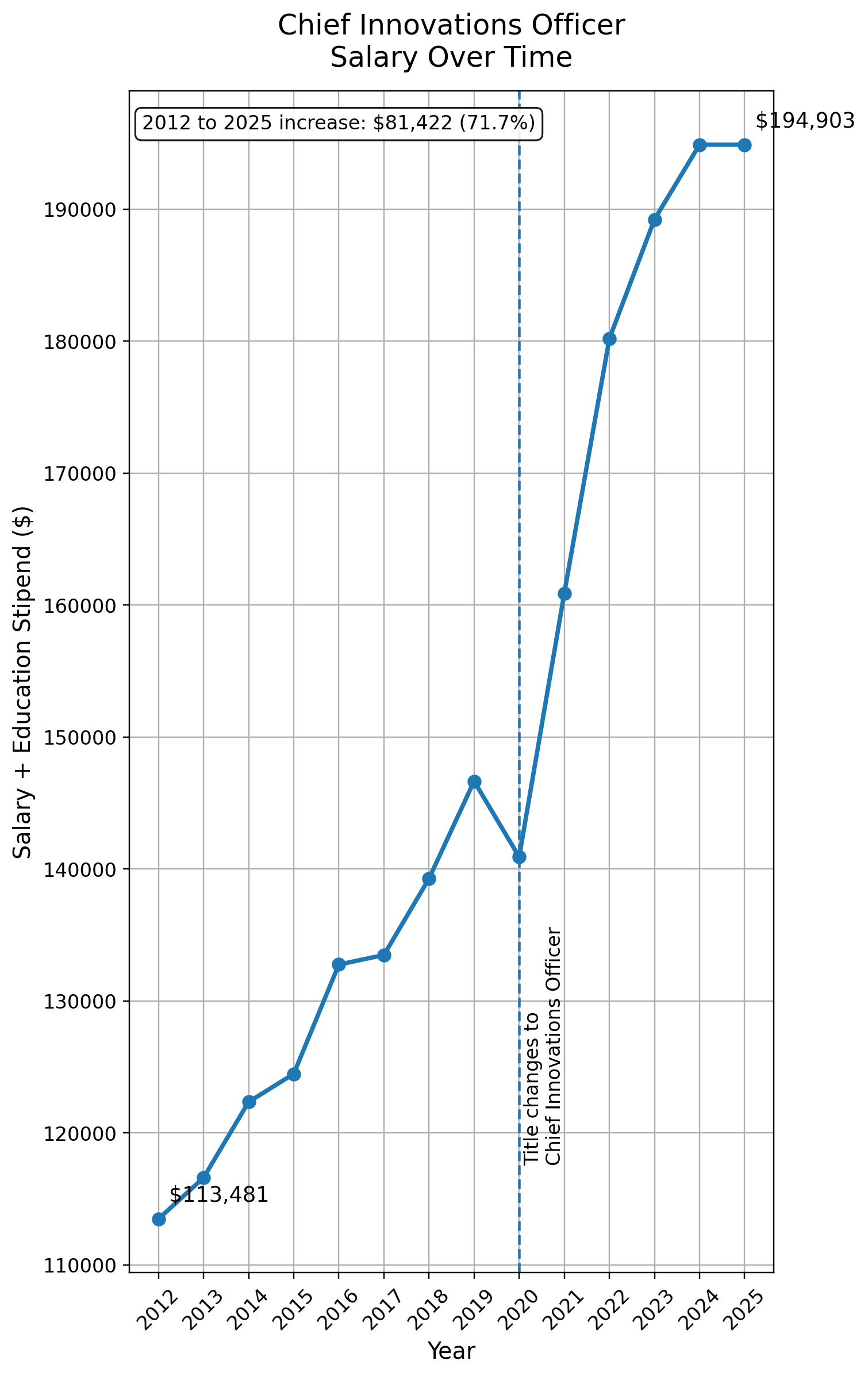
The point is not that employees did not deserve fair compensation. The point is that the Board had a duty to determine whether these commitments were sustainable in a district already facing declining ADA, rising expenditures, and a growing dependence on temporary funding. The audits confirm continuing compensation growth across these years. The 2023 audit states the district funded the 10% salary increase and 2% bonus (CliftonLarsonAllen LLP, 2023). The 2024 audit states certificated employees received a 4% increase retroactive to July 1, 2023 and another 2% increase effective January 1, 2024, while classified employees received $2 per hour increases on the same timeline (CliftonLarsonAllen LLP, 2024). The 2025 audit then shows another 2% base salary increase effective July 1, 2024 for certificated and classified employees (CliftonLarsonAllen LLP, 2025). These decisions did not happen in a vacuum. They happened while the district’s own financial records were warning that the path was becoming unsustainable.
Eventually, the temporary support weakened enough that the underlying structural imbalance could no longer be hidden. By 2025, the district’s General Fund revenues were $255.1 million while expenditures were $275.9 million. The General Fund fell by $19.4 million. The Board approved reductions or eliminations totaling 65.3 full-time equivalent positions (CliftonLarsonAllen LLP, 2025). At that point, the consequences of years of failed oversight were no longer abstract. Students, staff, families, and the community were left paying the price for decisions that should have been confronted much earlier.
The Board’s own public role is not passive. Ventura Unified says the Board is responsible for setting the district’s direction, directing resources where they are most needed, and ensuring accountability to the community (Ventura Unified School District, n.d.). When elected trustees fail to provide honest financial oversight, fail to respond to clear warning signs, and continue approving obligations while temporary funding masks deeper problems, they fail in that responsibility. Under California law, recall exists so voters can remove elected officials who have lost the public’s trust (California Secretary of State, n.d.). The executive cabinet should also be held accountable for its role in creating, enabling, and presenting this failure, but the appropriate remedies there are resignation, termination, or independent investigation rather than recall, because recall applies to elected officials (California Secretary of State, n.d.).
This recall effort is not about one difficult year or one unpopular vote. It is about a long pattern of failed stewardship. The district’s own records show the pattern clearly: temporary funding that masked deeper weakness, declining attendance that weakened the district’s base, rising expenditures that were not matched by stable recurring revenue, continuing approval of new obligations, and finally a major operating gap followed by cuts (CliftonLarsonAllen LLP, 2016, 2021, 2023, 2025). Four of the five current Board members were present during that period and helped lead the district to this point. They had an obligation to the community to govern responsibly, protect long-term stability, and act before the damage became unavoidable. They failed that obligation. For that reason, they deserve to be recalled from office. The executive cabinet should also be held fully accountable through removal, resignation, or independent investigation for its role in this failure.
References
CliftonLarsonAllen LLP. (2016). Ventura Unified School District financial statements and supplementary information: Year ended June 30, 2016. https://www.venturausd.org/fs/resource-manager/view/0244a313-80d0-488c-b31f-606c77f8b3eb
CliftonLarsonAllen LLP. (2017). Ventura Unified School District, Ventura County: Report on audit of financial statements and supplementary information including reports on compliance, June 30, 2017.
https://www.venturausd.org/fs/resource-manager/view/7c2411fd-8c82-45dd-95a4-c9917864ac3a
CliftonLarsonAllen LLP. (2018). Ventura Unified School District, Ventura County: Report on audit of financial statements and supplementary information including reports on compliance, June 30, 2018.
https://www.venturausd.org/fs/resource-manager/view/c5262088-d42d-4a77-93ab-12c09c20aeec
CliftonLarsonAllen LLP. (2019). Ventura Unified School District, Ventura County: Report on audit of financial statements and supplementary information including reports on compliance, June 30, 2019.
https://www.venturausd.org/fs/resource-manager/view/e518211c-a447-45c8-aa87-1513f6c2678c
CliftonLarsonAllen LLP. (2020). Ventura Unified School District financial statements and supplementary information: Year ended June 30, 2020. https://www.venturausd.org/fs/resource-manager/view/8c5c6900-a7ae-4806-8f7e-492986726123
CliftonLarsonAllen LLP. (2021). Ventura Unified School District financial statements and supplementary information: Year ended June 30, 2021. https://www.venturausd.org/fs/resource-manager/view/0609e720-aef4-4771-9567-92bfb703757e
CliftonLarsonAllen LLP. (2022). Ventura Unified School District financial statements and supplementary information: Year ended June 30, 2022. https://www.venturausd.org/fs/resource-manager/view/1bfa2ba3-0008-4b50-a6b3-884c98e24fcd
CliftonLarsonAllen LLP. (2023). Ventura Unified School District financial statements and supplementary information: Year ended June 30, 2023. https://www.venturausd.org/fs/resource-manager/view/3078760c-7f52-4685-bbfb-593a5ed2a5dc
CliftonLarsonAllen LLP. (2024). Ventura Unified School District financial statements and supplementary information: Year ended June 30, 2024. https://www.venturausd.org/fs/resource-manager/view/273fe479-4709-4de2-98bd-e95879edb9d7
CliftonLarsonAllen LLP. (2025). Ventura Unified School District financial statements and supplementary information: Year ended June 30, 2025. https://resources.finalsite.net/images/v1765494889/venturausdorg/natjaloljuw0pbyegc8t/VenturaUnifiedSDRptY25.pdf
California Secretary of State. (n.d.). Recall procedures guide. https://elections.cdn.sos.ca.gov/recalls/recall-procedures-guide.pdf
Ventura Unified School District. (n.d.). Board of Education. https://www.venturausd.org/about/board-of-education

1,642
The Issue
Ventura Unified’s financial crisis did not happen overnight. It was the result of years of failed oversight, growing obligations, declining attendance, and repeated dependence on one-time or short-term funding that temporarily masked the district’s underlying financial weakness. The district’s own audits show that these warning signs were visible for years. The Board of Education had a duty to recognize them, act responsibly, and protect the district’s long-term stability. They failed to do so (CliftonLarsonAllen LLP, 2016, 2017, 2018, 2019, 2020, 2021, 2023, 2024, 2025).
This is not a case where the current Board can simply blame the past. According to Ventura Unified’s current board roster, the current Board members are James Forsythe, Sabrena Rodriguez, Jerry Dannenberg, Shannon Trani Fredericks, and Calvin Peterson (Ventura Unified School District, n.d.). Of those five, Forsythe, Rodriguez, Dannenberg, and Peterson served during the period when the district’s financial condition worsened and major salary-related obligations were approved. Only Shannon Trani Fredericks was not part of those earlier votes. That matters because accountability belongs with the people who were actually there, who had the power to ask questions, and who chose not to change course (Ventura Unified School District, n.d.).
For years, the district’s financial picture was propped up in part by temporary funding rather than sustained by true structural balance. The audits repeatedly reference one-time state allocations, temporary grants, pandemic-related funding, emergency block grants, and other short-term revenue sources. In 2016, the district reported that its improved position was tied to state-allocated one-time funding and grants received up front for multi-year programs (CliftonLarsonAllen LLP, 2016). In 2021, the district reported major increases tied to pandemic and learning-loss funding (CliftonLarsonAllen LLP, 2021). In 2023, the audit states the General Fund increased by $27.3 million because of pandemic-related funding and one-time emergency block grants (CliftonLarsonAllen LLP, 2023). In 2024 and 2025, those temporary supports began shrinking or were being spent down (CliftonLarsonAllen LLP, 2024, 2025). These were not signs of long-term fiscal strength. They were signs of a district being temporarily carried by short-term money while deeper problems remained unresolved.
VUSD’s spending problem did not appear overnight. By 2025, expenditures had outrun revenues by about $20.8 million, exposing the consequences of years of failed oversight.
At the same time, the district’s attendance base kept weakening. The audits show average daily attendance steadily falling over time. ADA dropped from 16,462 in 2016 to 13,402.81 by 2025 (CliftonLarsonAllen LLP, 2016, 2025). That decline matters because attendance is tied directly to the district’s long-term funding base. A district with falling ADA should be governed with caution and long-range planning. Instead, General Fund expenditures rose from $176,056,300 in 2016 to $275.9 million in 2025, an increase of nearly $100 million while the attendance base moved in the opposite direction (CliftonLarsonAllen LLP, 2016, 2025). That is not responsible stewardship. That is a failure to align obligations with financial reality.
As attendance fell year after year, the district’s long-term funding base weakened. The Board should have adjusted to that reality long before the crisis became unavoidable.
The Board did not merely watch this happen. It approved new obligations while these warning signs were already visible. On January 3, 2023, the Board voted 5 to 0 to approve VESPA contract changes, benefit contributions, and salary schedules. The yes votes were Sabrena Rodriguez, Amy Callahan, Jerry Dannenberg, Calvin Peterson, and James Forsythe. That action included a 10% salary schedule increase retroactive to July 1, 2022, a 2% off-schedule bonus, and benefit-related changes. Four current board members — Rodriguez, Dannenberg, Peterson, and Forsythe — voted yes (CliftonLarsonAllen LLP, 2023).
Then, on February 13, 2024, the Board again voted 5 to 0 to approve VESPA contract changes and salary schedules for 2023 to 2024 and 2024 to 2025. The yes votes were Sabrena Rodriguez, Jerry Dannenberg, Calvin Peterson, James Forsythe, and Alicia Lavere. That package included a 4% increase retroactive to July 1, 2023 and an additional 2% increase effective January 1, 2024. Again, four current board members — Rodriguez, Dannenberg, Peterson, and Forsythe — voted yes (CliftonLarsonAllen LLP, 2024).
Temporary money helped prop up the books, but it was never a permanent solution. When that support faded, the underlying imbalance was exposed.
The point is not that employees did not deserve fair compensation. The point is that the Board had a duty to determine whether these commitments were sustainable in a district already facing declining ADA, rising expenditures, and a growing dependence on temporary funding. The audits confirm continuing compensation growth across these years. The 2023 audit states the district funded the 10% salary increase and 2% bonus (CliftonLarsonAllen LLP, 2023). The 2024 audit states certificated employees received a 4% increase retroactive to July 1, 2023 and another 2% increase effective January 1, 2024, while classified employees received $2 per hour increases on the same timeline (CliftonLarsonAllen LLP, 2024). The 2025 audit then shows another 2% base salary increase effective July 1, 2024 for certificated and classified employees (CliftonLarsonAllen LLP, 2025). These decisions did not happen in a vacuum. They happened while the district’s own financial records were warning that the path was becoming unsustainable.
Eventually, the temporary support weakened enough that the underlying structural imbalance could no longer be hidden. By 2025, the district’s General Fund revenues were $255.1 million while expenditures were $275.9 million. The General Fund fell by $19.4 million. The Board approved reductions or eliminations totaling 65.3 full-time equivalent positions (CliftonLarsonAllen LLP, 2025). At that point, the consequences of years of failed oversight were no longer abstract. Students, staff, families, and the community were left paying the price for decisions that should have been confronted much earlier.
The Board’s own public role is not passive. Ventura Unified says the Board is responsible for setting the district’s direction, directing resources where they are most needed, and ensuring accountability to the community (Ventura Unified School District, n.d.). When elected trustees fail to provide honest financial oversight, fail to respond to clear warning signs, and continue approving obligations while temporary funding masks deeper problems, they fail in that responsibility. Under California law, recall exists so voters can remove elected officials who have lost the public’s trust (California Secretary of State, n.d.). The executive cabinet should also be held accountable for its role in creating, enabling, and presenting this failure, but the appropriate remedies there are resignation, termination, or independent investigation rather than recall, because recall applies to elected officials (California Secretary of State, n.d.).
This recall effort is not about one difficult year or one unpopular vote. It is about a long pattern of failed stewardship. The district’s own records show the pattern clearly: temporary funding that masked deeper weakness, declining attendance that weakened the district’s base, rising expenditures that were not matched by stable recurring revenue, continuing approval of new obligations, and finally a major operating gap followed by cuts (CliftonLarsonAllen LLP, 2016, 2021, 2023, 2025). Four of the five current Board members were present during that period and helped lead the district to this point. They had an obligation to the community to govern responsibly, protect long-term stability, and act before the damage became unavoidable. They failed that obligation. For that reason, they deserve to be recalled from office. The executive cabinet should also be held fully accountable through removal, resignation, or independent investigation for its role in this failure.
References
CliftonLarsonAllen LLP. (2016). Ventura Unified School District financial statements and supplementary information: Year ended June 30, 2016. https://www.venturausd.org/fs/resource-manager/view/0244a313-80d0-488c-b31f-606c77f8b3eb
CliftonLarsonAllen LLP. (2017). Ventura Unified School District, Ventura County: Report on audit of financial statements and supplementary information including reports on compliance, June 30, 2017.
https://www.venturausd.org/fs/resource-manager/view/7c2411fd-8c82-45dd-95a4-c9917864ac3a
CliftonLarsonAllen LLP. (2018). Ventura Unified School District, Ventura County: Report on audit of financial statements and supplementary information including reports on compliance, June 30, 2018.
https://www.venturausd.org/fs/resource-manager/view/c5262088-d42d-4a77-93ab-12c09c20aeec
CliftonLarsonAllen LLP. (2019). Ventura Unified School District, Ventura County: Report on audit of financial statements and supplementary information including reports on compliance, June 30, 2019.
https://www.venturausd.org/fs/resource-manager/view/e518211c-a447-45c8-aa87-1513f6c2678c
CliftonLarsonAllen LLP. (2020). Ventura Unified School District financial statements and supplementary information: Year ended June 30, 2020. https://www.venturausd.org/fs/resource-manager/view/8c5c6900-a7ae-4806-8f7e-492986726123
CliftonLarsonAllen LLP. (2021). Ventura Unified School District financial statements and supplementary information: Year ended June 30, 2021. https://www.venturausd.org/fs/resource-manager/view/0609e720-aef4-4771-9567-92bfb703757e
CliftonLarsonAllen LLP. (2022). Ventura Unified School District financial statements and supplementary information: Year ended June 30, 2022. https://www.venturausd.org/fs/resource-manager/view/1bfa2ba3-0008-4b50-a6b3-884c98e24fcd
CliftonLarsonAllen LLP. (2023). Ventura Unified School District financial statements and supplementary information: Year ended June 30, 2023. https://www.venturausd.org/fs/resource-manager/view/3078760c-7f52-4685-bbfb-593a5ed2a5dc
CliftonLarsonAllen LLP. (2024). Ventura Unified School District financial statements and supplementary information: Year ended June 30, 2024. https://www.venturausd.org/fs/resource-manager/view/273fe479-4709-4de2-98bd-e95879edb9d7
CliftonLarsonAllen LLP. (2025). Ventura Unified School District financial statements and supplementary information: Year ended June 30, 2025. https://resources.finalsite.net/images/v1765494889/venturausdorg/natjaloljuw0pbyegc8t/VenturaUnifiedSDRptY25.pdf
California Secretary of State. (n.d.). Recall procedures guide. https://elections.cdn.sos.ca.gov/recalls/recall-procedures-guide.pdf
Ventura Unified School District. (n.d.). Board of Education. https://www.venturausd.org/about/board-of-education
1,642
The Decision Makers


Supporter Voices
Petition Updates
Share this petition
Petition created on February 8, 2026