
Demand change: Stop the ESEA rule that kills the North American CS developmental pipeline
The Issue
Preamble:
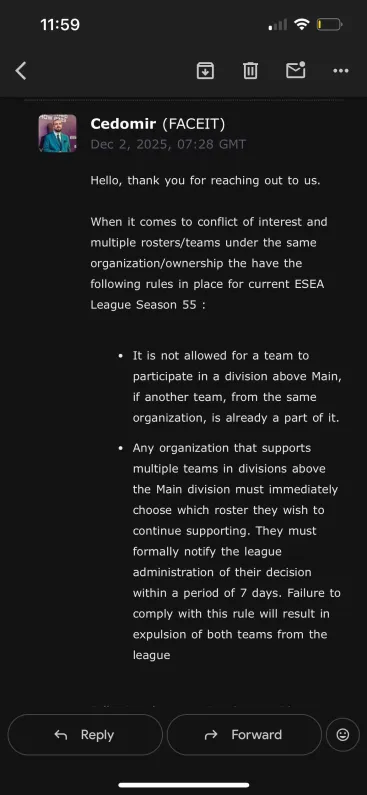
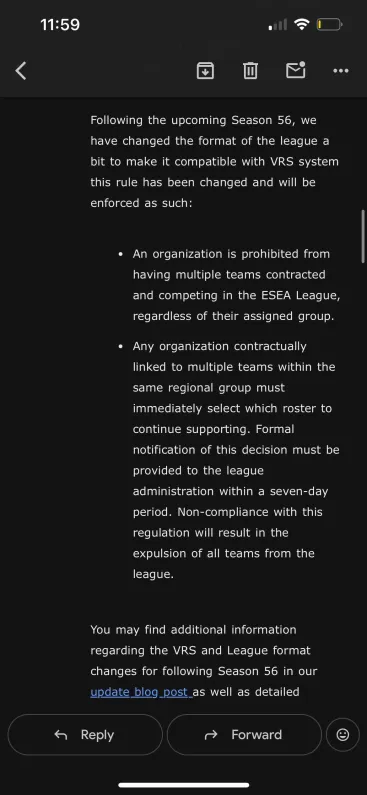
We, the undersigned organizations, players, and community members, demand the immediate reversal of the new Faceit/ESEA League rule that bans organizations from fielding multiple affiliated teams. This rule dismantles a crucial development path for new talent in North America based on an unverified claim, and the league is actively harming the ecosystem it is supposed to support.
1. Why Organizations Are Essential for NA CS?
The Academy Team → Intermediate → Main → Advanced → ECL progression is one of the few stable development paths available to North American players.
The new S56 rule cripples this system entirely, fracturing every existing pipeline and forcing the scene back into a “Wild West” environment of mix teams with no structure. This further consolidates FACEIT/ESEA’s monopoly and makes players even more dependent on the very system that is removing their opportunities.
What Organizations Provide:
• Stability and consistency through contracts, codes of conduct, coaching, financial backing, training, guidance, career building and long-term development structure.
• A real, merit-based player pipeline that allows younger or less-experienced players to grow under mentors and rise through well-defined tiers.
• Recognition and legitimacy for players who invest countless hours into improvement. When these players lose league access, they are pushed into creating unsupported mix teams with less structure, fewer resources, and far fewer opportunities, accelerating churn in a scene already struggling with instability.
The simple truth is that these players want to compete and test their skills, and they will not remain with an organization that restricts their ability to play in league competition.
What Happens Without Organizations:
• Teams devolve into short-term mix rosters with no backing, breaking apart frequently and preventing long-term growth or identity.
• Player development becomes dependent on luck, social circles, and gatekeeping instead of proven merit.
• There is little incentive for players to commit to the lower competitive ecosystem when no organizational support exists to help them move upward.
2. The League Has Failed to Justify the Rule FACEIT claims the ban is required but has provided no evidence to support the decision.
The “Mandatory VRS Compliance” Claim:
• FACEIT states the rule is needed to align with Valve’s Regional Standings (VRS) system.
• However, the VRS focuses on team stability and regional affiliation, not on banning developmental pipelines or academy programs.
• When asked to identify the specific VRS requirement necessitating this change, FACEIT stated the information was “internal,” offering no proof.
• This means the rule is being enforced based on an unverified claim despite its severe, community-wide consequences.
Destroying the Scene to benefit Less Than 1% of Players:
The VRS affects top-tier invitations and Majors, which fewer than one percent of players will ever reach. The league is sacrificing thousands of developing players and dozens of organizations to enforce a rule that benefits only the absolute top tier, while dismantling the system that feeds future talent into those ranks.
3. The Monopoly Problem and the Simple Solution ESEA/FACEIT effectively controls the entire North American CS league ecosystem.
Rolling out a sweeping, poorly justified rule with massive developmental consequences is an overreach of that authority.
A Better Solution Was Already Available:
The league has not clearly stated its concern, only that the change is “to align with VRS.” The community can only assume the intention is to prevent players from “jumping between rosters.” If that is the concern, the solution is simple: A strict, season-long roster lock for all affiliated teams.
• Roster locks are a widely used, proven competitive tool.
• They prevent roster abuse without destroying developmental structures.
• The league’s refusal to implement this targeted solution shows a choice was made to pursue a broad, harmful ban instead of a practical fix.
Our Immediate Demand
We demand that ESEA/FACEIT immediately reverse the ban on organizations fielding multiple affiliated teams.
We urge the league to instead implement a strict, season-long roster lock across all affiliated teams to preserve competitive integrity while protecting the development pipeline.
Sign this petition to stop the dismantling of the North American CS2 talent path.
Created by: Marcel “PimpDip” Brown,
Owner of Conscious Gaming, and supporter of North American CS Community

34
The Issue
Preamble:
We, the undersigned organizations, players, and community members, demand the immediate reversal of the new Faceit/ESEA League rule that bans organizations from fielding multiple affiliated teams. This rule dismantles a crucial development path for new talent in North America based on an unverified claim, and the league is actively harming the ecosystem it is supposed to support.
1. Why Organizations Are Essential for NA CS?
The Academy Team → Intermediate → Main → Advanced → ECL progression is one of the few stable development paths available to North American players.
The new S56 rule cripples this system entirely, fracturing every existing pipeline and forcing the scene back into a “Wild West” environment of mix teams with no structure. This further consolidates FACEIT/ESEA’s monopoly and makes players even more dependent on the very system that is removing their opportunities.
What Organizations Provide:
• Stability and consistency through contracts, codes of conduct, coaching, financial backing, training, guidance, career building and long-term development structure.
• A real, merit-based player pipeline that allows younger or less-experienced players to grow under mentors and rise through well-defined tiers.
• Recognition and legitimacy for players who invest countless hours into improvement. When these players lose league access, they are pushed into creating unsupported mix teams with less structure, fewer resources, and far fewer opportunities, accelerating churn in a scene already struggling with instability.
The simple truth is that these players want to compete and test their skills, and they will not remain with an organization that restricts their ability to play in league competition.
What Happens Without Organizations:
• Teams devolve into short-term mix rosters with no backing, breaking apart frequently and preventing long-term growth or identity.
• Player development becomes dependent on luck, social circles, and gatekeeping instead of proven merit.
• There is little incentive for players to commit to the lower competitive ecosystem when no organizational support exists to help them move upward.
2. The League Has Failed to Justify the Rule FACEIT claims the ban is required but has provided no evidence to support the decision.
The “Mandatory VRS Compliance” Claim:
• FACEIT states the rule is needed to align with Valve’s Regional Standings (VRS) system.
• However, the VRS focuses on team stability and regional affiliation, not on banning developmental pipelines or academy programs.
• When asked to identify the specific VRS requirement necessitating this change, FACEIT stated the information was “internal,” offering no proof.
• This means the rule is being enforced based on an unverified claim despite its severe, community-wide consequences.
Destroying the Scene to benefit Less Than 1% of Players:
The VRS affects top-tier invitations and Majors, which fewer than one percent of players will ever reach. The league is sacrificing thousands of developing players and dozens of organizations to enforce a rule that benefits only the absolute top tier, while dismantling the system that feeds future talent into those ranks.
3. The Monopoly Problem and the Simple Solution ESEA/FACEIT effectively controls the entire North American CS league ecosystem.
Rolling out a sweeping, poorly justified rule with massive developmental consequences is an overreach of that authority.
A Better Solution Was Already Available:
The league has not clearly stated its concern, only that the change is “to align with VRS.” The community can only assume the intention is to prevent players from “jumping between rosters.” If that is the concern, the solution is simple: A strict, season-long roster lock for all affiliated teams.
• Roster locks are a widely used, proven competitive tool.
• They prevent roster abuse without destroying developmental structures.
• The league’s refusal to implement this targeted solution shows a choice was made to pursue a broad, harmful ban instead of a practical fix.
Our Immediate Demand
We demand that ESEA/FACEIT immediately reverse the ban on organizations fielding multiple affiliated teams.
We urge the league to instead implement a strict, season-long roster lock across all affiliated teams to preserve competitive integrity while protecting the development pipeline.
Sign this petition to stop the dismantling of the North American CS2 talent path.
Created by: Marcel “PimpDip” Brown,
Owner of Conscious Gaming, and supporter of North American CS Community
The Decision Makers

Supporter Voices
Petition Updates
Share this petition
Petition created on December 9, 2025