Demand an Independent Investigation and Certification Review of Officer Darnell Hall(LPD)
The Issue
Petition Target
- Illinois Law Enforcement Training and Standards Board
- Village of Lansing
- Lansing Police Department
- Appropriate independent oversight and prosecutorial authorities
Petition Summary
We call upon the Illinois Law Enforcement Training and Standards Board to conduct an independent, evidence-based investigation into allegations involving Lansing Police Officer Darnell Hall, Star No. 407, and to determine whether the officer’s certification should be suspended or revoked under Illinois law.
This petition does not ask the public to decide disputed criminal or civil issues. It asks the responsible authorities to preserve the evidence, investigate the reported conduct, compare sworn testimony against objective records, and impose appropriate consequences if disciplinary or decertification grounds are proven.
Full Petition
Public trust requires an independent investigation
A police officer’s authority depends upon honesty, sound judgment, lawful conduct, accurate reporting, and respect for constitutional rights. When sworn testimony, video evidence, official reports, witness declarations, forensic records, and property-recovery claims appear to raise serious unresolved questions, those questions should not be ignored or left exclusively to the officer’s employing agency.
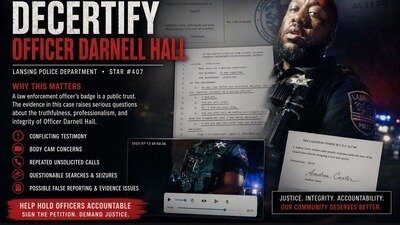
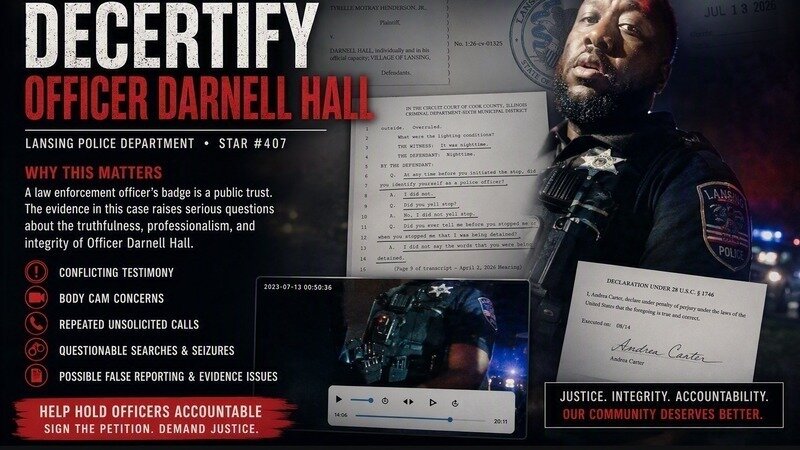
This petition concerns Lansing Police Officer Darnell Hall, Star No. 407, and events arising from a nighttime encounter in Lansing, Illinois, on July 13, 2023.
A related federal civil-rights action is pending in the United States District Court for the Northern District of Illinois as Henderson v. Hall, Case No. 1:26-cv-01325. The pending complaints contain allegations of an unconstitutional stop, excessive force, evidence fabrication, an unlawful digital search, false reporting, evidence concealment, and other misconduct. Those pleadings contain allegations that remain subject to litigation and should not, standing alone, be treated as final findings.
However, the record includes sworn testimony, a signed court-reporter certification, a signed witness declaration, photographs of transcript pages, and video stills that warrant a complete investigation by an authority independent of the Lansing Police Department.
Officer Hall’s sworn testimony raises important questions
During an April 2, 2026 suppression hearing, Officer Hall testified under oath about the initial encounter.
According to the transcript, the encounter occurred at nighttime. Officer Hall testified that, before initiating the stop, Officer Hall did not verbally identify as a police officer, did not yell “stop,” and did not expressly state that a detention was occurring.
Officer Hall also testified:
“At that point when I observed you, I did not see you committing any crime.”
When asked whether a weapon was visible, Officer Hall answered:
“I did not.”
On redirect examination, Officer Hall again testified that no weapon was seen when the stop was initiated and that the person stopped was not seen near a vehicle.
Officer Hall further testified that Officer Hall did not personally speak with witnesses and that no witness told Officer Hall that the person stopped had been seen shooting.
These statements do not independently resolve whether the initial investigative detention was lawful. Officer Hall also testified that dispatch had received multiple calls concerning shots fired and had provided a description involving a person in a black sweatshirt. The complete dispatch recordings, 911 calls, timing information, body-camera files, and descriptions supplied to responding officers must therefore be reviewed together.
The issue is not whether one isolated line of testimony proves misconduct. The issue is whether the complete evidence supports the officer’s actions and whether every material statement in reports, charging documents, testimony, and other official records was accurate and made in good faith.
The initiation and escalation of the encounter should be reviewed
Officer Hall testified that a firearm was held at a low-ready position, with the barrel directed toward the ground. Officer Hall further testified that the person stopped appeared confused, slightly backpedaled, and was then approached for detention.
The pending federal pleadings allege that Officer Hall grabbed the person’s wrist, applied a wrist lock, and participated with other officers in a forceful takedown onto concrete. The pleadings characterize the force as unnecessary and excessive. These remain disputed allegations that should be tested against native body-camera footage, reports, medical information, and testimony from every officer present.
Investigators should establish:
- What Officer Hall said before making physical contact;
- Whether Officer Hall’s status and purpose were reasonably apparent;
- The exact point at which a detention occurred;
- What movement occurred before and after physical contact;
- What commands were given and when;
- Whether the words “stop moving” or “stop resisting” were used;
- Whether the person complied after recognizing police authority;
- Which officer applied each use-of-force technique;
- Whether the force continued after compliance or restraint; and
- Whether every report accurately described the sequence shown by video.
Body-camera activation and preservation require examination
When asked whether the body camera was activated, Officer Hall testified:
“I do not recall.”
That answer makes the native body-camera files, activation records, audit logs, buffering information, export history, metadata, and chain of custody particularly important.
The federal pleadings allege that discovery recordings contained muted audio and missing, clipped, altered, or concealed portions. Those assertions are disputed allegations, but they are serious enough to require a forensic review of the original agency files—not merely compressed discovery copies, cellphone recordings, screenshots, or exported playback versions.
The investigation should determine:
- When every involved officer’s camera was activated;
- Whether pre-event buffering should exist;
- Whether any officer failed to activate, muted, stopped, or obstructed a camera;
- Whether footage was edited, clipped, transcoded, overwritten, or re-exported;
- Whether the files produced in discovery match the native agency files;
- Who accessed the evidence-management system;
- Whether any audit-log entries reflect modification or deletion; and
- Whether all footage covering the initial approach, physical detention, search, recovery of property, transportation, and station processing has been preserved.
The reported recovery of a firearm and other property must be independently verified
The pending pleadings dispute the reported recovery of a green Glock 19 handgun, an extended magazine, an OBD2 diagnostic device, and a blank vehicle key. They allege that these items were falsely attributed to the person arrested. Those allegations have not been finally adjudicated.
Officer Hall testified that a green Glock 19 with an extended magazine was recovered from the front waistband during a protective pat-down. The transcript also shows that Officer Hall did not see a weapon before initiating the stop and did not see the person near a vehicle.
Those statements are not automatically contradictory. An officer could fail to see an item initially and later recover it during a lawful search. The central question is whether the reported recovery actually occurred as described and whether the native video, property records, forensic evidence, and chain of custody independently confirm it.
Investigators should determine:
- Which officer first claimed to see or feel each item;
- Which officer physically recovered each item;
- Whether the complete recovery is continuously visible on video;
- Where each item was located;
- Whether accounts differ between reports, testimony, and recordings;
- When the items were photographed, inventoried, packaged, and sealed;
- Whether fingerprint or DNA testing was conducted or requested;
- Whether any serial-number discrepancies exist;
- Whether the property inventory and evidence-room records are complete; and
- Whether every sworn statement about the recovery had a truthful factual basis.
Forensic and eyewitness evidence should be obtained
The federal pleadings allege that a gunshot-residue test was negative, that the result became available before an eyewitness show-up, that the witness did not identify the detained person as the shooter, and that no shell casings or ballistics evidence connected the detained person to a shooting. These assertions should be verified through the original laboratory report, timestamps, witness records, body-camera footage, CAD data, dispatch communications, and show-up documentation.
An independent investigation should determine:
- The exact time the hands were swabbed;
- The method and chain of custody for the samples;
- The test result and when that result became available;
- Who received or reviewed the result;
- When the witness show-up occurred;
- What instructions were given to the witness;
- The witness’s exact words;
- Whether the witness made a positive, negative, or inconclusive identification;
- Whether shell casings or other ballistic evidence were recovered; and
- Whether later reports and testimony accurately disclosed all exculpatory and contradictory information.
A negative gunshot-residue result does not, by itself, prove that a person did not possess or discharge a firearm. Likewise, a failed identification does not alone resolve every issue. But those facts, if confirmed, are material and must be accurately preserved and reported.
The alleged digital search and telephone calls require investigation
Officer Hall testified that Officer Hall did not search the cellphone “on video camera.” The federal pleadings allege that station surveillance shows Officer Hall and another officer examining a cellphone and digital-camera information without a warrant or consent. The pleadings further allege that private contact information was obtained and used to call a family member. These remain disputed allegations requiring review of the actual station footage and records.
A signed declaration from Andrea Carter states that Officer Hall made repeated unsolicited telephone calls, attempted to ask questions concerning Tyrelle Henderson’s identity or location, continued after being instructed to stop calling, and associated the telephone number 708-XXX-XXXX with Andrea Carter even though the declarant states that the number was not owned by or registered in Andrea Carter’s name. The declaration states that the association with the number was only as a representative on a T-Mobile account.
Investigators should obtain:
- Station-surveillance footage;
- The original cellphone and camera property records;
- Any search warrant or consent form;
- I-CLEAR and other database audit logs;
- Department-issued and station telephone records;
- Recordings of calls, if available;
- Relevant subscriber and account records obtained through lawful process;
- Reports documenting the calls;
- The source from which the number was obtained; and
- Statements from all persons who participated in or witnessed the calls.
Illinois law provides a process for certification review
Illinois law authorizes the Illinois Law Enforcement Training and Standards Board to investigate conduct that may support discretionary decertification. Potential grounds include excessive force, body-camera tampering intended to conceal or alter evidence, knowingly false statements, perjury, evidence fabrication, and unprofessional, unethical, deceptive, or harmful conduct.
Illinois also permits any person to notify the Board of conduct believed to fall within those categories. The Board’s allegation process requests a detailed incident description and an identification of supporting evidence, including videos, reports, laboratory records, photographs, computer data, GPS records, and witness interviews.
This petition does not demand that the Board predetermine the outcome. It demands that the Board conduct the investigation required to reach a fair, evidence-based decision.
What We Are Demanding
We call upon the Illinois Law Enforcement Training and Standards Board and every appropriate independent authority to:
- Open a formal certification investigation into Officer Darnell Hall’s conduct concerning the July 13, 2023 encounter and subsequent reporting, searches, evidence handling, communications, and testimony.
- Preserve and obtain all native body-camera files, including metadata, pre-event buffers, activation logs, audit histories, access logs, export records, deletion records, and unedited footage from every officer involved.
- Obtain all station-surveillance recordings depicting property handling, cellphone or camera access, booking procedures, database inquiries, and communications.
- Compare Officer Hall’s sworn testimony with the police reports, grand-jury testimony, native video, dispatch audio, CAD records, 911 recordings, station footage, forensic results, property records, and witness evidence.
- Conduct a forensic examination of the discovery recordings to determine whether any audio or video was muted, clipped, deleted, altered, concealed, or exported incompletely.
- Audit the alleged firearm and property recovery, including photographs, fingerprints, DNA, serial numbers, packaging, inventory, chain of custody, and evidence-room records.
- Obtain the gunshot-residue report and timestamp history, together with the complete witness show-up records and statements.
- Investigate the alleged cellphone or digital-property search and determine how private contact information was obtained.
- Investigate the repeated telephone calls described in the signed witness declaration and compare the declaration with call logs, recordings, database searches, and official reports.
- Obtain a fresh, unannotated certified transcript directly from the court reporter’s office, the State’s Attorney’s Office, or the appropriate records custodian.
- Require the Village of Lansing to preserve all relevant evidence and prohibit destruction under any routine retention schedule while the investigation and related litigation remain pending.
- Determine whether temporary administrative safeguards are appropriate during the investigation, consistent with due process and applicable employment protections.
- Issue a written determination explaining whether the evidence substantiates misconduct and whether discipline, retraining, suspension, or decertification proceedings are warranted.
Initiate decertification proceedings if the evidence establishes statutory grounds, while providing all legally required notice and due process.
Why Your Signature Matters
This petition is not about hostility toward law enforcement. It is about protecting the legitimacy of lawful policing.
Honest officers and residents share the same interest: complete evidence, accurate reports, truthful testimony, constitutional conduct, and meaningful accountability when standards are violated.
No officer should be condemned solely through public accusation. But no officer should be insulated from investigation when sworn testimony, video evidence, forensic records, witness declarations, and official reports raise substantial unresolved questions.
Sign this petition to demand preservation, transparency, an independent investigation, and a fair certification decision based on the complete evidence.

42
The Issue
Petition Target
- Illinois Law Enforcement Training and Standards Board
- Village of Lansing
- Lansing Police Department
- Appropriate independent oversight and prosecutorial authorities
Petition Summary
We call upon the Illinois Law Enforcement Training and Standards Board to conduct an independent, evidence-based investigation into allegations involving Lansing Police Officer Darnell Hall, Star No. 407, and to determine whether the officer’s certification should be suspended or revoked under Illinois law.
This petition does not ask the public to decide disputed criminal or civil issues. It asks the responsible authorities to preserve the evidence, investigate the reported conduct, compare sworn testimony against objective records, and impose appropriate consequences if disciplinary or decertification grounds are proven.
Full Petition
Public trust requires an independent investigation
A police officer’s authority depends upon honesty, sound judgment, lawful conduct, accurate reporting, and respect for constitutional rights. When sworn testimony, video evidence, official reports, witness declarations, forensic records, and property-recovery claims appear to raise serious unresolved questions, those questions should not be ignored or left exclusively to the officer’s employing agency.
This petition concerns Lansing Police Officer Darnell Hall, Star No. 407, and events arising from a nighttime encounter in Lansing, Illinois, on July 13, 2023.
A related federal civil-rights action is pending in the United States District Court for the Northern District of Illinois as Henderson v. Hall, Case No. 1:26-cv-01325. The pending complaints contain allegations of an unconstitutional stop, excessive force, evidence fabrication, an unlawful digital search, false reporting, evidence concealment, and other misconduct. Those pleadings contain allegations that remain subject to litigation and should not, standing alone, be treated as final findings.
However, the record includes sworn testimony, a signed court-reporter certification, a signed witness declaration, photographs of transcript pages, and video stills that warrant a complete investigation by an authority independent of the Lansing Police Department.
Officer Hall’s sworn testimony raises important questions
During an April 2, 2026 suppression hearing, Officer Hall testified under oath about the initial encounter.
According to the transcript, the encounter occurred at nighttime. Officer Hall testified that, before initiating the stop, Officer Hall did not verbally identify as a police officer, did not yell “stop,” and did not expressly state that a detention was occurring.
Officer Hall also testified:
“At that point when I observed you, I did not see you committing any crime.”
When asked whether a weapon was visible, Officer Hall answered:
“I did not.”
On redirect examination, Officer Hall again testified that no weapon was seen when the stop was initiated and that the person stopped was not seen near a vehicle.
Officer Hall further testified that Officer Hall did not personally speak with witnesses and that no witness told Officer Hall that the person stopped had been seen shooting.
These statements do not independently resolve whether the initial investigative detention was lawful. Officer Hall also testified that dispatch had received multiple calls concerning shots fired and had provided a description involving a person in a black sweatshirt. The complete dispatch recordings, 911 calls, timing information, body-camera files, and descriptions supplied to responding officers must therefore be reviewed together.
The issue is not whether one isolated line of testimony proves misconduct. The issue is whether the complete evidence supports the officer’s actions and whether every material statement in reports, charging documents, testimony, and other official records was accurate and made in good faith.
The initiation and escalation of the encounter should be reviewed
Officer Hall testified that a firearm was held at a low-ready position, with the barrel directed toward the ground. Officer Hall further testified that the person stopped appeared confused, slightly backpedaled, and was then approached for detention.
The pending federal pleadings allege that Officer Hall grabbed the person’s wrist, applied a wrist lock, and participated with other officers in a forceful takedown onto concrete. The pleadings characterize the force as unnecessary and excessive. These remain disputed allegations that should be tested against native body-camera footage, reports, medical information, and testimony from every officer present.
Investigators should establish:
- What Officer Hall said before making physical contact;
- Whether Officer Hall’s status and purpose were reasonably apparent;
- The exact point at which a detention occurred;
- What movement occurred before and after physical contact;
- What commands were given and when;
- Whether the words “stop moving” or “stop resisting” were used;
- Whether the person complied after recognizing police authority;
- Which officer applied each use-of-force technique;
- Whether the force continued after compliance or restraint; and
- Whether every report accurately described the sequence shown by video.
Body-camera activation and preservation require examination
When asked whether the body camera was activated, Officer Hall testified:
“I do not recall.”
That answer makes the native body-camera files, activation records, audit logs, buffering information, export history, metadata, and chain of custody particularly important.
The federal pleadings allege that discovery recordings contained muted audio and missing, clipped, altered, or concealed portions. Those assertions are disputed allegations, but they are serious enough to require a forensic review of the original agency files—not merely compressed discovery copies, cellphone recordings, screenshots, or exported playback versions.
The investigation should determine:
- When every involved officer’s camera was activated;
- Whether pre-event buffering should exist;
- Whether any officer failed to activate, muted, stopped, or obstructed a camera;
- Whether footage was edited, clipped, transcoded, overwritten, or re-exported;
- Whether the files produced in discovery match the native agency files;
- Who accessed the evidence-management system;
- Whether any audit-log entries reflect modification or deletion; and
- Whether all footage covering the initial approach, physical detention, search, recovery of property, transportation, and station processing has been preserved.
The reported recovery of a firearm and other property must be independently verified
The pending pleadings dispute the reported recovery of a green Glock 19 handgun, an extended magazine, an OBD2 diagnostic device, and a blank vehicle key. They allege that these items were falsely attributed to the person arrested. Those allegations have not been finally adjudicated.
Officer Hall testified that a green Glock 19 with an extended magazine was recovered from the front waistband during a protective pat-down. The transcript also shows that Officer Hall did not see a weapon before initiating the stop and did not see the person near a vehicle.
Those statements are not automatically contradictory. An officer could fail to see an item initially and later recover it during a lawful search. The central question is whether the reported recovery actually occurred as described and whether the native video, property records, forensic evidence, and chain of custody independently confirm it.
Investigators should determine:
- Which officer first claimed to see or feel each item;
- Which officer physically recovered each item;
- Whether the complete recovery is continuously visible on video;
- Where each item was located;
- Whether accounts differ between reports, testimony, and recordings;
- When the items were photographed, inventoried, packaged, and sealed;
- Whether fingerprint or DNA testing was conducted or requested;
- Whether any serial-number discrepancies exist;
- Whether the property inventory and evidence-room records are complete; and
- Whether every sworn statement about the recovery had a truthful factual basis.
Forensic and eyewitness evidence should be obtained
The federal pleadings allege that a gunshot-residue test was negative, that the result became available before an eyewitness show-up, that the witness did not identify the detained person as the shooter, and that no shell casings or ballistics evidence connected the detained person to a shooting. These assertions should be verified through the original laboratory report, timestamps, witness records, body-camera footage, CAD data, dispatch communications, and show-up documentation.
An independent investigation should determine:
- The exact time the hands were swabbed;
- The method and chain of custody for the samples;
- The test result and when that result became available;
- Who received or reviewed the result;
- When the witness show-up occurred;
- What instructions were given to the witness;
- The witness’s exact words;
- Whether the witness made a positive, negative, or inconclusive identification;
- Whether shell casings or other ballistic evidence were recovered; and
- Whether later reports and testimony accurately disclosed all exculpatory and contradictory information.
A negative gunshot-residue result does not, by itself, prove that a person did not possess or discharge a firearm. Likewise, a failed identification does not alone resolve every issue. But those facts, if confirmed, are material and must be accurately preserved and reported.
The alleged digital search and telephone calls require investigation
Officer Hall testified that Officer Hall did not search the cellphone “on video camera.” The federal pleadings allege that station surveillance shows Officer Hall and another officer examining a cellphone and digital-camera information without a warrant or consent. The pleadings further allege that private contact information was obtained and used to call a family member. These remain disputed allegations requiring review of the actual station footage and records.
A signed declaration from Andrea Carter states that Officer Hall made repeated unsolicited telephone calls, attempted to ask questions concerning Tyrelle Henderson’s identity or location, continued after being instructed to stop calling, and associated the telephone number 708-XXX-XXXX with Andrea Carter even though the declarant states that the number was not owned by or registered in Andrea Carter’s name. The declaration states that the association with the number was only as a representative on a T-Mobile account.
Investigators should obtain:
- Station-surveillance footage;
- The original cellphone and camera property records;
- Any search warrant or consent form;
- I-CLEAR and other database audit logs;
- Department-issued and station telephone records;
- Recordings of calls, if available;
- Relevant subscriber and account records obtained through lawful process;
- Reports documenting the calls;
- The source from which the number was obtained; and
- Statements from all persons who participated in or witnessed the calls.
Illinois law provides a process for certification review
Illinois law authorizes the Illinois Law Enforcement Training and Standards Board to investigate conduct that may support discretionary decertification. Potential grounds include excessive force, body-camera tampering intended to conceal or alter evidence, knowingly false statements, perjury, evidence fabrication, and unprofessional, unethical, deceptive, or harmful conduct.
Illinois also permits any person to notify the Board of conduct believed to fall within those categories. The Board’s allegation process requests a detailed incident description and an identification of supporting evidence, including videos, reports, laboratory records, photographs, computer data, GPS records, and witness interviews.
This petition does not demand that the Board predetermine the outcome. It demands that the Board conduct the investigation required to reach a fair, evidence-based decision.
What We Are Demanding
We call upon the Illinois Law Enforcement Training and Standards Board and every appropriate independent authority to:
- Open a formal certification investigation into Officer Darnell Hall’s conduct concerning the July 13, 2023 encounter and subsequent reporting, searches, evidence handling, communications, and testimony.
- Preserve and obtain all native body-camera files, including metadata, pre-event buffers, activation logs, audit histories, access logs, export records, deletion records, and unedited footage from every officer involved.
- Obtain all station-surveillance recordings depicting property handling, cellphone or camera access, booking procedures, database inquiries, and communications.
- Compare Officer Hall’s sworn testimony with the police reports, grand-jury testimony, native video, dispatch audio, CAD records, 911 recordings, station footage, forensic results, property records, and witness evidence.
- Conduct a forensic examination of the discovery recordings to determine whether any audio or video was muted, clipped, deleted, altered, concealed, or exported incompletely.
- Audit the alleged firearm and property recovery, including photographs, fingerprints, DNA, serial numbers, packaging, inventory, chain of custody, and evidence-room records.
- Obtain the gunshot-residue report and timestamp history, together with the complete witness show-up records and statements.
- Investigate the alleged cellphone or digital-property search and determine how private contact information was obtained.
- Investigate the repeated telephone calls described in the signed witness declaration and compare the declaration with call logs, recordings, database searches, and official reports.
- Obtain a fresh, unannotated certified transcript directly from the court reporter’s office, the State’s Attorney’s Office, or the appropriate records custodian.
- Require the Village of Lansing to preserve all relevant evidence and prohibit destruction under any routine retention schedule while the investigation and related litigation remain pending.
- Determine whether temporary administrative safeguards are appropriate during the investigation, consistent with due process and applicable employment protections.
- Issue a written determination explaining whether the evidence substantiates misconduct and whether discipline, retraining, suspension, or decertification proceedings are warranted.
Initiate decertification proceedings if the evidence establishes statutory grounds, while providing all legally required notice and due process.
Why Your Signature Matters
This petition is not about hostility toward law enforcement. It is about protecting the legitimacy of lawful policing.
Honest officers and residents share the same interest: complete evidence, accurate reports, truthful testimony, constitutional conduct, and meaningful accountability when standards are violated.
No officer should be condemned solely through public accusation. But no officer should be insulated from investigation when sworn testimony, video evidence, forensic records, witness declarations, and official reports raise substantial unresolved questions.
Sign this petition to demand preservation, transparency, an independent investigation, and a fair certification decision based on the complete evidence.
Petition Updates
Share this petition
Petition created on August 23, 2026