

Deliver Us From Evil: The Veto Campaign for Fair Elections
Deliver Us From Evil: The Veto Campaign for Fair Elections
The Issue
Hello and welcome.
I’m Rohin Vadera, founder of the Veto Campaign.
The Problem:
The root of much of the evil in this world is letting those who don't suffer the consequences of their decisions make decisions that affect everyone else. If this campaign succeeds, it can stop letting at least some evil into your life. And, even better, maximise the common good.
The idea is simple.
Add an option to VETO elections (legislative only) on ballots, which triggers a rerun if chosen by a majority.
Why do we let people without majority consent into parliament or local councils? Why do we go to all the trouble of setting up elections for 20,000 elected officials when none of them needs majority consent to gain power and dictate our lives?
Do you feel represented? Isn't an election's basic function to elect representatives? If so, then why do they only represent a small sliver of the population? There are at least 150 MPs in parliament with fewer than 20,000 votes out of constituencies of about 70,000 to 75,000, with pitiful turnouts.
If we are going to fix anything, isn't the electoral system the first thing we need to change?
The VETO option is not the final reform; rather, it is the foundational first reform because it helps us assess the success of future reforms by measuring public dissatisfaction.
How can someone govern effectively without analysing the VETO pattern and identifying which policies are succeeding, failing, or excluding certain groups? How can they deduce unexpected second-order effects? A veto is a tool that assists the government and incentivises improvements. And when things fall off a cliff, we can reset without much turmoil.
It's so useful. What MP worth their salt would want to get into parliament without majority consent?
Warning: A technical note: No MP needs to receive over 50% of the votes; they only need to ensure that the majority does not veto their election.
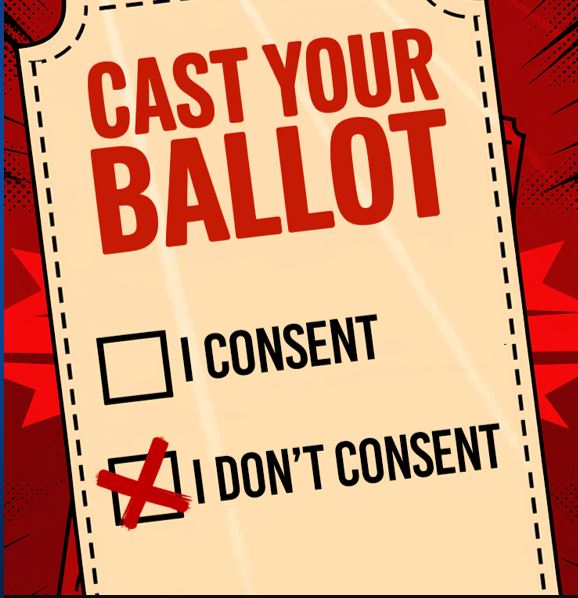
If you don't have a candidate to support, you must either cast a hopeless or uncertain ballot, vote tactically, or choose the least bad option. For these reasons or if there are unaddressed issues you want addressed, then just tick "I VETO this election."
The election is meant for voters, not for political parties or candidates.
If you are satisfied with who will win to represent you, vote for whoever you want. The majority is no longer divided. In fact, the vast majority of people do not trust the political parties we elect. Yet there they are.
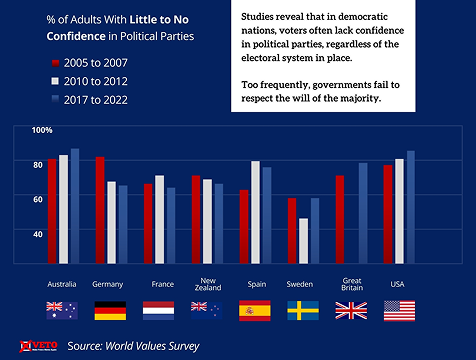
We wouldn’t let someone spend our money or borrow in our name without our consent. However, governments frequently form without the majority support in their seats. This is the reason we are in the situation we are now.
How it works
In our current FPTP system, we should implement a do-over. If over 50% veto, the election reruns—as many times as needed—until we obtain options we can believe in. Original candidates can try again.
This means that MPs now have an interest in uniting their constituencies. Currently, the more fragmented our country is, the fewer votes an MP or councillor needs to win an election; there is no incentive to unite a constituency.
We can now see sectarian voting blocks that can sway an election. It's a worrying trend, especially now that politicians will pander to those blocs.
What about proportional representation? (PR)
PR necessitates a veto option since it allocates all seats without ensuring representation for all potential voters, risking the election of MPs who represent no one. It still allows for tactical voting and voting for the least undesirable, and it has the potential to provide small minority parties a disproportionate influence over policy that the majority oppose.
PR didn't stop Germany from kneecapping itself.
The principle that applies is that a percentage VETO results in the same percentage of empty seats. For example, if there is a 30% veto, then 30% of the seats will remain empty. The rest are assigned as per vote share. This arrangement retains proportionality, allows more voters to be represented in future elections, and keeps pressure on elected MPs to do a competent job; otherwise, even more seats will become empty.
There's no way around requiring the majority's consent to optimise governance. If you believe a minority is consistently better at making decisions for a country's governance, you imply that democracy doesn't work and that this minority can be trusted to care for the majority's interests as if they were pets or children.
That's just absurd. However, our current operation is based on minority rule, which explains the current state of chaos. Elections without vetoes are a "lead, follow, or get out of the way" approach. It's not democratic and sets us up for poor governance and division.
Sign this petition to introduce a simple VETO option on every ballot.
Why It Works
Democracy should work; we live with the consequences of our decisions, so we have the greatest incentive to achieve effective governance. We are currently just fuel for the election system, not its owners, which is why it fails to serve us.
As soon as the veto pool is larger than the difference between the winner and second place, the winner must govern with the veto pool in mind or risk losing in the next election. There are plenty of seats won with low margins.
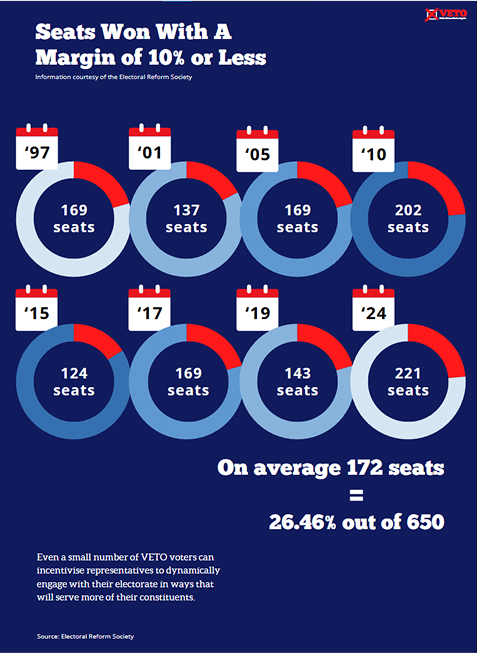
Imagine the impact
Better policies: politicians will want to resolve problems like the cost of living crisis, immigration, long NHS wait times, or a lack of housing to avoid vetoes. They can no longer break their promises without consequences.
Real voter power: It shows where people are most unhappy, even before a majority veto, and pushes for change across the country. It provides a reliable measure of public dissatisfaction—essential feedback for consistent, effective governance.
Please Sign the Petition! :)
Recent elections have shown there is a record low trust; therefore, this veto could transform UK politics by making it work for the people instead of the parties.
Visit the website to find out more: www.vetocampaign.com
Please share this petition!

1,673
The Issue
Hello and welcome.
I’m Rohin Vadera, founder of the Veto Campaign.
The Problem:
The root of much of the evil in this world is letting those who don't suffer the consequences of their decisions make decisions that affect everyone else. If this campaign succeeds, it can stop letting at least some evil into your life. And, even better, maximise the common good.
The idea is simple.
Add an option to VETO elections (legislative only) on ballots, which triggers a rerun if chosen by a majority.
Why do we let people without majority consent into parliament or local councils? Why do we go to all the trouble of setting up elections for 20,000 elected officials when none of them needs majority consent to gain power and dictate our lives?
Do you feel represented? Isn't an election's basic function to elect representatives? If so, then why do they only represent a small sliver of the population? There are at least 150 MPs in parliament with fewer than 20,000 votes out of constituencies of about 70,000 to 75,000, with pitiful turnouts.
If we are going to fix anything, isn't the electoral system the first thing we need to change?
The VETO option is not the final reform; rather, it is the foundational first reform because it helps us assess the success of future reforms by measuring public dissatisfaction.
How can someone govern effectively without analysing the VETO pattern and identifying which policies are succeeding, failing, or excluding certain groups? How can they deduce unexpected second-order effects? A veto is a tool that assists the government and incentivises improvements. And when things fall off a cliff, we can reset without much turmoil.
It's so useful. What MP worth their salt would want to get into parliament without majority consent?
Warning: A technical note: No MP needs to receive over 50% of the votes; they only need to ensure that the majority does not veto their election.
If you don't have a candidate to support, you must either cast a hopeless or uncertain ballot, vote tactically, or choose the least bad option. For these reasons or if there are unaddressed issues you want addressed, then just tick "I VETO this election."
The election is meant for voters, not for political parties or candidates.
If you are satisfied with who will win to represent you, vote for whoever you want. The majority is no longer divided. In fact, the vast majority of people do not trust the political parties we elect. Yet there they are.
We wouldn’t let someone spend our money or borrow in our name without our consent. However, governments frequently form without the majority support in their seats. This is the reason we are in the situation we are now.
How it works
In our current FPTP system, we should implement a do-over. If over 50% veto, the election reruns—as many times as needed—until we obtain options we can believe in. Original candidates can try again.
This means that MPs now have an interest in uniting their constituencies. Currently, the more fragmented our country is, the fewer votes an MP or councillor needs to win an election; there is no incentive to unite a constituency.
We can now see sectarian voting blocks that can sway an election. It's a worrying trend, especially now that politicians will pander to those blocs.
What about proportional representation? (PR)
PR necessitates a veto option since it allocates all seats without ensuring representation for all potential voters, risking the election of MPs who represent no one. It still allows for tactical voting and voting for the least undesirable, and it has the potential to provide small minority parties a disproportionate influence over policy that the majority oppose.
PR didn't stop Germany from kneecapping itself.
The principle that applies is that a percentage VETO results in the same percentage of empty seats. For example, if there is a 30% veto, then 30% of the seats will remain empty. The rest are assigned as per vote share. This arrangement retains proportionality, allows more voters to be represented in future elections, and keeps pressure on elected MPs to do a competent job; otherwise, even more seats will become empty.
There's no way around requiring the majority's consent to optimise governance. If you believe a minority is consistently better at making decisions for a country's governance, you imply that democracy doesn't work and that this minority can be trusted to care for the majority's interests as if they were pets or children.
That's just absurd. However, our current operation is based on minority rule, which explains the current state of chaos. Elections without vetoes are a "lead, follow, or get out of the way" approach. It's not democratic and sets us up for poor governance and division.
Sign this petition to introduce a simple VETO option on every ballot.
Why It Works
Democracy should work; we live with the consequences of our decisions, so we have the greatest incentive to achieve effective governance. We are currently just fuel for the election system, not its owners, which is why it fails to serve us.
As soon as the veto pool is larger than the difference between the winner and second place, the winner must govern with the veto pool in mind or risk losing in the next election. There are plenty of seats won with low margins.
Imagine the impact
Better policies: politicians will want to resolve problems like the cost of living crisis, immigration, long NHS wait times, or a lack of housing to avoid vetoes. They can no longer break their promises without consequences.
Real voter power: It shows where people are most unhappy, even before a majority veto, and pushes for change across the country. It provides a reliable measure of public dissatisfaction—essential feedback for consistent, effective governance.
Please Sign the Petition! :)
Recent elections have shown there is a record low trust; therefore, this veto could transform UK politics by making it work for the people instead of the parties.
Visit the website to find out more: www.vetocampaign.com
Please share this petition!
1,673
The Decision Makers

Supporter Voices
Petition Updates
Share this petition
Petition created on 1 July 2025