

Deliver Us From Evil: The Veto Campaign for Fair Elections
The Issue
Hello and welcome.
I’m Rohin Vadera, founder of the Veto Campaign.
Goal: Make maximisation of the common good the default mode of governance.
Definition of common good: the state’s set of policies, decisions, and actions that benefit the majority, if not all, of a nation.
How to determine if it has been maximised: Voters, as the primary stakeholders in a democratic society, ultimately bear the consequences of their choices. As such, they can be considered the final arbiters of the common good.
Premise: Politicians who are elected without majority support have no incentive to maximise the common good. Their incentive is to target benefits to their support base, even if it is at the cost of the majority.
The Solution: Ensure no politician can be elected without majority support or no government can form without majority support. Now, each elected politician and government is incentivised to deliver results and unify the country.
The Strategy: replace the lead, follow, or get-out-of-the-way electoral model with one that makes voters sovereign.
While there are many types of electoral models, they are all variations of LFOG.
FPTP or PR, whether they incorporate AV or STV or not, do not make provision to account for:
•Voters who don’t think they have anyone to adequately represent their interests (this includes tactical voters and those voting for the lesser evil, as well as those who don’t have anyone they can vote for at all)
•Voters who want inadequately or ignored issue(s) addressed, either local or national.
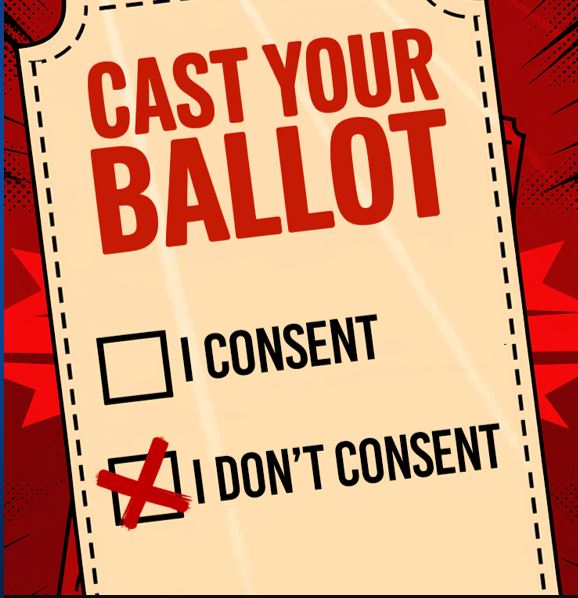
The Tactic: At the top of every ballot for legislative positions, there is an option labelled – I VETO this election.
The effect of the option is logically determined by the system in which it operates.
E.g., FPTP: if a majority of those who vote choose to veto, the election is rerun in that constituency. If a majority don’t veto, it indicates those likely to win have majority support and is, in effect, a ranked ballot.
Don’t get too caught up in the minutiae of the possibility of multiple reruns, etc. I can explain how all that works at later stage. In any case, it's unlikely FPTP will exist once veto appears.
Just understand the principle that the veto optimises each electoral model to produce the best results possible for that model.
Even if the veto doesn’t achieve a majority, it influences governance as soon as the veto pool is greater than the winning margin. Whoever wins has to govern to entice the veto pool to support them, or this pool can be captured by the 2nd place candidate in the next election.
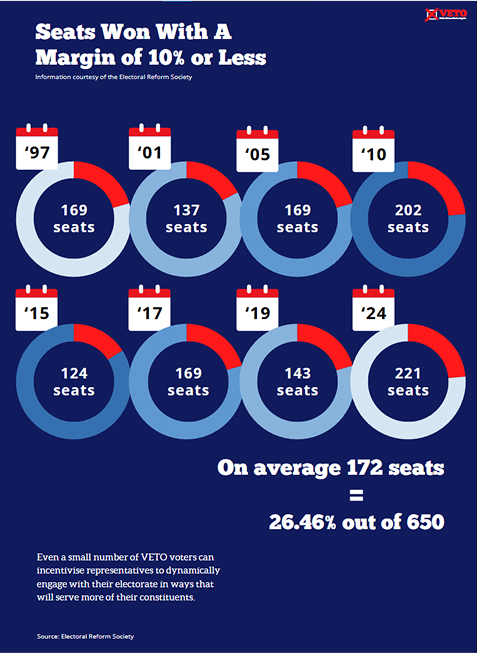
The effect of the veto is to set up incentives to try and minimise its use. The less the veto is used, the more likely that the common good is being maximised.
FPTP currently has a de facto minority veto and forces a majority to accept taxation and legislation by a privileged minority, even though it may be detrimental to their interests.
It’s a joke of a system.
PR: There are many types of PR, but the principle is that % veto results in the same % of empty seats.
e.g., if 20% veto the election, then 20% of the seats remain empty. If 50% of the seats or more are empty, then there must be a national rerun.
We don’t know how many of those who don’t vote in PR systems don't do so because they don’t have anyone to represent them, or how many are forced into choosing the least-worst.
If you force people to either choose subpar representation or abstain, the result is obviously going to be subpar.
This result retains proportionality but ensures that MPs who don’t represent anyone cannot occupy seats. (A massive and unaddressed flaw, similar in scope to FPTP’s minority veto.)
This means whoever gets elected must focus on delivering results to their voters, or even more seats will become empty, and the only way to increase power in such an assembly is to win over the veto pool.
Once again, don’t get too caught up in quorum issues, etc. (BTW, this would only occur if there would have been a huge number of dead wood MPs anyway.) It can all be dealt with and used to turn any argument against it on its head.
What’s interesting is that the veto is a reliable measure of public dissatisfaction, as it contains within it the incentive to reduce its use.
Lawmakers and those with executive powers are presented with a goldmine of information on the patterns of breadth and depth of public dissatisfaction, which can only help policymakers refine their offerings.
Please don’t get too caught up in the delivery of the veto, but understand how it constantly influences policymakers to take pre-emptive measures to minimise its use through:
•Having an electoral system that optimally serves voters
•Provides much-needed periodic feedback on current policies
I am trying hard to promote awareness of this idea, but people get too caught up in the minutiae of implementation and don’t focus on the premise itself. My current goal is to build up enough signatures and social media presence so I can ensure I get 10,000 signatures on a parliamentary petition.
We are up the proverbial creek, and each election hands voters a straw. The veto gives them a paddle. Only voters can get us out of this.
If democracy doesn't work, we are screwed no matter what.
Thank you for reading.
Please Sign the Petition! :)
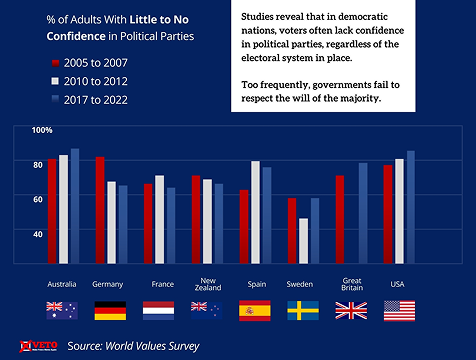
Recent elections have shown there is a record low trust; therefore, this veto could transform UK politics by making it work for the people instead of the parties.
Visit the website to find out more: www.vetocampaign.com
Please share this petition!

3,117
The Issue
Hello and welcome.
I’m Rohin Vadera, founder of the Veto Campaign.
Goal: Make maximisation of the common good the default mode of governance.
Definition of common good: the state’s set of policies, decisions, and actions that benefit the majority, if not all, of a nation.
How to determine if it has been maximised: Voters, as the primary stakeholders in a democratic society, ultimately bear the consequences of their choices. As such, they can be considered the final arbiters of the common good.
Premise: Politicians who are elected without majority support have no incentive to maximise the common good. Their incentive is to target benefits to their support base, even if it is at the cost of the majority.
The Solution: Ensure no politician can be elected without majority support or no government can form without majority support. Now, each elected politician and government is incentivised to deliver results and unify the country.
The Strategy: replace the lead, follow, or get-out-of-the-way electoral model with one that makes voters sovereign.
While there are many types of electoral models, they are all variations of LFOG.
FPTP or PR, whether they incorporate AV or STV or not, do not make provision to account for:
•Voters who don’t think they have anyone to adequately represent their interests (this includes tactical voters and those voting for the lesser evil, as well as those who don’t have anyone they can vote for at all)
•Voters who want inadequately or ignored issue(s) addressed, either local or national.
The Tactic: At the top of every ballot for legislative positions, there is an option labelled – I VETO this election.
The effect of the option is logically determined by the system in which it operates.
E.g., FPTP: if a majority of those who vote choose to veto, the election is rerun in that constituency. If a majority don’t veto, it indicates those likely to win have majority support and is, in effect, a ranked ballot.
Don’t get too caught up in the minutiae of the possibility of multiple reruns, etc. I can explain how all that works at later stage. In any case, it's unlikely FPTP will exist once veto appears.
Just understand the principle that the veto optimises each electoral model to produce the best results possible for that model.
Even if the veto doesn’t achieve a majority, it influences governance as soon as the veto pool is greater than the winning margin. Whoever wins has to govern to entice the veto pool to support them, or this pool can be captured by the 2nd place candidate in the next election.
The effect of the veto is to set up incentives to try and minimise its use. The less the veto is used, the more likely that the common good is being maximised.
FPTP currently has a de facto minority veto and forces a majority to accept taxation and legislation by a privileged minority, even though it may be detrimental to their interests.
It’s a joke of a system.
PR: There are many types of PR, but the principle is that % veto results in the same % of empty seats.
e.g., if 20% veto the election, then 20% of the seats remain empty. If 50% of the seats or more are empty, then there must be a national rerun.
We don’t know how many of those who don’t vote in PR systems don't do so because they don’t have anyone to represent them, or how many are forced into choosing the least-worst.
If you force people to either choose subpar representation or abstain, the result is obviously going to be subpar.
This result retains proportionality but ensures that MPs who don’t represent anyone cannot occupy seats. (A massive and unaddressed flaw, similar in scope to FPTP’s minority veto.)
This means whoever gets elected must focus on delivering results to their voters, or even more seats will become empty, and the only way to increase power in such an assembly is to win over the veto pool.
Once again, don’t get too caught up in quorum issues, etc. (BTW, this would only occur if there would have been a huge number of dead wood MPs anyway.) It can all be dealt with and used to turn any argument against it on its head.
What’s interesting is that the veto is a reliable measure of public dissatisfaction, as it contains within it the incentive to reduce its use.
Lawmakers and those with executive powers are presented with a goldmine of information on the patterns of breadth and depth of public dissatisfaction, which can only help policymakers refine their offerings.
Please don’t get too caught up in the delivery of the veto, but understand how it constantly influences policymakers to take pre-emptive measures to minimise its use through:
•Having an electoral system that optimally serves voters
•Provides much-needed periodic feedback on current policies
I am trying hard to promote awareness of this idea, but people get too caught up in the minutiae of implementation and don’t focus on the premise itself. My current goal is to build up enough signatures and social media presence so I can ensure I get 10,000 signatures on a parliamentary petition.
We are up the proverbial creek, and each election hands voters a straw. The veto gives them a paddle. Only voters can get us out of this.
If democracy doesn't work, we are screwed no matter what.
Thank you for reading.
Please Sign the Petition! :)
Recent elections have shown there is a record low trust; therefore, this veto could transform UK politics by making it work for the people instead of the parties.
Visit the website to find out more: www.vetocampaign.com
Please share this petition!
The Decision Makers

Supporter Voices
Petition Updates
Share this petition
Petition created on 1 July 2025