
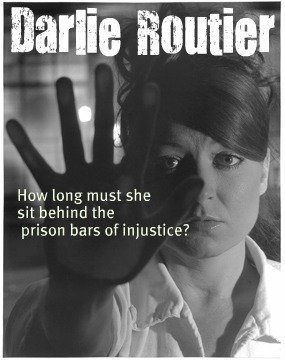
Give her a FAIR trial using real DNA evidence this time.
Give her a FAIR trial using real DNA evidence this time.
The Issue
In Search of the Truth: The Story of Darlie Lynn Routier
by Anne Good
Part 1: INTRODUCTION
The Mystery Unravels
On June 6, 1996, in the quiet suburbs of North Dallas, little Damon, 5,and Devon, 6, lay sleeping on the floor in front of the television. Their mother, Darlie Routier, 26, slept on the couch. What happened next remains a mystery. Suffering from partial amnesia, Ms. Routier recalls being "awakened" by her son and "feeling groggy." She saw a man in a baseball cap standing near the couch. Both of her sons died that night of multiple and brutal stab wounds to the upper torso inflicted by a knife from the Routier kitchen, and a second knife which has never been found. Ms. Routier's throat was slashed to within 2 mm. of her carotid artery and she also suffered multiple injuries and stab wounds. Although Routier claims an intruder had attached them, within twenty minutes the Rowlett Police Department decided she was their suspect and her wounds were self-inflicted. Twelve days later, she was arrested. Seven months later, she was convicted and sentenced to die.
With no substantial evidence, no confession, no motive, and no eyewitness, her conviction is as much of a mystery as the actual events surrounding the murders. One explanation may lie in the tremendous impact of the"Silly String" tape. This fifteen-second tape, shot by a local news station, shows a smiling Darlie spraying the "silly string" on the boys' freshly dug graves just eight days after the murders. The jury viewed it nine times during deliberations. Rita Way, a juror and spokesperson for the jury, referring to the tape, said, "I don't think the defense proved that she was innocent and no mother that had their children murdered can act that way after eight days. I mean eight days! I just can't see it." What Ms. Ways and the other jurors did not see was the surveillance tape, made by the Rowlett Police Department on the same day, which clearly shows a solemn graveside service and a mother in pain. The irony is that a Judge ruled this tape could not be admitted into evidence as there was no warrant and the taping was illegal. Had the jury been allowed to see the entire graveside service, would they have reached a different conclusion? For many in Texas and throughout the country, this question demands an answer.
Another explanation may be connected to the media-created image of Darlie Routier. It primarily consisted of endless titillating chatter about her "freshly-dyed blonde hair," "breast implants," and "sex toys" found in her bedroom. Drug use and child abuse were also implied, although a blood test and hair analysis revealed Ms. Routier was not a user of illegal drugs and no evidence has ever been presented to substantiate any claims of child abuse. In tabloid fashion, they characterized her as "the mother from hell," and "the next Susan Smith," despite the fact that those who knew her well said just the opposite. Family and friends portrayed her as a loving mother and wife, a woman concerned with the well-being of others. The state opted to present the media-produced image of Darlie to the jury.
Serious Doubts
There is also serious doubt about the integrity of the investigation and trial of Ms. Routier. Claims of incompetence, bias, witness tampering, tainted evidence, prosecutorial misconduct, and perjury have gained a rapid momentum as many Texans begin to reexamine the case that has held their attention for three long years. Ms. Routier, now awaiting a lethal injection, continues steadfast in her claim of innocence. Newly discovered evidence and recently released crime scene photos seem to support her. At the time of trial, the defense was only allowed 400 of the 1000 photos taken. When viewed in context, the additional 600 photos reveal the full depth of police incompetence and a severely compromised crime scene. Evidence is moved, blood is trampled on, blankets are folded and unfolded (disturbing the blood-spatter pattern), key DNA evidence is placed in paper bags from a local grocery store, and several bloody boot prints not belonging to any police officer are clearly revealed as well as two bloody finger prints, one on the alleged point of exit by the intruder. The "new" photos also contradict and impeach key testimony given by various investigators on behalf of the state. Additionally, a neighbor has now come forward saying that on the night of the murders she saw two men near the Routier home. This supports testimony by Angela Rickles who came forward after Ms. Routier's arrest and told police that two men tried to break into her home on the night of the murders. L.D. Middleton also states that on March 22, 1996 an intruder slashed a few of his window screens before finding an unlocked window over the kitchen sink. The intruder rifled through the kitchen drawers and police told Mr.Middleton, "He was probably getting a large knife in case you woke up." The Middletons live five minutes from the Routier home. They now state, "Obviously, we didn't wake up or we would both be either dead or worse, one of us might be on Death Row."
Aside from new evidence, the old evidence remains problematic. The prosecution presented a time frame that is simply not feasible and the murders could not have occurred as they theorized. There is also the blood-stained sock found 75 yards from the Routier home. The sock contains both of the boys' blood and Darlie's DNA, most likely from saliva. How it got there is something the prosecution could not answer. They didn't need to answer. They had pure emotion on their side and a nation still feeling the sting of betrayal from Susan Smith, the South Carolina woman who claimed on national television that her two young boys were abducted by a black man. Ten days later, she confessed to killing them.
United By Truth
There is an old saying in the world of law, "If the facts don't fit, cite the law. If the law doesn't fit, cite the facts. If neither fits....pound your fist on the podium and play to the juror's emotions." Lead prosecutor Greg Davis chose the latter. The law didn't fit, the facts didn't fit -- but the "silly string" did. In a profession that dictates truth and justice above all else, Mr. Davis implemented what some observers have called, "a surprisingly gutless, win-at-any-cost style of prosecution." Even those who think Ms. Routier is guilty are beginning to ask for more from our system of justice than macho "fist pounding." Many want Darlie to go to the death chamber with evidence so solid, so damning, so iron-clad, that even her family can no longer maintain her innocence. Without that, the death penalty is in serious jeopardy. It is precisely cases like Ms. Routier's that give justice advocates a pole on which to fly their flag and weakens the popular belief in state-sanctioned executions. The very survival of this law hinges upon a societal belief that all avenues of truth are fully explored, that the prosecution has proven its case beyond a reasonable doubt, and the defendant was presumed innocent at the onset and for the duration of the trial. Ms. Routier's investigation and trial, although labeled by some, "an anomaly," contained not one of these basic elements. Death penalty proponents and opponents alike may be united, if only for a moment, by this seemingly flagrant disregard for our system of justice. In another ironic twist, Texans are beginning to see it is only in obtaining justice for Ms. Routier that this unjust law can remain intact.
The demand for a new trial for Darlie Routier seems to be gaining support from many Texans regardless of their point of view. If the prosecution's case is fair and solid, she will be found guilty again. If there is any validity to the claims of incompetence, prosecutorial misconduct, witness and jury tampering, and perjury, that too will be revealed and Ms. Routier will be exonerated.
The debate on the death penalty put aside, reasonable people can agree that a young woman who claims to be innocent should not be executed in "the name of justice" over nothing more than character assassination and a meaningless can of "silly string."
With the firm belief that Darlie Routier was in part, convicted by media-hype, it seemed critical in my search for the truth to meet her face-to-face. In May, 1999, I had the opportunity to do just that.. The following is a condensed account of our afternoon together.
Part 2: THE WOMAN BENEATH THE HYPE
{Note from the Editor: Sometimes a newspaper or magazine sends a reporter out on an assignment without anticipating that she will become involved to the point of becoming an advocate in a way even the reporter could not foresee. This happened to Anne Good. Anne's story is the result of the unexpected. Like Chris Brown, whose book is reviewed in this issue by Anne, she has been persuaded by both the facts and her meeting with Ms. Routier. As Justice Denied, the magazine, we take no collective stand about anyone's innocence or guilt because we see things differently. As individuals, we must be free to take a stand, and often become advocates. -- Clara A. Thomas Boggs}
In his opening statement, Prosecutor Greg Davis told the jury, the state of Texas and the country that "the real Darlie Routier is a self-centered woman, a materialistic woman and a woman cold enough to murder her own children." His case was built on the premise that Ms. Routier, angry over losing her money, her freedom, and her figure, brutally and savagely stabbed her two young sons to death while they slept, then staged a crime scene and blamed an intruder.
Today, three years later, just mention the name of Darlie Routier anywhere in the state of Texas and people feel compelled to speak out. Not from some platform of knowledge built on facts and evidence, but from some deep inner vision of the way they think the world should be, based on the most significant relationship in all our lives -- our mothers -- and the media-produced image of Darlie is simply in direct conflict with our societal fantasies of "mom."
Vehement cries of "Fry the bitch," "Cold-blooded, child-killer," and "It's Susan Smith all over again" lie in direct contrast to cool, logical comments like "Maybe she is innocent" to a slightly louder "She was railroaded by the media and the courts." -- It was with some slight trepidation that I agreed to meet Darlie Routier.
With blonde highlights in her long, dark hair, the only evidence of the life she once lived, Darlie Routier appears younger than her twenty-nine years. The make-up and gold jewelry, now long gone, have been replaced by an inner glow and a simple handmade beaded cross necklace. A white prison uniform is her only choice of clothing. In another setting she would be considered naturally attractive. Here on death row, she feels "older than I am."
With the brutal murder of her two boys, 7 year-old Devon and 5 year-old Damon, and Darlie herself savagely attacked, she has survived more than most people experience in a lifetime. Add the fact that she has now been tried, convicted and sentenced to die for a crime she says, "I did not commit," and it totals an experience that is unfathomable to most of us. All before her 27th birthday.
Still, Darlie managed a warm smile when we met and spoke with a candor and sincerity that only people who understand the temporal, fragile nature of life can seem to muster. I was instantly taken aback.
I began my journey to Dallas County with the simple belief that Darlie deserved a new trial. Her guilt or innocence was not an issue for me and I suspected she was indeed "self-centered." I doubted I would like her but liking someone is not a condition for promoting justice. I only intended to support the notion that a new trial was absolutely necessary and that Silly String and "hype" are not evidence. I was going to ask Darlie a few questions, take some notes, and get the heck out of downtown Dallas before rush hour traffic began and my waiting pitcher of Margaritas began to melt. -- But something happened along the way.
Maybe it was the way Darlie held her head up high. Maybe it was when she asked all about my little boy. Maybe it was her courage when she candidly spoke about the night of June 6, 1996. Maybe it was the way she tugged on her cross necklace when she occasionally groped for the right word. Maybe it was the pain in her eyes when she spoke of her "babies," Devon and Damon, and the fire in her eyes when she vowed to continue her daily struggle for survival. Most likely it was all of these things, and more.
I saw her soul and it was kind and gentle and forgiving. I knew the media and the prosecutors had lied to me.
During our afternoon together I discovered that Darlie is not just a case for the courts to decide. She is a human being; part of the sum total that connects us all. Darlie is valiantly fighting to survive for all of us: her husband, Darin, her baby, Drake, her family, friends, supporters and detractors. She does not fear a lethal injection. Her faith tells her a better world is waiting for her -- a world where Damon and Devon now live. What Darlie says she fears most is that Drake, now age 3, may have to grow up with "the lies and contempt and without a Mother." She also fears letting down her steadfast supporters. She fears that the state will win with tainted evidence and the tabloid image the media helped create.
She is wise enough to know if that happens, we all lose.
Now, Darlie gets up each day and lives with the cloudy, surreal images from that long ago June night floating in and out of her consciousness like a Fellini film gone awry. As Darlie describes it, "I can never forget that night. My entire world collapsed. I relive it all the time. I remember telling Damon, 'Hold on, baby, hold on!' The last thing he said to me was 'OK, Mommy.'" Her eyes were distant and moist with tears. She was in a place we all fear entering and where we pray we never have to go. This writer's eyes were moist, too.
Her strength is inspiring.
Midway through our conversation Darlie paused, looked directly into my eyes and said, "Anne, do you know what it is like to beg people to believe you? To tell them over and over and over that I didn't kill my babies ... and they just don't get it? They want me to be guilty -- they want this wrapped up and forgotten about. I spent my first several months in here thinking 'Any minute now they will realize that they have made a mistake.' I thought that for a very long time. And what really scares me, and should scare all of us, is the police have never found the real killer. He is still out there and he could be living in Dallas or Detroit or anywhere. Our children are not safe. I worry about that.... I worry about that a lot."
"I love children. All the kids in our neighborhood liked to be at my house. Mine was the only house in the neighborhood that allowed all the kids to play inside. That was how I wanted it. I always knew what Devon and Damon were doing and what they were being exposed to."
"Now I try to help some of the young girls who come in here. I remember what it was like for me in the beginning and I hope they can learn from my experience. This can be a very rough place."
Even in her own battle for her life, she is concerned with the well-being of others.
That fateful June night is never very far from her thoughts and she returns to it frequently, unwillingly drawn into that bleak emotional abyss where she said good bye to her little boys forever, in this lifetime.
When Darlie Routier speaks, it is with the quiet wisdom of one who has been beaten down but refuses to give up. Frequently, she looks at her hands. Unconsciously, she holds onto her cross necklace as though the very act may give her the strength to make it through the next few sentences. I swear I could sometimes see the images she lives with daily.
Darlie has grown from a woman who "lived in her own world" into an advocate for justice. Often it is not her own appeal that is first and foremost on her mind, but rather it is the situation of any one of a number of young girls she is trying to help.
The "flashy Texas housewife" is really down to earth and introspective. Why didn't I know this before?
Darlie speaks about her friends on The Row. Karla Faye Tucker immediately becomes her focal point and mine. "She was magnetic. She influenced a lot of people, even the guards. She spoke about love and faith without sounding preachy, just genuine concern. Everyone who spent time with her knew she was special. I wish I could be more like the person she became." Her eyes begin to moisten as she recalls the life of the dear friend who died at the hands of the state. I can see she has suffered much loss and the pain it causes her is easily visible to anyone who is willing to look. My eyes are moist once again. She continues in a soft, gentle voice, steadied by her hand clasping her necklace, "See, most people don't know that about her and the other women on The Row. People on the outside don't know they are human beings....not some animals.They laugh, they cry, they have hopes and dreams, and they have people they love. There are many who will always see Karla as the 'cold-blooded pick ax murderer who deserved what she got.' It makes me sad because she was so much more and most people will never know about it. She lifted me through some very tough times." Her voice cracking slightly and her eyes staring intently at her hands, Darlie recalls the night her friend Karla was executed. "I sobbed and sobbed all night long. Karla really, really cared about people and I knew it wasn't right what they did to her." To some extent, Darlie still grieves the loss -- or perhaps loss and grieving have become an everyday aspect of her life. She has certainly experienced more than her fair share.
Lost children, lost family, lost freedom, lost friends ... and still she manages a warm smile. I, on the other hand, have been known to frown due to adverse weather conditions.
Inevitably, the subject of the death penalty comes up. I don't know if I mentioned it first or Darlie did. It had been hanging in the air since my arrival. Darlie shut her eyes for a moment. She was not proud of what she was about to say but, because it was the truth, she continued. "It's a weird thing. I mean here I am on Death Row and I used to really believe in capital punishment. And I was very outspoken about it. I have come to see how all life is valuable but when I think about the man who did this to my little boys -- sometimes I think a lethal injection would be too good for him. It's a constant struggle for me. I mean, here I am on Death Row and he is out there somewhere, free to do this to another family. Many people think like I used to -- if someone is tried and convicted, they must be guilty. I was shocked to initially find out I wasn't the only innocent person in here. By getting my story out I hope I can help people see that I am not the only one in this situation. There are many innocent people in prisons all over the country. A lot of them are there because they maintain their innocence. If I would have confessed to a crime I didn't commit, I may not be on death row today. But you know what? I would rather have the state murder me than to ever say "I killed my boys." I will never do that! I loved them with all my heart and I won't betray that love. I would never have hurt them. They were my life. I always believed the justice system worked. I was naive. I am not naive now." As almost an afterthought she added, "Why would I call 911 while my baby was still alive if I wanted him dead?"
On that note, I felt it was time to address "The Silly String Graveside Party," as it has come to be known. Like the rest of the country, I watched the news in 1996 uneasily as a smiling Darlie sprayed the boy's freshly dug graves with this party favor. With slight apprehension I said, "I suppose if you had it all to do over again you would pass on the Silly String." I expected a resounding, "Yes!" Instead, there was a long a pause. "Anne, I know that the video tape is the reason I was convicted. But I can honestly say I would do it the same way again. If someone wants to take fifteen seconds out of my life and distort it, there is nothing I can do about that. It was a gesture of love for my boys and it was a way to help ease the minds of their little friends who were in pain. I wanted them to see Devon and Damon as being happy in heaven. It doesn't make sense to kids if you tell them how great heaven is and then sob with grief. It barely makes sense to adults. This was a celebration of Devon's life -- not his death. It made sense at the time. I just wish the jury could have seen the rest of the tape. Then maybe they would have understood." The "rest of the tape" indeed captures a tearful, heartbroken mother lost in grief and confusion, unable to maintain her composure. She had a point.
Darlie is reluctant to think about being exonerated. She has had her "hopes dashed too many times." Throughout this adversity she has received many promises of help, promises made in haste and never kept. If she is ever released she promises, "I will never shut up about my ordeal and what I have experienced first hand in here. I will spend the rest of my life trying to help the other innocent people left inside." I suspect this promise has been well thought out. There is a resonating ring of sincerity about it.
What happened to the "self-absorbed, materialistic, cold-blooded housewife" the prosecution and media told me I would meet?
Darlie spends twenty-three hours each day, seven days a week, locked up in a 6 x 9 cell. Reading has become her main source of escape and she devotes endless hours to answering some of the 200 or so letters she receives each week. Surprisingly, she receives little hate mail. "Maybe there was more in the beginning but now most of the mail I get is supportive and encouraging. Just ordinary people from all over the world offering a kind word and their friendship. It means a lot to me. I try to answer every single one of them personally." She laughs out loud as she tells me about one of her favorite "hate" letters." This woman wrote to me and started the letter out by saying, 'Dear Darlie, I am a devout Christian and I think you are a murdering slut." I joined in the laughter. The moment is light and I catch a momentary glimpse of her finely tuned, keen sense of humor. "You have to have a sense of humor in this place or you will go crazy," she explains.
The other most important thing that keeps Darlie grounded is her faith in God. She states with quiet confidence, "I know there is some divine plan at work here. I just don't know what it is. Some days I ask God, 'Why did this have to happen to me and my boys?' Other days, I just accept it. It is God's love that has helped me survive the pain of losing my boys...and the night that everything changed. Someday I hope I will understand it all. Right now I just have to hold onto my faith. It isn't always easy." She tugs at her cross and sighs. I suspect it is the subtle sigh of resignation coming from a person who has not had many people believe her in the past three years. "I know everyone in prison says stuff like that, but in a lot of cases, it happens to be true."
She leaves me with no reason to doubt her.
By the time our visit was brought to an abrupt end by a prison guard clanging her keys, I suspected I would never be able to view my life in quite the same way. I sat there alone for a few minutes, trying to absorb some of what had just transpired. Tears ran down my cheek when I realized that while Darlie Routier was able to change my life profoundly, there was very little I could do to change hers.
Isn't it ironic? I visited Darlie Routier, convicted "cold-blooded killer," and I left having received more than I could ever give.
Three days later I was back in Michigan and immersed in my own family life. I was lying on the couch watching a movie while my husband slept downstairs at the other end of the house. My ten year-old son, Joey, came in dragging his sleeping bag behind him and placed it on the floor beside me. We turned on the Disney channel and snuggled together for a few moments when it struck me -- Darlie had a moment exactly like this just three years ago! Within hours it was shattered and her life would never be the same. It was just as she told me. It could have been me or you, but it was Darlie -- her happy, normal family torn apart at the seams in an instant.
I watched my son as he drifted off to sleep, happy and content. And I held him just a little bit tighter. I thought of Darlie with gratitude.
Lest any reader misinterpret my words, I do not feel sorry for Darlie Routier. I am sad that her beautiful boys are gone and I deplore the system that has made a victim into a criminal but the Darlie I met, the woman beneath the "hype," is confident with the truth, solid in her faith, and she courageously accepts her uncertain fate with love, forgiveness, and dignity. In spite of her frightening and grim circumstances, she seems to embody the very qualities that many in the free world still strive to attain. I have reflected on my meeting with Darlie countless times in the past few weeks. It was not my intention to become involved in any way other than as a journalist who is committed to justice. Now that is impossible. I feel a kindred spirit with her and every single one of my instincts (and the evidence!) tells me that the night of June 6, 1996 and the aftermath, happened exactly the way she explained it.
Was she being straightforward and completely honest with me? I say "absolutely." You can decide for yourself. Afterword: As my editor told you, I am now an advocate for Darlie's innocence. You may question my objectivity, however, I can say that I went into the interview with no firm position on her guilt or innocence. I followed my instincts. I reported on what I observed. I viewed hundreds of crime scene photos. I sat through one of her hearings. I spoke with the prosecutors. I even gave them a chance to offer their insights (The only statement they would make was said with annoyance and anger. "We feel good about what we are doing.") I spoke with Darin Routier, Darlie's mother, Darlie Kee, and various friends and supporters. I read numerous articles. I walked away from all of it knowing that Darlie Routier is innocent, victimized first by an intruder and a second time by our judicial system. I believe my position is more valid than that of the mainstream media, the prosecution team, and perhaps even the jury (who were not allowed to see all of the evidence). They never once sat down and listened to her. They never once viewed the newly released crime scene photos. They never once examined Darlie from a perspective of possible innocence. It appears they never once thought of anything but newspaper sales and winning. The media used sensationalism. The prosecution used character assassination and hyperbole. Would I be considered more objective if I used those too? I simply sat down with Darlie and talked with her for several hours. I listened carefully and wrote down exactly what I heard and experienced. I was only searching for the truth; I had no vested interests in the results.
Press Conference of August 17, 2004
Sponsored by the Texas Innocence Network and the Texas Coalition to Abolish the Death Penalty
click here for diagram of crime scene
Summary of the Underlying Trial Evidence
In the trial of Darlie Routier, the prosecution sought to convict a person who steadfastly maintained her innocence. The prosecution had no eye witnesses - the only potential eyewitness, five-year-old Damon Routier, died shortly after the paramedics arrived on the scene - and no confession. The evidence presented by the prosecution included Ms. Routier's statements and conduct in the hours and days after the crime, forensic evidence from the crime scene, and testimony from investigators who believed that the crime scene had been staged, despite Ms. Routier's telling them that an intruder had attacked her and her sons and left the house through the garage. The prosecution also offered evidence purporting to show that Ms. Routier was a materialistic, self-centered woman, whose life was unraveling in the wake of the birth of her third son and supposed financial difficulties that were facing the family.
Throughout the trial, the prosecution offered evidence attempting to support its theory of a staged crime scene. There was no blood in the garage through which Ms. Routier told the police the intruder fled. In addition, dust on the window ledge where Ms. Routier believed the intruder left the garage, and the mulch just outside that same window, were undisturbed. A knife in the Routier kitchen contained fibers that were microscopically consistent with material in the screen in a garage window that had been cut, allegedly to stage entry by an intruder. In addition, investigators testified that certain items in the Routier house, including a broken wine glass and a turned-over vacuum cleaner, had been staged to suggest a struggle. A prosecution expert testified that the blood on the back of Ms. Routier's shirt was consistent with what would be expected if she had stabbed Devon.
The Need for the Defense to Have Access to Previously Unexamined Evidence
The case against Darlie Routier turned on circumstantial evidence and the testimony of numerous prosecution experts. Since the trial, evidence has surfaced that suggests that the prosecution's case was wrong in focusing on Ms. Routier. Unidentified, bloody fingerprints not belonging to Ms. Routier have been found. These fingerprints contradict the prosecution's central theory that Ms. Routier "staged" the crime scene. Significant items of evidence remain untested for DNA, including hairs found on a bloody tube sock and at least one pubic hair found in the room where the murders and the assault on Ms. Routier occurred. Ms. Routier's trial counsel - who should not have represented Ms. Routier because of a conflict of interest that arose from his agreement not to pursue any defense that would implicate Darin Routier (Darlie's husband) - stopped key defense experts from completing their forensic examination. Because the evidence against Ms. Routier is so flawed, the court should have ordered the prosecutor to cooperate with defense investigators and to allow access to new and untested crime scene evidence.
The key questions that need to be addressed are:
Who left the bloody fingerprint on the living room table?
Who left two fingerprints - including a bloody print - on the door to the garage?
Whose blood is on the blue jeans of Darlie Routier's husband?
Who left limb hairs on a bloody tube sock found outside the Routiers’ home?
Who left a pubic hair in the Routiers' living room?
Whose blood was on Darlie Routier’s night shirt, and how did it get there?
Did the debris on the kitchen knife-which, according to the prosecution's own expert, can be subjected to more refined testing-come from a screen door or police investigation?
These questions were never investigated or addressed by the prosecution or by Ms. Routier's conflicted trial counsel. The questions cannot be investigated any further by her present counsel because of the prosecution's refusal to provide access to evidence in their custody. Justice requires that the investigation into these crimes be completed now. The trial court should have ordered the prosecution, long before now, to provide defense investigators and experts access to crime scene evidence and should have ordered DNA testing of biological evidence.
The History of Ms. Routier's Efforts to Gain Access to the Physical Evidence
Until August 4, 2004, Ms. Routier had a habeas corpus petition pending before the trial court attacking the fairness of her trial and arguing again that she is innocent and has been wrongfully convicted. Under the Texas habeas corpus statute, Ms. Routier is entitled to fully develop the factual claims that support her petition for habeas corpus, including her claim of innocence. Under a related statute, Ms. Routier is entitled to DNA testing of biological evidence that is likely to prove her innocence. In a separate motion, she asked for DNA testing.
During the pendency of her state habeas corpus proceeding, Ms. Routier repeatedly asked Judge Robert Francis of the Criminal District Court for the right to access and test the evidence she believes will prove her innocence. Ms. Routier also repeatedly asked for an evidentiary hearing in order to air the disputed issues of fact that surround her conviction. In addition to her Petition for Habeas Corpus, Ms. Routier filed the followingmotions before Judge Francis seeking access to the crime scene evidence:
1. Expedited Motion for Access to State’s Physical Evidence: Filed May 29, 2002.
2. Renewed Request for Access to State’s Evidence: Filed July 2, 2002.
3. Post-Application Motion for Access to State’s Evidence: Filed July 17, 2002.
4. Second Renewed Request for Access to State’s Evidence: Filed July 29, 2003.
5. Motion for Forensic DNA Testing: Filed November 4, 2003.
6. Applicant Darlie Lynn Routier’s Motion For Reconsideration: Filed November 3, 2003.
7. Renewed Motion for Testing of Physical and Biological Evidence and Request for an Evidentiary Hearing: Filed January 23, 2004.
In response to Ms. Routier's original motion, Judge Francis allowed Ms. Routier only to view the evidence already in the court's possession; he did not order the State to turn over any additional evidence, nor did he allow the evidence to be tested. Judge Francis did not deny Ms. Routier's requests for access to other evidence; he simply ignored them.
On August 4, 2004, Judge Francis issued a 193-page ruling denying Ms. Routier's habeas corpus petition and finding she received a fair trial. This ruling included findings on numerous outstanding and sharply disputed factual issues. The court's judgment on these issues – for example, that Ms. Routier failed to prove that the bloody fingerprints in the living room belonged to an intruder - were made without a single evidentiary hearing, without giving Ms. Routier access to the critical items of evidence in her case, and without DNA testing of outstanding biological evidence, as is Ms. Routier’s right under Texas law.
Until such access and hearing are granted, Ms. Routier will be unable to develop the evidence necessary to prove she is innocent of this crime.
Access to Various Items of Evidence Is Necessary to Prevent the Execution of an Innocent Person
Judge Francis' ruling tries, unsatisfactorily, to explain why no further testing of some of the evidence is necessary. His ruling ignores other items of evidence altogether. Judge Francis is wrong in denying testing. He turns a blind eye to the search for the truth in a death penalty case where serious questions about a wrongful conviction have been raised. His ruling in no way answers these questions.
The following evidence still needs further scientific and forensic analysis or a fair court hearing, or both:
& An unidentified bloody fingerprint taken from a table in the room where the murders and assault occurred.
A prosecution expert filed a report in the habeas proceeding ruling out every known adult as leaving this fingerprint except for Ms. Routier. There was some question whether the print could have been left by one of the children.
In a written reply to this report, Ms. Routier filed the report of an independent expert excluding Ms. Routier as the source of the fingerprint.
Judge Francis made no mention of this independent expert's report in ruling that the fingerprint was left by Ms. Routier or one of her children. Judge Francis had no basis for resolving this issue as he did in light of the conflicting expert opinions.
A factual dispute remains as to whether this unidentified bloody fingerprint belonged to one of the Routier children or to the assailant, and if to the assailant, whether it was Ms. Routier. Without permitting additional analysis as requested by Ms. Routier, and without hearing from all experts through testimony in court, Judge Francis could not fairly decide that this fingerprint belonged to Ms. Routier or one of her children.
& A bloody fingerprint taken from the utility room door heading from the kitchen toward the garage.
This fingerprint appears to have been left by the assailant as he fled the house through the garage.
Ms. Routier's expert filed a report in the habeas corpus proceeding determining that this fingerprint had insufficient detail to identify the person who left it but sufficient detail to exclude various people as its source.
This expert excluded Ms. Routier as the source of this fingerprint.
At trial, the prosecution took the position that the crime scene was carefully preserved and that no law enforcement or medical emergency personnel left any bloody fingerprints.
Without acknowledging the prosecution's position at trial that this bloody print could not have been left by any personnel attending to the crime scene, Judge Francis faulted Ms. Routier in his habeas corpus decision for not having ruled out law enforcement personnel as the source of the fingerprint - and mistakenly assumed that one of them was the source.
In these circumstances, Judge Francis could not fairly determine that this fingerprint had no relevance to proving Ms. Routier innocent. Ms. Routier was ruled out as the source. No one who came to the crime scene after the crime occurred - according to the prosecution - could have left the print. It was very likely left by the assailant.
& A latent fingerprint taken from the utility room door heading from the kitchen toward the garage.
This fingerprint may also have been left by the assailant as he fled the house through the garage.
An independent expert concluded that this print was suitable for comparison. This expert also matched the print to Darin Routier's second finger joint on the middle finger of his left hand.
Ms. Routier's expert also concluded that this print was suitable for comparison. Ms. Routier's expert, however, excluded both Ms. Routier and her husband Darin as the source of this print.
Ms. Routier submitted the report of both experts to Judge Francis. Thereafter, the independent expert revised his analysis, and agreed that Darin Routier could be excluded as the source of this print.
Without allowing further testing of the fingerprint, Judge Francis determined that the fingerprint might not be connected to the crime. Judge Francis found that, because the print was not bloody, it may have been deposited by an individual known to be in the Routiers’ house prior to the crime.
A factual dispute remains as to whether this print belongs to an unknown third party. Without further analysis of this print, Judge Francis cannot fairly have decided that the print had no connection to the crime.
& The blood on the blue jeans of Darin Routier.
Darin Routier told the police that he got his son Devon's blood on his jeans when he attempted to resuscitate Devon.
In her habeas corpus petition, Ms. Routier set out a variety of facts suggesting that Darin Routier was responsible for the murders and the assault, by acting alone or by hiring another person to commit the crime.
Ms. Routier asked that the blood on Mr. Routier's jeans be tested to determine whether the blood was solely from Devon or also from her other son, Damon, or from her. Judge Francis ignored this request.
Without acknowledging that Ms. Routier had asked for access to the jeans, Judge Francis' habeas corpus ruling faulted Ms. Routier for failing to show that the blood on Mr. Routier's jeans came from a source in addition to or other than Devon.
In these circumstances, Judge Francis could not fairly determine that the blood on Darin Routier's jeans had no relevance to proving Ms. Routier's innocence.
& Pubic hairs in the living room and limb hairs on a bloody tube sock.
At least one pubic hair was recovered from or near the couch where Ms. Routier slept the night of the murders and assault. Before trial, a prosecution expert conducted DNA testing of this hair but could not determine the DNA makeup of the hair.
A bloody tube sock was found in the alley behind the Routiers' home. The prosecution conducted no DNA analysis of a human limb hair found on the sock.
In connection with the pending habeas corpus proceeding, Ms. Routier asked for access to these hairs to conduct DNA analysis. Ms. Routier's expert explained that the evolution of DNA testing since the time of trial could well allow the DNA to be identified from the pubic hair, as well as from the limb hair.
If these hairs are analyzed and the DNA does not match anyone in the Routier household, this would provide substantial evidence that an intruder committed the crime and confirm what until now has been an uncorroborated suspicion by Ms. Routier that this person tried to assault her sexually before he stabbed her.
Judge Francis ignored Ms. Routier's request for DNA testing and said nothing about this evidence in the ruling on Ms. Routier’s habeas corpus petition.
& The blood on Ms. Routier's night shirt.
The prosecution's expert testified at trial that several of the stains on Ms. Routier's night shirt contained both her blood and the blood of Damon or Devon.
Judge Francis found in the habeas corpus ruling, on the basis of this expert's trial testimony, that Damon's and Devon's blood was "cast off" from the knife as Ms. Routier stabbed her children, and that her own blood came from what Judge Francis found was her self-inflicted wounds.
Ms. Routier earlier filed a report in the habeas corpus proceeding from defense experts challenging the very assumptions that Judge Francis later relied on. These experts concluded that the critical areas of blood "spatter" (that is, blood that spews out from a directly inflicted wound or drops from a bloody weapon) on the night shirt had never been tested to determine whose blood this was and thus, could have been confused as blood "cast off" from a knife when in fact it was Ms. Routier's own blood. The defense experts also disputed whether there was "cast off" blood in the part of the night shirt that it would have been on had Ms. Routier stabbed her children. Ms. Routier asked for access to the night shirt to conduct additional testing, but Judge Francis ignored her request.
Judge Francis had no basis for resolving this factual dispute as he did without further testing and without hearing testimony from the prosecution and defense experts.
& Fibers on the kitchen knife.
At trial, a prosecution expert testified that microscopic debris found on a knife in the Routiers' kitchen was consistent with the screening material in a garage window. The prosecutor used this evidence to argue that Ms. Routier cut the screen to make it appear that an intruder had entered through that window.
In her habeas corpus petition, Ms. Routier alleged that prior to the prosecution expert’s testing of the debris on the kitchen knife, that knife had been dusted for fingerprints. She then presented the opinion of an expert that fingerprint powder residue may have been mistaken for the residue of screening material. Ms. Routier asked that she be given access to the knife debris to conduct further testing to determine if the debris on the knife was in fact the residue of fingerprint powder.
Along with her habeas corpus petition, Ms. Routier filed an affidavit from the prosecution's own forensic scientist, Charlie Linch, in which Linch confirmed that the debris from the knife could be subjected to more refined testing than the microscopic analysis performed prior to Ms. Routier’s trial. Ms. Routier has asked to conduct such testing.
Judge Francis ignored Ms. Routier's request for access to the knife debris.
Ruling against Ms. Routier, Judge Francis found that this evidence would not have been helpful to Ms. Routier because the fibers in the fingerprint brush were larger in diameter than the fibers used in the screen. Judge Francis did not mention at all the possibility that the debris on the knife was fingerprint powder.
Judge Francis also found that the knife was not even dusted for fingerprints. He made this finding even though Ms. Routier's allegation that the kitchen knife was dusted for fingerprints was supported by a police officer's testimony at trial that he had thoroughly dusted for fingerprints in the Routiers’ kitchen.
Judge Francis could not have come to either conclusion fairly. There was a dispute as to whether the police dusted the knife for fingerprints, and that dispute could not have been resolved without the questioning of crime scene investigators in a hearing. Judge Francis did not even consider whether the debris on the knife could have come from fingerprint powder (as distinct from the fingerprint brush), nor did he permit the defense expert access to the knife to test whether the debris was from fingerprint powder.
Ms. Routier Will Continue Her Quest to Show that She Is Innocent
Judge Francis' ruling denying Ms. Routier’s habeas corpus proceeding will be forwarded to the Texas Court of Criminal Appeals for review. Ms. Routier's counsel will file objections to Judge Francis' findings with the Court of Criminal Appeals and will ask that her case be sent back to Judge Francis for a fair review, including access to the evidence, testing of new evidence, additional testing of evidence already tested at trial, and a hearing on all the evidence.
In November, 2003, Ms. Routier filed a motion asking for DNA testing of numerous items of evidence. Judge Francis has ignored this motion altogether, not even requiring the prosecution to account for the evidence that she seeks to test, as Texas law requires Judge Francis to do when such a motion is filed. Today, Ms. Routier has filed a mandamus petition with the Texas Court of Criminal Appeals asking that it require Judge Francis to comply with his obligations under the DNA testing statute.
Ms. Routier has consistently maintained that she is innocent from the moment she was accused of killing her children. She continues to maintain her innocence. Because she is innocent, she is confident that, when she is provided a fair opportunity to test the evidence and present the evidence of her innocence to a fair and impartial judge, she will be found to have been wrongfully convicted.
The Darlie Routier Case
HER PROOF
** The police say there was no evidence of an intruder but: **
1) There were bloody finger/palm prints at the scene that do not match any family member. Also hairs (facial and limb) were found and were not matched with any known person in the house.
2) Two Murder weapons were used, only one was found. Two weapons because some of the deep wounds were too narrow to be made by the knife that was found. Also blood from the 7 year old was not on the knife that was found.
3) Witnesses of the intruders not taken seriously by officers, and not checked out - including sighting of a man fitting the description given earlier by Darlie.
See testimony of Officer Jimmy Patterson prior to taking the fifth.
4) Blood pattern on Darlie's clothes (w/ DNA map) is not consistent with her as the murderer.
5) The police contaminated the evidence by putting many of the bloody items in one bag before the blood was dry.
6) Contradicting statements within the four corners of the affidavit made by officer Jimmy Ray Patterson and used to swear out a warrant.
7) Mistakes in facts in the affidavit used to swear out a warrant.
8) Blood found in the garage and seen in exhibits, despite police statements to the contrary.
9) No mulch under window with slit screen, despite police statements.
10) Screen was proven in court to be cut from the outside despite early police press releases and sworn statements to the contrary.
11) There was a bloody sock found 75 yards from the house which could not have been left by Darlie or Darin because of the time line (See Mosty's explanation in closing arguments)
** They say wounds were self inflicted and superficial but **
1) Emergency surgery cost over $12,000.
2) A Necklace that was embedded into a wound, had to be removed by a surgeon.
3) Severe bruising shown in police photos, despite nurses testimony that bruises did not exist
4) Before family members could see Darlie in the hospital the morning of the attack, they were denied access. After the members insisted, they were warned that Darlie was in bad shape and they better have a strong stomach. During the visit the nurses changed some bandages, exposing severe bruises and commenting on them.
5) The doctors testimony was that the wounds were very serious. For example, the neck wound came within 2mm of the carotid sheath but was superficial to the carotid artery. Depth of knife wound was limited by necklace which was damaged as a result. Prosecutors focus only on the word "Superficial"
6) First State psychologist does not agree with state and believes Darlie. Second state psychologist was coerced by state because of discrepancy in the doctors credentials were discovered by prosecutors. State denied existence of first psychologist (exculpatory evidence) but she was discovered 2 years after trial while reviewing financial statements provided in response to an open records request.
7) Listen to 911 tape - could not be faked. Find the best actor to comment. This tape clearly demonstrates a woman pleading for help despite officers testimony that she showed no concern.
**Violations in due process, flawed logic, flawed procedure**
1) Key state investigators take the 5'th during cross examination by defense denying defense to challenge accuser
2) Investigator Jimmy Patterson should not have been assigned to case because his son was a potential suspect. He owns a car matching neighbors description and was a defendant in a drug related drive by shooting in which he was convicted. Another murder was committed in the same neighborhood in the same week but this information was not given to the media and the case was sealed until recently and is still unsolved.
3) Investigator concluded in first 30 minutes that Darlie was the murderer, the investigation was in the mode of building a case against Routier rather than investigating and seeing where the evidence leads. She was targeted at the expense of following up on other leads.
4) First cop testified seeing the husband in the front yard when he arrived. The 911 tape shows that the husband was in the house the entire time till paramedics showed up. Who was the man that fooled the officer?
5) Many poor investigation techniques. Crime scene video being used as training tape for other police departments on how NOT to handle crime scenes, according to the author of the book "Media Tried Justice Denied"
6) No motive and convicted for only one of two deaths.
7) Darlie called 911 while Damon is still alive. You can hear Darlie tell him to hang on.
8) Darlie and husband tried to save kids despite statements by police and investigators - listen to 911 tape.
9) State manipulated hospital personnel's attitude towards Darlie through mock trials, coercion, and abuse of authority.
10) Witnesses providing exculpatory evidence, were instructed by prosecutors under color of authority not to talk to defense attorneys.
11) At the scene, Paramedics were restricted by police, care delayed to child still alive (Damon), the very child that Darlie was convicted of killing. She was not convicted for the death of the other child (Devon) who was dead before first cop arrived. Damon died after the paramedics got to him.
12) Entire trial process was based on character assassination, not merits, I.E.: Grave video, "Trailer trash" and similar prejudicial false statements by prosecutors, witness tampering through mock trials which caused witnesses to change testimony (nurses)
13) Bugging of grave without warrant.
14) Denial of defendant to cross examine accusers. Denial of defendant to show video recordings in full context because of investigators taking the fifth.
15) Detectable incompetence of police covered up by false and manipulated testimony.
16) No follow up with Eye witnesses (the neighbors who saw the getaway car and a man fitting the description)
17) Press release say that the husband slept through the whole thing but the 911 tape shows that the husband was assisting Darlie in helping the kids until paramedics showed up.
18) Darlie waives Fifth amendment to cooperate with police in effort to find killer. Investigators take the fifth under cross examination. Who is the one that has something to hide?
19) Credibility of expert witnesses were totally discredited after trial and reported in the media. The problems included: Incompetence, Goal was to convict rather than analyze evidence (see grievance hearing filed by Officer Lynch)
20) Improper read back to the jury by the court reporter. Court reporter admits filling a falsified record for the purpose of hiding her mistake. There were tens of thousands of reported errors in the transcript (other than typos). There was other misconduct by the court reporter. Prosecutor refused to prosecute her for perjury dispite the fact that the state paid $30,000 for the transcript and she sold several copies to the media. Her conduct delayed the appeal for 2 years and resulted in 6 hearings that would have otherwise been unnecessary.
** Possible reasons why **
1) Overwhelming political, media, and community pressure to solve the crime and close the case.
2) City council wanted arrest made so that upcoming fair would not be haunted.
3) City Mayor (who was previously charged with federal crimes) was selling high priced houses and preferred arrest to be within family rather than create stigma that this is a crime area for intruders.
4) First cop to arrive at scene immediately got sick at the sight of the victims and was indisposed for some time in the bathroom. He tried to hide this by changing story of what happened.
5) Cops, investigators and prosecutors made numerous errors (which are documented), needed to ensure conviction to avoid embarrassment of arresting wrong person or acquittal based on mistakes.
6) Chief Investigator looking out to avoid suspicion against his own son who was arrested and later convicted of a drug related drive by shooting along with other accomplices.
7) Since the real killer is unknown, there may be other reasons for this crime that were not yet considered.
** Convicted by a jury of her peers but **
1) State controls the evidence and investigation. Defense only gets what State provides. Discovery is not a right in a Texas Criminal proceeding. Only at the discretion of the judge. Only exculpatory evidence is compulserary but the prosecutor is the gate keeper.
2) All family members were listed as a witness and the rule was invoked which means no one but Darlie was in the courtroom to assist the attorneys on how to rebut false testimony. The attornys never knew what was false until after trial was over and family reviewed transcript. Example - interpreting events at grave site, Darin being in front yard was false, Nurses testimony, etc. Most of the witnesses were not called because the sole purpose was merely to restrict them from hearing testimony and assisting the defense.
3) Jury did not hear truthful testimony, and crucial information was withheld from jury.
4) Because of these two practices, Texas Criminal trials is known among lawyers in Texas as "Trial by Ambush", not "Trial by Jury"
** Addressing specific evidence ** (partial list)
1) Crime scene photos shows manipulation (papers on couch, lamp shade, coffee table etc.) How can you say Darlies testimony is not consistent with crime scene photos when the photos themselves are not consistent.
2) State changes position during trial that the screen was cut from outside.
3) Evidence that kitchen knife was used to cut screen was impeached.
4) Bloody fingerprints do not match anyone legitimately in the house that night ( not any of the police, emergency people, neighbors or family,) Who do they belong to? Testimony was that prints were "unidentifiable" but they are decipherable.
5) Hair in screen belonged to cop, not Darlie
6) Window sill dust testimony impeached during trial
7) Photos showing severe wounds withheld from jury which would have rebutted nurses testimony
PS: It is easier to convict an innocent person because the defense does not know what to expect from the prosecution and therefore cannot prepare rebuttals in time for trial. Also the Defense does not have access to the fruits of the state's investigation, nor the same resources. Also the state witnesses have a big pow wow before the trial to coordinate their testimony, and as the testimony unfolds in the courtroom, the defense witnesses are excluded from the court and are not able to advise attorneys when false testimony is given. A guilty person on the other hand, knows exactly what to hide, rebut and can attempt to prepare a challenge to the prosecutor's case.
Darlie is innocent on all counts. The police and DA spent no time investigating these murders and attempted murder. Please feel free to research Darlie's case. It's about time we step up and clear her name. She is INNOCENT!!

The Issue
In Search of the Truth: The Story of Darlie Lynn Routier
by Anne Good
Part 1: INTRODUCTION
The Mystery Unravels
On June 6, 1996, in the quiet suburbs of North Dallas, little Damon, 5,and Devon, 6, lay sleeping on the floor in front of the television. Their mother, Darlie Routier, 26, slept on the couch. What happened next remains a mystery. Suffering from partial amnesia, Ms. Routier recalls being "awakened" by her son and "feeling groggy." She saw a man in a baseball cap standing near the couch. Both of her sons died that night of multiple and brutal stab wounds to the upper torso inflicted by a knife from the Routier kitchen, and a second knife which has never been found. Ms. Routier's throat was slashed to within 2 mm. of her carotid artery and she also suffered multiple injuries and stab wounds. Although Routier claims an intruder had attached them, within twenty minutes the Rowlett Police Department decided she was their suspect and her wounds were self-inflicted. Twelve days later, she was arrested. Seven months later, she was convicted and sentenced to die.
With no substantial evidence, no confession, no motive, and no eyewitness, her conviction is as much of a mystery as the actual events surrounding the murders. One explanation may lie in the tremendous impact of the"Silly String" tape. This fifteen-second tape, shot by a local news station, shows a smiling Darlie spraying the "silly string" on the boys' freshly dug graves just eight days after the murders. The jury viewed it nine times during deliberations. Rita Way, a juror and spokesperson for the jury, referring to the tape, said, "I don't think the defense proved that she was innocent and no mother that had their children murdered can act that way after eight days. I mean eight days! I just can't see it." What Ms. Ways and the other jurors did not see was the surveillance tape, made by the Rowlett Police Department on the same day, which clearly shows a solemn graveside service and a mother in pain. The irony is that a Judge ruled this tape could not be admitted into evidence as there was no warrant and the taping was illegal. Had the jury been allowed to see the entire graveside service, would they have reached a different conclusion? For many in Texas and throughout the country, this question demands an answer.
Another explanation may be connected to the media-created image of Darlie Routier. It primarily consisted of endless titillating chatter about her "freshly-dyed blonde hair," "breast implants," and "sex toys" found in her bedroom. Drug use and child abuse were also implied, although a blood test and hair analysis revealed Ms. Routier was not a user of illegal drugs and no evidence has ever been presented to substantiate any claims of child abuse. In tabloid fashion, they characterized her as "the mother from hell," and "the next Susan Smith," despite the fact that those who knew her well said just the opposite. Family and friends portrayed her as a loving mother and wife, a woman concerned with the well-being of others. The state opted to present the media-produced image of Darlie to the jury.
Serious Doubts
There is also serious doubt about the integrity of the investigation and trial of Ms. Routier. Claims of incompetence, bias, witness tampering, tainted evidence, prosecutorial misconduct, and perjury have gained a rapid momentum as many Texans begin to reexamine the case that has held their attention for three long years. Ms. Routier, now awaiting a lethal injection, continues steadfast in her claim of innocence. Newly discovered evidence and recently released crime scene photos seem to support her. At the time of trial, the defense was only allowed 400 of the 1000 photos taken. When viewed in context, the additional 600 photos reveal the full depth of police incompetence and a severely compromised crime scene. Evidence is moved, blood is trampled on, blankets are folded and unfolded (disturbing the blood-spatter pattern), key DNA evidence is placed in paper bags from a local grocery store, and several bloody boot prints not belonging to any police officer are clearly revealed as well as two bloody finger prints, one on the alleged point of exit by the intruder. The "new" photos also contradict and impeach key testimony given by various investigators on behalf of the state. Additionally, a neighbor has now come forward saying that on the night of the murders she saw two men near the Routier home. This supports testimony by Angela Rickles who came forward after Ms. Routier's arrest and told police that two men tried to break into her home on the night of the murders. L.D. Middleton also states that on March 22, 1996 an intruder slashed a few of his window screens before finding an unlocked window over the kitchen sink. The intruder rifled through the kitchen drawers and police told Mr.Middleton, "He was probably getting a large knife in case you woke up." The Middletons live five minutes from the Routier home. They now state, "Obviously, we didn't wake up or we would both be either dead or worse, one of us might be on Death Row."
Aside from new evidence, the old evidence remains problematic. The prosecution presented a time frame that is simply not feasible and the murders could not have occurred as they theorized. There is also the blood-stained sock found 75 yards from the Routier home. The sock contains both of the boys' blood and Darlie's DNA, most likely from saliva. How it got there is something the prosecution could not answer. They didn't need to answer. They had pure emotion on their side and a nation still feeling the sting of betrayal from Susan Smith, the South Carolina woman who claimed on national television that her two young boys were abducted by a black man. Ten days later, she confessed to killing them.
United By Truth
There is an old saying in the world of law, "If the facts don't fit, cite the law. If the law doesn't fit, cite the facts. If neither fits....pound your fist on the podium and play to the juror's emotions." Lead prosecutor Greg Davis chose the latter. The law didn't fit, the facts didn't fit -- but the "silly string" did. In a profession that dictates truth and justice above all else, Mr. Davis implemented what some observers have called, "a surprisingly gutless, win-at-any-cost style of prosecution." Even those who think Ms. Routier is guilty are beginning to ask for more from our system of justice than macho "fist pounding." Many want Darlie to go to the death chamber with evidence so solid, so damning, so iron-clad, that even her family can no longer maintain her innocence. Without that, the death penalty is in serious jeopardy. It is precisely cases like Ms. Routier's that give justice advocates a pole on which to fly their flag and weakens the popular belief in state-sanctioned executions. The very survival of this law hinges upon a societal belief that all avenues of truth are fully explored, that the prosecution has proven its case beyond a reasonable doubt, and the defendant was presumed innocent at the onset and for the duration of the trial. Ms. Routier's investigation and trial, although labeled by some, "an anomaly," contained not one of these basic elements. Death penalty proponents and opponents alike may be united, if only for a moment, by this seemingly flagrant disregard for our system of justice. In another ironic twist, Texans are beginning to see it is only in obtaining justice for Ms. Routier that this unjust law can remain intact.
The demand for a new trial for Darlie Routier seems to be gaining support from many Texans regardless of their point of view. If the prosecution's case is fair and solid, she will be found guilty again. If there is any validity to the claims of incompetence, prosecutorial misconduct, witness and jury tampering, and perjury, that too will be revealed and Ms. Routier will be exonerated.
The debate on the death penalty put aside, reasonable people can agree that a young woman who claims to be innocent should not be executed in "the name of justice" over nothing more than character assassination and a meaningless can of "silly string."
With the firm belief that Darlie Routier was in part, convicted by media-hype, it seemed critical in my search for the truth to meet her face-to-face. In May, 1999, I had the opportunity to do just that.. The following is a condensed account of our afternoon together.
Part 2: THE WOMAN BENEATH THE HYPE
{Note from the Editor: Sometimes a newspaper or magazine sends a reporter out on an assignment without anticipating that she will become involved to the point of becoming an advocate in a way even the reporter could not foresee. This happened to Anne Good. Anne's story is the result of the unexpected. Like Chris Brown, whose book is reviewed in this issue by Anne, she has been persuaded by both the facts and her meeting with Ms. Routier. As Justice Denied, the magazine, we take no collective stand about anyone's innocence or guilt because we see things differently. As individuals, we must be free to take a stand, and often become advocates. -- Clara A. Thomas Boggs}
In his opening statement, Prosecutor Greg Davis told the jury, the state of Texas and the country that "the real Darlie Routier is a self-centered woman, a materialistic woman and a woman cold enough to murder her own children." His case was built on the premise that Ms. Routier, angry over losing her money, her freedom, and her figure, brutally and savagely stabbed her two young sons to death while they slept, then staged a crime scene and blamed an intruder.
Today, three years later, just mention the name of Darlie Routier anywhere in the state of Texas and people feel compelled to speak out. Not from some platform of knowledge built on facts and evidence, but from some deep inner vision of the way they think the world should be, based on the most significant relationship in all our lives -- our mothers -- and the media-produced image of Darlie is simply in direct conflict with our societal fantasies of "mom."
Vehement cries of "Fry the bitch," "Cold-blooded, child-killer," and "It's Susan Smith all over again" lie in direct contrast to cool, logical comments like "Maybe she is innocent" to a slightly louder "She was railroaded by the media and the courts." -- It was with some slight trepidation that I agreed to meet Darlie Routier.
With blonde highlights in her long, dark hair, the only evidence of the life she once lived, Darlie Routier appears younger than her twenty-nine years. The make-up and gold jewelry, now long gone, have been replaced by an inner glow and a simple handmade beaded cross necklace. A white prison uniform is her only choice of clothing. In another setting she would be considered naturally attractive. Here on death row, she feels "older than I am."
With the brutal murder of her two boys, 7 year-old Devon and 5 year-old Damon, and Darlie herself savagely attacked, she has survived more than most people experience in a lifetime. Add the fact that she has now been tried, convicted and sentenced to die for a crime she says, "I did not commit," and it totals an experience that is unfathomable to most of us. All before her 27th birthday.
Still, Darlie managed a warm smile when we met and spoke with a candor and sincerity that only people who understand the temporal, fragile nature of life can seem to muster. I was instantly taken aback.
I began my journey to Dallas County with the simple belief that Darlie deserved a new trial. Her guilt or innocence was not an issue for me and I suspected she was indeed "self-centered." I doubted I would like her but liking someone is not a condition for promoting justice. I only intended to support the notion that a new trial was absolutely necessary and that Silly String and "hype" are not evidence. I was going to ask Darlie a few questions, take some notes, and get the heck out of downtown Dallas before rush hour traffic began and my waiting pitcher of Margaritas began to melt. -- But something happened along the way.
Maybe it was the way Darlie held her head up high. Maybe it was when she asked all about my little boy. Maybe it was her courage when she candidly spoke about the night of June 6, 1996. Maybe it was the way she tugged on her cross necklace when she occasionally groped for the right word. Maybe it was the pain in her eyes when she spoke of her "babies," Devon and Damon, and the fire in her eyes when she vowed to continue her daily struggle for survival. Most likely it was all of these things, and more.
I saw her soul and it was kind and gentle and forgiving. I knew the media and the prosecutors had lied to me.
During our afternoon together I discovered that Darlie is not just a case for the courts to decide. She is a human being; part of the sum total that connects us all. Darlie is valiantly fighting to survive for all of us: her husband, Darin, her baby, Drake, her family, friends, supporters and detractors. She does not fear a lethal injection. Her faith tells her a better world is waiting for her -- a world where Damon and Devon now live. What Darlie says she fears most is that Drake, now age 3, may have to grow up with "the lies and contempt and without a Mother." She also fears letting down her steadfast supporters. She fears that the state will win with tainted evidence and the tabloid image the media helped create.
She is wise enough to know if that happens, we all lose.
Now, Darlie gets up each day and lives with the cloudy, surreal images from that long ago June night floating in and out of her consciousness like a Fellini film gone awry. As Darlie describes it, "I can never forget that night. My entire world collapsed. I relive it all the time. I remember telling Damon, 'Hold on, baby, hold on!' The last thing he said to me was 'OK, Mommy.'" Her eyes were distant and moist with tears. She was in a place we all fear entering and where we pray we never have to go. This writer's eyes were moist, too.
Her strength is inspiring.
Midway through our conversation Darlie paused, looked directly into my eyes and said, "Anne, do you know what it is like to beg people to believe you? To tell them over and over and over that I didn't kill my babies ... and they just don't get it? They want me to be guilty -- they want this wrapped up and forgotten about. I spent my first several months in here thinking 'Any minute now they will realize that they have made a mistake.' I thought that for a very long time. And what really scares me, and should scare all of us, is the police have never found the real killer. He is still out there and he could be living in Dallas or Detroit or anywhere. Our children are not safe. I worry about that.... I worry about that a lot."
"I love children. All the kids in our neighborhood liked to be at my house. Mine was the only house in the neighborhood that allowed all the kids to play inside. That was how I wanted it. I always knew what Devon and Damon were doing and what they were being exposed to."
"Now I try to help some of the young girls who come in here. I remember what it was like for me in the beginning and I hope they can learn from my experience. This can be a very rough place."
Even in her own battle for her life, she is concerned with the well-being of others.
That fateful June night is never very far from her thoughts and she returns to it frequently, unwillingly drawn into that bleak emotional abyss where she said good bye to her little boys forever, in this lifetime.
When Darlie Routier speaks, it is with the quiet wisdom of one who has been beaten down but refuses to give up. Frequently, she looks at her hands. Unconsciously, she holds onto her cross necklace as though the very act may give her the strength to make it through the next few sentences. I swear I could sometimes see the images she lives with daily.
Darlie has grown from a woman who "lived in her own world" into an advocate for justice. Often it is not her own appeal that is first and foremost on her mind, but rather it is the situation of any one of a number of young girls she is trying to help.
The "flashy Texas housewife" is really down to earth and introspective. Why didn't I know this before?
Darlie speaks about her friends on The Row. Karla Faye Tucker immediately becomes her focal point and mine. "She was magnetic. She influenced a lot of people, even the guards. She spoke about love and faith without sounding preachy, just genuine concern. Everyone who spent time with her knew she was special. I wish I could be more like the person she became." Her eyes begin to moisten as she recalls the life of the dear friend who died at the hands of the state. I can see she has suffered much loss and the pain it causes her is easily visible to anyone who is willing to look. My eyes are moist once again. She continues in a soft, gentle voice, steadied by her hand clasping her necklace, "See, most people don't know that about her and the other women on The Row. People on the outside don't know they are human beings....not some animals.They laugh, they cry, they have hopes and dreams, and they have people they love. There are many who will always see Karla as the 'cold-blooded pick ax murderer who deserved what she got.' It makes me sad because she was so much more and most people will never know about it. She lifted me through some very tough times." Her voice cracking slightly and her eyes staring intently at her hands, Darlie recalls the night her friend Karla was executed. "I sobbed and sobbed all night long. Karla really, really cared about people and I knew it wasn't right what they did to her." To some extent, Darlie still grieves the loss -- or perhaps loss and grieving have become an everyday aspect of her life. She has certainly experienced more than her fair share.
Lost children, lost family, lost freedom, lost friends ... and still she manages a warm smile. I, on the other hand, have been known to frown due to adverse weather conditions.
Inevitably, the subject of the death penalty comes up. I don't know if I mentioned it first or Darlie did. It had been hanging in the air since my arrival. Darlie shut her eyes for a moment. She was not proud of what she was about to say but, because it was the truth, she continued. "It's a weird thing. I mean here I am on Death Row and I used to really believe in capital punishment. And I was very outspoken about it. I have come to see how all life is valuable but when I think about the man who did this to my little boys -- sometimes I think a lethal injection would be too good for him. It's a constant struggle for me. I mean, here I am on Death Row and he is out there somewhere, free to do this to another family. Many people think like I used to -- if someone is tried and convicted, they must be guilty. I was shocked to initially find out I wasn't the only innocent person in here. By getting my story out I hope I can help people see that I am not the only one in this situation. There are many innocent people in prisons all over the country. A lot of them are there because they maintain their innocence. If I would have confessed to a crime I didn't commit, I may not be on death row today. But you know what? I would rather have the state murder me than to ever say "I killed my boys." I will never do that! I loved them with all my heart and I won't betray that love. I would never have hurt them. They were my life. I always believed the justice system worked. I was naive. I am not naive now." As almost an afterthought she added, "Why would I call 911 while my baby was still alive if I wanted him dead?"
On that note, I felt it was time to address "The Silly String Graveside Party," as it has come to be known. Like the rest of the country, I watched the news in 1996 uneasily as a smiling Darlie sprayed the boy's freshly dug graves with this party favor. With slight apprehension I said, "I suppose if you had it all to do over again you would pass on the Silly String." I expected a resounding, "Yes!" Instead, there was a long a pause. "Anne, I know that the video tape is the reason I was convicted. But I can honestly say I would do it the same way again. If someone wants to take fifteen seconds out of my life and distort it, there is nothing I can do about that. It was a gesture of love for my boys and it was a way to help ease the minds of their little friends who were in pain. I wanted them to see Devon and Damon as being happy in heaven. It doesn't make sense to kids if you tell them how great heaven is and then sob with grief. It barely makes sense to adults. This was a celebration of Devon's life -- not his death. It made sense at the time. I just wish the jury could have seen the rest of the tape. Then maybe they would have understood." The "rest of the tape" indeed captures a tearful, heartbroken mother lost in grief and confusion, unable to maintain her composure. She had a point.
Darlie is reluctant to think about being exonerated. She has had her "hopes dashed too many times." Throughout this adversity she has received many promises of help, promises made in haste and never kept. If she is ever released she promises, "I will never shut up about my ordeal and what I have experienced first hand in here. I will spend the rest of my life trying to help the other innocent people left inside." I suspect this promise has been well thought out. There is a resonating ring of sincerity about it.
What happened to the "self-absorbed, materialistic, cold-blooded housewife" the prosecution and media told me I would meet?
Darlie spends twenty-three hours each day, seven days a week, locked up in a 6 x 9 cell. Reading has become her main source of escape and she devotes endless hours to answering some of the 200 or so letters she receives each week. Surprisingly, she receives little hate mail. "Maybe there was more in the beginning but now most of the mail I get is supportive and encouraging. Just ordinary people from all over the world offering a kind word and their friendship. It means a lot to me. I try to answer every single one of them personally." She laughs out loud as she tells me about one of her favorite "hate" letters." This woman wrote to me and started the letter out by saying, 'Dear Darlie, I am a devout Christian and I think you are a murdering slut." I joined in the laughter. The moment is light and I catch a momentary glimpse of her finely tuned, keen sense of humor. "You have to have a sense of humor in this place or you will go crazy," she explains.
The other most important thing that keeps Darlie grounded is her faith in God. She states with quiet confidence, "I know there is some divine plan at work here. I just don't know what it is. Some days I ask God, 'Why did this have to happen to me and my boys?' Other days, I just accept it. It is God's love that has helped me survive the pain of losing my boys...and the night that everything changed. Someday I hope I will understand it all. Right now I just have to hold onto my faith. It isn't always easy." She tugs at her cross and sighs. I suspect it is the subtle sigh of resignation coming from a person who has not had many people believe her in the past three years. "I know everyone in prison says stuff like that, but in a lot of cases, it happens to be true."
She leaves me with no reason to doubt her.
By the time our visit was brought to an abrupt end by a prison guard clanging her keys, I suspected I would never be able to view my life in quite the same way. I sat there alone for a few minutes, trying to absorb some of what had just transpired. Tears ran down my cheek when I realized that while Darlie Routier was able to change my life profoundly, there was very little I could do to change hers.
Isn't it ironic? I visited Darlie Routier, convicted "cold-blooded killer," and I left having received more than I could ever give.
Three days later I was back in Michigan and immersed in my own family life. I was lying on the couch watching a movie while my husband slept downstairs at the other end of the house. My ten year-old son, Joey, came in dragging his sleeping bag behind him and placed it on the floor beside me. We turned on the Disney channel and snuggled together for a few moments when it struck me -- Darlie had a moment exactly like this just three years ago! Within hours it was shattered and her life would never be the same. It was just as she told me. It could have been me or you, but it was Darlie -- her happy, normal family torn apart at the seams in an instant.
I watched my son as he drifted off to sleep, happy and content. And I held him just a little bit tighter. I thought of Darlie with gratitude.
Lest any reader misinterpret my words, I do not feel sorry for Darlie Routier. I am sad that her beautiful boys are gone and I deplore the system that has made a victim into a criminal but the Darlie I met, the woman beneath the "hype," is confident with the truth, solid in her faith, and she courageously accepts her uncertain fate with love, forgiveness, and dignity. In spite of her frightening and grim circumstances, she seems to embody the very qualities that many in the free world still strive to attain. I have reflected on my meeting with Darlie countless times in the past few weeks. It was not my intention to become involved in any way other than as a journalist who is committed to justice. Now that is impossible. I feel a kindred spirit with her and every single one of my instincts (and the evidence!) tells me that the night of June 6, 1996 and the aftermath, happened exactly the way she explained it.
Was she being straightforward and completely honest with me? I say "absolutely." You can decide for yourself. Afterword: As my editor told you, I am now an advocate for Darlie's innocence. You may question my objectivity, however, I can say that I went into the interview with no firm position on her guilt or innocence. I followed my instincts. I reported on what I observed. I viewed hundreds of crime scene photos. I sat through one of her hearings. I spoke with the prosecutors. I even gave them a chance to offer their insights (The only statement they would make was said with annoyance and anger. "We feel good about what we are doing.") I spoke with Darin Routier, Darlie's mother, Darlie Kee, and various friends and supporters. I read numerous articles. I walked away from all of it knowing that Darlie Routier is innocent, victimized first by an intruder and a second time by our judicial system. I believe my position is more valid than that of the mainstream media, the prosecution team, and perhaps even the jury (who were not allowed to see all of the evidence). They never once sat down and listened to her. They never once viewed the newly released crime scene photos. They never once examined Darlie from a perspective of possible innocence. It appears they never once thought of anything but newspaper sales and winning. The media used sensationalism. The prosecution used character assassination and hyperbole. Would I be considered more objective if I used those too? I simply sat down with Darlie and talked with her for several hours. I listened carefully and wrote down exactly what I heard and experienced. I was only searching for the truth; I had no vested interests in the results.
Press Conference of August 17, 2004
Sponsored by the Texas Innocence Network and the Texas Coalition to Abolish the Death Penalty
click here for diagram of crime scene
Summary of the Underlying Trial Evidence
In the trial of Darlie Routier, the prosecution sought to convict a person who steadfastly maintained her innocence. The prosecution had no eye witnesses - the only potential eyewitness, five-year-old Damon Routier, died shortly after the paramedics arrived on the scene - and no confession. The evidence presented by the prosecution included Ms. Routier's statements and conduct in the hours and days after the crime, forensic evidence from the crime scene, and testimony from investigators who believed that the crime scene had been staged, despite Ms. Routier's telling them that an intruder had attacked her and her sons and left the house through the garage. The prosecution also offered evidence purporting to show that Ms. Routier was a materialistic, self-centered woman, whose life was unraveling in the wake of the birth of her third son and supposed financial difficulties that were facing the family.
Throughout the trial, the prosecution offered evidence attempting to support its theory of a staged crime scene. There was no blood in the garage through which Ms. Routier told the police the intruder fled. In addition, dust on the window ledge where Ms. Routier believed the intruder left the garage, and the mulch just outside that same window, were undisturbed. A knife in the Routier kitchen contained fibers that were microscopically consistent with material in the screen in a garage window that had been cut, allegedly to stage entry by an intruder. In addition, investigators testified that certain items in the Routier house, including a broken wine glass and a turned-over vacuum cleaner, had been staged to suggest a struggle. A prosecution expert testified that the blood on the back of Ms. Routier's shirt was consistent with what would be expected if she had stabbed Devon.
The Need for the Defense to Have Access to Previously Unexamined Evidence
The case against Darlie Routier turned on circumstantial evidence and the testimony of numerous prosecution experts. Since the trial, evidence has surfaced that suggests that the prosecution's case was wrong in focusing on Ms. Routier. Unidentified, bloody fingerprints not belonging to Ms. Routier have been found. These fingerprints contradict the prosecution's central theory that Ms. Routier "staged" the crime scene. Significant items of evidence remain untested for DNA, including hairs found on a bloody tube sock and at least one pubic hair found in the room where the murders and the assault on Ms. Routier occurred. Ms. Routier's trial counsel - who should not have represented Ms. Routier because of a conflict of interest that arose from his agreement not to pursue any defense that would implicate Darin Routier (Darlie's husband) - stopped key defense experts from completing their forensic examination. Because the evidence against Ms. Routier is so flawed, the court should have ordered the prosecutor to cooperate with defense investigators and to allow access to new and untested crime scene evidence.
The key questions that need to be addressed are:
Who left the bloody fingerprint on the living room table?
Who left two fingerprints - including a bloody print - on the door to the garage?
Whose blood is on the blue jeans of Darlie Routier's husband?
Who left limb hairs on a bloody tube sock found outside the Routiers’ home?
Who left a pubic hair in the Routiers' living room?
Whose blood was on Darlie Routier’s night shirt, and how did it get there?
Did the debris on the kitchen knife-which, according to the prosecution's own expert, can be subjected to more refined testing-come from a screen door or police investigation?
These questions were never investigated or addressed by the prosecution or by Ms. Routier's conflicted trial counsel. The questions cannot be investigated any further by her present counsel because of the prosecution's refusal to provide access to evidence in their custody. Justice requires that the investigation into these crimes be completed now. The trial court should have ordered the prosecution, long before now, to provide defense investigators and experts access to crime scene evidence and should have ordered DNA testing of biological evidence.
The History of Ms. Routier's Efforts to Gain Access to the Physical Evidence
Until August 4, 2004, Ms. Routier had a habeas corpus petition pending before the trial court attacking the fairness of her trial and arguing again that she is innocent and has been wrongfully convicted. Under the Texas habeas corpus statute, Ms. Routier is entitled to fully develop the factual claims that support her petition for habeas corpus, including her claim of innocence. Under a related statute, Ms. Routier is entitled to DNA testing of biological evidence that is likely to prove her innocence. In a separate motion, she asked for DNA testing.
During the pendency of her state habeas corpus proceeding, Ms. Routier repeatedly asked Judge Robert Francis of the Criminal District Court for the right to access and test the evidence she believes will prove her innocence. Ms. Routier also repeatedly asked for an evidentiary hearing in order to air the disputed issues of fact that surround her conviction. In addition to her Petition for Habeas Corpus, Ms. Routier filed the followingmotions before Judge Francis seeking access to the crime scene evidence:
1. Expedited Motion for Access to State’s Physical Evidence: Filed May 29, 2002.
2. Renewed Request for Access to State’s Evidence: Filed July 2, 2002.
3. Post-Application Motion for Access to State’s Evidence: Filed July 17, 2002.
4. Second Renewed Request for Access to State’s Evidence: Filed July 29, 2003.
5. Motion for Forensic DNA Testing: Filed November 4, 2003.
6. Applicant Darlie Lynn Routier’s Motion For Reconsideration: Filed November 3, 2003.
7. Renewed Motion for Testing of Physical and Biological Evidence and Request for an Evidentiary Hearing: Filed January 23, 2004.
In response to Ms. Routier's original motion, Judge Francis allowed Ms. Routier only to view the evidence already in the court's possession; he did not order the State to turn over any additional evidence, nor did he allow the evidence to be tested. Judge Francis did not deny Ms. Routier's requests for access to other evidence; he simply ignored them.
On August 4, 2004, Judge Francis issued a 193-page ruling denying Ms. Routier's habeas corpus petition and finding she received a fair trial. This ruling included findings on numerous outstanding and sharply disputed factual issues. The court's judgment on these issues – for example, that Ms. Routier failed to prove that the bloody fingerprints in the living room belonged to an intruder - were made without a single evidentiary hearing, without giving Ms. Routier access to the critical items of evidence in her case, and without DNA testing of outstanding biological evidence, as is Ms. Routier’s right under Texas law.
Until such access and hearing are granted, Ms. Routier will be unable to develop the evidence necessary to prove she is innocent of this crime.
Access to Various Items of Evidence Is Necessary to Prevent the Execution of an Innocent Person
Judge Francis' ruling tries, unsatisfactorily, to explain why no further testing of some of the evidence is necessary. His ruling ignores other items of evidence altogether. Judge Francis is wrong in denying testing. He turns a blind eye to the search for the truth in a death penalty case where serious questions about a wrongful conviction have been raised. His ruling in no way answers these questions.
The following evidence still needs further scientific and forensic analysis or a fair court hearing, or both:
& An unidentified bloody fingerprint taken from a table in the room where the murders and assault occurred.
A prosecution expert filed a report in the habeas proceeding ruling out every known adult as leaving this fingerprint except for Ms. Routier. There was some question whether the print could have been left by one of the children.
In a written reply to this report, Ms. Routier filed the report of an independent expert excluding Ms. Routier as the source of the fingerprint.
Judge Francis made no mention of this independent expert's report in ruling that the fingerprint was left by Ms. Routier or one of her children. Judge Francis had no basis for resolving this issue as he did in light of the conflicting expert opinions.
A factual dispute remains as to whether this unidentified bloody fingerprint belonged to one of the Routier children or to the assailant, and if to the assailant, whether it was Ms. Routier. Without permitting additional analysis as requested by Ms. Routier, and without hearing from all experts through testimony in court, Judge Francis could not fairly decide that this fingerprint belonged to Ms. Routier or one of her children.
& A bloody fingerprint taken from the utility room door heading from the kitchen toward the garage.
This fingerprint appears to have been left by the assailant as he fled the house through the garage.
Ms. Routier's expert filed a report in the habeas corpus proceeding determining that this fingerprint had insufficient detail to identify the person who left it but sufficient detail to exclude various people as its source.
This expert excluded Ms. Routier as the source of this fingerprint.
At trial, the prosecution took the position that the crime scene was carefully preserved and that no law enforcement or medical emergency personnel left any bloody fingerprints.
Without acknowledging the prosecution's position at trial that this bloody print could not have been left by any personnel attending to the crime scene, Judge Francis faulted Ms. Routier in his habeas corpus decision for not having ruled out law enforcement personnel as the source of the fingerprint - and mistakenly assumed that one of them was the source.
In these circumstances, Judge Francis could not fairly determine that this fingerprint had no relevance to proving Ms. Routier innocent. Ms. Routier was ruled out as the source. No one who came to the crime scene after the crime occurred - according to the prosecution - could have left the print. It was very likely left by the assailant.
& A latent fingerprint taken from the utility room door heading from the kitchen toward the garage.
This fingerprint may also have been left by the assailant as he fled the house through the garage.
An independent expert concluded that this print was suitable for comparison. This expert also matched the print to Darin Routier's second finger joint on the middle finger of his left hand.
Ms. Routier's expert also concluded that this print was suitable for comparison. Ms. Routier's expert, however, excluded both Ms. Routier and her husband Darin as the source of this print.
Ms. Routier submitted the report of both experts to Judge Francis. Thereafter, the independent expert revised his analysis, and agreed that Darin Routier could be excluded as the source of this print.
Without allowing further testing of the fingerprint, Judge Francis determined that the fingerprint might not be connected to the crime. Judge Francis found that, because the print was not bloody, it may have been deposited by an individual known to be in the Routiers’ house prior to the crime.
A factual dispute remains as to whether this print belongs to an unknown third party. Without further analysis of this print, Judge Francis cannot fairly have decided that the print had no connection to the crime.
& The blood on the blue jeans of Darin Routier.
Darin Routier told the police that he got his son Devon's blood on his jeans when he attempted to resuscitate Devon.
In her habeas corpus petition, Ms. Routier set out a variety of facts suggesting that Darin Routier was responsible for the murders and the assault, by acting alone or by hiring another person to commit the crime.
Ms. Routier asked that the blood on Mr. Routier's jeans be tested to determine whether the blood was solely from Devon or also from her other son, Damon, or from her. Judge Francis ignored this request.
Without acknowledging that Ms. Routier had asked for access to the jeans, Judge Francis' habeas corpus ruling faulted Ms. Routier for failing to show that the blood on Mr. Routier's jeans came from a source in addition to or other than Devon.
In these circumstances, Judge Francis could not fairly determine that the blood on Darin Routier's jeans had no relevance to proving Ms. Routier's innocence.
& Pubic hairs in the living room and limb hairs on a bloody tube sock.
At least one pubic hair was recovered from or near the couch where Ms. Routier slept the night of the murders and assault. Before trial, a prosecution expert conducted DNA testing of this hair but could not determine the DNA makeup of the hair.
A bloody tube sock was found in the alley behind the Routiers' home. The prosecution conducted no DNA analysis of a human limb hair found on the sock.
In connection with the pending habeas corpus proceeding, Ms. Routier asked for access to these hairs to conduct DNA analysis. Ms. Routier's expert explained that the evolution of DNA testing since the time of trial could well allow the DNA to be identified from the pubic hair, as well as from the limb hair.
If these hairs are analyzed and the DNA does not match anyone in the Routier household, this would provide substantial evidence that an intruder committed the crime and confirm what until now has been an uncorroborated suspicion by Ms. Routier that this person tried to assault her sexually before he stabbed her.
Judge Francis ignored Ms. Routier's request for DNA testing and said nothing about this evidence in the ruling on Ms. Routier’s habeas corpus petition.
& The blood on Ms. Routier's night shirt.
The prosecution's expert testified at trial that several of the stains on Ms. Routier's night shirt contained both her blood and the blood of Damon or Devon.
Judge Francis found in the habeas corpus ruling, on the basis of this expert's trial testimony, that Damon's and Devon's blood was "cast off" from the knife as Ms. Routier stabbed her children, and that her own blood came from what Judge Francis found was her self-inflicted wounds.
Ms. Routier earlier filed a report in the habeas corpus proceeding from defense experts challenging the very assumptions that Judge Francis later relied on. These experts concluded that the critical areas of blood "spatter" (that is, blood that spews out from a directly inflicted wound or drops from a bloody weapon) on the night shirt had never been tested to determine whose blood this was and thus, could have been confused as blood "cast off" from a knife when in fact it was Ms. Routier's own blood. The defense experts also disputed whether there was "cast off" blood in the part of the night shirt that it would have been on had Ms. Routier stabbed her children. Ms. Routier asked for access to the night shirt to conduct additional testing, but Judge Francis ignored her request.
Judge Francis had no basis for resolving this factual dispute as he did without further testing and without hearing testimony from the prosecution and defense experts.
& Fibers on the kitchen knife.
At trial, a prosecution expert testified that microscopic debris found on a knife in the Routiers' kitchen was consistent with the screening material in a garage window. The prosecutor used this evidence to argue that Ms. Routier cut the screen to make it appear that an intruder had entered through that window.
In her habeas corpus petition, Ms. Routier alleged that prior to the prosecution expert’s testing of the debris on the kitchen knife, that knife had been dusted for fingerprints. She then presented the opinion of an expert that fingerprint powder residue may have been mistaken for the residue of screening material. Ms. Routier asked that she be given access to the knife debris to conduct further testing to determine if the debris on the knife was in fact the residue of fingerprint powder.
Along with her habeas corpus petition, Ms. Routier filed an affidavit from the prosecution's own forensic scientist, Charlie Linch, in which Linch confirmed that the debris from the knife could be subjected to more refined testing than the microscopic analysis performed prior to Ms. Routier’s trial. Ms. Routier has asked to conduct such testing.
Judge Francis ignored Ms. Routier's request for access to the knife debris.
Ruling against Ms. Routier, Judge Francis found that this evidence would not have been helpful to Ms. Routier because the fibers in the fingerprint brush were larger in diameter than the fibers used in the screen. Judge Francis did not mention at all the possibility that the debris on the knife was fingerprint powder.
Judge Francis also found that the knife was not even dusted for fingerprints. He made this finding even though Ms. Routier's allegation that the kitchen knife was dusted for fingerprints was supported by a police officer's testimony at trial that he had thoroughly dusted for fingerprints in the Routiers’ kitchen.
Judge Francis could not have come to either conclusion fairly. There was a dispute as to whether the police dusted the knife for fingerprints, and that dispute could not have been resolved without the questioning of crime scene investigators in a hearing. Judge Francis did not even consider whether the debris on the knife could have come from fingerprint powder (as distinct from the fingerprint brush), nor did he permit the defense expert access to the knife to test whether the debris was from fingerprint powder.
Ms. Routier Will Continue Her Quest to Show that She Is Innocent
Judge Francis' ruling denying Ms. Routier’s habeas corpus proceeding will be forwarded to the Texas Court of Criminal Appeals for review. Ms. Routier's counsel will file objections to Judge Francis' findings with the Court of Criminal Appeals and will ask that her case be sent back to Judge Francis for a fair review, including access to the evidence, testing of new evidence, additional testing of evidence already tested at trial, and a hearing on all the evidence.
In November, 2003, Ms. Routier filed a motion asking for DNA testing of numerous items of evidence. Judge Francis has ignored this motion altogether, not even requiring the prosecution to account for the evidence that she seeks to test, as Texas law requires Judge Francis to do when such a motion is filed. Today, Ms. Routier has filed a mandamus petition with the Texas Court of Criminal Appeals asking that it require Judge Francis to comply with his obligations under the DNA testing statute.
Ms. Routier has consistently maintained that she is innocent from the moment she was accused of killing her children. She continues to maintain her innocence. Because she is innocent, she is confident that, when she is provided a fair opportunity to test the evidence and present the evidence of her innocence to a fair and impartial judge, she will be found to have been wrongfully convicted.
The Darlie Routier Case
HER PROOF
** The police say there was no evidence of an intruder but: **
1) There were bloody finger/palm prints at the scene that do not match any family member. Also hairs (facial and limb) were found and were not matched with any known person in the house.
2) Two Murder weapons were used, only one was found. Two weapons because some of the deep wounds were too narrow to be made by the knife that was found. Also blood from the 7 year old was not on the knife that was found.
3) Witnesses of the intruders not taken seriously by officers, and not checked out - including sighting of a man fitting the description given earlier by Darlie.
See testimony of Officer Jimmy Patterson prior to taking the fifth.
4) Blood pattern on Darlie's clothes (w/ DNA map) is not consistent with her as the murderer.
5) The police contaminated the evidence by putting many of the bloody items in one bag before the blood was dry.
6) Contradicting statements within the four corners of the affidavit made by officer Jimmy Ray Patterson and used to swear out a warrant.
7) Mistakes in facts in the affidavit used to swear out a warrant.
8) Blood found in the garage and seen in exhibits, despite police statements to the contrary.
9) No mulch under window with slit screen, despite police statements.
10) Screen was proven in court to be cut from the outside despite early police press releases and sworn statements to the contrary.
11) There was a bloody sock found 75 yards from the house which could not have been left by Darlie or Darin because of the time line (See Mosty's explanation in closing arguments)
** They say wounds were self inflicted and superficial but **
1) Emergency surgery cost over $12,000.
2) A Necklace that was embedded into a wound, had to be removed by a surgeon.
3) Severe bruising shown in police photos, despite nurses testimony that bruises did not exist
4) Before family members could see Darlie in the hospital the morning of the attack, they were denied access. After the members insisted, they were warned that Darlie was in bad shape and they better have a strong stomach. During the visit the nurses changed some bandages, exposing severe bruises and commenting on them.
5) The doctors testimony was that the wounds were very serious. For example, the neck wound came within 2mm of the carotid sheath but was superficial to the carotid artery. Depth of knife wound was limited by necklace which was damaged as a result. Prosecutors focus only on the word "Superficial"
6) First State psychologist does not agree with state and believes Darlie. Second state psychologist was coerced by state because of discrepancy in the doctors credentials were discovered by prosecutors. State denied existence of first psychologist (exculpatory evidence) but she was discovered 2 years after trial while reviewing financial statements provided in response to an open records request.
7) Listen to 911 tape - could not be faked. Find the best actor to comment. This tape clearly demonstrates a woman pleading for help despite officers testimony that she showed no concern.
**Violations in due process, flawed logic, flawed procedure**
1) Key state investigators take the 5'th during cross examination by defense denying defense to challenge accuser
2) Investigator Jimmy Patterson should not have been assigned to case because his son was a potential suspect. He owns a car matching neighbors description and was a defendant in a drug related drive by shooting in which he was convicted. Another murder was committed in the same neighborhood in the same week but this information was not given to the media and the case was sealed until recently and is still unsolved.
3) Investigator concluded in first 30 minutes that Darlie was the murderer, the investigation was in the mode of building a case against Routier rather than investigating and seeing where the evidence leads. She was targeted at the expense of following up on other leads.
4) First cop testified seeing the husband in the front yard when he arrived. The 911 tape shows that the husband was in the house the entire time till paramedics showed up. Who was the man that fooled the officer?
5) Many poor investigation techniques. Crime scene video being used as training tape for other police departments on how NOT to handle crime scenes, according to the author of the book "Media Tried Justice Denied"
6) No motive and convicted for only one of two deaths.
7) Darlie called 911 while Damon is still alive. You can hear Darlie tell him to hang on.
8) Darlie and husband tried to save kids despite statements by police and investigators - listen to 911 tape.
9) State manipulated hospital personnel's attitude towards Darlie through mock trials, coercion, and abuse of authority.
10) Witnesses providing exculpatory evidence, were instructed by prosecutors under color of authority not to talk to defense attorneys.
11) At the scene, Paramedics were restricted by police, care delayed to child still alive (Damon), the very child that Darlie was convicted of killing. She was not convicted for the death of the other child (Devon) who was dead before first cop arrived. Damon died after the paramedics got to him.
12) Entire trial process was based on character assassination, not merits, I.E.: Grave video, "Trailer trash" and similar prejudicial false statements by prosecutors, witness tampering through mock trials which caused witnesses to change testimony (nurses)
13) Bugging of grave without warrant.
14) Denial of defendant to cross examine accusers. Denial of defendant to show video recordings in full context because of investigators taking the fifth.
15) Detectable incompetence of police covered up by false and manipulated testimony.
16) No follow up with Eye witnesses (the neighbors who saw the getaway car and a man fitting the description)
17) Press release say that the husband slept through the whole thing but the 911 tape shows that the husband was assisting Darlie in helping the kids until paramedics showed up.
18) Darlie waives Fifth amendment to cooperate with police in effort to find killer. Investigators take the fifth under cross examination. Who is the one that has something to hide?
19) Credibility of expert witnesses were totally discredited after trial and reported in the media. The problems included: Incompetence, Goal was to convict rather than analyze evidence (see grievance hearing filed by Officer Lynch)
20) Improper read back to the jury by the court reporter. Court reporter admits filling a falsified record for the purpose of hiding her mistake. There were tens of thousands of reported errors in the transcript (other than typos). There was other misconduct by the court reporter. Prosecutor refused to prosecute her for perjury dispite the fact that the state paid $30,000 for the transcript and she sold several copies to the media. Her conduct delayed the appeal for 2 years and resulted in 6 hearings that would have otherwise been unnecessary.
** Possible reasons why **
1) Overwhelming political, media, and community pressure to solve the crime and close the case.
2) City council wanted arrest made so that upcoming fair would not be haunted.
3) City Mayor (who was previously charged with federal crimes) was selling high priced houses and preferred arrest to be within family rather than create stigma that this is a crime area for intruders.
4) First cop to arrive at scene immediately got sick at the sight of the victims and was indisposed for some time in the bathroom. He tried to hide this by changing story of what happened.
5) Cops, investigators and prosecutors made numerous errors (which are documented), needed to ensure conviction to avoid embarrassment of arresting wrong person or acquittal based on mistakes.
6) Chief Investigator looking out to avoid suspicion against his own son who was arrested and later convicted of a drug related drive by shooting along with other accomplices.
7) Since the real killer is unknown, there may be other reasons for this crime that were not yet considered.
** Convicted by a jury of her peers but **
1) State controls the evidence and investigation. Defense only gets what State provides. Discovery is not a right in a Texas Criminal proceeding. Only at the discretion of the judge. Only exculpatory evidence is compulserary but the prosecutor is the gate keeper.
2) All family members were listed as a witness and the rule was invoked which means no one but Darlie was in the courtroom to assist the attorneys on how to rebut false testimony. The attornys never knew what was false until after trial was over and family reviewed transcript. Example - interpreting events at grave site, Darin being in front yard was false, Nurses testimony, etc. Most of the witnesses were not called because the sole purpose was merely to restrict them from hearing testimony and assisting the defense.
3) Jury did not hear truthful testimony, and crucial information was withheld from jury.
4) Because of these two practices, Texas Criminal trials is known among lawyers in Texas as "Trial by Ambush", not "Trial by Jury"
** Addressing specific evidence ** (partial list)
1) Crime scene photos shows manipulation (papers on couch, lamp shade, coffee table etc.) How can you say Darlies testimony is not consistent with crime scene photos when the photos themselves are not consistent.
2) State changes position during trial that the screen was cut from outside.
3) Evidence that kitchen knife was used to cut screen was impeached.
4) Bloody fingerprints do not match anyone legitimately in the house that night ( not any of the police, emergency people, neighbors or family,) Who do they belong to? Testimony was that prints were "unidentifiable" but they are decipherable.
5) Hair in screen belonged to cop, not Darlie
6) Window sill dust testimony impeached during trial
7) Photos showing severe wounds withheld from jury which would have rebutted nurses testimony
PS: It is easier to convict an innocent person because the defense does not know what to expect from the prosecution and therefore cannot prepare rebuttals in time for trial. Also the Defense does not have access to the fruits of the state's investigation, nor the same resources. Also the state witnesses have a big pow wow before the trial to coordinate their testimony, and as the testimony unfolds in the courtroom, the defense witnesses are excluded from the court and are not able to advise attorneys when false testimony is given. A guilty person on the other hand, knows exactly what to hide, rebut and can attempt to prepare a challenge to the prosecutor's case.
Darlie is innocent on all counts. The police and DA spent no time investigating these murders and attempted murder. Please feel free to research Darlie's case. It's about time we step up and clear her name. She is INNOCENT!!
Petition Closed
Share this petition
The Decision Makers

Petition Updates
Share this petition
Petition created on September 17, 2011