CULTIVATING A GREENER FUTURE: NURTURING LEARNERS MINDS THROUGH SCHOOL GARDENING

CULTIVATING A GREENER FUTURE: NURTURING LEARNERS MINDS THROUGH SCHOOL GARDENING
The Issue
INTRODUCTION
Modern education is not only about textbooks and classroom lectures; it is also about instilling values, promoting holistic development, and preparing students to be responsible global citizens. Recognizing the need for a hands-on, experiential approach to learning, the School Garden Project emerges as a response to the growing disconnect between the younger generation and the environment. Recent studies indicate a decline in outdoor activities among children, leading to various health issues such as sedentary lifestyles and a lack of appreciation for the environment. The School Garden Project is a proactive initiative to counteract these trends by providing students with a dynamic space where they can actively participate in the cultivation of a school garden. This project goes beyond the conventional classroom setup, offering a unique platform for interdisciplinary learning that integrates science, nutrition, sustainability, and environmental studies. The School Garden Project not only addresses health concerns but also aims to instill a sense of environmental responsibility. Through hands-on gardening experiences, students will gain practical knowledge about plant life cycles, soil health, and the importance of biodiversity. Moreover, they will be exposed to sustainable gardening practices, composting, and water conservation methods, empowering them with skills that can contribute to a more sustainable future. By establishing a school garden, we seek to create an immersive learning environment that fosters curiosity, teamwork, and a sense of responsibility towards the environment. As students witness the fruits of their labor, they are likely to develop a deeper connection with nature, leading to a greater understanding of the impact of their choices on the world around them. The School Garden Project is not just about planting seeds; it is about nurturing the growth of responsible, environmentally conscious individuals who will carry these values into adulthood.
Schools are convenient settings to implement health promoting interventions targeting children because of the continuous, intensive contact with children and the opportunity to reach almost all children. One approach that can contribute to health behaviors of children is the implementation of school gardens, defined by the Food and Agricultural Organization of the United Nations as“cultivated areas around or near to primary schools, which can be used mainly for learning purposes but could also generate some food and income for the school”. Gardening projects in schools give primary school children the opportunity to grow and harvest their own fruit and vegetables. The systematic review of Ohly et al. (2016), which aimed to examine the health and well-being impacts of school gardening, shows that school garden interventions have beneficial effects on children’s willingness to taste vegetables, on preferences for fruits and vegetables and on knowledge of and attitudes towards food.
The school garden contributes decidedly to improving sustainable school indicators according to the specification that Kalaitzidis introduced. Specifically, it greatly influences some of the educational indicators, such as alternative teaching methods or techniques employed by teachers to make the lesson more attractive and more productive. Teaching methods and techniques utilized by teachers to develop critical, systemic and creative thinking among the students. Furthermore, the school garden contributes decidedly to environmental indicators such as creating and maintaining a vegetable or flower or roof garden in the school grounds and also the students themselves planting trees, shrubs, and other local flora, in the school grounds or outside; after the grouping proposed by Kalaitzidis (2013).
A healthy lifestyle is something that most people aspire to, but there are many reasons why people struggle to maintain one. School gardens can be a perfect long-term solution to this problem because they are a great way to promote healthy habits in children and healthy lifestyles in adults . In addition, school gardens can also teach kids about the importance of living in harmony with nature and how it is essential for the environment as well as their own health ─ mental and physical. Gardening is also a life skill that can help children to be more self-sufficient throughout adulthood.
The Gulayan sa Paaralan Project shall be implemented in all public elementary and secondary schools. in according to Deped Memorandum No.223s.2016,entitled "Strengthening the Implementation of GULAYAN SA PAARALAN(GPP) in Public Elementary and Secondary Schools Nationwide,"to address Malnutrition and promote vegetable production and consumption among school children. This memorandum is issued to sustain school gardens, not only to support sustainable gardens at present but also to establish gardens in schools nationwide. The GPP was issued and implemented through DepED Memorandum No. 293, s.2001 entitled Gulayan sa Paaralan. This Program is an activity that aims to promote proper nutrition and mitigate hunger among learners. Eating the correct number of fruits and vegetables will help to develop the body and minds of the students, and that’s why all schools are encouraged to have this kind of Program.
PROJECT DESCRIPTION
This project proposal will initiate a seminar and daily school gardening activities for the learners to let them experience the hands on effort it takes to build and sustain a school garden. This initiative activity will indulge the learners appreciate and learn the importance and benefits of school gardens among the learners.
The purpose of the Proponents’ advocacy campaign is to let the students become closer to the environment specifically in participating the creation and sustainability of the school garden. The proponents will first conduct a seminar about the basic information on gardening, how to plant, the right way to take care of plants and how could the learners sustain them. By this information and learning's they could get from the seminar, they would be able to apply it in the school garden. This activity will established a greater connection between the students and the environment by daily exposing the learners into activities that concern the environment. The proponents will also join hands with the Youth For Environment in Schools Organization (YES-O) officers in facilitating the activity. The seminar and commencing of the school garden will have a theme “ Cultivating a Greener Future: Nurturing Learners Minds Through School Gardening”. The projected outcome will be a one day seminar and the creation of school garden in San Juan Senior High School Stand - Alone. Overall, school gardening enriches the educational experience, promotes healthier lifestyles, strengthens community ties, and fosters environmental stewardship.
This advocacy campaign aims to benefit the following:
To the Learners. School gardening provides practical, hands-on learning experiences that complement classroom education. Through gardening, learners learn about ecosystems, biodiversity, and sustainable practices, fostering environmental awareness and responsibility.
To the Teachers. School Gardening provides opportunities for interdisciplinary teaching, integrating subjects like science, math, language arts, and social studies. This will also create memorable bonds between the learners and their teachers.
To the Parents. Gardening projects provide opportunities for parents to get involved in their children's education by volunteering in the garden or participating in related activities Parents can learn alongside their children about the benefits of healthy eating and gain practical knowledge about growing their own food, which they can apply at home.
To the School. Gardening projects can foster a sense of community among students, teachers, parents, and local residents who participate in planning, planting, and maintaining the garden.
To the Environment. Gardening in stills a sense of environmental stewardship in students, teaching them the importance of caring for the planet and preserving natural resources for future generations.
To the Future Proponents. The outcome of the study will serve as a reference for the future project proposal with the similar insights and purpose.
TIMELINE FOR THE SEMINAR AND CREATION OF THE SCHOOL GARDEN
PROJECT: A SEMINAR EVENT AND CREATION OF SCHOOL GARDEN WITH THE THEME: “Cultivating a Greener Future: Nurturing Learners Minds Through School Gardening”
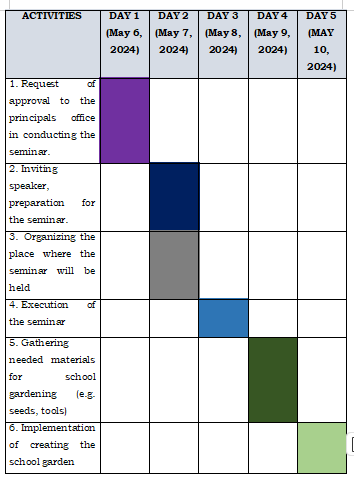
The activities in preparation for the seminar and creating the school garden are as follows: request of approval to the principals office in conducting the seminar, inviting speaker, preparation for the seminar, organizing the place where the seminar will be held, execution of the seminar, gathering needed materials for school gardening (e.g. seeds, tools) and lastly the implementation of creating the school garden. This will start on May 6, 2024 and will on May 10, 2024.
PROJECT NEEDS AND COSTS
Support
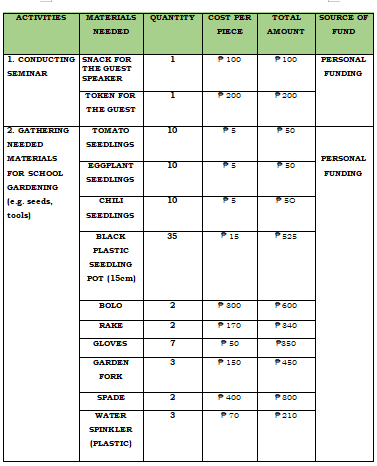
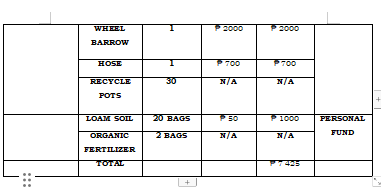
The estimated budget for this project is ₱ 7 425 . It is also recommended to tap organizations such as the Department of Agriculture and Local Government unit of San Juan, La Union to assist in giving information about the basic needs in school gardening.
Contact Information
The proponent can be contacted through the following:
Email - guzmanrogelyne@gmail.com
Cell number - 0915 831 169

101
The Issue
INTRODUCTION
Modern education is not only about textbooks and classroom lectures; it is also about instilling values, promoting holistic development, and preparing students to be responsible global citizens. Recognizing the need for a hands-on, experiential approach to learning, the School Garden Project emerges as a response to the growing disconnect between the younger generation and the environment. Recent studies indicate a decline in outdoor activities among children, leading to various health issues such as sedentary lifestyles and a lack of appreciation for the environment. The School Garden Project is a proactive initiative to counteract these trends by providing students with a dynamic space where they can actively participate in the cultivation of a school garden. This project goes beyond the conventional classroom setup, offering a unique platform for interdisciplinary learning that integrates science, nutrition, sustainability, and environmental studies. The School Garden Project not only addresses health concerns but also aims to instill a sense of environmental responsibility. Through hands-on gardening experiences, students will gain practical knowledge about plant life cycles, soil health, and the importance of biodiversity. Moreover, they will be exposed to sustainable gardening practices, composting, and water conservation methods, empowering them with skills that can contribute to a more sustainable future. By establishing a school garden, we seek to create an immersive learning environment that fosters curiosity, teamwork, and a sense of responsibility towards the environment. As students witness the fruits of their labor, they are likely to develop a deeper connection with nature, leading to a greater understanding of the impact of their choices on the world around them. The School Garden Project is not just about planting seeds; it is about nurturing the growth of responsible, environmentally conscious individuals who will carry these values into adulthood.
Schools are convenient settings to implement health promoting interventions targeting children because of the continuous, intensive contact with children and the opportunity to reach almost all children. One approach that can contribute to health behaviors of children is the implementation of school gardens, defined by the Food and Agricultural Organization of the United Nations as“cultivated areas around or near to primary schools, which can be used mainly for learning purposes but could also generate some food and income for the school”. Gardening projects in schools give primary school children the opportunity to grow and harvest their own fruit and vegetables. The systematic review of Ohly et al. (2016), which aimed to examine the health and well-being impacts of school gardening, shows that school garden interventions have beneficial effects on children’s willingness to taste vegetables, on preferences for fruits and vegetables and on knowledge of and attitudes towards food.
The school garden contributes decidedly to improving sustainable school indicators according to the specification that Kalaitzidis introduced. Specifically, it greatly influences some of the educational indicators, such as alternative teaching methods or techniques employed by teachers to make the lesson more attractive and more productive. Teaching methods and techniques utilized by teachers to develop critical, systemic and creative thinking among the students. Furthermore, the school garden contributes decidedly to environmental indicators such as creating and maintaining a vegetable or flower or roof garden in the school grounds and also the students themselves planting trees, shrubs, and other local flora, in the school grounds or outside; after the grouping proposed by Kalaitzidis (2013).
A healthy lifestyle is something that most people aspire to, but there are many reasons why people struggle to maintain one. School gardens can be a perfect long-term solution to this problem because they are a great way to promote healthy habits in children and healthy lifestyles in adults . In addition, school gardens can also teach kids about the importance of living in harmony with nature and how it is essential for the environment as well as their own health ─ mental and physical. Gardening is also a life skill that can help children to be more self-sufficient throughout adulthood.
The Gulayan sa Paaralan Project shall be implemented in all public elementary and secondary schools. in according to Deped Memorandum No.223s.2016,entitled "Strengthening the Implementation of GULAYAN SA PAARALAN(GPP) in Public Elementary and Secondary Schools Nationwide,"to address Malnutrition and promote vegetable production and consumption among school children. This memorandum is issued to sustain school gardens, not only to support sustainable gardens at present but also to establish gardens in schools nationwide. The GPP was issued and implemented through DepED Memorandum No. 293, s.2001 entitled Gulayan sa Paaralan. This Program is an activity that aims to promote proper nutrition and mitigate hunger among learners. Eating the correct number of fruits and vegetables will help to develop the body and minds of the students, and that’s why all schools are encouraged to have this kind of Program.
PROJECT DESCRIPTION
This project proposal will initiate a seminar and daily school gardening activities for the learners to let them experience the hands on effort it takes to build and sustain a school garden. This initiative activity will indulge the learners appreciate and learn the importance and benefits of school gardens among the learners.
The purpose of the Proponents’ advocacy campaign is to let the students become closer to the environment specifically in participating the creation and sustainability of the school garden. The proponents will first conduct a seminar about the basic information on gardening, how to plant, the right way to take care of plants and how could the learners sustain them. By this information and learning's they could get from the seminar, they would be able to apply it in the school garden. This activity will established a greater connection between the students and the environment by daily exposing the learners into activities that concern the environment. The proponents will also join hands with the Youth For Environment in Schools Organization (YES-O) officers in facilitating the activity. The seminar and commencing of the school garden will have a theme “ Cultivating a Greener Future: Nurturing Learners Minds Through School Gardening”. The projected outcome will be a one day seminar and the creation of school garden in San Juan Senior High School Stand - Alone. Overall, school gardening enriches the educational experience, promotes healthier lifestyles, strengthens community ties, and fosters environmental stewardship.
This advocacy campaign aims to benefit the following:
To the Learners. School gardening provides practical, hands-on learning experiences that complement classroom education. Through gardening, learners learn about ecosystems, biodiversity, and sustainable practices, fostering environmental awareness and responsibility.
To the Teachers. School Gardening provides opportunities for interdisciplinary teaching, integrating subjects like science, math, language arts, and social studies. This will also create memorable bonds between the learners and their teachers.
To the Parents. Gardening projects provide opportunities for parents to get involved in their children's education by volunteering in the garden or participating in related activities Parents can learn alongside their children about the benefits of healthy eating and gain practical knowledge about growing their own food, which they can apply at home.
To the School. Gardening projects can foster a sense of community among students, teachers, parents, and local residents who participate in planning, planting, and maintaining the garden.
To the Environment. Gardening in stills a sense of environmental stewardship in students, teaching them the importance of caring for the planet and preserving natural resources for future generations.
To the Future Proponents. The outcome of the study will serve as a reference for the future project proposal with the similar insights and purpose.
TIMELINE FOR THE SEMINAR AND CREATION OF THE SCHOOL GARDEN
PROJECT: A SEMINAR EVENT AND CREATION OF SCHOOL GARDEN WITH THE THEME: “Cultivating a Greener Future: Nurturing Learners Minds Through School Gardening”
The activities in preparation for the seminar and creating the school garden are as follows: request of approval to the principals office in conducting the seminar, inviting speaker, preparation for the seminar, organizing the place where the seminar will be held, execution of the seminar, gathering needed materials for school gardening (e.g. seeds, tools) and lastly the implementation of creating the school garden. This will start on May 6, 2024 and will on May 10, 2024.
PROJECT NEEDS AND COSTS
Support
The estimated budget for this project is ₱ 7 425 . It is also recommended to tap organizations such as the Department of Agriculture and Local Government unit of San Juan, La Union to assist in giving information about the basic needs in school gardening.
Contact Information
The proponent can be contacted through the following:
Email - guzmanrogelyne@gmail.com
Cell number - 0915 831 169
101
Petition created on May 13, 2024