Comply with section 4 of RTI Act 2005 as it is the obligation of M.C. Kapurthala.

Comply with section 4 of RTI Act 2005 as it is the obligation of M.C. Kapurthala.
The Issue
Local residents of Kapurthala city face problem, they have problems but when a complaint(s) is file/ brought to notice of Administration/ Head of Office, most of time either no resolution is done or resolution is very late.
So, we feel there is need for public participation, transparency in working of local governments and accountability of government officials/ officers.
There is a law named RTI Act 2005 which can bring transparency and accountability in public offices.
Section 4(1)(b) is mandatory, for every public authority in India, to comply with.
Under section 5 of the Act, every public authority shall designate as many officers as the Public Information Officers or the Assistant Public Information Officers in all administrative units or offices under it as may be necessary to provide information to persons requesting for the information under this Act.
Furthermore, the Commission referred to the observations made by Hon'ble Courts in the light of disclosure of information in "public interest", keeping in view the true spirit behind the promulgation of the RTI Act, 2005, which are as under:
- The Hon'ble Supreme Court of India in SLP(C) NO. 7526/2009 (CBSE & Anr. Vs. Aditya Bandopadhyay & Ors) had observed as under:
"37. The right to information is a cherished right. Information and right to information are intended to be formidable tools in the hands of responsible citizens to fight corruption and to bring in transparency and accountability. The provisions of RTI Act should be enforced strictly and all efforts should be made to bring to light the necessary information under Clause (b) of Section 4(1) of the Act which relates to securing transparency and accountability in the working of public authorities and in discouraging corruption".
- The High Court of Delhi in General Manager Finance Air India Ltd & Anr v. Virender Singh, LPA No. 205/2012, Decided On: 16.07.2012 regarding the disclosure of information for public interest, held:
"8. The RTI Act, as per its preamble was enacted to enable the citizens to secure access to information under the control of public authorities, in order to promote transparency and accountability in the working of every public authority. An informed citizenry and transparency of information have been spelled out as vital to democracy and to contain corruption and to hold Governments and their instrumentalities accountable to the governed. The said legislation is undoubtedly one of the most significant enactments of independent India and a landmark in governance."
- The Commission also observes the Hon'ble Delhi High Court ruling in WP (C) 12714/2009 Delhi Development Authority v. Central Information Commission and Another (delivered on: 21.05.2010), wherein it was held as under:
"16.It also provides that the information should be easily accessible and to the extent possible should be in electronic format with the Central Public Information Officer or the State Public Information Officer, as the case may be. The word disseminate has also been defined in the explanation to mean - making the information known or communicating the information to the public through notice boards, newspapers, public announcements, media broadcasts, the internet, etc. It is, therefore, clear from a plain reading of Section 4 of the RTI Act that the information, which a public authority is obliged to publish under the said section should be made available to the public and specifically through the internet. There is no denying that the petitioner is duty bound by virtue of the provisions of Section 4 of the RTI Act to publish the information indicated in Section 4(1)(b) and 4(1)(c) on its website so that the public have minimum resort to the use of the RTI Act to obtain the information."
- Furthermore, High Court of Delhi in the decision of General Manager Finance Air India Ltd & Anr v. Virender Singh, LPA No. 205/2012, Decided On: 16.07.2012 had held as under:
"8. The RTI Act, as per its preamble was enacted to enable the citizens to secure access to information under the control of public authorities, in order to promote transparency and accountability in the working of every public authority. An informed citizenry and transparency of information have been spelled out as vital to democracy and to contain corruption and to hold Governments and their instrumentalities accountable to the governed. The said legislation is undoubtedly one of the most significant enactments of independent India and a landmark in governance. The spirit of the legislation is further evident from various provisions thereof which require public authorities to:
A. Publish inter alia:
i) the procedure followed in the decision making process;
ii) the norms for the discharge of its functions;
iii) rules, regulations, instructions manuals and records used by its employees in discharging of its functions;
iv) the manner and execution of subsidy programmes including the amounts allocated and the details of beneficiaries of such programmes;
v) the particulars of recipients of concessions, permits or authorizations granted. [see Section 4(1) (b), (iii), (iv), (v); (xii) & (xiii)].
B. Suo moto provide to the public at regular intervals as much information as possible [see Section 4(2)]."
The above mentioned judgements clearly state the duty of public authority to disclose information on suo moto basis so that public have minimum resort use RTI.
We have placed several complaints about no compliance to section 4,5 of RTI Act to Kapurthala and Punjab State Administration but no resolution till date.
Examples:
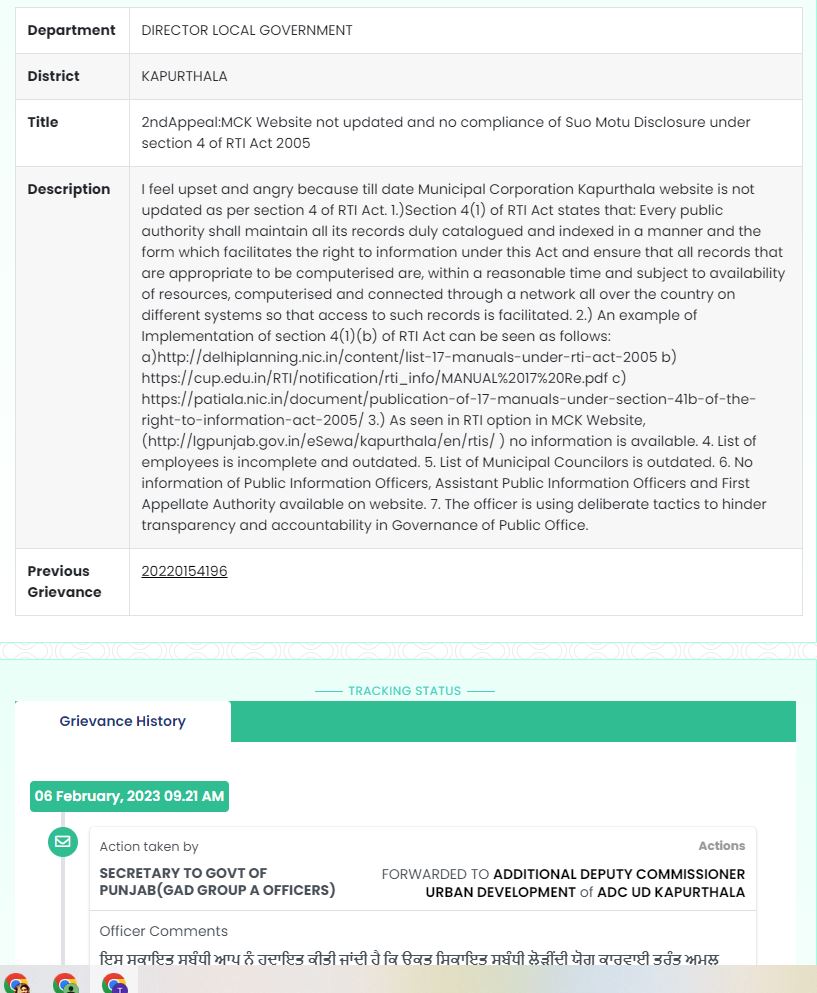
Public authority may be pleased to pass orders or further orders to concerned officials to comply with section 4(1)(b) of RTI Act 2005.
An example of such compliance can found here : http://www.municipalcouncildalhousie.in/Suo%20moto%20RTI%20Disclosure.html
It is the website of Dalhousie Municipal Council.
We are taking this matter to public, citizens of this country will sign this petition and enforce local authorities to follow rule of law.

The Issue
Local residents of Kapurthala city face problem, they have problems but when a complaint(s) is file/ brought to notice of Administration/ Head of Office, most of time either no resolution is done or resolution is very late.
So, we feel there is need for public participation, transparency in working of local governments and accountability of government officials/ officers.
There is a law named RTI Act 2005 which can bring transparency and accountability in public offices.
Section 4(1)(b) is mandatory, for every public authority in India, to comply with.
Under section 5 of the Act, every public authority shall designate as many officers as the Public Information Officers or the Assistant Public Information Officers in all administrative units or offices under it as may be necessary to provide information to persons requesting for the information under this Act.
Furthermore, the Commission referred to the observations made by Hon'ble Courts in the light of disclosure of information in "public interest", keeping in view the true spirit behind the promulgation of the RTI Act, 2005, which are as under:
- The Hon'ble Supreme Court of India in SLP(C) NO. 7526/2009 (CBSE & Anr. Vs. Aditya Bandopadhyay & Ors) had observed as under:
"37. The right to information is a cherished right. Information and right to information are intended to be formidable tools in the hands of responsible citizens to fight corruption and to bring in transparency and accountability. The provisions of RTI Act should be enforced strictly and all efforts should be made to bring to light the necessary information under Clause (b) of Section 4(1) of the Act which relates to securing transparency and accountability in the working of public authorities and in discouraging corruption".
- The High Court of Delhi in General Manager Finance Air India Ltd & Anr v. Virender Singh, LPA No. 205/2012, Decided On: 16.07.2012 regarding the disclosure of information for public interest, held:
"8. The RTI Act, as per its preamble was enacted to enable the citizens to secure access to information under the control of public authorities, in order to promote transparency and accountability in the working of every public authority. An informed citizenry and transparency of information have been spelled out as vital to democracy and to contain corruption and to hold Governments and their instrumentalities accountable to the governed. The said legislation is undoubtedly one of the most significant enactments of independent India and a landmark in governance."
- The Commission also observes the Hon'ble Delhi High Court ruling in WP (C) 12714/2009 Delhi Development Authority v. Central Information Commission and Another (delivered on: 21.05.2010), wherein it was held as under:
"16.It also provides that the information should be easily accessible and to the extent possible should be in electronic format with the Central Public Information Officer or the State Public Information Officer, as the case may be. The word disseminate has also been defined in the explanation to mean - making the information known or communicating the information to the public through notice boards, newspapers, public announcements, media broadcasts, the internet, etc. It is, therefore, clear from a plain reading of Section 4 of the RTI Act that the information, which a public authority is obliged to publish under the said section should be made available to the public and specifically through the internet. There is no denying that the petitioner is duty bound by virtue of the provisions of Section 4 of the RTI Act to publish the information indicated in Section 4(1)(b) and 4(1)(c) on its website so that the public have minimum resort to the use of the RTI Act to obtain the information."
- Furthermore, High Court of Delhi in the decision of General Manager Finance Air India Ltd & Anr v. Virender Singh, LPA No. 205/2012, Decided On: 16.07.2012 had held as under:
"8. The RTI Act, as per its preamble was enacted to enable the citizens to secure access to information under the control of public authorities, in order to promote transparency and accountability in the working of every public authority. An informed citizenry and transparency of information have been spelled out as vital to democracy and to contain corruption and to hold Governments and their instrumentalities accountable to the governed. The said legislation is undoubtedly one of the most significant enactments of independent India and a landmark in governance. The spirit of the legislation is further evident from various provisions thereof which require public authorities to:
A. Publish inter alia:
i) the procedure followed in the decision making process;
ii) the norms for the discharge of its functions;
iii) rules, regulations, instructions manuals and records used by its employees in discharging of its functions;
iv) the manner and execution of subsidy programmes including the amounts allocated and the details of beneficiaries of such programmes;
v) the particulars of recipients of concessions, permits or authorizations granted. [see Section 4(1) (b), (iii), (iv), (v); (xii) & (xiii)].
B. Suo moto provide to the public at regular intervals as much information as possible [see Section 4(2)]."
The above mentioned judgements clearly state the duty of public authority to disclose information on suo moto basis so that public have minimum resort use RTI.
We have placed several complaints about no compliance to section 4,5 of RTI Act to Kapurthala and Punjab State Administration but no resolution till date.
Examples:
Public authority may be pleased to pass orders or further orders to concerned officials to comply with section 4(1)(b) of RTI Act 2005.
An example of such compliance can found here : http://www.municipalcouncildalhousie.in/Suo%20moto%20RTI%20Disclosure.html
It is the website of Dalhousie Municipal Council.
We are taking this matter to public, citizens of this country will sign this petition and enforce local authorities to follow rule of law.
Petition Closed
Share this petition
The Decision Makers
Petition created on 20 February 2023