

Close the Ethics Loophole for Coronado’s Mayor & City Council
The Issue
Coronado's Ethics Code and Conflict of Interest Policy have a big problem: They don't apply at all to the Mayor or City Council members or the City Manager!
As a result of this ethics loophole, the person who cleans the floor of City Hall is held to a higher ethical standard than our local elected officials.
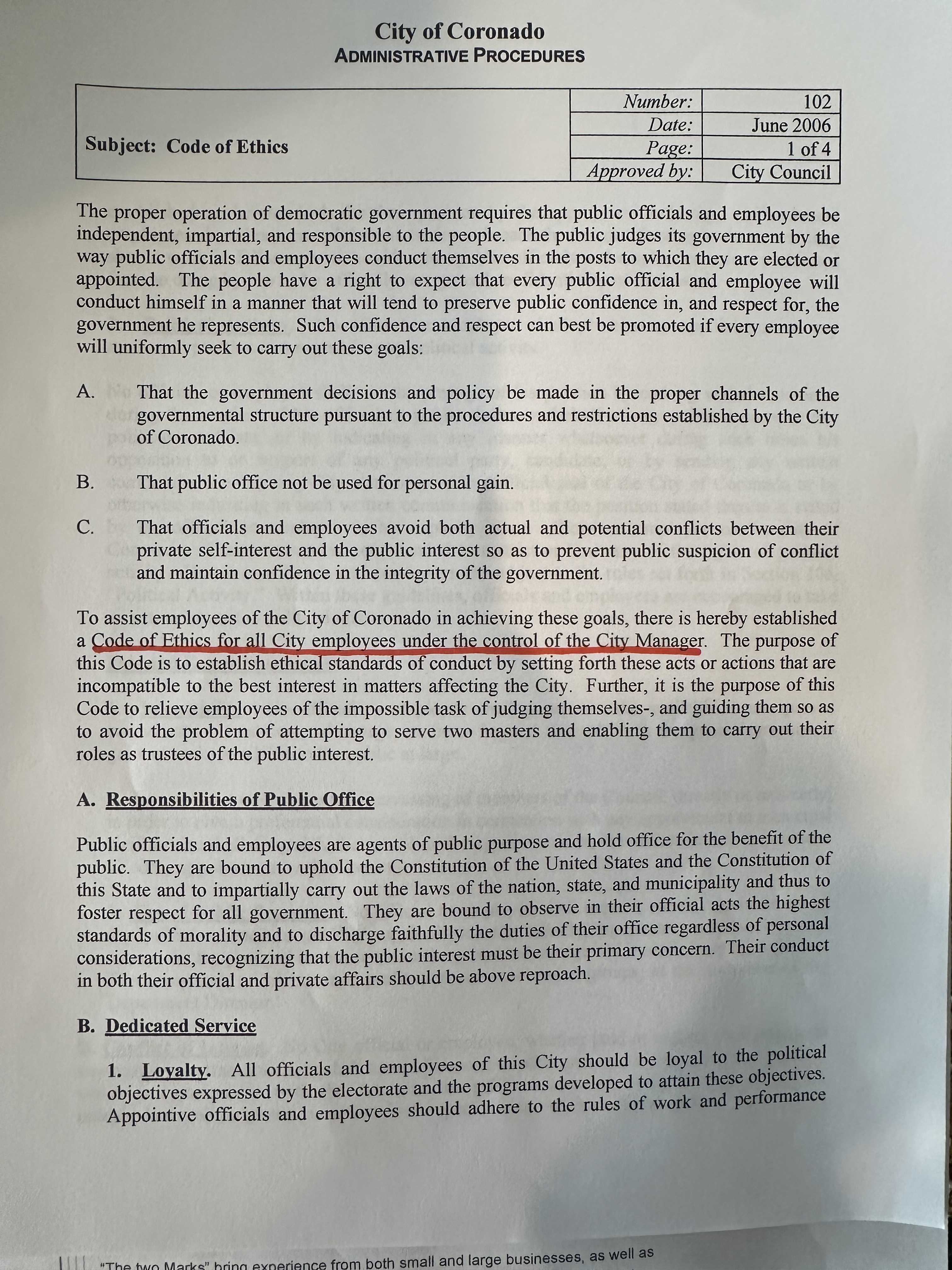
Under current law, Coronado’s Code of Ethics and conflict of interest policy only applies to City employees “under the control of the City Manager.”
The Mayor and council members do not report to the City Manager and are therefore not “under the control of the City Manager.” This means that Coronado’s Code of Ethics including its conflict of interest policy does not apply to the Mayor or other members of City Council. It also does not apply to the City Manager.
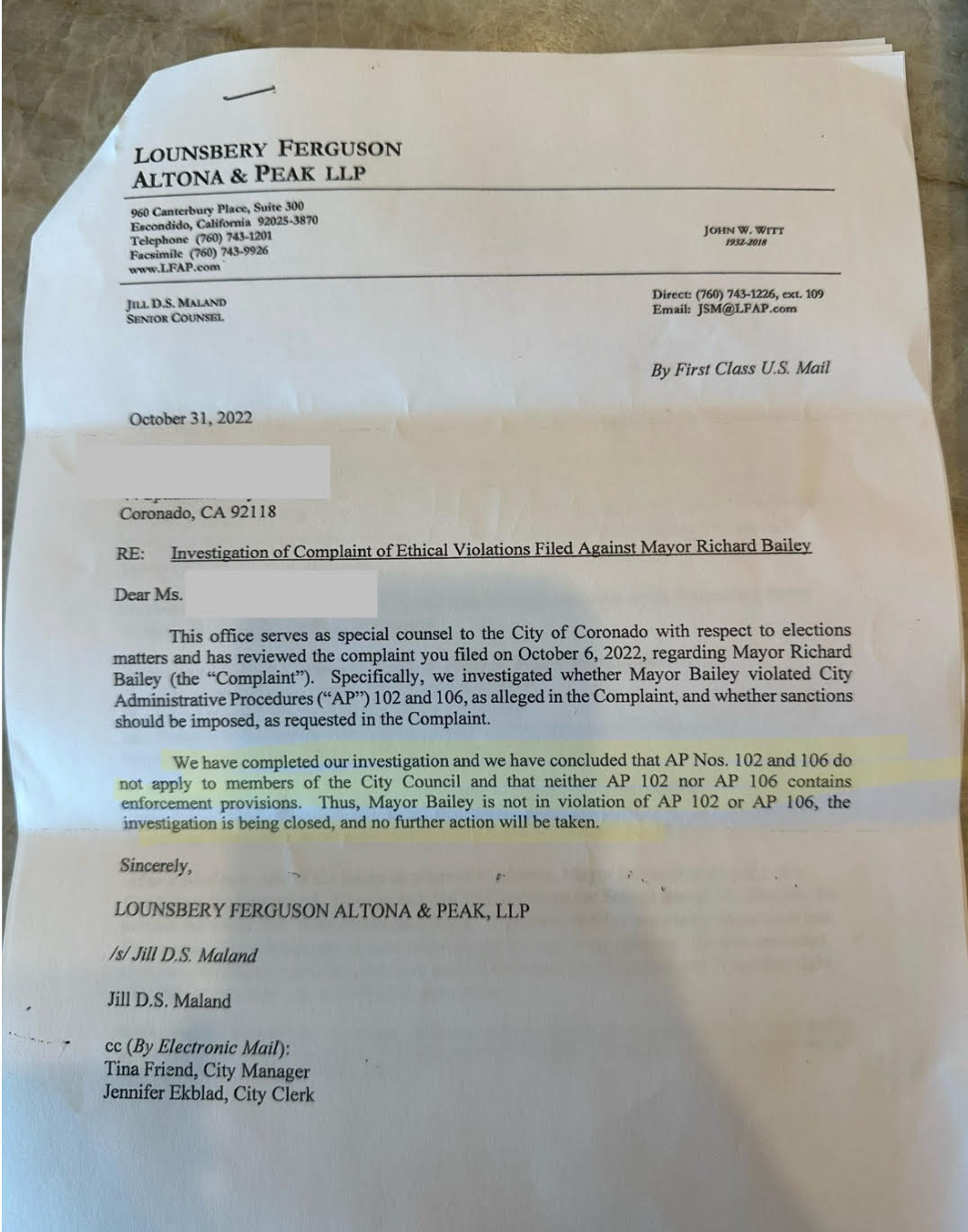
The City has also concluded that because Coronado's Ethics Code does not contain any enforcement provisions, the City is unable to impose sanctions or any other consequences of any kind when the Code is violated.
As a result, there is absolutely no mechanism in local law to hold our Mayor, City Council members or City Manager accountable for basic standards of conduct.
Good governance requires government accountability to the people. Why does our City Ethics Code apply to all other City employees but not the Mayor, City Council members and City Manager? The Mayor and City Council members and City Manager should be held to the same (or higher) ethical standards as other City employees.
The citizens of Coronado are calling on our elected officials to act in the best interests of our community by taking action to amend our City laws to ensure that Coronado’s Code of Ethics and conflict of interest policy applies specifically to the Mayor, members of City Council and the City Manager and to contain appropriate enforcement mechanisms and penalties.
Why would anyone object to government accountability?
Opponents claim that we shouldn’t bother to make our local Coronado ethics code apply to elected officials because they are already covered by “very strict” state ethics codes and laws and that an amendment to our coronado ethics laws “would do nothing.”
This is patently false and misleading. The truth is there is a huge gap between state laws and reality in Coronado.
Case in point: Over the past several years there have been multiple good faith complaints filed with the City regarding conduct of elected officials which have resulted in zero consequences.
The reason: Coronado ethics laws don’t apply to our elected officials.
Under state law, conflict of interest rules only require elected officials to disqualify themselves for contributions of over $500.
In Coronado the maximum campaign contribution is $200.
Because Coronado’s $200 maximum political campaign contributions limit is far lower than the state law disclosure thresholds of over $500 per donor — it is impossible for the state law to ever come into play here. The state law is effectively irrelevant.
This means that even if a Coronado official received the maximum local contribution, the state law conflicts rules would never apply because it hasn’t reached the state threshold of $500+
What is more, the state laws do not adequately address other relevant “personal interests” (based on relationships and affiliations) that could impact an official’s decision-making:
Coronado’s Ethics Code (Administrative Procedure No. 102) provides that
- “No City official or employee, whether paid or unpaid, shall engage in any business or transaction, or shall have a financial or other personal interest, direct or indirect, which is incompatible with the duties in the public interest or would tend to impair his independence of judgment or action in the performance of his official duties. Personal, as distinguished from financial, interest includes an interest arising from blood or marriage relationships or close relationships in business or political association.”
- “Whenever the performance of his official duties shall require any official or employee to deliberate and vote on any matter involving his financial or personal interest, he shall publicly disclose the nature and extent of such interest and disqualify himself from participating in the deliberations as well as abstaining from voting.”
While all other Coronado City employees are bound to disclose such personal interests and be recused from voting where personal or financial interests pose a conflict, the Mayor, City Council Members and City Manager are inexplicably exempt from these rules.
The result is a lack of any meaningful local conflict of interest policy for our mayor or city council. The person who cleans the floors at City Hall is held to a higher ethical standard than our Mayor and City Council.
Please help us close the ethics loophole in Coronado by signing our community petition and by writing to City Council (cityclerk@coronado.ca.us).
UPDATE: At the March 4th City Council meeting, the City Attorney, at the behest of council, provided a presentation arguing that because there are state ethics laws applicable to elected officials, local ethics codes are unnecessary. This argument is misleading and demonstrates a concerning preference for the self-interests of the city council over the needs of our community.
The city attorney’s presentation failed to address the key issue: State laws are insufficient for meaningful ethics protection in Coronado. Case in point: Over the past several years there have been multiple good faith complaints filed with the City regarding conduct of elected officials which have resulted in zero consequences.
Consider the following:
1. There is a gap between state law disclosure thresholds and Coronado campaign contribution laws making state law irrelevant.
Under State law, conflict of interest rules only require elected officials to disqualify themselves for contributions of over $500. Coronado’s campaign contributions max out at $200; therefore it is impossible for the state law disqualifying financial threshold of $500 to be reached. This means that even if a Coronado official received the maximum local contribution, the state law conflicts rules would never apply because the state threshold of $500 has not been met. As a result the state law is effectively irrelevant in Coronado.
2. Coronado’s local ethics laws have higher standards which are missing from state law.
For example:
State law only requires elected officials to make financial disclosures once a year in their Form 700 (which does not require disclosure of personal interests such as relevant relationships, etc.). Compare this to the local ethics code which requires all other city employees to disclose any financial or personal interests on a rolling-basis in real time whenever the city employee is faced with a matter for decision.
o City A.P. #106, D.5 “Whenever the performance of his official duties shall require any official or employee to deliberate and vote on any matter involving his financial or personal interest, he shall publicly disclose the nature and extent of such interest and disqualify himself from participating in the deliberations as well as abstaining from voting.”
Another example:
o City A.P. #106, F: “You may endorse or oppose a candidate or political measure through a political advertisement, broadcast, campaign, literature or similar material, but not as a City employee or official.”
Compare this strict liability standard which applies to all other Coronado employees vs. State law which only prohibits such conduct where there is an “intent to deceive” (Cal. Gov’t Code §34501.5)
Another example:
State laws do not address other relevant “personal interests” (based on relationships and affiliations) that could impact an official’s decision-making:
Coronado’s Ethics Code (Administrative Procedure No. 102) provides that:
o “No City official or employee, whether paid or unpaid, shall engage in any business or transaction, or shall have a financial or other personal interest, direct or indirect, which is incompatible with the duties in the public interest or would tend to impair his independence of judgment or action in the performance of his official duties. Personal, as distinguished from financial, interest includes an interest arising from blood or marriage relationships or close relationships in business or political association.”
o “Whenever the performance of his official duties shall require any official or employee to deliberate and vote on any matter involving his financial or personal interest, he shall publicly disclose the nature and extent of such interest and disqualify himself from participating in the deliberations as well as abstaining from voting.”
Compare this to the “common law” state law which provides vague standards relating to personal interests. While all other Coronado City employees are bound to disclose such personal interests and must be recused from voting where personal or financial interests pose a conflict, the Mayor, City Council Members and City Manager are inexplicably exempt from these rules. The result is a lack of any meaningful local conflict of interest policy for our elected officials – the very people we should expect to be held to the highest ethical standards.
3. Good luck getting the state’s attention on local matters. It is much more challenging to get state enforcement on local issues vs the ability to nimbly enforce codes locally. FPPC has to cover all of CA. The District Attorney is overwhelmed with cases. While an ethics issue in Coronado is critical locally, it will unlikely get state attention unless egregious. Many other cities in CA have enacted their own local ethics codes and ethics commissions for this reason. Additionally as noted above State law has an intent component for many ethics previous (for example, the state has to prove the official used city logo or misused his political office with the intent to deceive (Cal. Gov’t Code §34501.5) vs city code which has a strict liability provision that prohibits such conduct regardless of intent (City A.P. #106, B. 2), making it much more difficult for citizens to get meaningful redress in state law.
4. Double standards. The gap between state and city laws results in a ridiculous double standard for elected officials and all other city employees on a local level. Case in point: The petition cites specific examples where the former mayor’s conduct was reported and the city declined to act on it because elected officials are exempt. The conduct at issue would have been prohibited by any other Coronado employee.
Sources:
Coronado Code of Ethics: https://www.coronado.ca.us/DocumentCenter/View/183/Code-of-Ethics-PDF
CA FPPC Conflict of Interest Rules: https://www.fppc.ca.gov/learn/conflicts-of-interest-rules.html
Levine Act Disclosures: https://www.sandiegocounty.gov/content/sdc/cob/conflict_interest/levineact.html
Levine Act Update: https://www.sandiego.gov/sites/default/files/2025-01/250127_press.pdf
Coronado Campaign Regulations: https://www.coronado.ca.us/DocumentCenter/View/878/Coronados-Campaign-Regulations-PDF?bidId=
Coronado Candidate Financial Disclosure Summary:
NBC San Diego: Does Coronado need ethics code for mayor, council or do state regulations do the job? (Feb. 25, 2025)
October 31, 2022 Letter from Coronado's Law Firm, Lounsbery Ferguson Altona & Peak LLP (concluding that the City's Administrative Procedures 102 (Code of Ethics) and 106 "do not apply to members of the City Council and that neither AP 102 nor AP 106 contains enforcement provisions")
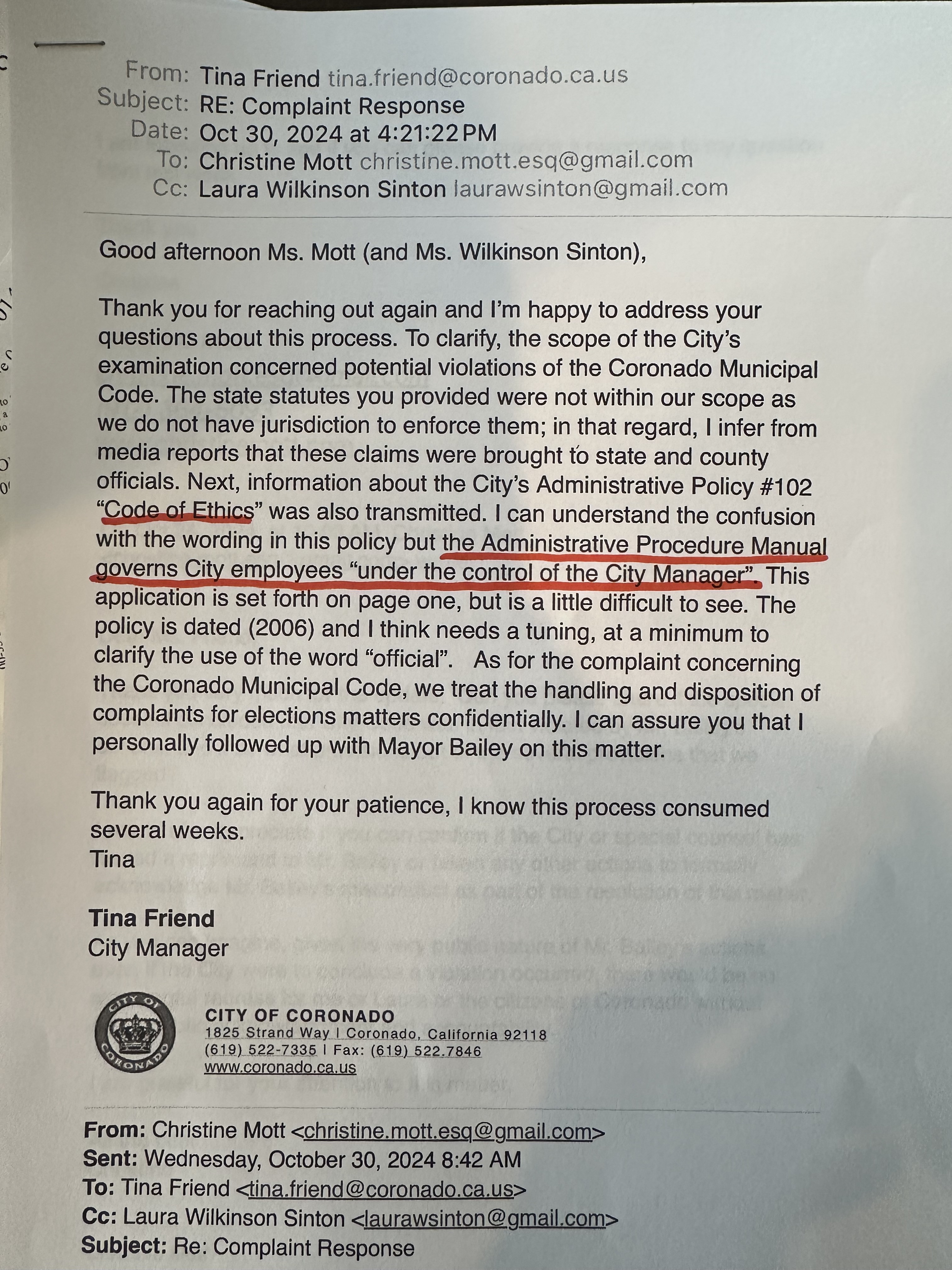
October 30, 2024 Email from Coronado City Manager Tina Friend to C. Mott and L. Wilkinson Sinton (concluding that the City's Administrative Policy 102 Code of Ethics only "governs City employees 'under the control of the City Manager' and therefore does not apply to the Mayor)

366
The Issue
Coronado's Ethics Code and Conflict of Interest Policy have a big problem: They don't apply at all to the Mayor or City Council members or the City Manager!
As a result of this ethics loophole, the person who cleans the floor of City Hall is held to a higher ethical standard than our local elected officials.
Under current law, Coronado’s Code of Ethics and conflict of interest policy only applies to City employees “under the control of the City Manager.”
The Mayor and council members do not report to the City Manager and are therefore not “under the control of the City Manager.” This means that Coronado’s Code of Ethics including its conflict of interest policy does not apply to the Mayor or other members of City Council. It also does not apply to the City Manager.
The City has also concluded that because Coronado's Ethics Code does not contain any enforcement provisions, the City is unable to impose sanctions or any other consequences of any kind when the Code is violated.
As a result, there is absolutely no mechanism in local law to hold our Mayor, City Council members or City Manager accountable for basic standards of conduct.
Good governance requires government accountability to the people. Why does our City Ethics Code apply to all other City employees but not the Mayor, City Council members and City Manager? The Mayor and City Council members and City Manager should be held to the same (or higher) ethical standards as other City employees.
The citizens of Coronado are calling on our elected officials to act in the best interests of our community by taking action to amend our City laws to ensure that Coronado’s Code of Ethics and conflict of interest policy applies specifically to the Mayor, members of City Council and the City Manager and to contain appropriate enforcement mechanisms and penalties.
Why would anyone object to government accountability?
Opponents claim that we shouldn’t bother to make our local Coronado ethics code apply to elected officials because they are already covered by “very strict” state ethics codes and laws and that an amendment to our coronado ethics laws “would do nothing.”
This is patently false and misleading. The truth is there is a huge gap between state laws and reality in Coronado.
Case in point: Over the past several years there have been multiple good faith complaints filed with the City regarding conduct of elected officials which have resulted in zero consequences.
The reason: Coronado ethics laws don’t apply to our elected officials.
Under state law, conflict of interest rules only require elected officials to disqualify themselves for contributions of over $500.
In Coronado the maximum campaign contribution is $200.
Because Coronado’s $200 maximum political campaign contributions limit is far lower than the state law disclosure thresholds of over $500 per donor — it is impossible for the state law to ever come into play here. The state law is effectively irrelevant.
This means that even if a Coronado official received the maximum local contribution, the state law conflicts rules would never apply because it hasn’t reached the state threshold of $500+
What is more, the state laws do not adequately address other relevant “personal interests” (based on relationships and affiliations) that could impact an official’s decision-making:
Coronado’s Ethics Code (Administrative Procedure No. 102) provides that
- “No City official or employee, whether paid or unpaid, shall engage in any business or transaction, or shall have a financial or other personal interest, direct or indirect, which is incompatible with the duties in the public interest or would tend to impair his independence of judgment or action in the performance of his official duties. Personal, as distinguished from financial, interest includes an interest arising from blood or marriage relationships or close relationships in business or political association.”
- “Whenever the performance of his official duties shall require any official or employee to deliberate and vote on any matter involving his financial or personal interest, he shall publicly disclose the nature and extent of such interest and disqualify himself from participating in the deliberations as well as abstaining from voting.”
While all other Coronado City employees are bound to disclose such personal interests and be recused from voting where personal or financial interests pose a conflict, the Mayor, City Council Members and City Manager are inexplicably exempt from these rules.
The result is a lack of any meaningful local conflict of interest policy for our mayor or city council. The person who cleans the floors at City Hall is held to a higher ethical standard than our Mayor and City Council.
Please help us close the ethics loophole in Coronado by signing our community petition and by writing to City Council (cityclerk@coronado.ca.us).
UPDATE: At the March 4th City Council meeting, the City Attorney, at the behest of council, provided a presentation arguing that because there are state ethics laws applicable to elected officials, local ethics codes are unnecessary. This argument is misleading and demonstrates a concerning preference for the self-interests of the city council over the needs of our community.
The city attorney’s presentation failed to address the key issue: State laws are insufficient for meaningful ethics protection in Coronado. Case in point: Over the past several years there have been multiple good faith complaints filed with the City regarding conduct of elected officials which have resulted in zero consequences.
Consider the following:
1. There is a gap between state law disclosure thresholds and Coronado campaign contribution laws making state law irrelevant.
Under State law, conflict of interest rules only require elected officials to disqualify themselves for contributions of over $500. Coronado’s campaign contributions max out at $200; therefore it is impossible for the state law disqualifying financial threshold of $500 to be reached. This means that even if a Coronado official received the maximum local contribution, the state law conflicts rules would never apply because the state threshold of $500 has not been met. As a result the state law is effectively irrelevant in Coronado.
2. Coronado’s local ethics laws have higher standards which are missing from state law.
For example:
State law only requires elected officials to make financial disclosures once a year in their Form 700 (which does not require disclosure of personal interests such as relevant relationships, etc.). Compare this to the local ethics code which requires all other city employees to disclose any financial or personal interests on a rolling-basis in real time whenever the city employee is faced with a matter for decision.
o City A.P. #106, D.5 “Whenever the performance of his official duties shall require any official or employee to deliberate and vote on any matter involving his financial or personal interest, he shall publicly disclose the nature and extent of such interest and disqualify himself from participating in the deliberations as well as abstaining from voting.”
Another example:
o City A.P. #106, F: “You may endorse or oppose a candidate or political measure through a political advertisement, broadcast, campaign, literature or similar material, but not as a City employee or official.”
Compare this strict liability standard which applies to all other Coronado employees vs. State law which only prohibits such conduct where there is an “intent to deceive” (Cal. Gov’t Code §34501.5)
Another example:
State laws do not address other relevant “personal interests” (based on relationships and affiliations) that could impact an official’s decision-making:
Coronado’s Ethics Code (Administrative Procedure No. 102) provides that:
o “No City official or employee, whether paid or unpaid, shall engage in any business or transaction, or shall have a financial or other personal interest, direct or indirect, which is incompatible with the duties in the public interest or would tend to impair his independence of judgment or action in the performance of his official duties. Personal, as distinguished from financial, interest includes an interest arising from blood or marriage relationships or close relationships in business or political association.”
o “Whenever the performance of his official duties shall require any official or employee to deliberate and vote on any matter involving his financial or personal interest, he shall publicly disclose the nature and extent of such interest and disqualify himself from participating in the deliberations as well as abstaining from voting.”
Compare this to the “common law” state law which provides vague standards relating to personal interests. While all other Coronado City employees are bound to disclose such personal interests and must be recused from voting where personal or financial interests pose a conflict, the Mayor, City Council Members and City Manager are inexplicably exempt from these rules. The result is a lack of any meaningful local conflict of interest policy for our elected officials – the very people we should expect to be held to the highest ethical standards.
3. Good luck getting the state’s attention on local matters. It is much more challenging to get state enforcement on local issues vs the ability to nimbly enforce codes locally. FPPC has to cover all of CA. The District Attorney is overwhelmed with cases. While an ethics issue in Coronado is critical locally, it will unlikely get state attention unless egregious. Many other cities in CA have enacted their own local ethics codes and ethics commissions for this reason. Additionally as noted above State law has an intent component for many ethics previous (for example, the state has to prove the official used city logo or misused his political office with the intent to deceive (Cal. Gov’t Code §34501.5) vs city code which has a strict liability provision that prohibits such conduct regardless of intent (City A.P. #106, B. 2), making it much more difficult for citizens to get meaningful redress in state law.
4. Double standards. The gap between state and city laws results in a ridiculous double standard for elected officials and all other city employees on a local level. Case in point: The petition cites specific examples where the former mayor’s conduct was reported and the city declined to act on it because elected officials are exempt. The conduct at issue would have been prohibited by any other Coronado employee.
Sources:
Coronado Code of Ethics: https://www.coronado.ca.us/DocumentCenter/View/183/Code-of-Ethics-PDF
CA FPPC Conflict of Interest Rules: https://www.fppc.ca.gov/learn/conflicts-of-interest-rules.html
Levine Act Disclosures: https://www.sandiegocounty.gov/content/sdc/cob/conflict_interest/levineact.html
Levine Act Update: https://www.sandiego.gov/sites/default/files/2025-01/250127_press.pdf
Coronado Campaign Regulations: https://www.coronado.ca.us/DocumentCenter/View/878/Coronados-Campaign-Regulations-PDF?bidId=
Coronado Candidate Financial Disclosure Summary:
NBC San Diego: Does Coronado need ethics code for mayor, council or do state regulations do the job? (Feb. 25, 2025)
October 31, 2022 Letter from Coronado's Law Firm, Lounsbery Ferguson Altona & Peak LLP (concluding that the City's Administrative Procedures 102 (Code of Ethics) and 106 "do not apply to members of the City Council and that neither AP 102 nor AP 106 contains enforcement provisions")
October 30, 2024 Email from Coronado City Manager Tina Friend to C. Mott and L. Wilkinson Sinton (concluding that the City's Administrative Policy 102 Code of Ethics only "governs City employees 'under the control of the City Manager' and therefore does not apply to the Mayor)
The Decision Makers

Supporter Voices
Petition Updates
Share this petition
Petition created on February 5, 2025