

Change One Seattle Permanent NR (HB1110) Ordinance to Grow Housing Thoughtfully
The Issue
Dear Seattle City Councilmembers,
We ask you to implement changes to the Neighborhood Residential Zones, under the Permanent HB1110 NR Ordinance, that meet the requirements of HB1110 and incent the development of true Middle Housing as intended.
HB1110 requires the City to substantially upzone our neighborhoods by allowing 4 to 6 primary dwelling units on every lot citywide. This upzone opens three-quarters of Seattle’s residential land to Middle Housing, creating potential for over 400,000 new homes. We support this broadened housing choice and have many examples of Middle Housing that fit well in our neighborhoods. They fit because their heights and setbacks match the single-family homes beside them.
Middle Housing that “fits.”
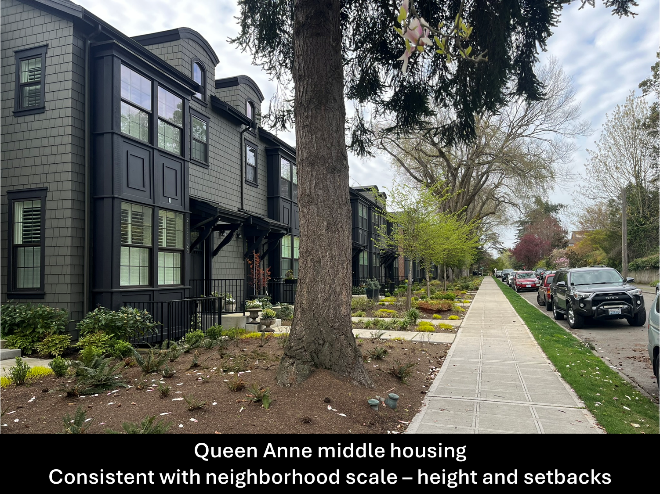
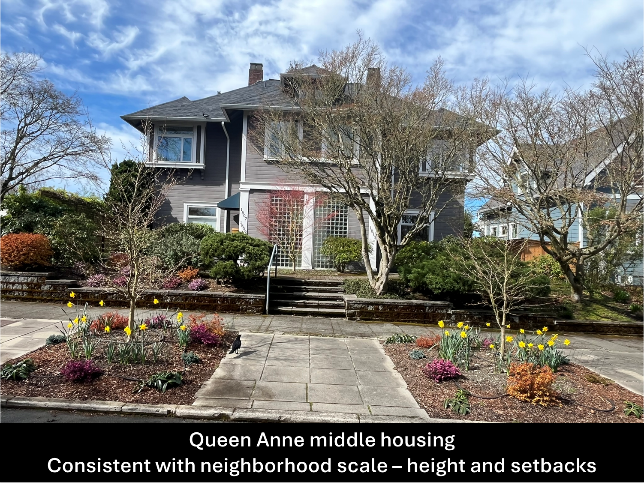
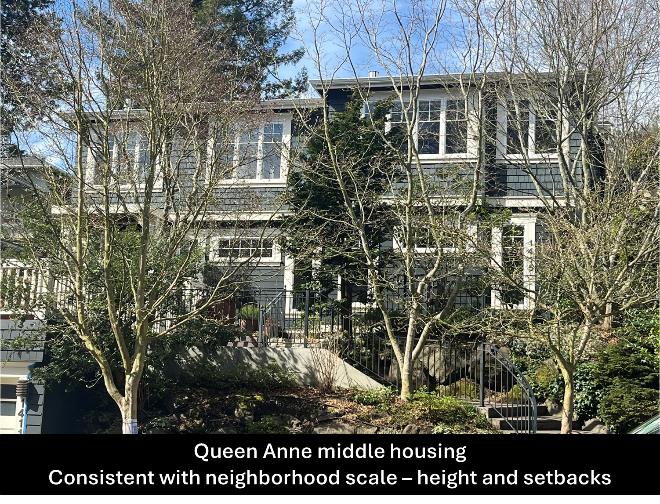
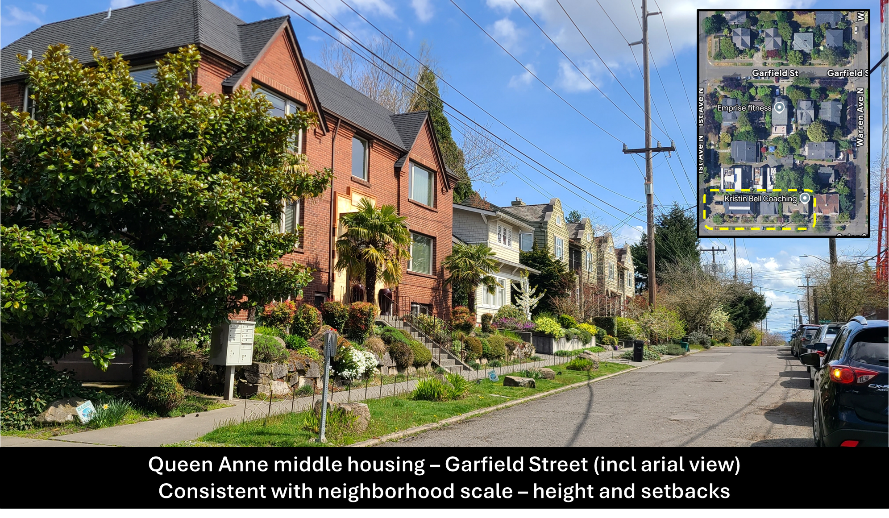
The zoning changes proposed in the NR Ordinance go way beyond state requirements, changing the very standards that have made Middle family Housing compatible in the past. Reducing traditional setbacks, increasing building heights and expanding lot coverage as proposed will significantly disrupt neighborhood form and quality of life. HB1110 does not require eliminating longstanding design protections which have allowed neighborhoods to maintain consistency, tree-lined streets and front yard gardens, during decades of densification. The law simply prohibits cities from applying any development standard to middle housing that is more restrictive than those for detached single-family houses. Importantly, changes to setbacks and height are not required for Middle Housing to be developed – as is evidenced by the many Middle Housing units throughout Seattle have been built with the current zoning. The state-mandated increase to 4 or 6 units will spur even more Middle Housing.
Middle Housing that does not “fit” but is the kind likely to be developed under “relaxed” rules:
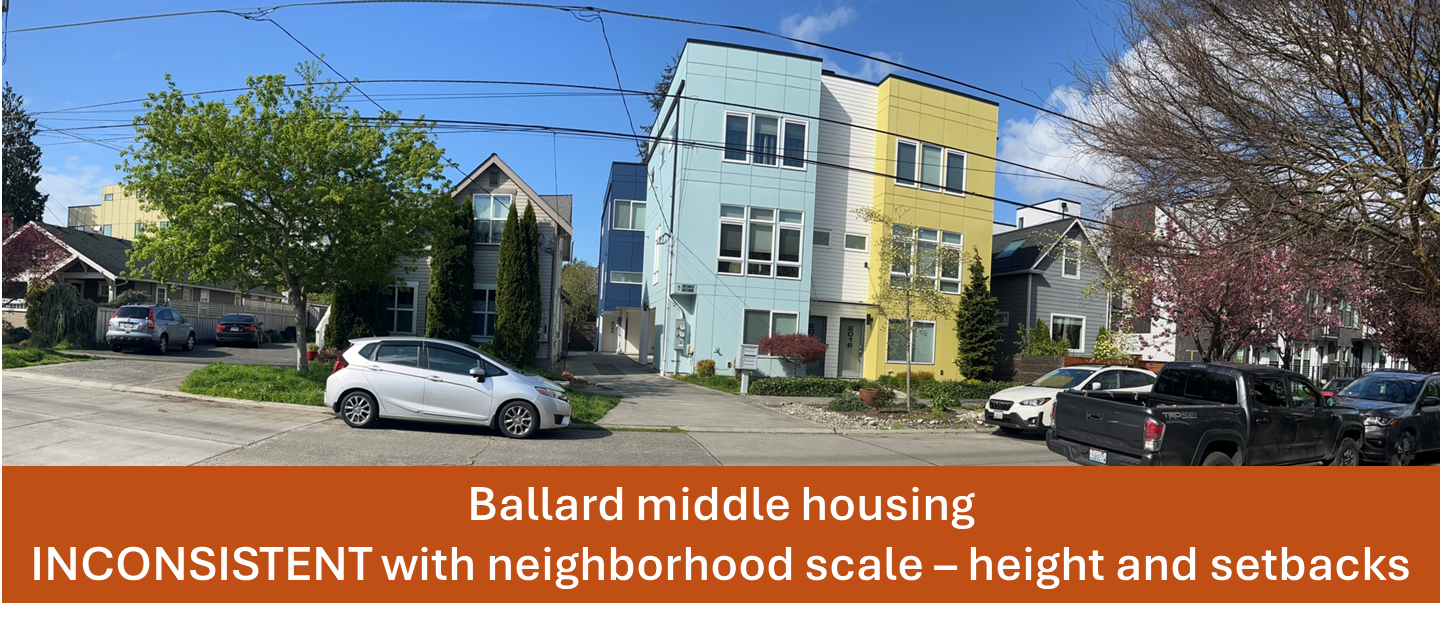
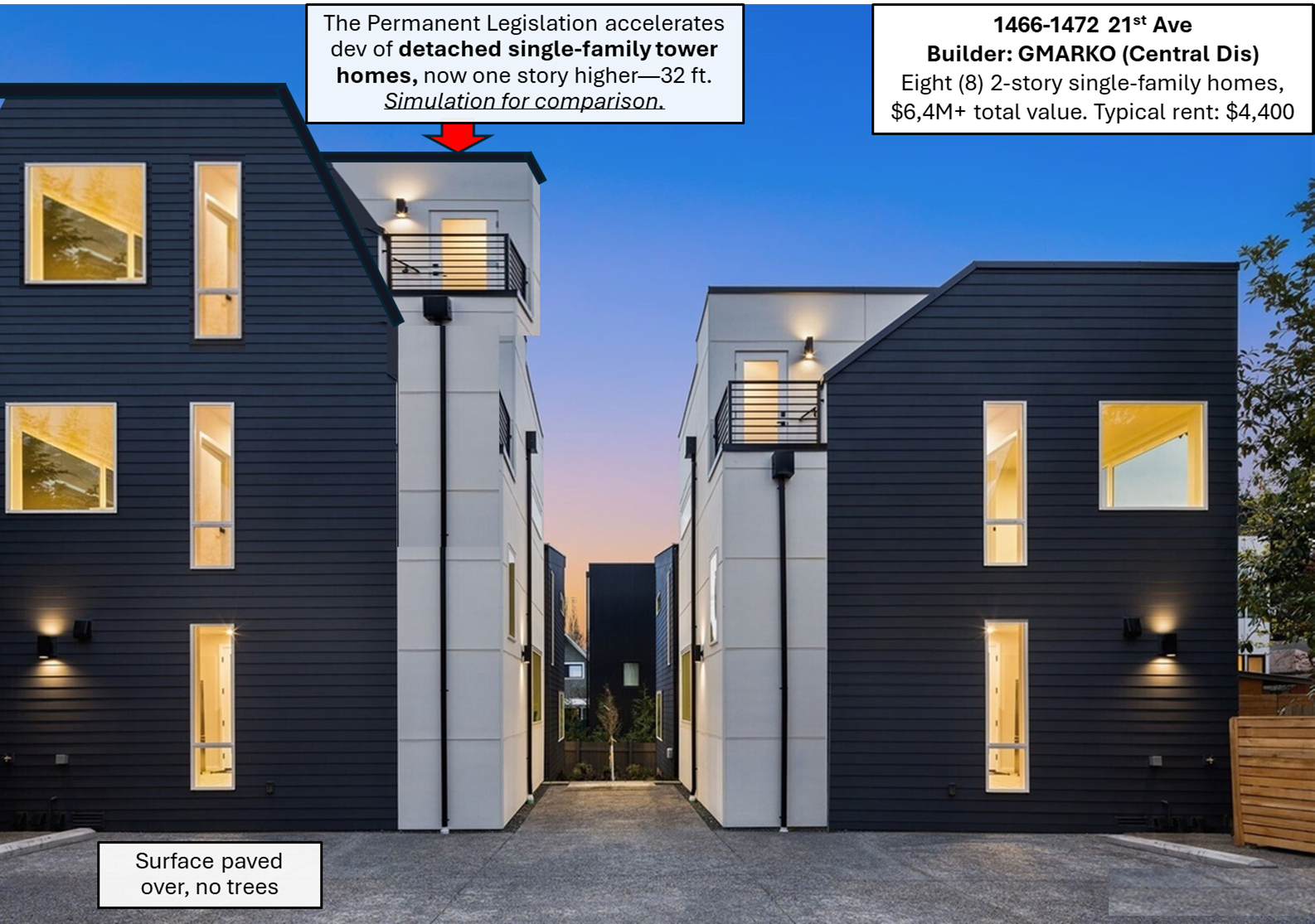
Setbacks Matter: Setback requirements exist for good reasons—they preserve open space around structures, ensure light, air and privacy between neighbors. They provide room for landscaping and trees—and most importantly fresh air. By reducing front and rear yard setbacks, we will allow buildings closer to sidewalks and property lines, leaving less room for meaningful outdoor space. Our front yard setbacks are an especially important feature of our neighborhoods—forming parkways of trees and front yard gardens we enjoy strolling along and that contribute to our quality of life. Most neighborhoods won’t be getting new park space, therefore our streets, sidewalks and setbacks should be recognized as important public parkways. Reducing front yard setbacks from 20 to 10 feet and allowing front porches inside the setback will disrupt the visual harmony of our streetscape and remove the buffer of greenery that creates these parkways, and will significantly reduce our mature tree canopy.
Lot Coverage Matters: Seattle's lush tree canopy and gardens are a defining feature of our communities and a critical environmental asset. Private yards and setback areas are where mature trees and plantings grow representing 47% of the city’s total tree cover.[1] We’ve already lost an alarming 28% of our trees. Increasing lot coverage will accelerate this tree loss and reduce space to plant the two mature trees per lot required under Seattle’s new tree ordinance. It will also reduce the ability to absorb the increasing storm water runoff. The Oct 2024 One Seattle document on NR shows that when you increase the lot coverage to 50%, with the hardscape allowances/requirements, 73% of a lot would be covered with pavement and buildings.
Height Matters: Increasing height limits would allow new structures to be noticeably taller and more expensive than most existing homes. The increased height limits will further erode privacy and eliminate light from neighboring windows and yards, while doing nothing for affordability or density.
Affordability Matters: As currently written, the NR Legislation would allow larger single family homes with smaller setbacks on existing NR lots. Quite simply, larger houses are more expensive houses, an outcome diametrically opposed to the goal of increasing the supply of middle housing in our city. The same observation is true for duplexes and other multi-unit developments, bigger is not necessarily better, particularly when it comes at the expense of middle income affordability and access.
Environmental Considerations Matter: CB120993 ignores the provision of HB1110 that explicitly states that the law does not apply to broadly defined critical areas. Critical areas are expressly excluded from the state’s minimum density mandate. But CB120993 allows the minimum density requirement (4-6 units) to apply to all but the most severe precipitous slopes, i.e., “cliffs,” in the city. Believe it or not, it would allow middle housing on “geologic hazard areas” including “landslide-prone areas,” “liquefaction-prone areas,” “seismic hazards areas,” and similar “critical areas,” all as defined in Washington state law. Excluding further densification from these areas is critical because building in steep slope and landslide prone areas is expensive, dangerous and risky.
We ask the City Council to amend CB 120969 (the Permanent HB1110 legislation) as follows:
1. Restore current development standards for setbacks, heights, and lot coverage, and FAR for standard development, while incentivizing appropriate density maximization with development perks. (Amendments )
2. Ensure that all ECAs as defined in Washington state law are excluded from the new density mandates. (Amendments)
3. Ensure critical Tree Protections (Amendments)
Importantly, we do not need these changes to meet the demand for this type of housing in the next 20 years. The ECOnorthwest study, upon which the One Seattle Plan bases its NR-produced housing numbers uses a demand-based number vs. a supply-based number and excludes all housing produced by ADU, DADU and conversions of existing homes to multi-family (it only includes the numbers generated when developers raze lots). It estimated 69,300 market feasible middle-housing family units under NR zone changes, not including ANY of the owner or conversion-produced units. There is actually far less demand - the city only needs to ensure there are about 36,400 units over the next 20 years (double what will be produced). As such, we believe the NR zone changes don’t need to go beyond the requirements of HB 1110 to meet middle family housing demand.
Because the One Seattle Plan Legislation and NR Ordinance have been issued within a short period of time, citizens are overwhelmed trying to understand and respond to the vast changes proposed. Since we have adopted the Interim Legislation, there is no harm in taking the time to evaluate this legislation in its entirety, as well as study the FULL impact the HB1110-required density changes will bring without the additional developer entitlements. However, there could be irreparable harm done adopting these code changes that go beyond HB1110's mandate.
Seattle can meet its housing goals and preserve livability if we implement HB1110 thoughtfully. We look forward to working with you to implement a housing strategy that truly marries affordability, growth and livability in Seattle.
Sincerely,
Seattle Residents for Thoughtful Growth
[1] 2021 Seattle Tree Canopy Assessment
For more info, read our detailed position paper and supporting data and analysis. Recommended amendments can be found here.
TO:
Attn: Seattle City Council Select Committee on the Comprehensive Plan
Robert Kettle - robert.kettle@seattle.gov
Joy Hollingsworth - joy.hollingsworth@seattle.gov
Rob Saka - rob.saka@seattle.gov
Mark Solomon - mark.solomon2@seattle.gov
Maritza Rivera - maritza.rivera@seattle.gov
Cathy Moore - cathy.moore@seattle.gov
Dan Strauss - dan.strauss@seattle.gov
Alexis Mercedes Rinck - AlexisMercedes.Rinck@seattle.gov
Sara Nelson - sara.nelson@seattle.gov
Cc: Rebecca Duran, Executive Aide and Director of Constituent Affairs (via email at rebecca.duran@seattle.gov) and One Seattle Plan Zoning Team (via email at oneseattleplan.zoning@seattle.gov), Mayor Harrell (bruce.harrell@seattle.gov)

1,745
The Issue
Dear Seattle City Councilmembers,
We ask you to implement changes to the Neighborhood Residential Zones, under the Permanent HB1110 NR Ordinance, that meet the requirements of HB1110 and incent the development of true Middle Housing as intended.
HB1110 requires the City to substantially upzone our neighborhoods by allowing 4 to 6 primary dwelling units on every lot citywide. This upzone opens three-quarters of Seattle’s residential land to Middle Housing, creating potential for over 400,000 new homes. We support this broadened housing choice and have many examples of Middle Housing that fit well in our neighborhoods. They fit because their heights and setbacks match the single-family homes beside them.
Middle Housing that “fits.”
The zoning changes proposed in the NR Ordinance go way beyond state requirements, changing the very standards that have made Middle family Housing compatible in the past. Reducing traditional setbacks, increasing building heights and expanding lot coverage as proposed will significantly disrupt neighborhood form and quality of life. HB1110 does not require eliminating longstanding design protections which have allowed neighborhoods to maintain consistency, tree-lined streets and front yard gardens, during decades of densification. The law simply prohibits cities from applying any development standard to middle housing that is more restrictive than those for detached single-family houses. Importantly, changes to setbacks and height are not required for Middle Housing to be developed – as is evidenced by the many Middle Housing units throughout Seattle have been built with the current zoning. The state-mandated increase to 4 or 6 units will spur even more Middle Housing.
Middle Housing that does not “fit” but is the kind likely to be developed under “relaxed” rules:
Setbacks Matter: Setback requirements exist for good reasons—they preserve open space around structures, ensure light, air and privacy between neighbors. They provide room for landscaping and trees—and most importantly fresh air. By reducing front and rear yard setbacks, we will allow buildings closer to sidewalks and property lines, leaving less room for meaningful outdoor space. Our front yard setbacks are an especially important feature of our neighborhoods—forming parkways of trees and front yard gardens we enjoy strolling along and that contribute to our quality of life. Most neighborhoods won’t be getting new park space, therefore our streets, sidewalks and setbacks should be recognized as important public parkways. Reducing front yard setbacks from 20 to 10 feet and allowing front porches inside the setback will disrupt the visual harmony of our streetscape and remove the buffer of greenery that creates these parkways, and will significantly reduce our mature tree canopy.
Lot Coverage Matters: Seattle's lush tree canopy and gardens are a defining feature of our communities and a critical environmental asset. Private yards and setback areas are where mature trees and plantings grow representing 47% of the city’s total tree cover.[1] We’ve already lost an alarming 28% of our trees. Increasing lot coverage will accelerate this tree loss and reduce space to plant the two mature trees per lot required under Seattle’s new tree ordinance. It will also reduce the ability to absorb the increasing storm water runoff. The Oct 2024 One Seattle document on NR shows that when you increase the lot coverage to 50%, with the hardscape allowances/requirements, 73% of a lot would be covered with pavement and buildings.
Height Matters: Increasing height limits would allow new structures to be noticeably taller and more expensive than most existing homes. The increased height limits will further erode privacy and eliminate light from neighboring windows and yards, while doing nothing for affordability or density.
Affordability Matters: As currently written, the NR Legislation would allow larger single family homes with smaller setbacks on existing NR lots. Quite simply, larger houses are more expensive houses, an outcome diametrically opposed to the goal of increasing the supply of middle housing in our city. The same observation is true for duplexes and other multi-unit developments, bigger is not necessarily better, particularly when it comes at the expense of middle income affordability and access.
Environmental Considerations Matter: CB120993 ignores the provision of HB1110 that explicitly states that the law does not apply to broadly defined critical areas. Critical areas are expressly excluded from the state’s minimum density mandate. But CB120993 allows the minimum density requirement (4-6 units) to apply to all but the most severe precipitous slopes, i.e., “cliffs,” in the city. Believe it or not, it would allow middle housing on “geologic hazard areas” including “landslide-prone areas,” “liquefaction-prone areas,” “seismic hazards areas,” and similar “critical areas,” all as defined in Washington state law. Excluding further densification from these areas is critical because building in steep slope and landslide prone areas is expensive, dangerous and risky.
We ask the City Council to amend CB 120969 (the Permanent HB1110 legislation) as follows:
1. Restore current development standards for setbacks, heights, and lot coverage, and FAR for standard development, while incentivizing appropriate density maximization with development perks. (Amendments )
2. Ensure that all ECAs as defined in Washington state law are excluded from the new density mandates. (Amendments)
3. Ensure critical Tree Protections (Amendments)
Importantly, we do not need these changes to meet the demand for this type of housing in the next 20 years. The ECOnorthwest study, upon which the One Seattle Plan bases its NR-produced housing numbers uses a demand-based number vs. a supply-based number and excludes all housing produced by ADU, DADU and conversions of existing homes to multi-family (it only includes the numbers generated when developers raze lots). It estimated 69,300 market feasible middle-housing family units under NR zone changes, not including ANY of the owner or conversion-produced units. There is actually far less demand - the city only needs to ensure there are about 36,400 units over the next 20 years (double what will be produced). As such, we believe the NR zone changes don’t need to go beyond the requirements of HB 1110 to meet middle family housing demand.
Because the One Seattle Plan Legislation and NR Ordinance have been issued within a short period of time, citizens are overwhelmed trying to understand and respond to the vast changes proposed. Since we have adopted the Interim Legislation, there is no harm in taking the time to evaluate this legislation in its entirety, as well as study the FULL impact the HB1110-required density changes will bring without the additional developer entitlements. However, there could be irreparable harm done adopting these code changes that go beyond HB1110's mandate.
Seattle can meet its housing goals and preserve livability if we implement HB1110 thoughtfully. We look forward to working with you to implement a housing strategy that truly marries affordability, growth and livability in Seattle.
Sincerely,
Seattle Residents for Thoughtful Growth
[1] 2021 Seattle Tree Canopy Assessment
For more info, read our detailed position paper and supporting data and analysis. Recommended amendments can be found here.
TO:
Attn: Seattle City Council Select Committee on the Comprehensive Plan
Robert Kettle - robert.kettle@seattle.gov
Joy Hollingsworth - joy.hollingsworth@seattle.gov
Rob Saka - rob.saka@seattle.gov
Mark Solomon - mark.solomon2@seattle.gov
Maritza Rivera - maritza.rivera@seattle.gov
Cathy Moore - cathy.moore@seattle.gov
Dan Strauss - dan.strauss@seattle.gov
Alexis Mercedes Rinck - AlexisMercedes.Rinck@seattle.gov
Sara Nelson - sara.nelson@seattle.gov
Cc: Rebecca Duran, Executive Aide and Director of Constituent Affairs (via email at rebecca.duran@seattle.gov) and One Seattle Plan Zoning Team (via email at oneseattleplan.zoning@seattle.gov), Mayor Harrell (bruce.harrell@seattle.gov)
The Decision Makers


Supporter Voices
Petition Updates
Share this petition
Petition created on April 13, 2025