

Change EV Tax Credit to Encourage Efficiency and Safety
Change EV Tax Credit to Encourage Efficiency and Safety
The Issue
IRS, Congress, and Department of Transportation: Incentivize more efficient and lighter EVs for a greener and safer future!
The transition to Electric Vehicles (EVs) is crucial for a greener future. However, not all EVs are created equal. Several EVs that are being introduced in the U.S. market are very heavy, and not nearly as efficient as they can be.
Not only are heavy EVs worse for the environment than lighter ones (since they're not as efficient as they can be), they are also leading to a ratcheting up effect, where consumers are opting for heavier vehicles, fearing their fates if they were to get in an accident while driving a lighter vehicle.
Several articles describe the problem:
- The Atlantic: "Electric Vehicles Are Bringing Out the Worst in Us"
- Nature: "Make electric vehicles lighter to maximize climate and safety benefits"
- The American Council for an Energy-Efficient Economy (ACEEE): "9,000-Pound Electric Hummer Shows We Can’t Ignore Efficiency of EVs"
The U.S. government is incentivizing the transition to EVs through a Federal Tax Credit. However, the current credit does not take efficiency and safety into account. Rather, it is a uniform $7,500 regardless of the EV's efficiency and curb weight.
We think this needs to change. This moment in the transition to EVs is an opportunity to create the right incentives for a more efficient and safer future.
As such, we are proposing a change to the IRS EV Federal Tax Credit, which takes into account both the vehicle's efficiency and curb weight, in addition to the existing qualifications for manufacturers required by the current law.
Under the scheme being proposed here, the total Federal Tax Credit would be the sum of two components:
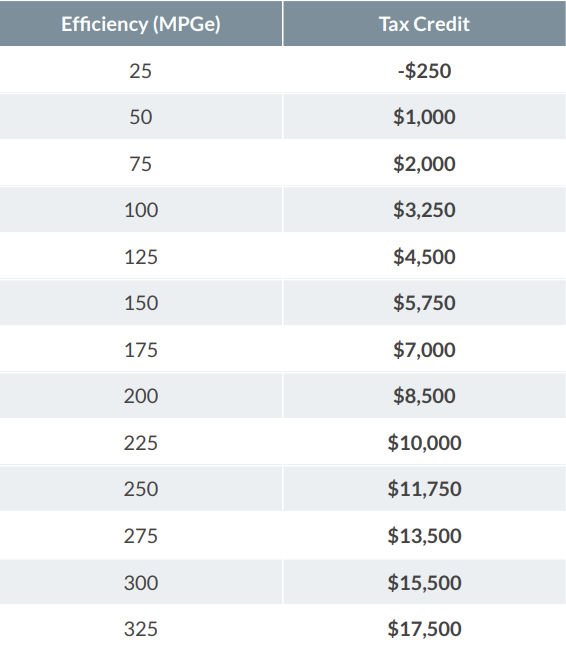
- A credit value based on the EV's combined city/highway efficiency, measured in MPGe. The baseline credit is $4,500 at 125 MPGe efficiency. The credit increases exponentially with higher efficiency.
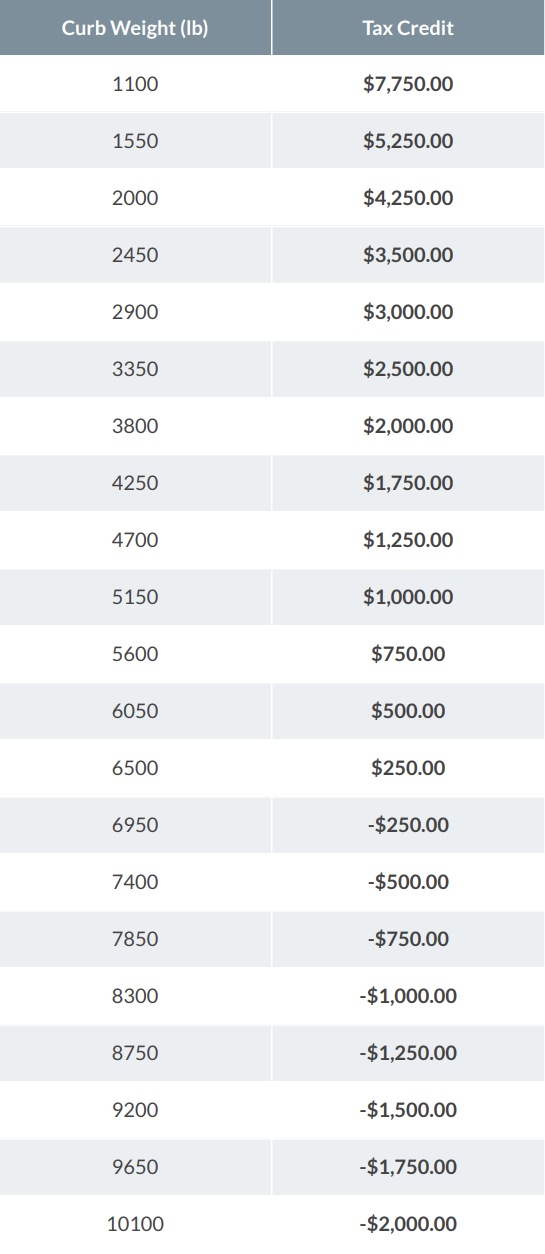
- A credit value based on the EV's curb weight, measured in pounds. The baseline credit is $3,000 at 2900lb curb weight. The credit decreases exponentially with heavier curb weight.
The net result is that lighter and more efficient EVs get much higher tax credit than less efficient and heavier ones. In this new scheme, efficiency is strongly incentivized, and weight is strongly disincentivized.
The hope is that the scheme would encourage consumers, and in turn EV manufacturers, to choose much lighter and more efficient vehicles, as the compounding EV credits for both efficiency and lower weight can add up to defray a substantial portion of their costs.
Here are some select EVs on the market today, all of which currently qualify for the $7,500 EV tax credit based on today's rules. The revised tax credits under the scheme being proposed here is in the last column.
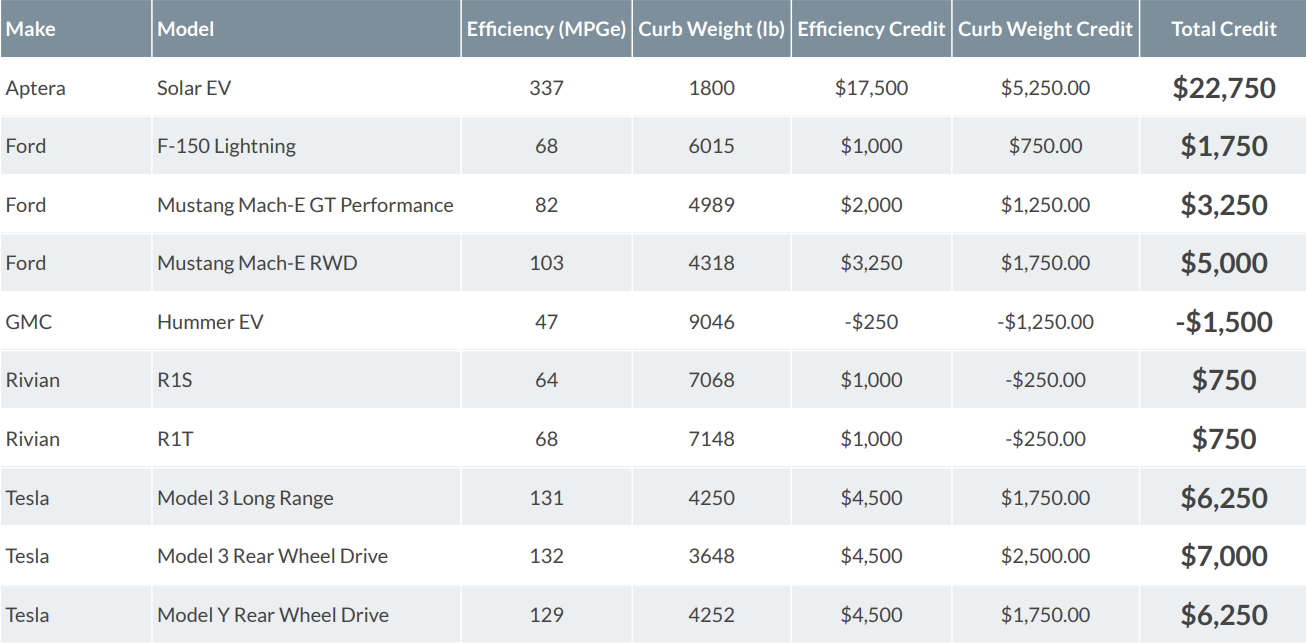
The table also includes an innovative future vehicle, the Aptera Solar EV, with its current estimated efficiency and curb weight. The new tax credit scheme strongly incentivizes highly innovative EV designs such as that one, with a substantially higher credit.
Join us in advocating with the IRS, the Department of Transportation, and Congress to adopt this revised EV Federal Tax Credit scheme for a greener and safer future!
=============
For completeness, we include the tables describing the Efficiency and Curb Weight components of the credit.

The Issue
IRS, Congress, and Department of Transportation: Incentivize more efficient and lighter EVs for a greener and safer future!
The transition to Electric Vehicles (EVs) is crucial for a greener future. However, not all EVs are created equal. Several EVs that are being introduced in the U.S. market are very heavy, and not nearly as efficient as they can be.
Not only are heavy EVs worse for the environment than lighter ones (since they're not as efficient as they can be), they are also leading to a ratcheting up effect, where consumers are opting for heavier vehicles, fearing their fates if they were to get in an accident while driving a lighter vehicle.
Several articles describe the problem:
- The Atlantic: "Electric Vehicles Are Bringing Out the Worst in Us"
- Nature: "Make electric vehicles lighter to maximize climate and safety benefits"
- The American Council for an Energy-Efficient Economy (ACEEE): "9,000-Pound Electric Hummer Shows We Can’t Ignore Efficiency of EVs"
The U.S. government is incentivizing the transition to EVs through a Federal Tax Credit. However, the current credit does not take efficiency and safety into account. Rather, it is a uniform $7,500 regardless of the EV's efficiency and curb weight.
We think this needs to change. This moment in the transition to EVs is an opportunity to create the right incentives for a more efficient and safer future.
As such, we are proposing a change to the IRS EV Federal Tax Credit, which takes into account both the vehicle's efficiency and curb weight, in addition to the existing qualifications for manufacturers required by the current law.
Under the scheme being proposed here, the total Federal Tax Credit would be the sum of two components:
- A credit value based on the EV's combined city/highway efficiency, measured in MPGe. The baseline credit is $4,500 at 125 MPGe efficiency. The credit increases exponentially with higher efficiency.
- A credit value based on the EV's curb weight, measured in pounds. The baseline credit is $3,000 at 2900lb curb weight. The credit decreases exponentially with heavier curb weight.
The net result is that lighter and more efficient EVs get much higher tax credit than less efficient and heavier ones. In this new scheme, efficiency is strongly incentivized, and weight is strongly disincentivized.
The hope is that the scheme would encourage consumers, and in turn EV manufacturers, to choose much lighter and more efficient vehicles, as the compounding EV credits for both efficiency and lower weight can add up to defray a substantial portion of their costs.
Here are some select EVs on the market today, all of which currently qualify for the $7,500 EV tax credit based on today's rules. The revised tax credits under the scheme being proposed here is in the last column.
The table also includes an innovative future vehicle, the Aptera Solar EV, with its current estimated efficiency and curb weight. The new tax credit scheme strongly incentivizes highly innovative EV designs such as that one, with a substantially higher credit.
Join us in advocating with the IRS, the Department of Transportation, and Congress to adopt this revised EV Federal Tax Credit scheme for a greener and safer future!
=============
For completeness, we include the tables describing the Efficiency and Curb Weight components of the credit.
Petition Closed
Share this petition
The Decision Makers


Petition Updates
Share this petition
Petition created on March 1, 2023