

Challenge misleading Enterprise AI narratives of the Tata Group charman!!
The Issue
A Counter-view on the Future of Enterprise IT: The Illusion of Seamless Adaptation
Here's a worthy simulator of the CEO's desk/dashboard at leading IT and ITES companies absolutely free. 👇
https://itessimulator.netlify.app/
Another petition by the same author pointing out how the HR strategy of leading private companies are far from transparent and fair to the job seekers and hence a profound cause for burgeoning angst of the job seekers. 👇
"Tata Sons ought to be Tata Sons Public Ltd" by the same author.
https://www.change.org/TataSonsPublicLtd
1. The Misapplication of Jevons’ Paradox to Cognitive Labor
The Column States:
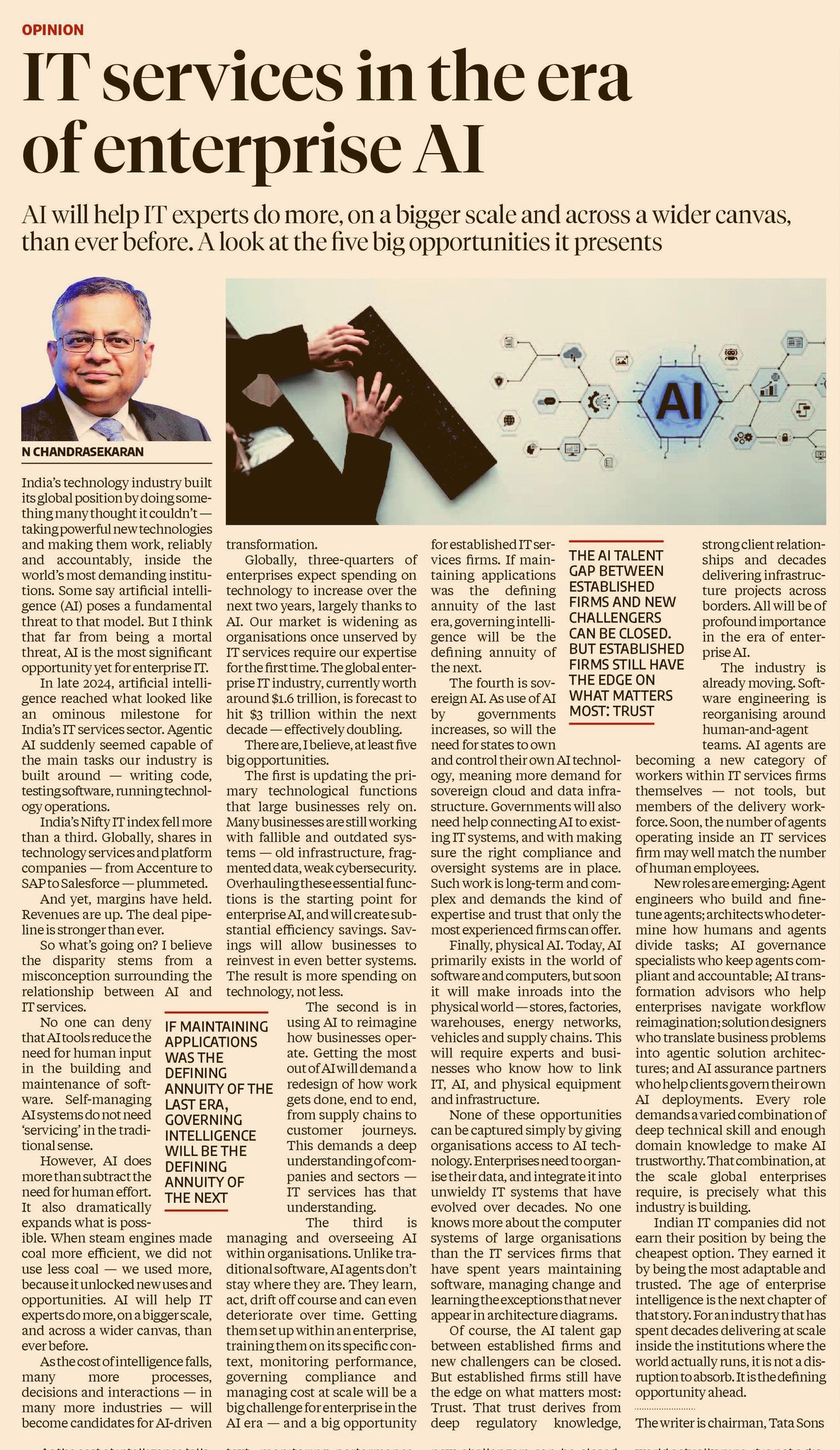
"No one can deny that AI tools reduce the need for human input... However, AI does more than subtract the need for human effort. It also dramatically expands what is possible. When steam engines made coal more efficient, we did not use less coal — we used more, because it unlocked new uses and opportunities."
The Critique:
The author invokes Jevons’ Paradox to argue that efficiency gains naturally explode demand. However, this analogy breaks down when applied to human labor. Coal is a passive, non-replicable material input; human labor is an active expense driven by time and wages.
Under the traditional time and materials billing model, if AI reduces human effort, revenue drops unless demand scales instantly to match. Real-world 2026 enterprise data reveals this equilibrium is failing. For instance, a Fortune 500 company deploying Salesforce Agentforce reduced a recurring financial reporting cycle from 15 days to just 35 minutes. More critically, the cost per report collapsed from 2200 dollars to 9 dollars. To maintain revenue parity under Jevons' Paradox when costs collapse by over 99%, an IT service vendor would need a 240-fold increase in client demand—an assumption completely detached from corporate budgetary realities.
2. The Fallacy of the Legacy Infrastructure Moat
The Column States:
"None of these opportunities can be captured simply by giving organisations access to AI technology. Enterprises need to organise their data... and integrate it into unwieldy IT systems that have evolved over decades. No one knows more about the computer systems of large organisations than the IT services firms that have spent years maintaining software..."
The Critique:
The author argues that the messy, unwieldy nature of legacy systems serves as a permanent moat for incumbent IT firms. This ignores the exact capability that makes Agentic AI revolutionary: its autonomous ability to map, parse, and refactor unstructured legacy code at machine speed.
Gartner data from 2026 shows that 40% of enterprise applications are embedding task-specific AI agents, skyrocketing from less than 5% in 2025. The institutional memory once locked in human engineering teams is being rapidly externalized into autonomous code-migration platforms. Legacy systems are no longer a protective barrier; they are a transient technical debt that automated agent networks can liquidate without requiring the massive human headcount traditionally supplied by legacy system integrators.
3. The Re-Aggregation of Value: Who Captures the $3 Trillion?
The Column States:
"The global enterprise IT industry, currently worth around $1.6 trillion, is forecast to hit $3 trillion within the next decade — effectively doubling... Our market is widening as organisations once unserved by IT services require our expertise for the first time."
The Critique:
While the aggregate enterprise IT market is projected to expand toward 3 trillion dollars, the distribution of this capital is undergoing a structural mutation. In the AI paradigm, value flows away from the service layer (human execution) and aggregates heavily into the infrastructure and platform layers (compute, hyperscalers, and proprietary foundational AI platforms).
When an enterprise adopts an AI agent network, its capital expenditure shifts from paying an IT services vendor for maintenance teams to paying compute costs directly to hyperscalers. The industry is witnessing a structural shift from time-based billing to outcome-driven contracts, which structurally reduces the number of human bodies a project requires. The market expansion is real, but it is a capital-intensive expansion that rewards digital infrastructure monopolies, not labor-heavy systems integrators.
4. The Labor Asymmetry and the Crisis of Complete Redundancy
The Column States:
"New roles are emerging: Agent engineers who build and fine-tune agents; architects who determine how humans and agents divide tasks; AI governance specialists... Every role demands a varied combination of deep technical skill and enough domain knowledge to make AI trustworthy. That combination... is precisely what this industry is building."
The Critique:
This argument presents an optimistic labor equilibrium that ignores an unprecedented economic crisis: the outright redundancy of cognitive and technical job profiles without the creation of commensurate replacement opportunities.
The author champions elite, hyper-specialized roles like agent engineers and AI architects, but the labor elasticity here is deeply asymmetric. A lean team of five elite AI architects can deploy an agentic framework that replaces the output of a 200-person traditional testing or maintenance team.
Furthermore, this disruption is not confined to software engineering. Across industries, core profiles are being hollowed out. Radiologists, data entry operators, application operators, drivers, and pilots are facing systematic automation where the target is not assistance, but full substitution. Crucially, the "newer job profiles" being created do not scale to match the volume of jobs lost, nor do they offer commensurate livelihoods for the billions of workers dependent on routine cognitive and physical labor.
The empirical consequences of this asymmetry are visible right now in the macro data of the Indian tech sector. In FY2026, the combined headcount of India's top five IT service providers dropped by 7,389 employees, representing a sharp historical reversal from previous growth eras. A World Economic Forum report notes that 41% of global employers plan to reduce workforces due to AI automation. The industry simply cannot absorb millions of displaced workers into niche governance roles.
5. The Vulnerability of the "Trust" Moat and the Looming Singularity
The Column States:
"But established firms still have the edge on what matters most: Trust. That trust derives from deep regulatory knowledge, strong client relationships and decades delivering infrastructure projects across borders... It is the defining opportunity ahead."
The Critique:
The column relies on "trust" as the ultimate defense mechanism against disruption. While enterprise clients value long-standing relationships, economic reality historically overrides institutional loyalty. When AI-native challengers offer to execute core processes at a fraction of the cost, the "trust moat" quickly evaporates.
More profoundly, framing trust as a permanent human edge ignores the looming threat of the technological singularity. While different experts hold varying estimates regarding its exact timeline, the horizon toward an artificial intelligence that entirely surpasses human cognitive capability across all domains is narrowing.
When intelligence itself becomes a virtually free, infinite utility, the service of a human being inside corporate IT infrastructure faces total obsolescence. Relying on "client relationships" and "regulatory knowledge" to shield an industry from an intelligence explosion is an archaic strategy. Trust is a trailing indicator of past performance, not a shield against systemic structural pricing pressures or an incoming algorithmic singularity.
Conclusion:
The narrative presented in the Business Standard column image uploaded herewith provides comfort to shareholders by framing a seismic structural shift as a manageable evolution. However, by treating AI as a complementary tool rather than a structural replacement for the traditional billable hour, it risks inducing strategic complacency. The public and policymakers must recognize that the transition to Enterprise AI requires a fundamental rewiring of economic models, education systems, and workforce planning—not merely a continuation of business as usual.
Here's a worthy simulator of the CEO's desk/dashboard at leading IT and ITES companies absolutely free.
https://itessimulator.netlify.app/
Here is counter column by Mr Vinod Khosla who is regarded as one of the foremost investors and technocrats of the Silicon Valley. https://www.business-standard.com/technology/tech-news/by-2050-people-may-not-need-jobs-as-ai-advances-predicts-vinod-khosla-126021701374_1.html
You are reminded to peruse my subsequent posts on the above mentioned hot topic thereafter, below.

1
The Issue
A Counter-view on the Future of Enterprise IT: The Illusion of Seamless Adaptation
Here's a worthy simulator of the CEO's desk/dashboard at leading IT and ITES companies absolutely free. 👇
https://itessimulator.netlify.app/
Another petition by the same author pointing out how the HR strategy of leading private companies are far from transparent and fair to the job seekers and hence a profound cause for burgeoning angst of the job seekers. 👇
"Tata Sons ought to be Tata Sons Public Ltd" by the same author.
https://www.change.org/TataSonsPublicLtd
1. The Misapplication of Jevons’ Paradox to Cognitive Labor
The Column States:
"No one can deny that AI tools reduce the need for human input... However, AI does more than subtract the need for human effort. It also dramatically expands what is possible. When steam engines made coal more efficient, we did not use less coal — we used more, because it unlocked new uses and opportunities."
The Critique:
The author invokes Jevons’ Paradox to argue that efficiency gains naturally explode demand. However, this analogy breaks down when applied to human labor. Coal is a passive, non-replicable material input; human labor is an active expense driven by time and wages.
Under the traditional time and materials billing model, if AI reduces human effort, revenue drops unless demand scales instantly to match. Real-world 2026 enterprise data reveals this equilibrium is failing. For instance, a Fortune 500 company deploying Salesforce Agentforce reduced a recurring financial reporting cycle from 15 days to just 35 minutes. More critically, the cost per report collapsed from 2200 dollars to 9 dollars. To maintain revenue parity under Jevons' Paradox when costs collapse by over 99%, an IT service vendor would need a 240-fold increase in client demand—an assumption completely detached from corporate budgetary realities.
2. The Fallacy of the Legacy Infrastructure Moat
The Column States:
"None of these opportunities can be captured simply by giving organisations access to AI technology. Enterprises need to organise their data... and integrate it into unwieldy IT systems that have evolved over decades. No one knows more about the computer systems of large organisations than the IT services firms that have spent years maintaining software..."
The Critique:
The author argues that the messy, unwieldy nature of legacy systems serves as a permanent moat for incumbent IT firms. This ignores the exact capability that makes Agentic AI revolutionary: its autonomous ability to map, parse, and refactor unstructured legacy code at machine speed.
Gartner data from 2026 shows that 40% of enterprise applications are embedding task-specific AI agents, skyrocketing from less than 5% in 2025. The institutional memory once locked in human engineering teams is being rapidly externalized into autonomous code-migration platforms. Legacy systems are no longer a protective barrier; they are a transient technical debt that automated agent networks can liquidate without requiring the massive human headcount traditionally supplied by legacy system integrators.
3. The Re-Aggregation of Value: Who Captures the $3 Trillion?
The Column States:
"The global enterprise IT industry, currently worth around $1.6 trillion, is forecast to hit $3 trillion within the next decade — effectively doubling... Our market is widening as organisations once unserved by IT services require our expertise for the first time."
The Critique:
While the aggregate enterprise IT market is projected to expand toward 3 trillion dollars, the distribution of this capital is undergoing a structural mutation. In the AI paradigm, value flows away from the service layer (human execution) and aggregates heavily into the infrastructure and platform layers (compute, hyperscalers, and proprietary foundational AI platforms).
When an enterprise adopts an AI agent network, its capital expenditure shifts from paying an IT services vendor for maintenance teams to paying compute costs directly to hyperscalers. The industry is witnessing a structural shift from time-based billing to outcome-driven contracts, which structurally reduces the number of human bodies a project requires. The market expansion is real, but it is a capital-intensive expansion that rewards digital infrastructure monopolies, not labor-heavy systems integrators.
4. The Labor Asymmetry and the Crisis of Complete Redundancy
The Column States:
"New roles are emerging: Agent engineers who build and fine-tune agents; architects who determine how humans and agents divide tasks; AI governance specialists... Every role demands a varied combination of deep technical skill and enough domain knowledge to make AI trustworthy. That combination... is precisely what this industry is building."
The Critique:
This argument presents an optimistic labor equilibrium that ignores an unprecedented economic crisis: the outright redundancy of cognitive and technical job profiles without the creation of commensurate replacement opportunities.
The author champions elite, hyper-specialized roles like agent engineers and AI architects, but the labor elasticity here is deeply asymmetric. A lean team of five elite AI architects can deploy an agentic framework that replaces the output of a 200-person traditional testing or maintenance team.
Furthermore, this disruption is not confined to software engineering. Across industries, core profiles are being hollowed out. Radiologists, data entry operators, application operators, drivers, and pilots are facing systematic automation where the target is not assistance, but full substitution. Crucially, the "newer job profiles" being created do not scale to match the volume of jobs lost, nor do they offer commensurate livelihoods for the billions of workers dependent on routine cognitive and physical labor.
The empirical consequences of this asymmetry are visible right now in the macro data of the Indian tech sector. In FY2026, the combined headcount of India's top five IT service providers dropped by 7,389 employees, representing a sharp historical reversal from previous growth eras. A World Economic Forum report notes that 41% of global employers plan to reduce workforces due to AI automation. The industry simply cannot absorb millions of displaced workers into niche governance roles.
5. The Vulnerability of the "Trust" Moat and the Looming Singularity
The Column States:
"But established firms still have the edge on what matters most: Trust. That trust derives from deep regulatory knowledge, strong client relationships and decades delivering infrastructure projects across borders... It is the defining opportunity ahead."
The Critique:
The column relies on "trust" as the ultimate defense mechanism against disruption. While enterprise clients value long-standing relationships, economic reality historically overrides institutional loyalty. When AI-native challengers offer to execute core processes at a fraction of the cost, the "trust moat" quickly evaporates.
More profoundly, framing trust as a permanent human edge ignores the looming threat of the technological singularity. While different experts hold varying estimates regarding its exact timeline, the horizon toward an artificial intelligence that entirely surpasses human cognitive capability across all domains is narrowing.
When intelligence itself becomes a virtually free, infinite utility, the service of a human being inside corporate IT infrastructure faces total obsolescence. Relying on "client relationships" and "regulatory knowledge" to shield an industry from an intelligence explosion is an archaic strategy. Trust is a trailing indicator of past performance, not a shield against systemic structural pricing pressures or an incoming algorithmic singularity.
Conclusion:
The narrative presented in the Business Standard column image uploaded herewith provides comfort to shareholders by framing a seismic structural shift as a manageable evolution. However, by treating AI as a complementary tool rather than a structural replacement for the traditional billable hour, it risks inducing strategic complacency. The public and policymakers must recognize that the transition to Enterprise AI requires a fundamental rewiring of economic models, education systems, and workforce planning—not merely a continuation of business as usual.
Here's a worthy simulator of the CEO's desk/dashboard at leading IT and ITES companies absolutely free.
https://itessimulator.netlify.app/
Here is counter column by Mr Vinod Khosla who is regarded as one of the foremost investors and technocrats of the Silicon Valley. https://www.business-standard.com/technology/tech-news/by-2050-people-may-not-need-jobs-as-ai-advances-predicts-vinod-khosla-126021701374_1.html
You are reminded to peruse my subsequent posts on the above mentioned hot topic thereafter, below.
Petition Updates
Share this petition
Petition created on 29 June 2026