
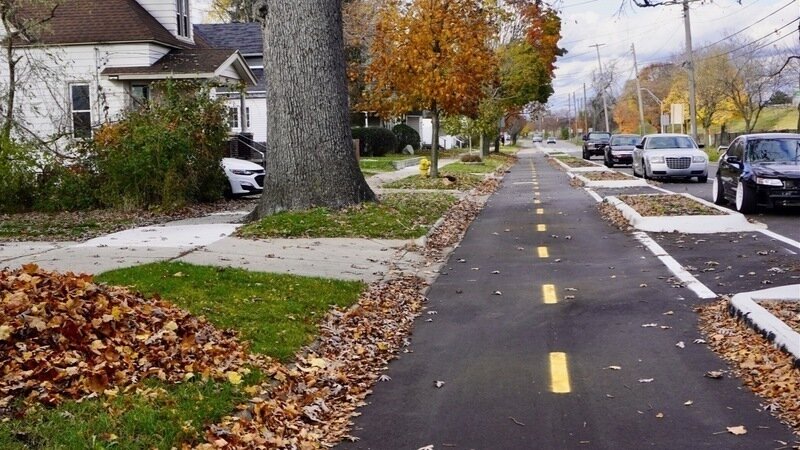
Build Protected Bicycle Lanes in Grand Rapids
The Issue
Friends of Slow Streets is a local community initiative advocating for people-centered places. We believe that with a little more attention to placemaking, Grand Rapids can be the most livable city in the Midwest.
Streets occupy roughly 40% of all of the land in Grand Rapids. Currently, the vast majority of the land dedicated to streets is only available to people driving cars or parking cars, while just a fraction of that space is dedicated to people. There are some excellent examples of streets that cater to people just as well as they do to cars, but these examples are few and far between. Friends of Slow Streets wants every street to be just as friendly to people as it is to cars.
This means improving mobility for people who choose to get around by bike, by scooter, on public transit, or on foot - making connectivity at least as safe and seamless for people as it is for cars.
This also means paying extra attention to the spaces around our buildings so that they become magnets for small business investment and community building. People are attracted to great places. When we foster great places we pull in more talent, more diversity, more capital, and more energy to grow our community.
We love cars and we know they play a critical role for mobility in West Michigan. But for too long cars have been the only factor in nearly every public space in the region. Let's begin to create a city that offers more spaces where people and prosperity are the priority.
West Michigan has more than 12 parking spaces for every person who lives in our region. That parking consumes some of the most valuable land in our community and it is impacting everything from where more housing can be built, to who is invited to enjoy our city, and how safely they can move around our community. Yet, the only reason we believe all of this parking is necessary is because it is so difficult to move around the City by any means other than the car.
Let's design our city in a way that welcomes people to come by car, by bike, by transit, or on foot. Let's design and invest in our infrastructure in a way that makes any option a great option in Grand Rapids.
Protected bicycle lanes are excellent for business. On average, cyclists visit more frequently and spend 20 % more per month at local businesses than drivers.
Protected bicycle lanes are great for family savings. Transportation is the second largest item in the household budget averaging $10,000/year. Being able to get around safely without a car is the fastest way to build wealth by putting money back in the taxpayers pocket.
Slow Streets could dramatically improve the issues that Grand Rapids Public Schools has been experiencing with Dean Transportation. There aren’t enough drivers to transport all of the children that need the bus every day. Yet, many kids live within easy biking distance to school. The trouble is, it is not safe for them to travel by bike in our city.
Protected bicycle lanes attract talent, and talent attracts business investment. Millennials and Gen-Z want vibrant cities with placemaking, people-oriented streets. The data says we need to have more mobility options to attract top talent and improve quality of life. A comprehensive network of connected protected bicycle lanes is the cheapest, most efficient way to get the job done.
Other cities and places that look and feel like Grand Rapids have told us that in order to increase bicycling, walking, scooting, and rolling: we need to build protected infrastructure that provides a low stress, dignified way of getting to and from where you want to go–and it needs to be dense, connected, and commonsense.
The Grand Rapids market is demanding protected bicycle lanes. Mobile GR has the bicycle share data. We know that people are taking hundreds of thousands of bicycle rides, annually. We know it attracts tourists. We know it’s part of our identity as an amenity-rich community.
The trouble is that government has over-regulated our streets to the point where the government is dictating what mode of transit people take. Because our streets have been engineered for drivers to get as quickly as possible from Point A to Point B, we have made the streets unsafe, we have falsely depressed business sales, we have over-polluted, over-congested, and over-funded car infrastructure. Everyone loves cars because everyone drives, they say. But that is a logical fallacy—everyone drives because that’s the way our streets have been engineered. We must build for the outcome we want; people-centered, bicycle friendly, vibrant streets. The good news is that our streets are wide enough to put in protected bicycle lanes, in addition to sidewalks, and still have space for cars.
We are calling on the City of Grand Rapids to:
1) Change the design standard for Vital Streets beginning in July of 2024: new streets on main roads must have concrete protected cycling infrastructure with bicycle lights, protected bicycle intersections, and protected bicycle lanes. It is the fiscally responsible thing to do.
2) Install 21 miles of concrete, jersey-barrier, protected bicycle lanes, annually, equitably throughout Grand Rapids. This will provide a temporary protected bicycle lane while the street waits for reconstruction. We made a map of where we think they should go.
3) Set key performance indicators and track progress.
4) Formally adopt Vision Zero and Safe Routes to School.
5) Fund this initiative from the general fund, $10 million dollars a year for 5 years. As billions of dollars are available from the Federal Government in the infrastructure and jobs act to fund bicycle infrastructure we need our City government to be competing and asking for that support. Mayor Bliss can work with Rep. Hood, Rep. Grant, Senator Brinks, Senator Huizenga, Rep. Scholten, Senator Peters, and Secretary Buttigieg to invest our City.
6) Pass the Cycling Safety Ordinance.
Finally, we know that business investment follows talent. As Michigan begins to reconcile with our serious population loss—we need to start thinking differently, right now. Grand Rapids is a vibrant city that attracts tourists from all over the world. As hybrid work continues to decouple talent from geography, we will increasingly compete to attract and retain talent.
In this new era of place, regions with infrastructure that support a high quality of life will win. Let’s continue to make Grand Rapids an easy place to move and an even easier place to move around.
Thank you!

705
The Issue
Friends of Slow Streets is a local community initiative advocating for people-centered places. We believe that with a little more attention to placemaking, Grand Rapids can be the most livable city in the Midwest.
Streets occupy roughly 40% of all of the land in Grand Rapids. Currently, the vast majority of the land dedicated to streets is only available to people driving cars or parking cars, while just a fraction of that space is dedicated to people. There are some excellent examples of streets that cater to people just as well as they do to cars, but these examples are few and far between. Friends of Slow Streets wants every street to be just as friendly to people as it is to cars.
This means improving mobility for people who choose to get around by bike, by scooter, on public transit, or on foot - making connectivity at least as safe and seamless for people as it is for cars.
This also means paying extra attention to the spaces around our buildings so that they become magnets for small business investment and community building. People are attracted to great places. When we foster great places we pull in more talent, more diversity, more capital, and more energy to grow our community.
We love cars and we know they play a critical role for mobility in West Michigan. But for too long cars have been the only factor in nearly every public space in the region. Let's begin to create a city that offers more spaces where people and prosperity are the priority.
West Michigan has more than 12 parking spaces for every person who lives in our region. That parking consumes some of the most valuable land in our community and it is impacting everything from where more housing can be built, to who is invited to enjoy our city, and how safely they can move around our community. Yet, the only reason we believe all of this parking is necessary is because it is so difficult to move around the City by any means other than the car.
Let's design our city in a way that welcomes people to come by car, by bike, by transit, or on foot. Let's design and invest in our infrastructure in a way that makes any option a great option in Grand Rapids.
Protected bicycle lanes are excellent for business. On average, cyclists visit more frequently and spend 20 % more per month at local businesses than drivers.
Protected bicycle lanes are great for family savings. Transportation is the second largest item in the household budget averaging $10,000/year. Being able to get around safely without a car is the fastest way to build wealth by putting money back in the taxpayers pocket.
Slow Streets could dramatically improve the issues that Grand Rapids Public Schools has been experiencing with Dean Transportation. There aren’t enough drivers to transport all of the children that need the bus every day. Yet, many kids live within easy biking distance to school. The trouble is, it is not safe for them to travel by bike in our city.
Protected bicycle lanes attract talent, and talent attracts business investment. Millennials and Gen-Z want vibrant cities with placemaking, people-oriented streets. The data says we need to have more mobility options to attract top talent and improve quality of life. A comprehensive network of connected protected bicycle lanes is the cheapest, most efficient way to get the job done.
Other cities and places that look and feel like Grand Rapids have told us that in order to increase bicycling, walking, scooting, and rolling: we need to build protected infrastructure that provides a low stress, dignified way of getting to and from where you want to go–and it needs to be dense, connected, and commonsense.
The Grand Rapids market is demanding protected bicycle lanes. Mobile GR has the bicycle share data. We know that people are taking hundreds of thousands of bicycle rides, annually. We know it attracts tourists. We know it’s part of our identity as an amenity-rich community.
The trouble is that government has over-regulated our streets to the point where the government is dictating what mode of transit people take. Because our streets have been engineered for drivers to get as quickly as possible from Point A to Point B, we have made the streets unsafe, we have falsely depressed business sales, we have over-polluted, over-congested, and over-funded car infrastructure. Everyone loves cars because everyone drives, they say. But that is a logical fallacy—everyone drives because that’s the way our streets have been engineered. We must build for the outcome we want; people-centered, bicycle friendly, vibrant streets. The good news is that our streets are wide enough to put in protected bicycle lanes, in addition to sidewalks, and still have space for cars.
We are calling on the City of Grand Rapids to:
1) Change the design standard for Vital Streets beginning in July of 2024: new streets on main roads must have concrete protected cycling infrastructure with bicycle lights, protected bicycle intersections, and protected bicycle lanes. It is the fiscally responsible thing to do.
2) Install 21 miles of concrete, jersey-barrier, protected bicycle lanes, annually, equitably throughout Grand Rapids. This will provide a temporary protected bicycle lane while the street waits for reconstruction. We made a map of where we think they should go.
3) Set key performance indicators and track progress.
4) Formally adopt Vision Zero and Safe Routes to School.
5) Fund this initiative from the general fund, $10 million dollars a year for 5 years. As billions of dollars are available from the Federal Government in the infrastructure and jobs act to fund bicycle infrastructure we need our City government to be competing and asking for that support. Mayor Bliss can work with Rep. Hood, Rep. Grant, Senator Brinks, Senator Huizenga, Rep. Scholten, Senator Peters, and Secretary Buttigieg to invest our City.
6) Pass the Cycling Safety Ordinance.
Finally, we know that business investment follows talent. As Michigan begins to reconcile with our serious population loss—we need to start thinking differently, right now. Grand Rapids is a vibrant city that attracts tourists from all over the world. As hybrid work continues to decouple talent from geography, we will increasingly compete to attract and retain talent.
In this new era of place, regions with infrastructure that support a high quality of life will win. Let’s continue to make Grand Rapids an easy place to move and an even easier place to move around.
Thank you!
The Decision Makers

Supporter Voices
Petition Updates
Share this petition
Petition created on December 10, 2023