

Bring True No-Fault Divorce to Mississippi
The Issue
I had to prove to a judge that what happened in my marriage was bad enough for me to be allowed to leave it.
I wish that were an exaggeration, but that is essentially how divorce works in Mississippi when one spouse refuses to agree to it.
My marriage was over in 2023. We had separated. I had moved out. We had both moved on with our lives.
But because my husband would not agree to an irreconcilable differences divorce, I was still legally his wife until 2026.
For almost three years, the question was not whether our marriage was actually functioning as a marriage. It clearly was not. The question was whether I could prove one of Mississippi’s legal grounds for divorce well enough for a judge to allow me out.
And when one person has the power to refuse a divorce, that power can very quickly become a bargaining chip.
“I’ll agree to the divorce if you give me the house.”
“I’ll agree to the divorce if you give up child support.”
“I’ll agree to the divorce if you accept these terms.”
That is the position Mississippi law can put people in. One spouse is not just negotiating over property, money, custody, or support. They are negotiating over whether the other person gets to stop being married to them at all.
That happened to me.
Instead of simply being able to end a marriage that had already ended in every practical sense, I spent almost three years in litigation. My divorce trial alone lasted 11 days. Friends and family testified. My private text messages became evidence. My therapy records were subpoenaed. I had to explain some of the most painful parts of my marriage under oath while lawyers argued over whether what happened to me legally counted as enough.
Eventually, the judge granted my divorce.
I got out. But getting out should never have required all of that.
I had a lawyer. I had the ability to keep paying legal fees. I could take time off work. I had people willing to testify. I could keep fighting.
A lot of people cannot.
The change I am asking Mississippi lawmakers to make is actually very simple: allow unilateral irreconcilable differences divorce.
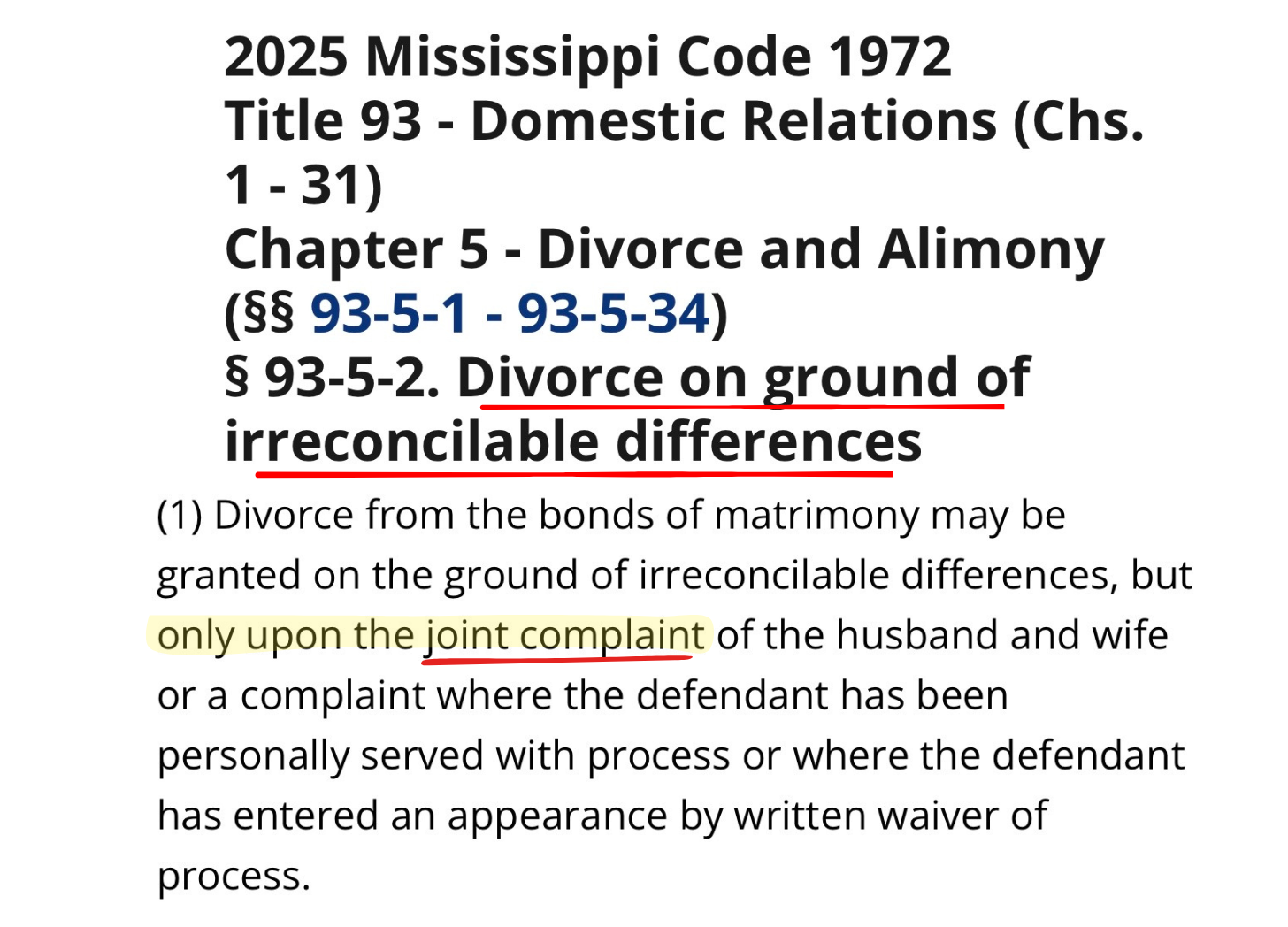
Right now, an irreconcilable differences divorce requires both spouses to agree. I believe one person should be able to file and say, simply, “This marriage is over,” and be granted a divorce.
That does not mean the other issues disappear.
If there is evidence that matters to custody, child support, alimony, property division, or finances, that evidence can still be presented. Those issues can still be negotiated, litigated, and decided by a judge.
But a person should not be forced to remain someone’s legal spouse for months or years while they wait for those issues to go to trial.
The court can decide who gets the house, custody, support, and divide the finances.
What the court should not have to decide is whether one adult has a good enough reason to stop being married to another adult.
One person should be enough to say the marriage is over.
Paid partnership. Hadley Fairley is a Change Ambassador who receives compensation in connection with this petition.

45,904
The Issue
I had to prove to a judge that what happened in my marriage was bad enough for me to be allowed to leave it.
I wish that were an exaggeration, but that is essentially how divorce works in Mississippi when one spouse refuses to agree to it.
My marriage was over in 2023. We had separated. I had moved out. We had both moved on with our lives.
But because my husband would not agree to an irreconcilable differences divorce, I was still legally his wife until 2026.
For almost three years, the question was not whether our marriage was actually functioning as a marriage. It clearly was not. The question was whether I could prove one of Mississippi’s legal grounds for divorce well enough for a judge to allow me out.
And when one person has the power to refuse a divorce, that power can very quickly become a bargaining chip.
“I’ll agree to the divorce if you give me the house.”
“I’ll agree to the divorce if you give up child support.”
“I’ll agree to the divorce if you accept these terms.”
That is the position Mississippi law can put people in. One spouse is not just negotiating over property, money, custody, or support. They are negotiating over whether the other person gets to stop being married to them at all.
That happened to me.
Instead of simply being able to end a marriage that had already ended in every practical sense, I spent almost three years in litigation. My divorce trial alone lasted 11 days. Friends and family testified. My private text messages became evidence. My therapy records were subpoenaed. I had to explain some of the most painful parts of my marriage under oath while lawyers argued over whether what happened to me legally counted as enough.
Eventually, the judge granted my divorce.
I got out. But getting out should never have required all of that.
I had a lawyer. I had the ability to keep paying legal fees. I could take time off work. I had people willing to testify. I could keep fighting.
A lot of people cannot.
The change I am asking Mississippi lawmakers to make is actually very simple: allow unilateral irreconcilable differences divorce.
Right now, an irreconcilable differences divorce requires both spouses to agree. I believe one person should be able to file and say, simply, “This marriage is over,” and be granted a divorce.
That does not mean the other issues disappear.
If there is evidence that matters to custody, child support, alimony, property division, or finances, that evidence can still be presented. Those issues can still be negotiated, litigated, and decided by a judge.
But a person should not be forced to remain someone’s legal spouse for months or years while they wait for those issues to go to trial.
The court can decide who gets the house, custody, support, and divide the finances.
What the court should not have to decide is whether one adult has a good enough reason to stop being married to another adult.
One person should be enough to say the marriage is over.
Paid partnership. Hadley Fairley is a Change Ambassador who receives compensation in connection with this petition.
The Decision Makers





Supporter Voices
Petition Updates
Share this petition
Petition created on August 17, 2026