

Bexley residents: sign if you oppose artificial turf on the Montrose and Maryland fields
The Issue
At the Board of Education meeting on Wednesday 1/14, the phase 1 plans for the facilities renovation were shared again by Harley Williams, and unfortunately, no changes had been made regarding the artificial turf proposal (with the exception of a note about expecting the cost of the turf to be "only" $4 million, as opposed to $6-7 million), and the Board members who commented following the presentation definitely implied that they approve of these plans. Therefore, unless there is significant community outcry, it appears that the district will move forward with the plans in their current state, including the turfing of the fields at Maryland and Montrose. If you would like to be part of that outcry, please have other adults in your Bexley household sign the petition, and also please submit your feedback at this link (a sample message to copy and paste is below--feel free to edit as you see fit):
https://docs.google.com/forms/d/e/1FAIpQLSdBWjWwLvvfbCC0DvtC2rvcHeOqIM0c_V8zm_0JIMJCEAxoMQ/viewform
SAMPLE MESSAGE
" The Bexley City School District plans to install artificial turf at the Montrose and Maryland fields. As Bexley residents, we oppose this change. These fields are public spaces used mostly by young children, and we believe natural grass is healthier for our kids and our community.
Artificial turf exposes children to harmful micro/nanoplastics and other toxic substances which have been linked to cancer, hormone problems, and other health issues. Children are more vulnerable to toxins because their bodies are still growing. Turf fields also get much hotter than real grass on sunny days, making them unsafe or unusable in hot weather. In addition, studies show higher rates of certain injuries on turf, such as foot and ankle injuries and skin scrapes that can become infected.
Artificial turf also harms the environment. Over time, it sheds large amounts of plastic and toxic chemicals that wash into waterways or end up in landfills. Replacing grass with plastic also reduces children’s contact with nature, which is important for healthy immune systems and overall well-being. Natural grass cools the air, absorbs water, supports soil health, and provides real environmental benefits. For these reasons, we ask the district to keep these school fields natural and remove artificial turf from the facilities plan. For a fraction of the cost of the artificial turf, with better grass species selection and more thoughtful maintenance, the grass fields could be upgraded to a sturdier, more durable state that would easily accommodate recess, neighborhood play, and increased use by high school and middle school sports teams.
We also ask for a large natural grass field to be incorporated into the plans for the Cassingham complex to give children in Central Bexley a healthy open place to play outside at recess and during non-school hours. "
The Bexley City School District states that phase 1 of the facilities renovation plan for the district includes laying artificial turf in the fields at Montrose and Maryland. As Bexley residents, we oppose adding plastic turf to these public space properties used primarily by young children, and collectively agree to maintain our current green spaces for the health of our community. A summary of our reasoning follows. Further details and references are below for those who would like more information.
***NO NEED TO "DONATE" (unless you really want to). We are not collecting $ and are not seeking an internet-wide audience. The platform has to monetize itself somehow, and this is how they're doing it. The most helpful thing you can do is share with other Bexley residents!!!***
Summary of reasons for opposition:
1) Exposure of young, growing bodies to microplastics and chemicals identified in artificial turf, including polycyclic aromatic hydrocarbons (PAHs) and phthalates, which are known carcinogens and endocrine disruptors. These are a concern even when the infill is made of sand, plant material, or minerals instead of the more commonly found crumb rubber made from old tires.
2) Dangerously high temperatures on plastic turf as compared to natural grass when the weather is warm and sunny. Temperatures can become so high on plastic turf fields that they are unusable for much of the day when it’s hot, including on artificial fields with infill consisting of sand, plant material, or natural minerals.
3) Increased incidence of certain types of injuries on artificial turf as compared to natural grass, particularly musculoskeletal injuries to the foot and ankle, and skin abrasions that more easily become infected due to the increased presence of pathogenic (i.e., disease-causing) and antibiotic-resistant bacteria (for example, MRSA) on synthetic fields (including those with other infill besides crumb rubber tires.)
4) Pollution—over time, each field creates many thousands of pounds of plastic that ends up in our environment (large amounts of the infill is lost every time it rains, and then the runoff carries this pollution into our waterways) and landfills (this is true even if the infill is not synthetic crumb rubber). The fields need to be replaced every 8-15 years, which not only negates some of the short term cost savings of maintenance of turf over natural grass, but also means the pollution is ongoing.
5) Decreased exposure to nature. Children whose play areas include dirt and plants have statistically significantly better gut flora, skin flora, and immune systems, when compared in a controlled fashion to those whose play areas do not include dirt and plants.
It would be very unfortunate if a levy to fund much-needed improvements to the schools failed due to the inclusion of this measure.
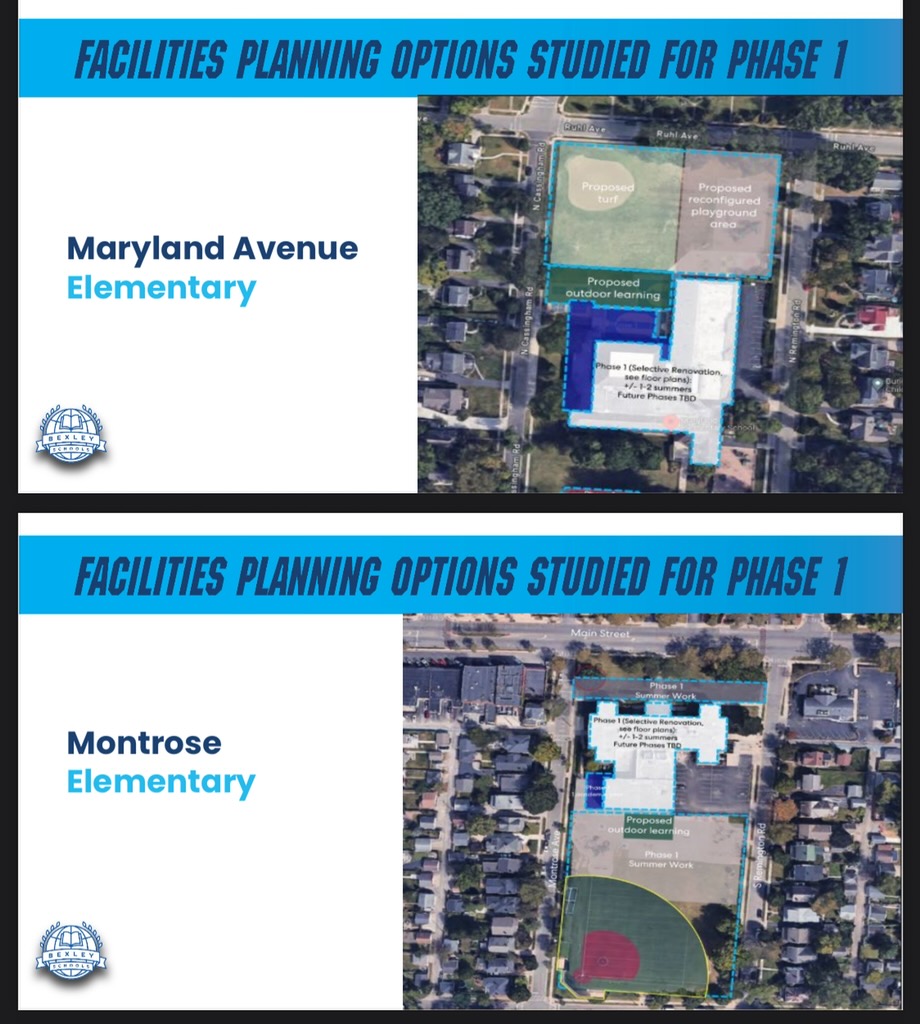
Representation of proposed changes as we understand them at this time:
Detailed explanation and references:
1) Exposure of young, growing bodies to microplastics and chemicals identified in artificial turf, including polycyclic aromatic hydrocarbons (PAHs) and phthalates, which are known carcinogens and endocrine disruptors. High quality research on the outcomes of such exposures in humans is notoriously difficult to do, and so while more investigation is still needed, there are already plenty of studies that show harm to animals and people exposed to the various substances that come out of the crumbled tires used for infill and out of the plastic grass surface (used even when the infill is made of less concerning material, e.g., sand, minerals, or plant-derived components.) Compared to adults, children are particularly vulnerable to the effects of toxins in general due to their small size and continual growth. A notable trend of changing out artificial turf for natural resource replacements is happening across school districts in other areas of the country. Why are we going backwards?
a) https://pmc.ncbi.nlm.nih.gov/articles/PMC10262297/
2) Dangerously high temperatures on plastic turf as compared to natural grass when the weather is warm and sunny. Temperatures can become so high on plastic turf fields that they are unusable during the day when it’s hot, which makes any arguments for greater seasonal availability of turf over grass much less compelling, especially given the increasingly high temperatures in Columbus expected in coming years due to climate change. Increased temperatures are particularly concerning in the context of play areas used by children, as children are physiologically less able to regulate their body temperature compared to adults and are therefore more prone to serious adverse events such as heat stroke. Using some types of non-synthetic infill instead of crumb rubber can improve the heat island effect, but only if irrigation systems are installed, which increases upfront and maintenance costs.
a) https://www.nrpa.org/parks-recreation-magazine/2019/may/synthetic-sports-fields-and-the-heat-island-effect/
b) https://climate.osu.edu/news/how-climate-change-already-impacting-ohio-and-whats-ahead
3) Increased incidence of certain types of injuries on artificial turf as compared to natural grass, particularly musculoskeletal injuries to the foot and ankle and skin abrasions that more easily become infected due to the increased presence of pathogenic (i.e., disease-causing) and antibiotic-resistant bacteria (including Staph aureus) on synthetic fields (including those with sand used as infill instead of crumb rubber tires) as opposed to natural grass fields, as the natural grass and dirt have an increased diversity of bacteria that are able to outcompete the pathogenic bacteria left on the fields by humans. Sports medicine physicians generally prefer for athletes to play on natural grass over artificial turf, due to data that's been collected on injuries and infections and for the other reasons cited here.
a) https://pubmed.ncbi.nlm.nih.gov/35593739/
b) https://pmc.ncbi.nlm.nih.gov/articles/PMC6728760/
4) Pollution—over time, each field creates many thousands of pounds of plastic that ends up in our environment (large amounts of the infill is lost every time it rains, and then the runoff carries this pollution into our waterways) and landfills. The fields need to be replaced every 8-15 years, which not only negates some of the short term cost savings of maintenance of turf over natural grass, but also means the pollution is ongoing. The materials used in the fields also contain toxic per- and polyfluoroalkyl substances (PFAS), and while initial studies seem to show that these substances are not easily extracted from the fields and so likely do not pose a risk to the health of users (although more studies are needed on how the substances are released over time under the natural conditions of temperature fluctuations and exposure to UV light and moisture), the byproducts of the manufacturing process and eventual disposal of the fields at the end of their life still contributes large amounts of these dangerous substances, which are also known as "forever chemicals" because they never biodegrade, to the environment. The 2nd reference includes information on the universal presence of fluoropolymers in the backing, plastic grass, and filling of 17 different fields, including some with sand and organic material filling. While fluoropolymer compounds are large and stable and known not to be absorbed into the body, the production process of adding them to these materials is concerning for the creation of byproduct PFAS chemicals.
a) https://www.sciencedirect.com/science/article/pii/S0269749123010965?via%3Dihub
b) https://pmc.ncbi.nlm.nih.gov/articles/PMC9367005/
c) https://esmedeprez.com/dark-plastics/
5) Decreased exposure to nature. We all know that children are generally spending less and less time in natural environments, and while the fields at Montrose and Maryland aren't exactly hubs of biodiversity, they do provide some exposure to the natural world, particularly the areas with trees at both locations, and the garden beds at Montrose. In the study cited below, a subset of children at daycares with gravel playgrounds had dirt and plants added to their playground, and after just 28 days of playing in the nature-added spaces, statistically significant improvements in the intervention group’s immune system, gut bacteria, and skin bacteria were found. Eliminating contact with dirt and plants on the playground by replacing the nature with artificial turf is absolutely counterproductive if our goal is to raise kids who are as healthy as possible.
a) https://www.science.org/doi/10.1126/sciadv.aba2578
Additional Resources:
The Santa Clara County Medical Association recommends against plastic turf playing fields citing “the health and safety of both your students and the environment.”
The California Coastal Commission rejected an artificial turf field at U.C. Santa Barbara, citing the impacts of microplastics on the marine environment.
The City of Millbrae has banned new artificial turf on all property – public and private - to “protect water quality...pursuant to the Clean Water Act.”
The Sierra Club wrote to the Santa Clara County Board of Supervisors, urging them to adopt an ordinance against the installation of artificial turf on “all property within County jurisdiction, whether for landscaping or athletic fields.”
There have been multiple studies and reports focused on children’s health which show plastic turf’s harms. For example:
A study focused on high schools, published by University Hospitals Cleveland Medical Center and Case Western Reserve University School of Medicine, determined that high school “athletes were 58% more likely to sustain an injury on artificial turf. Football, soccer, and rugby athletes were at a significantly greater injury risk on artificial turf. Upper and lower extremity and torso injuries also occurred with higher incidence on artificial turf.”
The San Francisco Estuary Institute’s Moffett Park Specific Plan Urban Ecology satellite images (p. 16-17) show the urban heat island effect causing “synthetic turf fields at Twin Creeks Sports Complex the highest surface temperatures” seen in the area on September 2, 2017.
The Guardian reports “Between 2018 and 2022, at least 11 football players in the US – at the student and professional level – have died of heat stroke” and “The artificial grass that students ... play on causes even more complications. Studies suggest that synthetic turf can get up to 60F (15.5C) hotter than natural grass, radiating temperatures above 160F (71C) on summer days.”
National Public Radio (NPR) reports that the EPA continues to add categories of the over 14,000 chemicals known as PFAS chemicals to it’s “hazardous constituents” list as they “cause a litany of ‘toxic effects’ ... including, but not limited to cancer, a decreased response to vaccinations, high cholesterol, decrease in fertility in women, preeclampsia, thyroid disorders and asthma”. PFAS chemicals and their unvetted replacement chemicals are in all artificial turf.
Studies also show plastic turf’s environmental harms. As plastics degrade, microplastics permeate the air and soil and wash into our watersheds. Microplastics are now found in the food we eat and even in newborns.
The turf industry admits turf is not recyclable; it’s comprised of layers of different petroleum products that can’t be separated. After its 10-year lifespan, it’s buried in a landfill or incinerated, releasing CO2 into the atmosphere.
Water is not absorbed to the same extent by the plastic mat as it is by natural grass or mulch. Instead of recharging aquifers, heavy rains run off the artificial turf, polluting waterways and burdening storm drains.
Outdoor play and team sport helps children learn skills, develop strength, and boost mental well-being, while nature rich environments improve children’s self-esteem, focus, participation in social settings, and even their immune system. Additionally, living grass and shrubs clean our air, reduce surrounding temperatures, sequester carbon and improve our groundwater stores and soils naturally. We, the undersigned, call on the district to refrain from eliminating the elementary schools’ green spaces by replacing them with artificial turf and to further remove these plans from the facilities proposal.

486
The Issue
At the Board of Education meeting on Wednesday 1/14, the phase 1 plans for the facilities renovation were shared again by Harley Williams, and unfortunately, no changes had been made regarding the artificial turf proposal (with the exception of a note about expecting the cost of the turf to be "only" $4 million, as opposed to $6-7 million), and the Board members who commented following the presentation definitely implied that they approve of these plans. Therefore, unless there is significant community outcry, it appears that the district will move forward with the plans in their current state, including the turfing of the fields at Maryland and Montrose. If you would like to be part of that outcry, please have other adults in your Bexley household sign the petition, and also please submit your feedback at this link (a sample message to copy and paste is below--feel free to edit as you see fit):
https://docs.google.com/forms/d/e/1FAIpQLSdBWjWwLvvfbCC0DvtC2rvcHeOqIM0c_V8zm_0JIMJCEAxoMQ/viewform
SAMPLE MESSAGE
" The Bexley City School District plans to install artificial turf at the Montrose and Maryland fields. As Bexley residents, we oppose this change. These fields are public spaces used mostly by young children, and we believe natural grass is healthier for our kids and our community.
Artificial turf exposes children to harmful micro/nanoplastics and other toxic substances which have been linked to cancer, hormone problems, and other health issues. Children are more vulnerable to toxins because their bodies are still growing. Turf fields also get much hotter than real grass on sunny days, making them unsafe or unusable in hot weather. In addition, studies show higher rates of certain injuries on turf, such as foot and ankle injuries and skin scrapes that can become infected.
Artificial turf also harms the environment. Over time, it sheds large amounts of plastic and toxic chemicals that wash into waterways or end up in landfills. Replacing grass with plastic also reduces children’s contact with nature, which is important for healthy immune systems and overall well-being. Natural grass cools the air, absorbs water, supports soil health, and provides real environmental benefits. For these reasons, we ask the district to keep these school fields natural and remove artificial turf from the facilities plan. For a fraction of the cost of the artificial turf, with better grass species selection and more thoughtful maintenance, the grass fields could be upgraded to a sturdier, more durable state that would easily accommodate recess, neighborhood play, and increased use by high school and middle school sports teams.
We also ask for a large natural grass field to be incorporated into the plans for the Cassingham complex to give children in Central Bexley a healthy open place to play outside at recess and during non-school hours. "
The Bexley City School District states that phase 1 of the facilities renovation plan for the district includes laying artificial turf in the fields at Montrose and Maryland. As Bexley residents, we oppose adding plastic turf to these public space properties used primarily by young children, and collectively agree to maintain our current green spaces for the health of our community. A summary of our reasoning follows. Further details and references are below for those who would like more information.
***NO NEED TO "DONATE" (unless you really want to). We are not collecting $ and are not seeking an internet-wide audience. The platform has to monetize itself somehow, and this is how they're doing it. The most helpful thing you can do is share with other Bexley residents!!!***
Summary of reasons for opposition:
1) Exposure of young, growing bodies to microplastics and chemicals identified in artificial turf, including polycyclic aromatic hydrocarbons (PAHs) and phthalates, which are known carcinogens and endocrine disruptors. These are a concern even when the infill is made of sand, plant material, or minerals instead of the more commonly found crumb rubber made from old tires.
2) Dangerously high temperatures on plastic turf as compared to natural grass when the weather is warm and sunny. Temperatures can become so high on plastic turf fields that they are unusable for much of the day when it’s hot, including on artificial fields with infill consisting of sand, plant material, or natural minerals.
3) Increased incidence of certain types of injuries on artificial turf as compared to natural grass, particularly musculoskeletal injuries to the foot and ankle, and skin abrasions that more easily become infected due to the increased presence of pathogenic (i.e., disease-causing) and antibiotic-resistant bacteria (for example, MRSA) on synthetic fields (including those with other infill besides crumb rubber tires.)
4) Pollution—over time, each field creates many thousands of pounds of plastic that ends up in our environment (large amounts of the infill is lost every time it rains, and then the runoff carries this pollution into our waterways) and landfills (this is true even if the infill is not synthetic crumb rubber). The fields need to be replaced every 8-15 years, which not only negates some of the short term cost savings of maintenance of turf over natural grass, but also means the pollution is ongoing.
5) Decreased exposure to nature. Children whose play areas include dirt and plants have statistically significantly better gut flora, skin flora, and immune systems, when compared in a controlled fashion to those whose play areas do not include dirt and plants.
It would be very unfortunate if a levy to fund much-needed improvements to the schools failed due to the inclusion of this measure.
Representation of proposed changes as we understand them at this time:
Detailed explanation and references:
1) Exposure of young, growing bodies to microplastics and chemicals identified in artificial turf, including polycyclic aromatic hydrocarbons (PAHs) and phthalates, which are known carcinogens and endocrine disruptors. High quality research on the outcomes of such exposures in humans is notoriously difficult to do, and so while more investigation is still needed, there are already plenty of studies that show harm to animals and people exposed to the various substances that come out of the crumbled tires used for infill and out of the plastic grass surface (used even when the infill is made of less concerning material, e.g., sand, minerals, or plant-derived components.) Compared to adults, children are particularly vulnerable to the effects of toxins in general due to their small size and continual growth. A notable trend of changing out artificial turf for natural resource replacements is happening across school districts in other areas of the country. Why are we going backwards?
a) https://pmc.ncbi.nlm.nih.gov/articles/PMC10262297/
2) Dangerously high temperatures on plastic turf as compared to natural grass when the weather is warm and sunny. Temperatures can become so high on plastic turf fields that they are unusable during the day when it’s hot, which makes any arguments for greater seasonal availability of turf over grass much less compelling, especially given the increasingly high temperatures in Columbus expected in coming years due to climate change. Increased temperatures are particularly concerning in the context of play areas used by children, as children are physiologically less able to regulate their body temperature compared to adults and are therefore more prone to serious adverse events such as heat stroke. Using some types of non-synthetic infill instead of crumb rubber can improve the heat island effect, but only if irrigation systems are installed, which increases upfront and maintenance costs.
a) https://www.nrpa.org/parks-recreation-magazine/2019/may/synthetic-sports-fields-and-the-heat-island-effect/
b) https://climate.osu.edu/news/how-climate-change-already-impacting-ohio-and-whats-ahead
3) Increased incidence of certain types of injuries on artificial turf as compared to natural grass, particularly musculoskeletal injuries to the foot and ankle and skin abrasions that more easily become infected due to the increased presence of pathogenic (i.e., disease-causing) and antibiotic-resistant bacteria (including Staph aureus) on synthetic fields (including those with sand used as infill instead of crumb rubber tires) as opposed to natural grass fields, as the natural grass and dirt have an increased diversity of bacteria that are able to outcompete the pathogenic bacteria left on the fields by humans. Sports medicine physicians generally prefer for athletes to play on natural grass over artificial turf, due to data that's been collected on injuries and infections and for the other reasons cited here.
a) https://pubmed.ncbi.nlm.nih.gov/35593739/
b) https://pmc.ncbi.nlm.nih.gov/articles/PMC6728760/
4) Pollution—over time, each field creates many thousands of pounds of plastic that ends up in our environment (large amounts of the infill is lost every time it rains, and then the runoff carries this pollution into our waterways) and landfills. The fields need to be replaced every 8-15 years, which not only negates some of the short term cost savings of maintenance of turf over natural grass, but also means the pollution is ongoing. The materials used in the fields also contain toxic per- and polyfluoroalkyl substances (PFAS), and while initial studies seem to show that these substances are not easily extracted from the fields and so likely do not pose a risk to the health of users (although more studies are needed on how the substances are released over time under the natural conditions of temperature fluctuations and exposure to UV light and moisture), the byproducts of the manufacturing process and eventual disposal of the fields at the end of their life still contributes large amounts of these dangerous substances, which are also known as "forever chemicals" because they never biodegrade, to the environment. The 2nd reference includes information on the universal presence of fluoropolymers in the backing, plastic grass, and filling of 17 different fields, including some with sand and organic material filling. While fluoropolymer compounds are large and stable and known not to be absorbed into the body, the production process of adding them to these materials is concerning for the creation of byproduct PFAS chemicals.
a) https://www.sciencedirect.com/science/article/pii/S0269749123010965?via%3Dihub
b) https://pmc.ncbi.nlm.nih.gov/articles/PMC9367005/
c) https://esmedeprez.com/dark-plastics/
5) Decreased exposure to nature. We all know that children are generally spending less and less time in natural environments, and while the fields at Montrose and Maryland aren't exactly hubs of biodiversity, they do provide some exposure to the natural world, particularly the areas with trees at both locations, and the garden beds at Montrose. In the study cited below, a subset of children at daycares with gravel playgrounds had dirt and plants added to their playground, and after just 28 days of playing in the nature-added spaces, statistically significant improvements in the intervention group’s immune system, gut bacteria, and skin bacteria were found. Eliminating contact with dirt and plants on the playground by replacing the nature with artificial turf is absolutely counterproductive if our goal is to raise kids who are as healthy as possible.
a) https://www.science.org/doi/10.1126/sciadv.aba2578
Additional Resources:
The Santa Clara County Medical Association recommends against plastic turf playing fields citing “the health and safety of both your students and the environment.”
The California Coastal Commission rejected an artificial turf field at U.C. Santa Barbara, citing the impacts of microplastics on the marine environment.
The City of Millbrae has banned new artificial turf on all property – public and private - to “protect water quality...pursuant to the Clean Water Act.”
The Sierra Club wrote to the Santa Clara County Board of Supervisors, urging them to adopt an ordinance against the installation of artificial turf on “all property within County jurisdiction, whether for landscaping or athletic fields.”
There have been multiple studies and reports focused on children’s health which show plastic turf’s harms. For example:
A study focused on high schools, published by University Hospitals Cleveland Medical Center and Case Western Reserve University School of Medicine, determined that high school “athletes were 58% more likely to sustain an injury on artificial turf. Football, soccer, and rugby athletes were at a significantly greater injury risk on artificial turf. Upper and lower extremity and torso injuries also occurred with higher incidence on artificial turf.”
The San Francisco Estuary Institute’s Moffett Park Specific Plan Urban Ecology satellite images (p. 16-17) show the urban heat island effect causing “synthetic turf fields at Twin Creeks Sports Complex the highest surface temperatures” seen in the area on September 2, 2017.
The Guardian reports “Between 2018 and 2022, at least 11 football players in the US – at the student and professional level – have died of heat stroke” and “The artificial grass that students ... play on causes even more complications. Studies suggest that synthetic turf can get up to 60F (15.5C) hotter than natural grass, radiating temperatures above 160F (71C) on summer days.”
National Public Radio (NPR) reports that the EPA continues to add categories of the over 14,000 chemicals known as PFAS chemicals to it’s “hazardous constituents” list as they “cause a litany of ‘toxic effects’ ... including, but not limited to cancer, a decreased response to vaccinations, high cholesterol, decrease in fertility in women, preeclampsia, thyroid disorders and asthma”. PFAS chemicals and their unvetted replacement chemicals are in all artificial turf.
Studies also show plastic turf’s environmental harms. As plastics degrade, microplastics permeate the air and soil and wash into our watersheds. Microplastics are now found in the food we eat and even in newborns.
The turf industry admits turf is not recyclable; it’s comprised of layers of different petroleum products that can’t be separated. After its 10-year lifespan, it’s buried in a landfill or incinerated, releasing CO2 into the atmosphere.
Water is not absorbed to the same extent by the plastic mat as it is by natural grass or mulch. Instead of recharging aquifers, heavy rains run off the artificial turf, polluting waterways and burdening storm drains.
Outdoor play and team sport helps children learn skills, develop strength, and boost mental well-being, while nature rich environments improve children’s self-esteem, focus, participation in social settings, and even their immune system. Additionally, living grass and shrubs clean our air, reduce surrounding temperatures, sequester carbon and improve our groundwater stores and soils naturally. We, the undersigned, call on the district to refrain from eliminating the elementary schools’ green spaces by replacing them with artificial turf and to further remove these plans from the facilities proposal.
The Decision Makers


Supporter Voices
Petition Updates
Share this petition
Petition created on December 6, 2025