Ban waste incineration in Australia
The issue
Communities all over Australia are currently facing the threat of waste incineration projects. This industry is pushing heavily into Australia right now exactly because they are in decline in other parts of the world, namely Europe. Vulnerable regional communities in Australia are especially being targeted with fast tracked approvals processes, in specialised job and industrial activation precincts, risking these environments and the agricultural industries that produce much of Australia's food and drinking water.
However, there are up to 200 times more jobs in sustainable Zero Waste models compared to waste incineration. Waste incineration is the most expensive and polluting way to make energy or manage our waste. It simply makes no sense to build waste incinerators in Australia while there are safer, more effective options available.
Incinerators emit a range of serious pollutants including fine particulate matter (including microplastics and PFAS), acid gases, heavy metals, dioxins and furans, which are harmful to human health and contribute to climate change. Incineration facilities can release 2.5 times as much carbon dioxide (CO2) per unit of electricity generated as natural gas-fired power plants.
Recent studies in Europe have shown that even the EU Best Practice incinerators (like those being proposed for Australia) are leaving a significant legacy of toxic dioxin contamination in the surrounding environment. This has forced French health authorities recently to place a ban on consuming backyard eggs and produce in 410 municipalities, affecting millions of people.
Moreover, these projects undermine recycling and reuse efforts because they require a constant waste stream (particularly plastic - a fossil fuel) to feed the furnace. Australia's inferior waste management systems generate significant volumes of residual waste that could be better collected and separated to access much needed compostable, recyclable and reusable waste resources. Yet Australia's waste circularity rate 0f 4.4% remains well below the global rate of 7.2%.
Waste incineration is therefore at odds with Australia's Circular Economy, Net Zero and Biodiversity protection policies. In fact waste incineration is driving the triple planetary crisis - climate change, biodiversity loss and chemical pollution, exceeding planetary tipping points.
Burning waste for energy supports a linear model of materials production, consumption and disposal which is a major driver of climate change, resource depletion, toxification of the global environment and the violation of human rights and environmental injustices this brings.
Australia needs to move to a sustainable Zero Waste management system and Circular Economy where finite resources are not discarded but reused and recycled back into our materials production systems, closing the loop and creating many more jobs and local economies than the waste incineration sector .
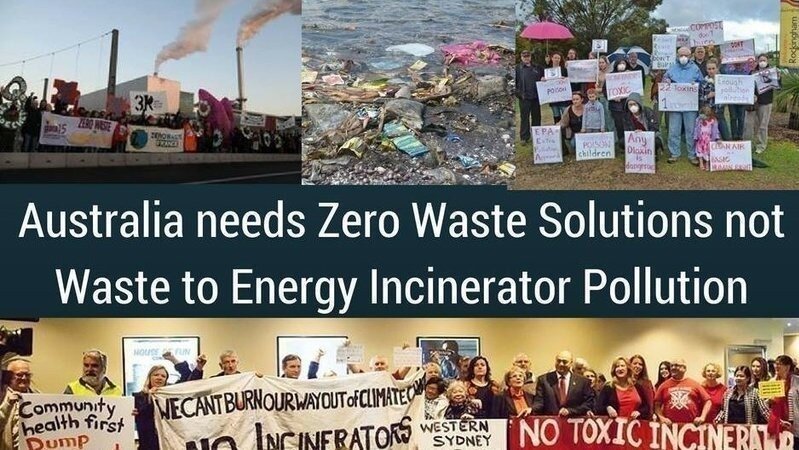
Our planet has been permanently harmed by plastic waste pollution. We can see the damage all around us. But burning plastic waste doesn't make this problem go away. It just transfers it into the atmosphere and global environment as toxic air pollutants and hazardous ash wastes, some of which bio-accumulate and bio-magnify through our environment and the food web, forever.
Australia is at a cross roads on waste management. The international recycling industry is in crisis and Australia can no longer dump its residual waste, contaminated recyclables and plastic waste in South East Asia.
Australia needs to step up, like Europe, and implement a sustainable zero waste and circular economy agenda. Australia needs to recognise (just like the EU) that waste to energy incineration can never produce clean, renewable energy and that it has undermined the recycling industry and stifled new, innovative, non combustion technologies that deliver better outcomes for residual waste management.
Therefore, we the undersigned call on the Australian government to implement an immediate moratorium on all new projects and introduce legislation to prohibit W2E incineration anywhere in Australia.
Please sign this petition today and share with your friends, family and communities.

1,351
The issue
Communities all over Australia are currently facing the threat of waste incineration projects. This industry is pushing heavily into Australia right now exactly because they are in decline in other parts of the world, namely Europe. Vulnerable regional communities in Australia are especially being targeted with fast tracked approvals processes, in specialised job and industrial activation precincts, risking these environments and the agricultural industries that produce much of Australia's food and drinking water.
However, there are up to 200 times more jobs in sustainable Zero Waste models compared to waste incineration. Waste incineration is the most expensive and polluting way to make energy or manage our waste. It simply makes no sense to build waste incinerators in Australia while there are safer, more effective options available.
Incinerators emit a range of serious pollutants including fine particulate matter (including microplastics and PFAS), acid gases, heavy metals, dioxins and furans, which are harmful to human health and contribute to climate change. Incineration facilities can release 2.5 times as much carbon dioxide (CO2) per unit of electricity generated as natural gas-fired power plants.
Recent studies in Europe have shown that even the EU Best Practice incinerators (like those being proposed for Australia) are leaving a significant legacy of toxic dioxin contamination in the surrounding environment. This has forced French health authorities recently to place a ban on consuming backyard eggs and produce in 410 municipalities, affecting millions of people.
Moreover, these projects undermine recycling and reuse efforts because they require a constant waste stream (particularly plastic - a fossil fuel) to feed the furnace. Australia's inferior waste management systems generate significant volumes of residual waste that could be better collected and separated to access much needed compostable, recyclable and reusable waste resources. Yet Australia's waste circularity rate 0f 4.4% remains well below the global rate of 7.2%.
Waste incineration is therefore at odds with Australia's Circular Economy, Net Zero and Biodiversity protection policies. In fact waste incineration is driving the triple planetary crisis - climate change, biodiversity loss and chemical pollution, exceeding planetary tipping points.
Burning waste for energy supports a linear model of materials production, consumption and disposal which is a major driver of climate change, resource depletion, toxification of the global environment and the violation of human rights and environmental injustices this brings.
Australia needs to move to a sustainable Zero Waste management system and Circular Economy where finite resources are not discarded but reused and recycled back into our materials production systems, closing the loop and creating many more jobs and local economies than the waste incineration sector .
Our planet has been permanently harmed by plastic waste pollution. We can see the damage all around us. But burning plastic waste doesn't make this problem go away. It just transfers it into the atmosphere and global environment as toxic air pollutants and hazardous ash wastes, some of which bio-accumulate and bio-magnify through our environment and the food web, forever.
Australia is at a cross roads on waste management. The international recycling industry is in crisis and Australia can no longer dump its residual waste, contaminated recyclables and plastic waste in South East Asia.
Australia needs to step up, like Europe, and implement a sustainable zero waste and circular economy agenda. Australia needs to recognise (just like the EU) that waste to energy incineration can never produce clean, renewable energy and that it has undermined the recycling industry and stifled new, innovative, non combustion technologies that deliver better outcomes for residual waste management.
Therefore, we the undersigned call on the Australian government to implement an immediate moratorium on all new projects and introduce legislation to prohibit W2E incineration anywhere in Australia.
Please sign this petition today and share with your friends, family and communities.
Supporter voices
Petition Updates
Share this petition
Petition created on 11 January 2024