
[Note: Any donations made through Change.org go directly to Change.org. If you wish to donate to the Irish Council Against Blood Sports to support our campaigns, you can do so at https://www.paypal.me/banbloodsports Thank you]
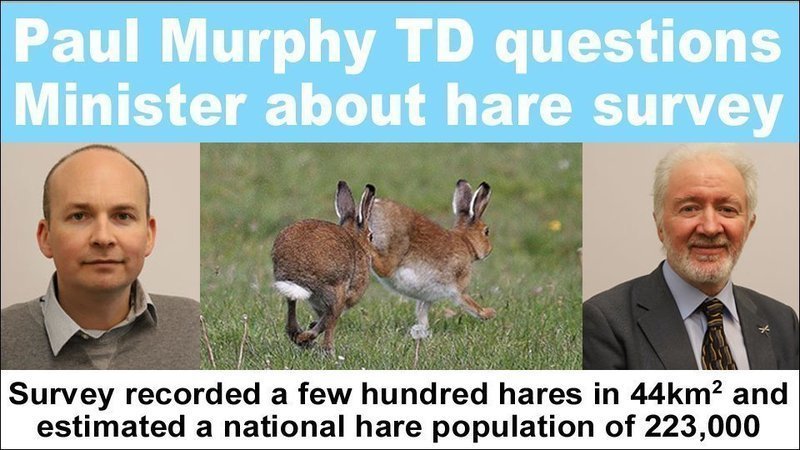
Paul Murphy TD has questioned the Heritage Minister about a survey which estimated the national Irish Hare population to be 223,000 but which admitted could be as low as 60,000.
In his Dail Question to Minister Darragh O’Brien, Deputy Murphy (Solidarity-People Before Profit) asked “if his attention has been drawn to the fact that those carrying out the survey only detected 229 hares in the pilot study (March to May 2018) and 253 hares during the full survey (November 2018 to February 2019) with the latter sightings made in just 44 x 1 kilometre squares around the country; and his views that these facts would raise questions around the conclusion that this suggests a highly widespread common distribution.”
Responding, Minister of State for Heritage Malcolm Noonan (Green Party) described the survey’s 44 kilometre squares of focus (out of a total country area of 70,000 square kilometres) within which the hares were spotted as “statistically representative of the country’s overall habitat composition”. He said that those carrying out the survey extrapolated the findings in the sample area to the whole country. From the sightings of a few hundred hares, they came up with a population figure of 223,000 hares (“with a 95% probability that the number is between 111,000 and 449,000”).
The report concedes that the population could be substantially lower, i.e. “the more conservative bootstrapped confidence limits suggested that the population could vary from 60,000 to 1.2 million individuals”.
The survey worryingly found that the latest 2018-19 average hare density estimate of 3.19 hares per km2 was 58% lower than the 7.44 hares per km2 density estimated during 2007. The most recent estimates ranged from 3.50 hares per km2 in the northwest down to just 2.66 hares per km2 in the east of the country.
Despite this, Minister Noonan maintained that the results of the survey “suggests that the population remains stable".
“Such was the width of the 95% confidence intervals that the current density estimate cannot be said to be significantly lower than the previous survey,” he said. “It should also be noted that hares are known to show significant, natural inter-annual fluctuations in population (as demonstrated by the 2006/2007 data).”
In 2018 (before the survey was carried out), one of the authors of the survey report - Dr Karina Dingerkus - spoke about the general decline of hares on RTE Radio 1's Mooney Goes Wild show. Programme presenter Derek Mooney told listeners that while hares are thriving at Dublin Airport, "their numbers elsewhere around the country are dwindling". Speaking on the show, ecologist Dr Dingerkus said that "over the last 50 years, numbers have declined significantly." "We know that hare populations do fluctuate naturally but we don't know by how much," Dr Dingerkus stated. "We certainly know that numbers have declined." Later in the programme, she added: "We don't see very many…Certainly over the past 50 years, we know numbers have dropped dramatically…they're in trouble…we do know that they have been dropping over a long period of time."
Meanwhile, the Department of Housing, Local Government & Heritage’s Wild Nephin National Park website states: "Hare populations can vary dramatically from year to year but it is believed that there has been a long-term decline overall". https://wildnephinnationalpark.ie/explore/wildlife/noteworthy-species/
The hare survey was completed just before the presence of the RHD2 disease was confirmed in Ireland but the survey report acknowledges the highly contagious virus as one of the threats "of highest importance" to the species, noting that "rabbit haemorrhagic disease virus 2 (RHDV2) has the potential to cause widespread mortality in Ireland but its impact on the Irish hare population remains unknown at this point” and that “whilst we currently judge future prospects for the species as favourable, we encourage vigilance with respect to the potential impacts of climate change, invasive species and disease."
The National Parks and Wildlife Service previously warned that licensed hare coursing was a risk factor in the spread of RHD2 (on nets and boxes).
Read the full Dail Q&A below and please respond to our urgent action alert.
URGENT ACTION ALERT
HELP THE HARES: Urgently contact Heritage Minister Darragh O’Brien and Minister of State Malcolm Noonan and tell them to refuse 2022-23 licences for cruel hare coursing.
Minister Darragh O’Brien (Fianna Fail, Dublin Fingal)
Tel: (01) 618 3802 OR (086) 251 9893
Email: minister@housing.gov.ie; darragh.obrien@oireachtas.ie
Facebook: http://www.facebook.com/DarraghOBrienTD
Twitter: http://twitter.com/DarraghOBrienTD
Malcolm Noonan TD (Carlow Kilkenny)
Minister of State for Heritage
Tel: (01) 618 3148 OR (01) 618 3156
Email: mos@housing.gov.ie; malcolm.noonan@oireachtas.ie
Facebook: https://www.facebook.com/votemalcolmnoonan1/
Twitter: https://twitter.com/noonan_malcolm
With a RED C opinion poll confirming that a 77 per cent majority of citizens want hare coursing banned (with just 9% disagreeing with a ban), it is now time for politicians to consign this nasty bloodsport to history. Join us in contacting all TDs and urging them to act to ensure that a ban is urgently introduced. Visit the Oireachtas website for contact details for TDs https://www.oireachtas.ie/en/members/tds/?term=/ie/oireachtas/house/dail/33
Urge Taoiseach Micheál Martin and Tanaiste Leo Varadkar to respect the wishes of the majority and ban hare coursing and all bloodsports.
Taoiseach Micheál Martin
Email: micheal.martin@oireachtas.ie; info@fiannafail.ie
Phone: +353 (0)1–618 4350 or +353 (0)21-432 0088
Facebook: https://www.facebook.com/michealmartintd/
Twitter: http://www.twitter.com/@MichealMartinTD
Tanaiste Leo Varadkar
Telephone: +353 (0)1-640 3133
Email: leo.varadkar@oireachtas.ie; finegael@finegael.ie
Tweet to: http://www.twitter.com/@LeoVaradkar
Facebook: https://www.facebook.com/LeoVaradkar
Contact Fianna Fail, Fine Gael, Green Party, Sinn Fein and Labour Party TDs and urge them to pledge support for Paul Murphy TD's upcoming Animal Health & Welfare (Ban on Hare Coursing) Bill 2020.
Fianna Fáil TDs
john.mcguinness@oireachtas.ie; niamh.smyth@oireachtas.ie; brendan.smith@oireachtas.ie; aindrias.moynihan@oireachtas.ie; michael.moynihan.td@oireachtas.ie; micheal.martin@oireachtas.ie; michael.mcgrath@oireachtas.ie; Charlie.McConalogue@oireachtas.ie; sean.haughey@oireachtas.ie; jim.ocallaghan@oireachtas.ie; darragh.obrien@oireachtas.ie; jack@jackchambers.ie; anne.rabbitte@oireachtas.ie; eamon.ocuiv@oireachtas.ie; james.lawless@oireachtas.ie; sean.ofearghail@oireachtas.ie; sean.fleming@oireachtas.ie; barry.cowen@oireachtas.ie; willie.odea@oireachtas.ie; niall.collins@oireachtas.ie; Robert.Troy@oireachtas.ie; dara.calleary@oireachtas.ie; thomas.byrne@oireachtas.ie; marc.macsharry@oireachtas.ie; jackie.cahill@oireachtas.ie; mary.butler@oireachtas.ie; james.browne@oireachtas.ie; jennifer.murnaneoconnor@oireachtas.ie; cathal.crowe@oireachtas.ie; james.oconnor@oireachtas.ie; padraig.osullivan@oireachtas.ie; christopher.osullivan@oireachtas.ie; paul.mcauliffe@oireachtas.ie; john.lahart@oireachtas.ie; cormac@cormacdevlin.ie; normafoley1@eircom.net; joe.flaherty@oireachtas.ie; Stephen.Donnelly@oireachtas.ie
Fine Gael TDs
JohnPaul.Phelan@oireachtas.ie; Heather.Humphreys@oireachtas.ie; joe.carey@oireachtas.ie; david.stanton@oir.ie; colm.burke@oireachtas.ie; michael.creed@oireachtas.ie; Simon.Coveney@oireachtas.ie; joe.mchugh@oireachtas.ie; richard.bruton@oireachtas.ie; Paschal.Donohoe@oireachtas.ie; Alan.Farrell@oireachtas.ie; emer.higgins@oireachtas.ie; neale.richmond@oireachtas.ie; josepha.madigan@oireachtas.ie; colm.brophy@oireachtas.ie; leo.varadkar@oireachtas.ie; jennifer.carrollmacneill@oireachtas.ie; Ciaran.Cannon@oireachtas.ie; hildegarde.naughton@oireachtas.ie; Brendan.Griffin@oireachtas.ie; bernard.durkan@oireachtas.ie; Martin.Heydon@oireachtas.ie; charles.flanagan@oireachtas.ie; kieran.odonnell@oireachtas.ie; Patrick.O’Donovan@oireachtas.ie; peter.burke@oireachtas.ie; fergus.odowd@oireachtas.ie; alan.dillon@oireachtas.ie; michael.ring@oireachtas.ie; helen.mcentee@oireachtas.ie; damien.english@oireachtas.ie; frank.feighan@oireachtas.ie; paul.kehoe@oireachtas.ie; Simon.Harris@oireachtas.ie
Green Party TDs
Eamon.Ryan@greenparty.ie; catherine.martin@oireachtas.ie; patrick.costello@oireachtas.ie; francisnoel.duffy@oireachtas.ie; neasa.hourigan@oireachtas.ie; brian.leddin@oireachtas.ie; steven.matthews@oireachtas.ie; malcolm.noonan@oireachtas.ie; joe.obrien@oireachtas.ie; marc.ocathasaigh@oireachtas.ie; roderic.ogorman@oireachtas.ie;
ossian.smyth@oireachtas.ie
Sinn Fein TDs
john.brady@oireachtas.ie; pat.buckley@oireachtas.ie; Sean.Crowe@oireachtas.ie; david.cullinane@oireachtas.ie; Pearse.Doherty@oireachtas.ie; dessie.ellis@oir.ie; kathleen.funchion@oireachtas.ie; martinkennysf@gmail.com; MaryLou.McDonald@oireachtas.ie; denise.mitchell@oireachtas.ie; imelda.munster@oireachtas.ie; eoin.obroin@oireachtas.ie; donnchadh.olaoghaire@oireachtas.ie; aengus.osnodaigh@oireachtas.ie; louiseoreillysf@gmail.com; maurice.quinlivan@oireachtas.ie; Brian.Stanley@oireachtas.ie; mark.ward@oireachtas.ie; chris.andrews@oireachtas.ie; martin.browne@oireachtas.ie; matt.carthy@oireachtas.ie; sorca.clarke@oireachtas.ie; roseconwaywalsh@eircom.net; reada.cronin@oireachtas.ie; pa.daly@oireachtas.ie; paul.donnelly@oireachtas.ie; mairead.farrell@oireachtas.ie; thomas.gould@oireachtas.ie; johnny.guirke@oireachtas.ie; claire.kerrane@oireachtas.ie; padraig.maclochlainn@oir.ie; johnny.mythen@oireachtas.ie; ruairi.omurchu@oireachtas.ie; darren.orourke@oireachtas.ie; patriciaryan975@gmail.com; pauline.tully@oireachtas.ie
Labour Party TDs
ivana.bacik@oireachtas.ie; sean.sherlock@oireachtas.ie; aodhan.oriordain@oireachtas.ie; duncan.smith@oireachtas.ie; gerald.nash@oireachtas.ie; Alan.Kelly@oireachtas.ie; brendan.howlin@oireachtas.ie
Please sign and share the petitions
Sinn Fein: Support a ban on cruel hare coursing
https://www.change.org/p/sinn-fein-support-a-ban-on-cruel-hare-coursing
Ireland – Ban cruel hare coursing
http://www.change.org/p/ireland-ban-cruel-hare-coursing
Please support our campaign with a donation
https://www.paypal.me/banbloodsports
Find us on Twitter and Instagram
https://twitter.com/banbloodsports
https://www.instagram.com/banbloodsports/
Witness the cruelty of hare coursing in Ireland
https://www.youtube.com/watch?v=5Dm0mmXYcv8
https://www.youtube.com/watch?v=yVIKc2CS4ko
DAIL QUESTION AND ANSWER
28 June 2022
Paul Murphy TD: To ask the Minister for Housing; Local Government and Heritage further to Parliamentary Question No. 222 of 2 June 2022 (details supplied), if his attention has been drawn to the fact that compared to the 1,421 public sightings, those carrying out the survey only detected 229 hares in the pilot study March to May 2018 and 253 hares during the full survey November 2018 to February 2019 with the latter sightings made in just 44 x 1 kilometre squares around the country; and his views that these facts would raise questions around the conclusion that this suggests a highly widespread common distribution.
Minister of State for Heritage Malcolm Noonan: A national hare survey, commissioned by the National Parks & Wildlife Service (NPWS) of my Department, took place in 2018 and 2019. The project was carried out, under tender, by an experienced team of wildlife biologists and hare researchers from Queens University, Belfast. The aim of this project was to estimate the current mean population density and the national total population of the Irish Hare and to examine variation in its population across space and time (principally since the previous Hare Survey of Ireland in 2006/07).
The full report of the survey is published in an Irish Wildlife Manual on the NPWS website here: https://www.npws.ie/sites/default/files/publications/pdf/IWM113.pdf
The survey involved deploying static wildlife cameras in 44 x 1km survey squares. These squares were selected throughout Ireland to be statistically representative of the country’s overall habitat composition. Multiple cameras were deployed within each of the 44 survey squares. Hares were detected in 85% of survey squares. As these 44 squares were statistically representative of the national landscape as a whole this allowed the researchers to extrapolate their findings to the whole country.
There are approximately 70,000 x 1km squares in Ireland and 85% occupancy of these indicates that the hare has a very widespread distribution. The researchers’ extrapolations were further underpinned by habitat modelling which suggested that virtually every 10 km square in Ireland contains suitable habitat for the species and should be included within its Favourable Reference Range.
The inclusion of citizen science records in the survey was designed to further inform the distribution model for the species. The 1,421 Irish Hare records that were submitted by the public through the National Biodiversity Data Centre supported the results of the camera trap surveys, i.e. that the Irish hare is very widespread in Ireland. These records were not used, however, in the population model which was solely based on the standardised sampling of the camera trap survey.
Using the camera trap data, methods were developed to estimate the distance of each hare detected on camera, enabling the use of distance sampling analysis. Distance sampling is a statistical package developed specifically to estimate the densities of wild animals.
Mean Irish Hare density during winter 2018/19 was estimated at 3.19 hares per km2 (95% confidence intervals: 1.59–6.43) with highest and very comparable densities in the northwest (3.50 hares/km2) and southwest (3.46 hares/km2) regions and lowest density in the east (2.66 hares/km2).
The average estimate was 4.5% lower than the 3.33 hares/km2 estimated during 2006 and 58% lower than the 7.44 hares/km2 estimated during 2007. Nevertheless, such was the width of the 95% confidence intervals that the current density estimate cannot be said to be significantly lower than the previous survey. It should also be noted that hares are known to show significant, natural inter-annual fluctuations in population (as demonstrated by the 2006/2007 data).
The mean density estimate from this latest national survey was comparable to the 20 year mean density from all surveys since 2000 of approximately 3 hares/km2. This suggests that the population remains stable. The national Irish Hare population was estimated at 223,000 individual hares during 2018/19 (with a 95% probability that the number is between 111,000 and 449,000). The other figures provided in Table 7 of the report and referenced in the question (the Bootstrapped Confidence Intervals) are indicative of the extreme limits of statistical possibility and both the lower limit (60,095) and the upper limit (1,197,709) are considered to be highly unlikely.