
Keep Mark Donohue at ANU
The issue
The School of Culture, History and Languages (CHL) which is situated in the College of Asia-Pacific (CAP) at the Australian National University (ANU) is currently at the end of a drawn-out budget review process in which up to 15 staff will be 'transitioned' - a term which promises options but in practice means voluntary separation or redundancy. This review threatens the reputation and prestige of not only CHL but the ANU as a whole. One of those who has been told that the university no longer requires their services is Dr Mark Donohue.
Dr Mark Donohue is a highly respected linguist working at ANU within CHL. As part of this review, Mark has been told that there is no place for him in the new school which will replace CHL. Mark has a long history as both a student and researcher at the ANU, with additional experience at Monash University, Sydney University and the National University of Singapore, yet the university has chosen to disregard his not insignificant contributions to its research output and reputation. In doing so, the university is also completely disregarding the wishes of his students and is damaging their future research opportunities.
Mark has over 125 published works, including books, conference proceedings and articles in journals such as Language, Science, PNAS, Linguistic Typology, Diachronica, Antiquity, American Journal of Human Genetics, Studies in Language, Oceanic Linguistics, Lingua and Morphology. This year alone, he has published multiple articles and a book detailing the lexicon of Tsum, a previously undescribed language of Nepal. He is frequently presenting at conferences and has been an invited speaker to over 20 different conferences and summer schools, including the Linguistic Society of America Linguistics Institute next year. His published works encompass subject areas such as phonology, morphology and syntax as well as historical linguistics, linguistic typology and computational linguistics. He has worked on languages from Indonesia to Bhutan, such as Tukang Besi, Skou, Warembori (Indonesia), Bumthang (Bhutan) and the highly endangered language isolate Kusunda (Nepal). He has been successful in applying for multiple grants to further study these languages from institutions such as the National Science Foundation (USA), Firebird Foundation and the Research School of Asia and the Pacific. He has also received the Australian Research Council’s Future Fellow award.
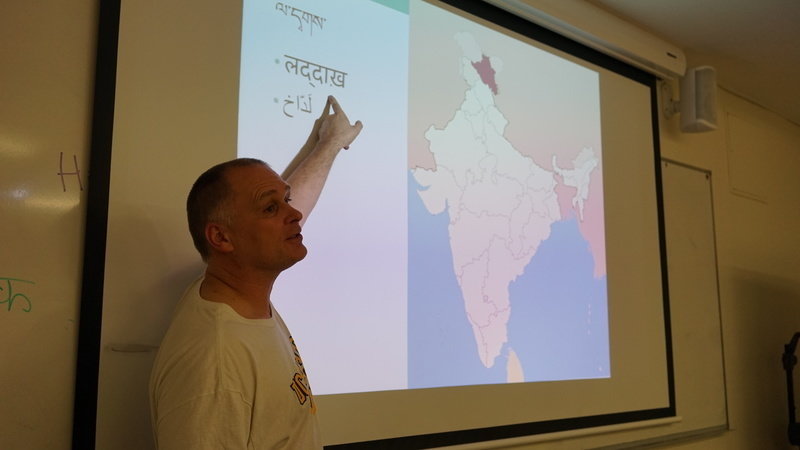
In particular, Mark’s contribution to the nascent study of Himalayan languages at the ANU cannot be ignored. He is the only researcher at the ANU working in this area, including delivering courses upon the topic to both undergraduates and postgraduates. As a result of his efforts, he has already inspired a PhD student to work in Nepal and also has five prospective Honours students wanting to work in Himalayan languages, not to mention students to want to work with him for his expertise in phonology. To put this in perspective, this totals more students than presently studying Honours in Linguistics at the ANU.
Mark currently lectures in Phonology, Introductory Indonesian, Languages of the Himalayan Area, forensic linguistics as well as conducting reading courses and a voluntary weekly phonetics group. He has also previously run courses in Phonetics and Field Methods. Notably, Mark has run Phonology for the first time after a long hiatus and the Languages of the Himalayan Course was a new readings course that he ran due to student interest. It is through these actions he has gained the respect of his students. His talent for student engagement is worthy of special mention as the links that he encourages between students are ones which will support them throughout their academic careers. His capacity to engage not only in the course material but with the bigger issues of language has challenged students to explore their full academic potential, whilst in many cases enduring a heavy workload.
It is for these reasons that we ask that Dr Mark Donohue continues at this university. His passion for his work and his unflagging enthusiasm to educate the future linguists of the ANU should not disregarded. Mark deserves his place at our university, and it is our hope that if he cannot continue in his current role in CHL that the university is able to find him a place for him in an area where he can continue to instruct and inspire future generations of students and their work.
Signed,
Concerned Students and Colleagues of Mark Donohue

Petition Closed
The issue
The School of Culture, History and Languages (CHL) which is situated in the College of Asia-Pacific (CAP) at the Australian National University (ANU) is currently at the end of a drawn-out budget review process in which up to 15 staff will be 'transitioned' - a term which promises options but in practice means voluntary separation or redundancy. This review threatens the reputation and prestige of not only CHL but the ANU as a whole. One of those who has been told that the university no longer requires their services is Dr Mark Donohue.
Dr Mark Donohue is a highly respected linguist working at ANU within CHL. As part of this review, Mark has been told that there is no place for him in the new school which will replace CHL. Mark has a long history as both a student and researcher at the ANU, with additional experience at Monash University, Sydney University and the National University of Singapore, yet the university has chosen to disregard his not insignificant contributions to its research output and reputation. In doing so, the university is also completely disregarding the wishes of his students and is damaging their future research opportunities.
Mark has over 125 published works, including books, conference proceedings and articles in journals such as Language, Science, PNAS, Linguistic Typology, Diachronica, Antiquity, American Journal of Human Genetics, Studies in Language, Oceanic Linguistics, Lingua and Morphology. This year alone, he has published multiple articles and a book detailing the lexicon of Tsum, a previously undescribed language of Nepal. He is frequently presenting at conferences and has been an invited speaker to over 20 different conferences and summer schools, including the Linguistic Society of America Linguistics Institute next year. His published works encompass subject areas such as phonology, morphology and syntax as well as historical linguistics, linguistic typology and computational linguistics. He has worked on languages from Indonesia to Bhutan, such as Tukang Besi, Skou, Warembori (Indonesia), Bumthang (Bhutan) and the highly endangered language isolate Kusunda (Nepal). He has been successful in applying for multiple grants to further study these languages from institutions such as the National Science Foundation (USA), Firebird Foundation and the Research School of Asia and the Pacific. He has also received the Australian Research Council’s Future Fellow award.
In particular, Mark’s contribution to the nascent study of Himalayan languages at the ANU cannot be ignored. He is the only researcher at the ANU working in this area, including delivering courses upon the topic to both undergraduates and postgraduates. As a result of his efforts, he has already inspired a PhD student to work in Nepal and also has five prospective Honours students wanting to work in Himalayan languages, not to mention students to want to work with him for his expertise in phonology. To put this in perspective, this totals more students than presently studying Honours in Linguistics at the ANU.
Mark currently lectures in Phonology, Introductory Indonesian, Languages of the Himalayan Area, forensic linguistics as well as conducting reading courses and a voluntary weekly phonetics group. He has also previously run courses in Phonetics and Field Methods. Notably, Mark has run Phonology for the first time after a long hiatus and the Languages of the Himalayan Course was a new readings course that he ran due to student interest. It is through these actions he has gained the respect of his students. His talent for student engagement is worthy of special mention as the links that he encourages between students are ones which will support them throughout their academic careers. His capacity to engage not only in the course material but with the bigger issues of language has challenged students to explore their full academic potential, whilst in many cases enduring a heavy workload.
It is for these reasons that we ask that Dr Mark Donohue continues at this university. His passion for his work and his unflagging enthusiasm to educate the future linguists of the ANU should not disregarded. Mark deserves his place at our university, and it is our hope that if he cannot continue in his current role in CHL that the university is able to find him a place for him in an area where he can continue to instruct and inspire future generations of students and their work.
Signed,
Concerned Students and Colleagues of Mark Donohue
The Decision Makers

Petition Updates
Share this petition
Petition created on 22 May 2016