

Australia: Recognition of Prince Reza Pahlavi as Leader of Iran’s Democratic Transition
The issue
Call for Australia to Recognise Prince Reza Pahlavi as a Transitional Leader for Iran
To: The Prime Minister of Australia, the Hon Anthony Albanese MP
CC:
The Hon Angus Taylor
Leader of Opposition
We, the undersigned, Iranian-Australians, Australians, permanent residents, and supporters of democratic values, human rights, and global stability, respectfully call on the Australian Government to engage directly with Crown Prince Reza Pahlavi to support a democratic transition in Iran.
For more than four decades, the Islamic Republic has governed through coercion and fear, establishing a system of control that permeates all aspects of public and private life. The regime has institutionalised gender apartheid that targets women and girls while enforcing coercive control over men; and eliminated freedom of expression and the press through censorship, arbitrary detention, and the imprisonment of journalists, academics, and artists. Beyond formal political repression, the state intrudes into everyday life through ideological regulation of cultural, social, and personal conduct.
These abuses are compounded by entrenched corruption, whereby regime-linked and IRGC-affiliated networks divert Iran’s vast natural resources and national wealth into private hands through opaque financial structures, transferring billions of dollars abroad while families of senior officials live securely in democratic countries. This systematic extraction and capital flight has depleted national resources and imposed severe hardship on ordinary Iranians, reflecting governance based on repression and corruption rather than consent or public welfare.
Previous protest movements have been met with mass arrests, maiming and mass killings, demonstrating that the Islamic Republic responds to demands for change with lethal force and reinforcing the conclusion held inside Iran that the regime itself must be dismantled.
Beyond Iran’s borders, the regime has actively sponsored and armed terrorist organisations including Hamas, Hezbollah, and the Houthis, exporting violence and instability across the region. Together, these actions have stripped the Islamic Republic of all legitimacy in the eyes of its own people.
Australia has already demonstrated leadership by designating the Islamic Revolutionary Guard Corps (IRGC) as a terrorist organisation. We welcome this recognition and note that similar conclusions are now being reached across Europe, reflecting a growing international consensus that the IRGC is inseparable from both domestic repression and external terrorism, and that the removal of the Islamic Republic is necessary to end both.
The reality is unmistakable. People inside Iran are not seeking reform or negotiation. They are demanding the complete dismantling of the Islamic Republic, including the IRGC, the Basij, and all institutions of repression, and the permanent end of the regime and its coercive machinery
A Transitional Figure at a Critical Juncture
In this context, Prince Reza Pahlavi has emerged as a widely recognised and unifying figure around whom a democratic transition can be coordinated. He has consistently stated that he does not seek permanent authority or power. Instead, he has positioned himself as a temporary facilitator whose sole purpose is to help guide Iran toward a democratic process in which the people themselves determine the country’s future.
These risks were starkly demonstrated on 8 and 9 January 2026, when unprecedented numbers of people across Iran responded to the call issued by Prince Reza Pahlavi for unified action, openly chanting his name and rejecting the Islamic Republic nationwide. The regime’s response was immediate and violent: the IRGC and affiliated forces deployed military-grade weapons against unarmed civilians in what constitutes one of the largest massacres in modern Iranian history.
Credible reporting indicates a civilian death toll of unprecedented scale. Multiple outlets reported more than 30,000 protest-related deaths for those two days alone, with estimates higher when accounting for widespread under-registration caused by intimidation, suppression of reporting, and deliberate concealment.
That Iranians nevertheless mobilised in such numbers, despite the certainty of violent reprisal, makes these acts of public support highly significant. In these circumstances, even limited visible expressions of support constitute a powerful and credible indicator of genuine and widespread public sentiment inside Iran.
In this context, people inside Iran have repeatedly and explicitly called for Prince Reza Pahlavi to serve as a unifying figure around whom a democratic transition can be coordinated. This support is not symbolic or speculative; it is expressed under conditions of extreme personal risk and therefore carries particular evidentiary weight.
Prince Reza Pahlavi has consistently stated that he does not seek permanent authority or power. He has made clear that any role he would accept would be strictly transitional, for the sole purpose of facilitating an orderly process leading to free and fair elections in which the Iranian people determine their country’s future.
He has articulated a clear transition framework grounded in universally recognised democratic principles, including national unity, preservation of Iran’s territorial integrity, separation of religion and state, equal rights and individual freedoms, and elections conducted under credible international observation. Importantly, this vision addresses not only the end of authoritarian rule, but the period that follows, preventing fragmentation or chaos, rebuilding national institutions and economic confidence, and restoring constructive engagement with the international community through a transparent and accountable transition process.
Support Inside Iran and Across the Diaspora
Support for Prince Reza Pahlavi comes from a broad cross-section of Iranian society, including civil society activists, human rights defenders, professionals in various fields, labour groups, ethnic minorities, women, men, youth, the LGBTQ+ community, religious minorities; and victims of state repression. Crucially, this support is expressed not only across the diaspora but from within Iran itself, where public political expression carries extreme personal risk.
In Australia, tens of thousands of people have gathered peacefully across major cities, uniting Iranians and non-Iranians alike in support of the Iranian people’s clear demand for the dismantling of the Islamic Republic and for Prince Reza Pahlavi to assume a transitional leadership role to facilitate an orderly democratic transition.
What Recognition Would and Would Not Mean
Recognising Prince Reza Pahlavi as a transitional leader does not endorse any predetermined political system, nor does it imply the restoration of monarchy. Rather, it acknowledges a practical reality that successful democratic transitions require identifiable leadership to coordinate planning, dialogue, and international engagement during a limited interim period.
Such recognition would support a people-driven transition while fully preserving the Iranian people’s right to choose their final system of governance through democratic means.
Our Request
We respectfully call on the Australian Government to:
- Acknowledge the calls from within Iran and among Iranian-Australians for Prince Reza Pahlavi to play a coordinating role in a democratic transition.
- Recognise Prince Reza Pahlavi as a transitional leader for the defined purpose of facilitating a peaceful and orderly move toward democratic self-determination.
- Engage with Prince Reza Pahlavi in Australia’s diplomatic and policy considerations relating to Iran’s future.
- Continue to support a transition process, coordinated by Prince Reza Pahlavi in his capacity as a transitional leader, that culminates in free and fair elections and a government chosen by the Iranian people.
We submit this request in recognition of Australia’s constructive role to date and in the hope of continued engagement that supports a peaceful, democratic transition outcome for the people of Iran.
Respectfully,
The Undersigned
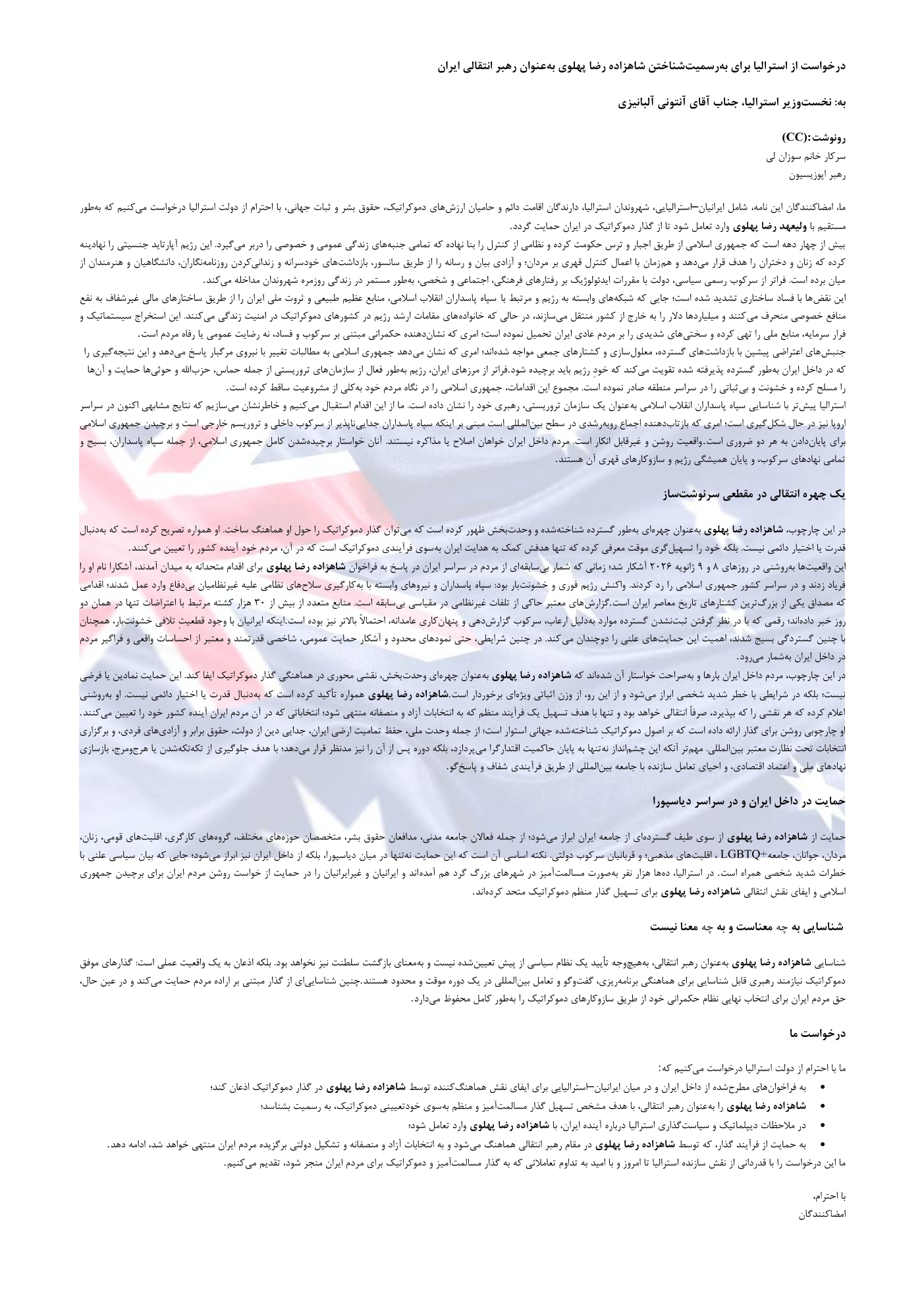
Farsi Translation
Note: This petition will remain open until 9 March 2026, after which it will be presented to the Prime Minister's Office. A copy will also be presented to the leader of Opposition seeking bipartisan support.

43,421
The issue
Call for Australia to Recognise Prince Reza Pahlavi as a Transitional Leader for Iran
To: The Prime Minister of Australia, the Hon Anthony Albanese MP
CC:
The Hon Angus Taylor
Leader of Opposition
We, the undersigned, Iranian-Australians, Australians, permanent residents, and supporters of democratic values, human rights, and global stability, respectfully call on the Australian Government to engage directly with Crown Prince Reza Pahlavi to support a democratic transition in Iran.
For more than four decades, the Islamic Republic has governed through coercion and fear, establishing a system of control that permeates all aspects of public and private life. The regime has institutionalised gender apartheid that targets women and girls while enforcing coercive control over men; and eliminated freedom of expression and the press through censorship, arbitrary detention, and the imprisonment of journalists, academics, and artists. Beyond formal political repression, the state intrudes into everyday life through ideological regulation of cultural, social, and personal conduct.
These abuses are compounded by entrenched corruption, whereby regime-linked and IRGC-affiliated networks divert Iran’s vast natural resources and national wealth into private hands through opaque financial structures, transferring billions of dollars abroad while families of senior officials live securely in democratic countries. This systematic extraction and capital flight has depleted national resources and imposed severe hardship on ordinary Iranians, reflecting governance based on repression and corruption rather than consent or public welfare.
Previous protest movements have been met with mass arrests, maiming and mass killings, demonstrating that the Islamic Republic responds to demands for change with lethal force and reinforcing the conclusion held inside Iran that the regime itself must be dismantled.
Beyond Iran’s borders, the regime has actively sponsored and armed terrorist organisations including Hamas, Hezbollah, and the Houthis, exporting violence and instability across the region. Together, these actions have stripped the Islamic Republic of all legitimacy in the eyes of its own people.
Australia has already demonstrated leadership by designating the Islamic Revolutionary Guard Corps (IRGC) as a terrorist organisation. We welcome this recognition and note that similar conclusions are now being reached across Europe, reflecting a growing international consensus that the IRGC is inseparable from both domestic repression and external terrorism, and that the removal of the Islamic Republic is necessary to end both.
The reality is unmistakable. People inside Iran are not seeking reform or negotiation. They are demanding the complete dismantling of the Islamic Republic, including the IRGC, the Basij, and all institutions of repression, and the permanent end of the regime and its coercive machinery
A Transitional Figure at a Critical Juncture
In this context, Prince Reza Pahlavi has emerged as a widely recognised and unifying figure around whom a democratic transition can be coordinated. He has consistently stated that he does not seek permanent authority or power. Instead, he has positioned himself as a temporary facilitator whose sole purpose is to help guide Iran toward a democratic process in which the people themselves determine the country’s future.
These risks were starkly demonstrated on 8 and 9 January 2026, when unprecedented numbers of people across Iran responded to the call issued by Prince Reza Pahlavi for unified action, openly chanting his name and rejecting the Islamic Republic nationwide. The regime’s response was immediate and violent: the IRGC and affiliated forces deployed military-grade weapons against unarmed civilians in what constitutes one of the largest massacres in modern Iranian history.
Credible reporting indicates a civilian death toll of unprecedented scale. Multiple outlets reported more than 30,000 protest-related deaths for those two days alone, with estimates higher when accounting for widespread under-registration caused by intimidation, suppression of reporting, and deliberate concealment.
That Iranians nevertheless mobilised in such numbers, despite the certainty of violent reprisal, makes these acts of public support highly significant. In these circumstances, even limited visible expressions of support constitute a powerful and credible indicator of genuine and widespread public sentiment inside Iran.
In this context, people inside Iran have repeatedly and explicitly called for Prince Reza Pahlavi to serve as a unifying figure around whom a democratic transition can be coordinated. This support is not symbolic or speculative; it is expressed under conditions of extreme personal risk and therefore carries particular evidentiary weight.
Prince Reza Pahlavi has consistently stated that he does not seek permanent authority or power. He has made clear that any role he would accept would be strictly transitional, for the sole purpose of facilitating an orderly process leading to free and fair elections in which the Iranian people determine their country’s future.
He has articulated a clear transition framework grounded in universally recognised democratic principles, including national unity, preservation of Iran’s territorial integrity, separation of religion and state, equal rights and individual freedoms, and elections conducted under credible international observation. Importantly, this vision addresses not only the end of authoritarian rule, but the period that follows, preventing fragmentation or chaos, rebuilding national institutions and economic confidence, and restoring constructive engagement with the international community through a transparent and accountable transition process.
Support Inside Iran and Across the Diaspora
Support for Prince Reza Pahlavi comes from a broad cross-section of Iranian society, including civil society activists, human rights defenders, professionals in various fields, labour groups, ethnic minorities, women, men, youth, the LGBTQ+ community, religious minorities; and victims of state repression. Crucially, this support is expressed not only across the diaspora but from within Iran itself, where public political expression carries extreme personal risk.
In Australia, tens of thousands of people have gathered peacefully across major cities, uniting Iranians and non-Iranians alike in support of the Iranian people’s clear demand for the dismantling of the Islamic Republic and for Prince Reza Pahlavi to assume a transitional leadership role to facilitate an orderly democratic transition.
What Recognition Would and Would Not Mean
Recognising Prince Reza Pahlavi as a transitional leader does not endorse any predetermined political system, nor does it imply the restoration of monarchy. Rather, it acknowledges a practical reality that successful democratic transitions require identifiable leadership to coordinate planning, dialogue, and international engagement during a limited interim period.
Such recognition would support a people-driven transition while fully preserving the Iranian people’s right to choose their final system of governance through democratic means.
Our Request
We respectfully call on the Australian Government to:
- Acknowledge the calls from within Iran and among Iranian-Australians for Prince Reza Pahlavi to play a coordinating role in a democratic transition.
- Recognise Prince Reza Pahlavi as a transitional leader for the defined purpose of facilitating a peaceful and orderly move toward democratic self-determination.
- Engage with Prince Reza Pahlavi in Australia’s diplomatic and policy considerations relating to Iran’s future.
- Continue to support a transition process, coordinated by Prince Reza Pahlavi in his capacity as a transitional leader, that culminates in free and fair elections and a government chosen by the Iranian people.
We submit this request in recognition of Australia’s constructive role to date and in the hope of continued engagement that supports a peaceful, democratic transition outcome for the people of Iran.
Respectfully,
The Undersigned
Farsi Translation
Note: This petition will remain open until 9 March 2026, after which it will be presented to the Prime Minister's Office. A copy will also be presented to the leader of Opposition seeking bipartisan support.
The Decision Makers


Supporter voices
Petition Updates
Share this petition
Petition created on 6 February 2026