

Ask Bank of Canada to stop raising interest rates further
The Issue
Canada’s Central Bank has already raised interest rates TEN times. Many Canadians are suffering from financial pressure, unable to qualify for much-needed loans or pay off crippling debts. Now, inflation has nearly returned to the normal range, and considering the time lag effect of rate hikes, it is time for the Central Bank to stop raising interest rates further.
1. It is evident in the graph below that inflation and gas (scaled down by a factor of 20 to match percentage numbers) curves have much similar peaks and valleys that match each other more than they are affected by interest rates.
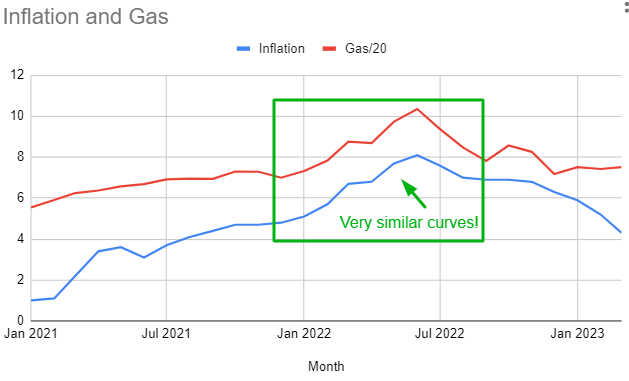
Factories need gas to produce goods and trucks need gas to transport these goods. People usually don’t need a loan from a bank to buy goods from a store. Thus, higher interest rates barely lower the price of the average goods, while lower gas prices do so much more effectively.
Following ten interest rate increases, the inflationary response to further rate hikes will become less sensitive. The apparent economic growth rate primarily stems from the post-COVID recovery consumption and the basic demands of new immigrants. To achieve a 2% inflation rate more effectively, it would be more prudent to focus on other factors, such as gas prices, supply chains, and immigration policies.
2. Previous interest rate hikes have already lowered inflation to near normal range, thus further hikes are unnecessary
Our current combination of interest rate hikes and other factors should have pushed inflation down to 2% already, if not lower. Since inflation takes a delayed time to respond to interest rates, further hikes would risk pushing us into deflation.
Evidence can be gathered from a similar situation in the early 1990s. As shown in the graphs below, inflation peaked at nearly 8% around 1991, very soon after interest rates peaked earlier in 1990.
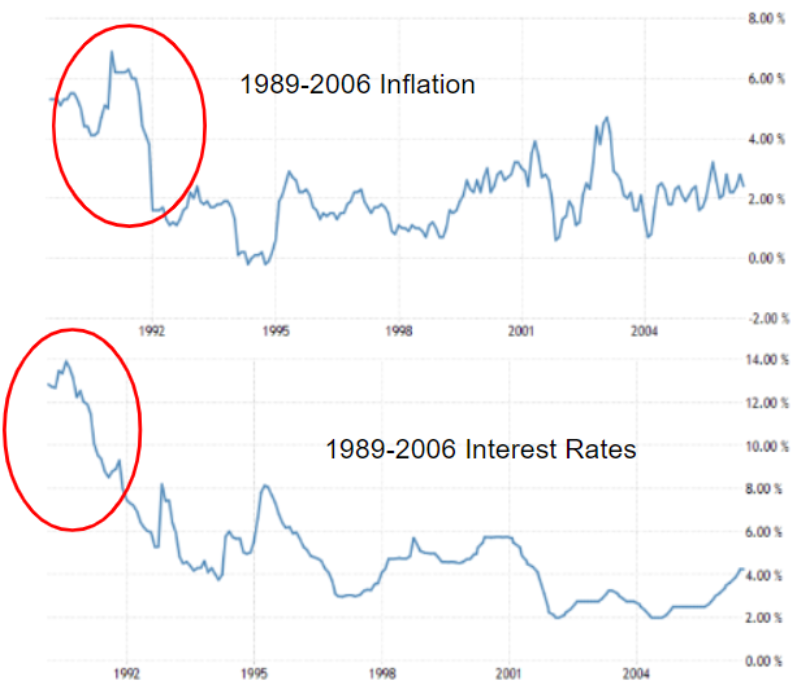
By analyzing the time difference between the two peaks, we can find the amount of time delay it takes for inflation to react to interest rates.
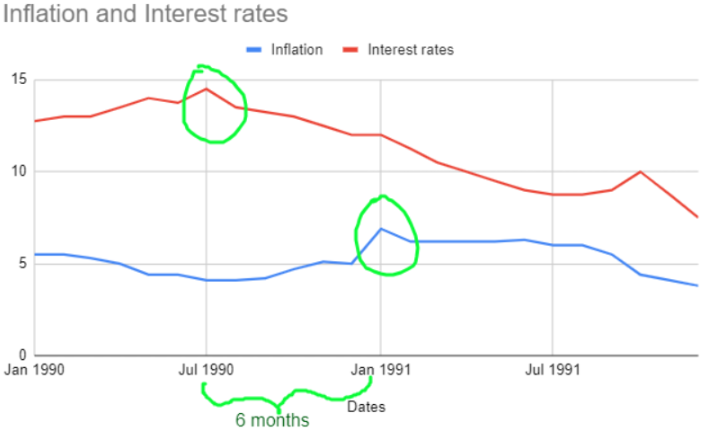
In this case, interest rates peaked in July 1990, while inflation peaked in January 1991 - which is SIX MONTHS LATER.
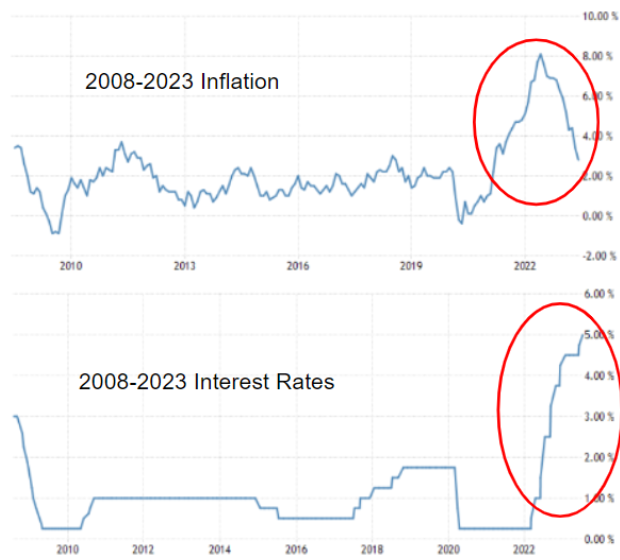
Applying a similar analysis to our current situation in 2023, we see that inflation has already peaked and is now steadily falling due to interest rate hikes from the months prior. This means previous hikes have already completed their job, thus there is no need for the Central Bank to raise interest rates again in September.
Fellow Canadians, please join us in signing this petition if you wish to halt further interest rate hikes and safeguard Canadians from financial hardships. Together, let's strive for a stable economy and a better quality of life for all.

1,061
The Issue
Canada’s Central Bank has already raised interest rates TEN times. Many Canadians are suffering from financial pressure, unable to qualify for much-needed loans or pay off crippling debts. Now, inflation has nearly returned to the normal range, and considering the time lag effect of rate hikes, it is time for the Central Bank to stop raising interest rates further.
1. It is evident in the graph below that inflation and gas (scaled down by a factor of 20 to match percentage numbers) curves have much similar peaks and valleys that match each other more than they are affected by interest rates.
Factories need gas to produce goods and trucks need gas to transport these goods. People usually don’t need a loan from a bank to buy goods from a store. Thus, higher interest rates barely lower the price of the average goods, while lower gas prices do so much more effectively.
Following ten interest rate increases, the inflationary response to further rate hikes will become less sensitive. The apparent economic growth rate primarily stems from the post-COVID recovery consumption and the basic demands of new immigrants. To achieve a 2% inflation rate more effectively, it would be more prudent to focus on other factors, such as gas prices, supply chains, and immigration policies.
2. Previous interest rate hikes have already lowered inflation to near normal range, thus further hikes are unnecessary
Our current combination of interest rate hikes and other factors should have pushed inflation down to 2% already, if not lower. Since inflation takes a delayed time to respond to interest rates, further hikes would risk pushing us into deflation.
Evidence can be gathered from a similar situation in the early 1990s. As shown in the graphs below, inflation peaked at nearly 8% around 1991, very soon after interest rates peaked earlier in 1990.
By analyzing the time difference between the two peaks, we can find the amount of time delay it takes for inflation to react to interest rates.
In this case, interest rates peaked in July 1990, while inflation peaked in January 1991 - which is SIX MONTHS LATER.
Applying a similar analysis to our current situation in 2023, we see that inflation has already peaked and is now steadily falling due to interest rate hikes from the months prior. This means previous hikes have already completed their job, thus there is no need for the Central Bank to raise interest rates again in September.
Fellow Canadians, please join us in signing this petition if you wish to halt further interest rate hikes and safeguard Canadians from financial hardships. Together, let's strive for a stable economy and a better quality of life for all.
The Decision Makers
Petition Updates
Share this petition
Petition created on July 23, 2023