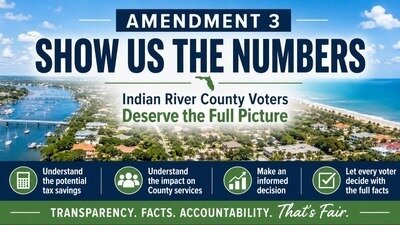

Amendment 3: Show Us the Numbers
The Issue
To the Indian River County Board of County Commissioners and County Administration:
Florida voters will be asked to vote on Amendment 3 in November 2026, a proposed constitutional amendment that would significantly increase the homestead exemption for most non-school property taxes.
For homeowners, the proposal could mean meaningful property-tax savings.
But those savings also mean less revenue available to local government — and Indian River County's own FY 2026/2027 Budget Workshop Book now quantifies that impact.
According to the County, Amendment 3 would increase the homestead exemption from the current $50,000 to $150,000 in FY 2027/2028 and $250,000 in FY 2028/2029 for most non-school property taxes. It would also reduce the annual assessment-growth cap on non-homestead properties from 10% to 5%.
Indian River County estimates the resulting loss in ad valorem revenue at approximately:
$22 MILLION in FY 2027/2028 and $41 MILLION in FY 2028/2029
The County further states that these changes would affect funding for services including public safety, infrastructure, recreational programs and facilities, citizen and children's services, libraries, veterans’ services and other local programs.
Those are significant numbers.
But for the average voter, an important question remains unanswered:
What would those numbers actually mean for Indian River County residents?
The County's proposed FY 2026/2027 budget totals approximately $614.8 million. But that number includes numerous separate funds — including enterprise, capital-project, special-revenue, internal-service and other funds — many of which have designated or restricted purposes.
The County's General Fund, by comparison, is approximately $172.4 million.
The Sheriff's Office alone represents 52.5% of General Fund expenditures, and Constitutional Offices collectively account for 61.4%.
This makes it difficult for residents simply looking at the County's $614.8 million total budget to understand where a $22 million — and eventually $41 million — reduction could realistically be absorbed.
The County is already preparing for this possibility. Its Budget Workshop Book states that departments funded through taxing funds have been asked to identify the effects of 5%, 10% and 15% budget reductions. County Administration also plans to evaluate essential services, survey residents about their priorities, and develop strategies through a Tax Reform Advisory Committee and more priority-based budgeting process.
We appreciate that advance planning.
Now we respectfully ask the County to share the results of that work with the people who will ultimately make this decision at the ballot box.
What We Are Asking For
Before the November 2026 election, we respectfully request that Indian River County prepare and make readily available to the public a concise, nonpartisan Amendment 3 Fiscal Impact Executive Summary that explains:
- What would the average Indian River County homesteaded homeowner actually save? Show examples at several representative assessed/taxable home values so voters can understand the potential benefit to their own household.
- Where would the County's projected $22 million and $41 million revenue reductions occur? Break the impact down by major affected funds — including the General Fund, MSTU and Emergency Services District.
- What could 5%, 10% and 15% budget reductions mean in practical terms? The County has already asked departments to examine these scenarios. Please show residents what those scenarios could mean for services and service levels.
- Which services would the County consider essential and protect first? And which programs, services or projects could potentially be reduced, delayed, consolidated or eliminated?
- Could residents face new or increased fees? Identify reasonable alternative revenue sources the County could consider and what they might mean for residents.
- What could happen to planned capital projects? Explain which projects could potentially be delayed and which have dedicated or restricted funding that would allow them to continue.
- What efficiencies and administrative savings could be achieved before reducing frontline services? Residents should understand how much of the projected revenue loss could realistically be addressed through vacancies, procurement savings, administrative reductions, efficiencies or other cost-saving measures.
- What is the County's overall plan if Amendment 3 passes? Give residents a straightforward picture of how Indian River County would manage the transition in FY 2027/28 and FY 2028/29.
This Is Not About Telling Residents How to Vote.
There are legitimate arguments on both sides of Amendment 3.
Homeowners understandably want relief from rising property taxes.
At the same time, local governments rely heavily on property-tax revenue to provide services residents use every day.
Our request is not for Indian River County to campaign for or against Amendment 3.
We are asking the County to educate us.
The County has already done much of the difficult financial analysis. It has identified the potential revenue loss. It has begun examining 5%, 10% and 15% reduction scenarios. And it is developing strategies to respond if property-tax reform is approved.
Now please put that information into a format ordinary residents can understand. (A 270-page Budget Workshop Book is an important public document — but it is not a substitute for a clear, concise fiscal-impact summary written for voters.)
Before We Vote, Show Us Both Sides of the Equation.
- What might a homeowner save?
- What revenue would Indian River County lose?
- What could change as a result?
- And what is the County's plan to address it?
Whether a voter ultimately supports or opposes Amendment 3, that voter should be able to make the decision with a clear understanding of both the personal tax benefit and the potential community impact.
Transparency. Facts. Accountability.
Indian River County voters deserve the full picture before November 2026.

28
The Issue
To the Indian River County Board of County Commissioners and County Administration:
Florida voters will be asked to vote on Amendment 3 in November 2026, a proposed constitutional amendment that would significantly increase the homestead exemption for most non-school property taxes.
For homeowners, the proposal could mean meaningful property-tax savings.
But those savings also mean less revenue available to local government — and Indian River County's own FY 2026/2027 Budget Workshop Book now quantifies that impact.
According to the County, Amendment 3 would increase the homestead exemption from the current $50,000 to $150,000 in FY 2027/2028 and $250,000 in FY 2028/2029 for most non-school property taxes. It would also reduce the annual assessment-growth cap on non-homestead properties from 10% to 5%.
Indian River County estimates the resulting loss in ad valorem revenue at approximately:
$22 MILLION in FY 2027/2028 and $41 MILLION in FY 2028/2029
The County further states that these changes would affect funding for services including public safety, infrastructure, recreational programs and facilities, citizen and children's services, libraries, veterans’ services and other local programs.
Those are significant numbers.
But for the average voter, an important question remains unanswered:
What would those numbers actually mean for Indian River County residents?
The County's proposed FY 2026/2027 budget totals approximately $614.8 million. But that number includes numerous separate funds — including enterprise, capital-project, special-revenue, internal-service and other funds — many of which have designated or restricted purposes.
The County's General Fund, by comparison, is approximately $172.4 million.
The Sheriff's Office alone represents 52.5% of General Fund expenditures, and Constitutional Offices collectively account for 61.4%.
This makes it difficult for residents simply looking at the County's $614.8 million total budget to understand where a $22 million — and eventually $41 million — reduction could realistically be absorbed.
The County is already preparing for this possibility. Its Budget Workshop Book states that departments funded through taxing funds have been asked to identify the effects of 5%, 10% and 15% budget reductions. County Administration also plans to evaluate essential services, survey residents about their priorities, and develop strategies through a Tax Reform Advisory Committee and more priority-based budgeting process.
We appreciate that advance planning.
Now we respectfully ask the County to share the results of that work with the people who will ultimately make this decision at the ballot box.
What We Are Asking For
Before the November 2026 election, we respectfully request that Indian River County prepare and make readily available to the public a concise, nonpartisan Amendment 3 Fiscal Impact Executive Summary that explains:
- What would the average Indian River County homesteaded homeowner actually save? Show examples at several representative assessed/taxable home values so voters can understand the potential benefit to their own household.
- Where would the County's projected $22 million and $41 million revenue reductions occur? Break the impact down by major affected funds — including the General Fund, MSTU and Emergency Services District.
- What could 5%, 10% and 15% budget reductions mean in practical terms? The County has already asked departments to examine these scenarios. Please show residents what those scenarios could mean for services and service levels.
- Which services would the County consider essential and protect first? And which programs, services or projects could potentially be reduced, delayed, consolidated or eliminated?
- Could residents face new or increased fees? Identify reasonable alternative revenue sources the County could consider and what they might mean for residents.
- What could happen to planned capital projects? Explain which projects could potentially be delayed and which have dedicated or restricted funding that would allow them to continue.
- What efficiencies and administrative savings could be achieved before reducing frontline services? Residents should understand how much of the projected revenue loss could realistically be addressed through vacancies, procurement savings, administrative reductions, efficiencies or other cost-saving measures.
- What is the County's overall plan if Amendment 3 passes? Give residents a straightforward picture of how Indian River County would manage the transition in FY 2027/28 and FY 2028/29.
This Is Not About Telling Residents How to Vote.
There are legitimate arguments on both sides of Amendment 3.
Homeowners understandably want relief from rising property taxes.
At the same time, local governments rely heavily on property-tax revenue to provide services residents use every day.
Our request is not for Indian River County to campaign for or against Amendment 3.
We are asking the County to educate us.
The County has already done much of the difficult financial analysis. It has identified the potential revenue loss. It has begun examining 5%, 10% and 15% reduction scenarios. And it is developing strategies to respond if property-tax reform is approved.
Now please put that information into a format ordinary residents can understand. (A 270-page Budget Workshop Book is an important public document — but it is not a substitute for a clear, concise fiscal-impact summary written for voters.)
Before We Vote, Show Us Both Sides of the Equation.
- What might a homeowner save?
- What revenue would Indian River County lose?
- What could change as a result?
- And what is the County's plan to address it?
Whether a voter ultimately supports or opposes Amendment 3, that voter should be able to make the decision with a clear understanding of both the personal tax benefit and the potential community impact.
Transparency. Facts. Accountability.
Indian River County voters deserve the full picture before November 2026.
The Decision Makers


Supporter Voices
Petition Updates
Share this petition
Petition created on August 12, 2026