
Add Separated Cycle Lanes on the A402 (Bayswater Rd & Holland Park Ave) - London, UK
The Issue
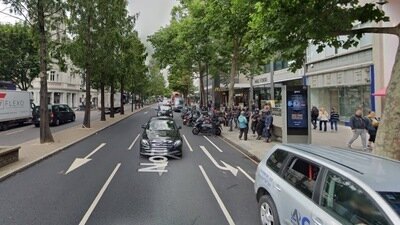
Safe roads are a public good from which all road users benefit. "Road users", in addition to cars, include buses, delivery vans, ambulances, police vehicles, public service vehicles, motorbikes, cyclists, and pedestrians. The varying needs of these users means that proper road planning is essential to ensuring road safety. Yet, safe roads don't need to be slow or frustrating to use. This is particularly true for London's major thoroughfares such as the A402 (which includes Hyde Park Place, Bayswater Road, and Holland Park Avenue).
The current road planning on the A402 is not fit for purpose. This is a major route into and out of London which is highly congested and poses significant safety risks (1). There are two primary causes of the congestion and safety risks on the A402:
- The existence of parking spaces and stop zones in traffic lanes
- The lack of physically separated cycle lanes
1. Remove Parking Spaces & Stop Zones on the A402
Different types of roads are required for different purposes. Transport thoroughfares, like the A402, function primarily for mobility - ensuring the efficient movement of large volumes of traffic. It is therefore inconceivable that a major thoroughfare would allow for dedicated parking spaces and stop zones in an existing traffic lane. Yet this is precisely the case on the A402! An occupied parking space or stop zone in one of the two traffic lanes on this thoroughfare means that vehicles and bicycles have to merge into a single lane, creating enormous congestion and safety hazards. Moving parking spaces and stop zones off the A402 and onto nearby perpendicular streets would alleviate these issues whilst still catering to those with specific access requirements.
2. Add Separated Cycle Lanes on the A402
There is a simple rule when it comes to cycling infrastructure: if you would not let your 5-year old child cycle then it doesn't count! People will only cycle if they feel safe to do so and currently the cycling infrastructure on the A402 does not facilitate this. Specifically, sharing a lane with traffic, relying on painted advisory lanes (that are regularly ignored by other road users), or having to merge with traffic owing to a parking space or stop zone creates enormous safety hazards for cyclists. Protected cycling infrastructure has been shown to reduce the risk of injury by up to 65% whereas advisory lanes increase the risk of injury by over 30% (2). This highlights how the only reasonable solution to protect cyclists on the A402 is to add separated cycle lanes. Furthermore, separating cyclists from the traffic flow on this road would improve congestion and likely be a benefit for motorists as well as cyclists.
Call to Action:
There is a simple solution to the congestion and safety problems on the A402. This road currently has two lanes travelling in each direction. Removing parking spaces and stop zones from the outer lanes of this road and replacing part of this lane with physically separated cycling infrastructure would alleviate both these problems. The remaining part of the outer lanes could be allocated to bus stops, turning points, and other access needs. This would leave a single, unimpeded lane travelling in each direction to allow the efficient flow of traffic into and out of Central London. Moreover, it would significantly improve the experience of all road users, including both cyclists and motorists.
References:
(1) https://roadtraffic.dft.gov.uk/regions/6
(2) Adams, Thomas, and Rachel Aldred. 2020. “Cycling Injury Risk in London: Impacts of Road Characteristics and Infrastructure.” Findings, December. https://doi.org/10.32866/001c.18226

1
The Issue
Safe roads are a public good from which all road users benefit. "Road users", in addition to cars, include buses, delivery vans, ambulances, police vehicles, public service vehicles, motorbikes, cyclists, and pedestrians. The varying needs of these users means that proper road planning is essential to ensuring road safety. Yet, safe roads don't need to be slow or frustrating to use. This is particularly true for London's major thoroughfares such as the A402 (which includes Hyde Park Place, Bayswater Road, and Holland Park Avenue).
The current road planning on the A402 is not fit for purpose. This is a major route into and out of London which is highly congested and poses significant safety risks (1). There are two primary causes of the congestion and safety risks on the A402:
- The existence of parking spaces and stop zones in traffic lanes
- The lack of physically separated cycle lanes
1. Remove Parking Spaces & Stop Zones on the A402
Different types of roads are required for different purposes. Transport thoroughfares, like the A402, function primarily for mobility - ensuring the efficient movement of large volumes of traffic. It is therefore inconceivable that a major thoroughfare would allow for dedicated parking spaces and stop zones in an existing traffic lane. Yet this is precisely the case on the A402! An occupied parking space or stop zone in one of the two traffic lanes on this thoroughfare means that vehicles and bicycles have to merge into a single lane, creating enormous congestion and safety hazards. Moving parking spaces and stop zones off the A402 and onto nearby perpendicular streets would alleviate these issues whilst still catering to those with specific access requirements.
2. Add Separated Cycle Lanes on the A402
There is a simple rule when it comes to cycling infrastructure: if you would not let your 5-year old child cycle then it doesn't count! People will only cycle if they feel safe to do so and currently the cycling infrastructure on the A402 does not facilitate this. Specifically, sharing a lane with traffic, relying on painted advisory lanes (that are regularly ignored by other road users), or having to merge with traffic owing to a parking space or stop zone creates enormous safety hazards for cyclists. Protected cycling infrastructure has been shown to reduce the risk of injury by up to 65% whereas advisory lanes increase the risk of injury by over 30% (2). This highlights how the only reasonable solution to protect cyclists on the A402 is to add separated cycle lanes. Furthermore, separating cyclists from the traffic flow on this road would improve congestion and likely be a benefit for motorists as well as cyclists.
Call to Action:
There is a simple solution to the congestion and safety problems on the A402. This road currently has two lanes travelling in each direction. Removing parking spaces and stop zones from the outer lanes of this road and replacing part of this lane with physically separated cycling infrastructure would alleviate both these problems. The remaining part of the outer lanes could be allocated to bus stops, turning points, and other access needs. This would leave a single, unimpeded lane travelling in each direction to allow the efficient flow of traffic into and out of Central London. Moreover, it would significantly improve the experience of all road users, including both cyclists and motorists.
References:
(1) https://roadtraffic.dft.gov.uk/regions/6
(2) Adams, Thomas, and Rachel Aldred. 2020. “Cycling Injury Risk in London: Impacts of Road Characteristics and Infrastructure.” Findings, December. https://doi.org/10.32866/001c.18226
The Decision Makers
Petition Updates
Share this petition
Petition created on 17 September 2024