
A Parent-Led Call to Fund Fair, Independent Research into DMI Therapy
The Issue
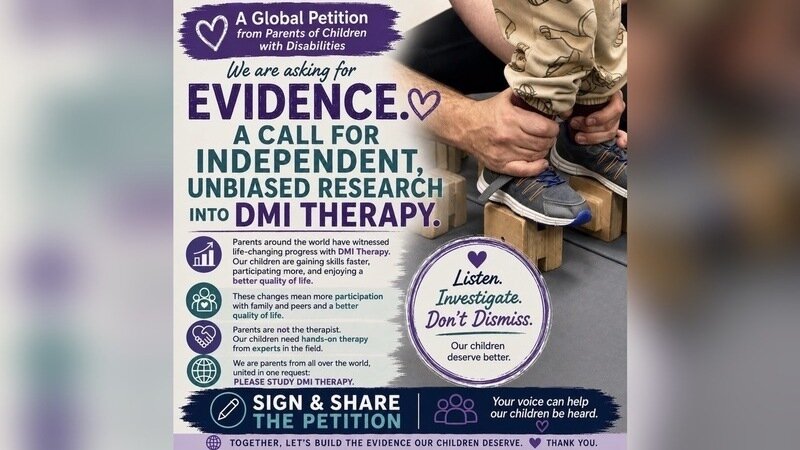
A Global Petition from Parents of Children with Disabilities: A Parent-Led Call to Fund Fair, Independent Research into DMI Therapy
About DMI: Dynamic Movement Intervention Therapy (DMI) is a hands on physical and occupational therapy approach for children with motor delay. A trained therapist guides the child through progressively challenging exercises that prompt the child’s own postural responses, working toward milestones such as head control, sitting, standing, and walking. DMI is a young approach, with its first training course held in 2021, and the independent research needed to evaluate it fairly has not yet been funded.
We are an international group of parents of children with disabilities. We are writing out of frustration, but also out of growing concern for our children and for the families who will come after us.
Many of us are exhausted from being told that we should not trust what we see happening with our own children. Parents are made to feel foolish, desperate, or irresponsible for choosing DMI Therapy. At the same time, we repeatedly hear that there is “no evidence,” when what families have been asking for all along is properly funded research.
We did not choose DMI without careful thought. Most of us spent many hours researching, speaking with other parents, and asking what changes they had seen. We considered whether those experiences might apply to our own child. We also looked honestly at what our child could manage, what was available where we live, and what our family could afford. Then we made the best decision we could.
Many of us have seen meaningful changes. Our children have become stronger, more active, and more involved in daily life. Some have learned to sit, stand, take steps, move between positions, balance better, or participate more fully with their families. Some had made very little progress before. To us, these changes are not simply numbers on an assessment. They affect a child's independence and quality of life.
We understand that our experiences are not a substitute for scientific research. But they should raise important questions and lead to research—not be dismissed.
The lack of research is being used against families Right now, the limited research on DMI is used to criticize parents for choosing it. Funding bodies and organizations also use that same lack of research to deny coverage. Families are told that DMI is experimental or unproven and must pay for it themselves. Many simply cannot. In rare cases, some families in the United States have obtained insurance coverage, but for the vast majority of families, no coverage is available, and treatment must be paid for entirely out of pocket.
Parents take on debt, ask relatives for help, and organize fundraisers. Some travel less often than their child needs; others stop treatment completely. The result is that access depends far too much on a family's finances. Children from families with greater resources have choices that other children do not. That is deeply unfair.
Families are trapped in a painful cycle. Without funding, there is not enough research. Without research, insurers refuse coverage. Meanwhile, our children are growing, and these important years cannot be given back.
Most critics are asking for more research We want to be very clear about this. Most critics are not saying that DMI does not work. They are saying that there is not yet enough published research. Parents understand that difference, and we agree that DMI needs more research. That is exactly why this petition is asking for grant funding and a fair chance to build the evidence.
“There is not enough research” should be the beginning of the conversation—not the end of it.
Our frustration is that the lack of research is repeatedly used against families, while too little effort is made to help create the research. Parents are criticized for choosing DMI, insurers deny coverage, and the therapy is discussed with suspicion—all because the evidence is still developing. Families are asking the research community to help close that gap.
From where we sit, the conversation still feels one-sided. New papers and reviews continue to focus on what DMI lacks, while very little direct DMI research is being funded. Families hear the criticism clearly. What we do not see is the same energy being put into answering the questions.
We are not asking anyone to shield DMI from criticism or guarantee a positive result. We understand that DMI may help some children more than others and that research may identify limitations. We want honest answers. We simply do not want DMI judged before those answers exist.
Please be accurate about the cost of DMI intensives Critics have also repeated inflated cost estimates for DMI intensives. Those figures are not accurate and do not reflect what many families actually pay. We are not pretending that intensives are inexpensive. Families understand the real cost, and for many of us it requires planning, sacrifice, travel, and fundraising. But criticism should be based on accurate, real-world prices—not exaggerated numbers that make DMI appear less accessible than it actually is.
Parents compare all of their options carefully. After doing that research, many of us are still glad to choose DMI despite the expense. The progress reported by other families, together with the changes we have seen in our own children, gives us more confidence that our child may benefit. We know there are no guarantees. Even so, this is the option in which many families have the greatest confidence. That is not a careless decision. It is a thoughtful choice made after weighing the cost against the possibility of meaningful progress.
DMI and CME should not be treated as the same therapy We understand that DMI grew out of CME and that the two approaches share some history. But they are not interchangeable. Parents have researched both methods. Many have categorically rejected CME for their own child because they did not believe that approach would help in the same way. They deliberately chose DMI because they see and appreciate how the techniques have evolved, how exercises are selected and progressed, and how clinical reasoning is brought together to pursue the strongest possible outcomes for each child.
Critics sometimes blame DMI for the lack of research because it developed as an offshoot of CME. Parents reject that argument. DMI's first training course was held in 2021. CME dates back to 1972. A five-year-old approach cannot fairly be blamed for the lack of research during more than fifty years of another method's existence. DMI should be studied and judged on its own program, its own practice, and its own outcomes.
Parents are demanding that the constant comparison between DMI and CME stop. Acknowledging where DMI began does not erase how it has developed into a distinct approach. DMI should not be dismissed as CME under a different name, and CME's fifty-year research history should not be transferred onto DMI. Study DMI directly. Describe it accurately. Then judge it by its own evidence.
What we are asking for We are asking research funders, major disability organizations, journals, and elected leaders to help make the following possible:
• Commit meaningful grant funding to independent DMI research. Begin with carefully designed early studies and build toward larger studies across clinics and countries.
• Make sure the intervention being studied is truly DMI. Use properly trained DMI therapists and clearly describe the treatment each child receives.
• Include parents when choosing research questions and outcomes. Sitting, standing, walking, playing, participating in family life, and becoming more independent are outcomes that matter deeply to us.
• Decide and publicly state what will be measured before the study begins. Whenever possible, use independent assessors and independent analysis.
• Make fair comparisons by accounting for the amount of therapy each child receives and any other treatments taking place at the same time.
• Publish positive, negative, mixed, and inconclusive findings. Families deserve the full truth, not only the results that fit one side of the debate.
• Create an international DMI registry so clinics can collect consistent information about treatment, progress, and safety while larger studies are developed.
We are also asking our elected leaders to help Government leaders can create research opportunities through legislation, public grants, and national disability programs. We are asking them to make pediatric rehabilitation research a priority and to include promising approaches that have not yet received adequate research funding, including DMI.
We are not asking elected leaders to declare that DMI works. We are asking them to make fair research possible, so families are not left waiting indefinitely for answers.
Parents should not be expected to replace skilled therapists We also see a growing push toward consultative care, where therapists mainly coach parents and parents carry out much of the treatment. Parent education and home practice have value, but they should not replace direct, skilled therapy or shift responsibility for treatment onto families.
Even the most dedicated parent cannot replace an experienced pediatric therapist. Therapists bring clinical reasoning, knowledge of neurology and body mechanics, skilled handling, and the ability to adjust treatment in the moment. This is one reason families value DMI: it brings these skills together in a clear, hands-on program. We want parent coaching and expert treatment—not one used to replace the other.
Inconsistent and limited funding for hands-on therapies, including DMI Hands-on therapies, including DMI, face inconsistent and limited funding from insurers, government programs, grant makers, and other funding bodies or organizations. In rare cases, families obtain financial support, but most are left with little or no coverage and must pay for treatment out of pocket. This inconsistency makes access depend too heavily on geography, insurance plans, and a family's finances rather than on a child's needs.
At the same time, substantial grant and government funding is being directed toward large studies of consultative approaches. Parent education and coaching can have value, but direct, skilled treatment deserves serious investment as well. Families are asking funding bodies and organizations to support rigorous research and meaningful access to hands-on therapies such as DMI, rather than allowing direct care to remain underfunded.
We are asking to be heard Parents of children with disabilities carry an enormous responsibility. We manage appointments, equipment, school, medical care, home programs, work, travel, and the needs of the rest of our family. We also live with the constant worry that we may miss something that could help our child.
We should not have to defend ourselves repeatedly for choosing a therapy that has helped our children, especially when the central criticism is that research—which families do not have the power to fund or conduct—has not yet been done.
We want evidence. We want safety. We want honest answers, and we also want respect. Please listen to the families living this every day. Please fund the research. Please study the DMI our children actually receive. Then let the results speak for themselves.
A lack of research should lead to more research. It should never be used to silence families or remove choices from our children.
Signed by parents and caregivers of children receiving DMI Therapy worldwide.
Our children deserve answers, access, and a fair chance. Full Petition Letter
This petition is directed to legislators and government leaders; NIH/NICHD's National Center for Medical Rehabilitation Research, PCORI, CIHR, NIHR, NHMRC, CanChild, the Cerebral Palsy Foundation, Cerebral Palsy Alliance Research Institute, and AACPDM; and journals including Developmental Medicine & Child Neurology, Pediatric Physical Therapy, Physical & Occupational Therapy in Pediatrics, Journal of Pediatric Rehabilitation Medicine, and Disability and Rehabilitation, along with other organizations and journals around the world.

1,562
The Issue
A Global Petition from Parents of Children with Disabilities: A Parent-Led Call to Fund Fair, Independent Research into DMI Therapy
About DMI: Dynamic Movement Intervention Therapy (DMI) is a hands on physical and occupational therapy approach for children with motor delay. A trained therapist guides the child through progressively challenging exercises that prompt the child’s own postural responses, working toward milestones such as head control, sitting, standing, and walking. DMI is a young approach, with its first training course held in 2021, and the independent research needed to evaluate it fairly has not yet been funded.
We are an international group of parents of children with disabilities. We are writing out of frustration, but also out of growing concern for our children and for the families who will come after us.
Many of us are exhausted from being told that we should not trust what we see happening with our own children. Parents are made to feel foolish, desperate, or irresponsible for choosing DMI Therapy. At the same time, we repeatedly hear that there is “no evidence,” when what families have been asking for all along is properly funded research.
We did not choose DMI without careful thought. Most of us spent many hours researching, speaking with other parents, and asking what changes they had seen. We considered whether those experiences might apply to our own child. We also looked honestly at what our child could manage, what was available where we live, and what our family could afford. Then we made the best decision we could.
Many of us have seen meaningful changes. Our children have become stronger, more active, and more involved in daily life. Some have learned to sit, stand, take steps, move between positions, balance better, or participate more fully with their families. Some had made very little progress before. To us, these changes are not simply numbers on an assessment. They affect a child's independence and quality of life.
We understand that our experiences are not a substitute for scientific research. But they should raise important questions and lead to research—not be dismissed.
The lack of research is being used against families Right now, the limited research on DMI is used to criticize parents for choosing it. Funding bodies and organizations also use that same lack of research to deny coverage. Families are told that DMI is experimental or unproven and must pay for it themselves. Many simply cannot. In rare cases, some families in the United States have obtained insurance coverage, but for the vast majority of families, no coverage is available, and treatment must be paid for entirely out of pocket.
Parents take on debt, ask relatives for help, and organize fundraisers. Some travel less often than their child needs; others stop treatment completely. The result is that access depends far too much on a family's finances. Children from families with greater resources have choices that other children do not. That is deeply unfair.
Families are trapped in a painful cycle. Without funding, there is not enough research. Without research, insurers refuse coverage. Meanwhile, our children are growing, and these important years cannot be given back.
Most critics are asking for more research We want to be very clear about this. Most critics are not saying that DMI does not work. They are saying that there is not yet enough published research. Parents understand that difference, and we agree that DMI needs more research. That is exactly why this petition is asking for grant funding and a fair chance to build the evidence.
“There is not enough research” should be the beginning of the conversation—not the end of it.
Our frustration is that the lack of research is repeatedly used against families, while too little effort is made to help create the research. Parents are criticized for choosing DMI, insurers deny coverage, and the therapy is discussed with suspicion—all because the evidence is still developing. Families are asking the research community to help close that gap.
From where we sit, the conversation still feels one-sided. New papers and reviews continue to focus on what DMI lacks, while very little direct DMI research is being funded. Families hear the criticism clearly. What we do not see is the same energy being put into answering the questions.
We are not asking anyone to shield DMI from criticism or guarantee a positive result. We understand that DMI may help some children more than others and that research may identify limitations. We want honest answers. We simply do not want DMI judged before those answers exist.
Please be accurate about the cost of DMI intensives Critics have also repeated inflated cost estimates for DMI intensives. Those figures are not accurate and do not reflect what many families actually pay. We are not pretending that intensives are inexpensive. Families understand the real cost, and for many of us it requires planning, sacrifice, travel, and fundraising. But criticism should be based on accurate, real-world prices—not exaggerated numbers that make DMI appear less accessible than it actually is.
Parents compare all of their options carefully. After doing that research, many of us are still glad to choose DMI despite the expense. The progress reported by other families, together with the changes we have seen in our own children, gives us more confidence that our child may benefit. We know there are no guarantees. Even so, this is the option in which many families have the greatest confidence. That is not a careless decision. It is a thoughtful choice made after weighing the cost against the possibility of meaningful progress.
DMI and CME should not be treated as the same therapy We understand that DMI grew out of CME and that the two approaches share some history. But they are not interchangeable. Parents have researched both methods. Many have categorically rejected CME for their own child because they did not believe that approach would help in the same way. They deliberately chose DMI because they see and appreciate how the techniques have evolved, how exercises are selected and progressed, and how clinical reasoning is brought together to pursue the strongest possible outcomes for each child.
Critics sometimes blame DMI for the lack of research because it developed as an offshoot of CME. Parents reject that argument. DMI's first training course was held in 2021. CME dates back to 1972. A five-year-old approach cannot fairly be blamed for the lack of research during more than fifty years of another method's existence. DMI should be studied and judged on its own program, its own practice, and its own outcomes.
Parents are demanding that the constant comparison between DMI and CME stop. Acknowledging where DMI began does not erase how it has developed into a distinct approach. DMI should not be dismissed as CME under a different name, and CME's fifty-year research history should not be transferred onto DMI. Study DMI directly. Describe it accurately. Then judge it by its own evidence.
What we are asking for We are asking research funders, major disability organizations, journals, and elected leaders to help make the following possible:
• Commit meaningful grant funding to independent DMI research. Begin with carefully designed early studies and build toward larger studies across clinics and countries.
• Make sure the intervention being studied is truly DMI. Use properly trained DMI therapists and clearly describe the treatment each child receives.
• Include parents when choosing research questions and outcomes. Sitting, standing, walking, playing, participating in family life, and becoming more independent are outcomes that matter deeply to us.
• Decide and publicly state what will be measured before the study begins. Whenever possible, use independent assessors and independent analysis.
• Make fair comparisons by accounting for the amount of therapy each child receives and any other treatments taking place at the same time.
• Publish positive, negative, mixed, and inconclusive findings. Families deserve the full truth, not only the results that fit one side of the debate.
• Create an international DMI registry so clinics can collect consistent information about treatment, progress, and safety while larger studies are developed.
We are also asking our elected leaders to help Government leaders can create research opportunities through legislation, public grants, and national disability programs. We are asking them to make pediatric rehabilitation research a priority and to include promising approaches that have not yet received adequate research funding, including DMI.
We are not asking elected leaders to declare that DMI works. We are asking them to make fair research possible, so families are not left waiting indefinitely for answers.
Parents should not be expected to replace skilled therapists We also see a growing push toward consultative care, where therapists mainly coach parents and parents carry out much of the treatment. Parent education and home practice have value, but they should not replace direct, skilled therapy or shift responsibility for treatment onto families.
Even the most dedicated parent cannot replace an experienced pediatric therapist. Therapists bring clinical reasoning, knowledge of neurology and body mechanics, skilled handling, and the ability to adjust treatment in the moment. This is one reason families value DMI: it brings these skills together in a clear, hands-on program. We want parent coaching and expert treatment—not one used to replace the other.
Inconsistent and limited funding for hands-on therapies, including DMI Hands-on therapies, including DMI, face inconsistent and limited funding from insurers, government programs, grant makers, and other funding bodies or organizations. In rare cases, families obtain financial support, but most are left with little or no coverage and must pay for treatment out of pocket. This inconsistency makes access depend too heavily on geography, insurance plans, and a family's finances rather than on a child's needs.
At the same time, substantial grant and government funding is being directed toward large studies of consultative approaches. Parent education and coaching can have value, but direct, skilled treatment deserves serious investment as well. Families are asking funding bodies and organizations to support rigorous research and meaningful access to hands-on therapies such as DMI, rather than allowing direct care to remain underfunded.
We are asking to be heard Parents of children with disabilities carry an enormous responsibility. We manage appointments, equipment, school, medical care, home programs, work, travel, and the needs of the rest of our family. We also live with the constant worry that we may miss something that could help our child.
We should not have to defend ourselves repeatedly for choosing a therapy that has helped our children, especially when the central criticism is that research—which families do not have the power to fund or conduct—has not yet been done.
We want evidence. We want safety. We want honest answers, and we also want respect. Please listen to the families living this every day. Please fund the research. Please study the DMI our children actually receive. Then let the results speak for themselves.
A lack of research should lead to more research. It should never be used to silence families or remove choices from our children.
Signed by parents and caregivers of children receiving DMI Therapy worldwide.
Our children deserve answers, access, and a fair chance. Full Petition Letter
This petition is directed to legislators and government leaders; NIH/NICHD's National Center for Medical Rehabilitation Research, PCORI, CIHR, NIHR, NHMRC, CanChild, the Cerebral Palsy Foundation, Cerebral Palsy Alliance Research Institute, and AACPDM; and journals including Developmental Medicine & Child Neurology, Pediatric Physical Therapy, Physical & Occupational Therapy in Pediatrics, Journal of Pediatric Rehabilitation Medicine, and Disability and Rehabilitation, along with other organizations and journals around the world.
The Decision Makers

Supporter Voices
Petition Updates
Share this petition
Petition created on August 23, 2026